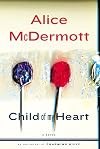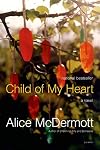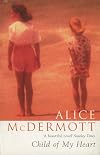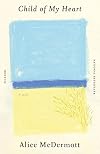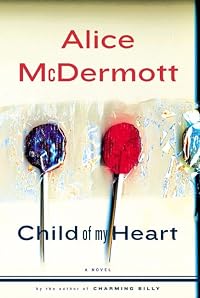
Child of My Heart
by Alice McDermott
On This Page
Description
A teenage girl, raised on the east end of Long Island among the country estates of the rich, reflects on her understanding of human nature during a seemingly idyllic summer spent with her eight-year-old cousin Daisy.Tags
Recommendations































Member Reviews
Well-written but predictable, Alice McDermott’s “Child of My Heart” charts a Long Island summer when a precocious teen, collector of broken things, crosses the threshold of adulthood.
Growing up an only child on a part of Long Island which seems to have only summer people and their assorted young offspring in it, Theresa babysits, walks dogs, comforts the emotionally neglected neighbor kids, and opens her heart especially to her cousin Daisy, the middle child of seven siblings, whose fey presence immediately sets up an internal tension. The events of the summer’s end advance inexorably, and some readers will drag their feet in an attempt to avoid what has been foreordained from the very beginning.
Theresa is also walking another show more tightrope – fifteen and beautiful, she attracts the attention of more than one of the adult males on the island, and here is where the story drifts into deep and uncomfortable waters. Theresa seems preternaturally aware of her own sexuality, neither encouraging nor discouraging her lecherous elder suitors, handling their attentions and her responses to them with an almost clinical detachment. The growing attraction between the teen and a 70-year-old artist is, frankly, uncomfortable to read, though the actions are never described in anything but G-rated terms.
Theresa is so capable with her young charges, so level-headed, so tenderly attentive to Daisy, that she is scarcely believable as a real teen. Beautifully written, yes – and the characteristics McDermott endows her with are absolutely critical to the unfolding of the plot. But there are moments when the reader wants her to simply break loose and BE fifteen years old – moon over a local boy, listen to pop radio, consider her shortcomings in a mirror, and daydream about what she will do when she grows up. That’s all irrelevant to the story McDermott is determined to tell, so it’s simply not addressed.
There are some chewy notions in here – child neglect that doesn’t always depend on physical violence; the dangerous waters of burgeoning sexuality that borders on pedophilia; an adult society that is parallel to but not really involved with its young – but most of it gets buried under McDermott’s portrait of a not-quite-woman shouldering the cloak of the Maiden Goddess. show less
Growing up an only child on a part of Long Island which seems to have only summer people and their assorted young offspring in it, Theresa babysits, walks dogs, comforts the emotionally neglected neighbor kids, and opens her heart especially to her cousin Daisy, the middle child of seven siblings, whose fey presence immediately sets up an internal tension. The events of the summer’s end advance inexorably, and some readers will drag their feet in an attempt to avoid what has been foreordained from the very beginning.
Theresa is also walking another show more tightrope – fifteen and beautiful, she attracts the attention of more than one of the adult males on the island, and here is where the story drifts into deep and uncomfortable waters. Theresa seems preternaturally aware of her own sexuality, neither encouraging nor discouraging her lecherous elder suitors, handling their attentions and her responses to them with an almost clinical detachment. The growing attraction between the teen and a 70-year-old artist is, frankly, uncomfortable to read, though the actions are never described in anything but G-rated terms.
Theresa is so capable with her young charges, so level-headed, so tenderly attentive to Daisy, that she is scarcely believable as a real teen. Beautifully written, yes – and the characteristics McDermott endows her with are absolutely critical to the unfolding of the plot. But there are moments when the reader wants her to simply break loose and BE fifteen years old – moon over a local boy, listen to pop radio, consider her shortcomings in a mirror, and daydream about what she will do when she grows up. That’s all irrelevant to the story McDermott is determined to tell, so it’s simply not addressed.
There are some chewy notions in here – child neglect that doesn’t always depend on physical violence; the dangerous waters of burgeoning sexuality that borders on pedophilia; an adult society that is parallel to but not really involved with its young – but most of it gets buried under McDermott’s portrait of a not-quite-woman shouldering the cloak of the Maiden Goddess. show less
I don't know how she does it, but Alice McDermott always manages to pierce my heart with the simplest of sentences. She is one of the most deceptive writers we’ve got tapping on a keyboard these days. By all appearances, her novels are mere wisps, feathery in weight and style. Open one to any page and read a few lines. You’ll think you’re snacking on puff pastry. In reality, it’s a bite of pound cake.
McDermott knows how to attach pendulous weight to the skinniest of words. Each verb, every noun counts for something and by the time you’ve reached the end of the story and accumulated enough verbs and nouns, you’ll realize just how skillfully she plies her craft. For instance, we get this long, perfect sentence opening her show more 1987 novel That Night: That night when he came to claim her, he stood on the short lawn before her house, his knees bent, his fists driven into his thighs, and bellowed her name with such passion that even the friends who surrounded him, who had come to support him, to drag her from the house, to murder her family if they had to, let the chains they carried go limp in their hands. A lesser writer—one who too cautiously approaches language and has a slippery grasp on her characters—would take three pages to convey the amount of information contained in that one sentence. Or, take this one from her National Book Award-winning Charming Billy (1998): My parents, I have to believe, had a marriage that ran the typical course from early infatuation to serious love to affection occasionally diminished by impatience and disagreement, bolstered by interdependence, fanned now and then by fondness, by humor. Compact, lyrical, perfect.
And so it is with McDermott’s newest novel, Child of My Heart, about as compact, lyrical and perfect a book as we’re likely to be blessed with this, or any other, publishing season.
By all appearances, it’s a wisp of a story—a young girl comes of age while babysitting for several families summering on Long Island—but, as always, it’s how the story is told which makes the difference. This is where McDermott shines like a full moon sparkling on the bay.
Her narrator, Theresa, looks back on her fifteenth summer with pained, wistful longing. These were the fulcrum months of her life, around which everything else teetered. She’s beautiful (“a young Elizabeth Taylor was the immediate wordâÂ?) and confident. Her brash, take-charge attitude inspires her young charges (which include her visiting cousin, eight-year-old Daisy, and the Moran kids, her messy, hapless neighbors). Theresa and Daisy spend the summer days walking dogs for the other too-rich-to-care Long Island summer residents and babysitting Flora, toddler daughter of the communityâÂÂs Pollock-like artist (who is never given a nameâÂÂonly âÂÂFloraâÂÂs fatherâÂ? or âÂÂthe artistâÂ?). The artist, old but remarkably virile, eventually plays a cataclysmic role in TheresaâÂÂs summer and subsequent life.
But in this short, fast novel (which McDermott has described as being written âÂÂalmost in a single breathâÂ?), it is the children who play the central rolesâÂÂespecially TheresaâÂÂs young, doomed cousin.
Daisy, neglected by her parents back at their Queens home, is immediately tucked under TheresaâÂÂs wing after arriving on Long Island for the summer. âÂÂChild of my heart,âÂ? the older girl muses as she sets about braiding her hair, spinning marvelous fairy tales, and doing her best to safeguard Daisy from sorrow, death and betrayalâÂÂall part of the adult world of which Theresa is aware, but unwilling to be part ofâ¦yet. SheâÂÂll soon have no choice but to enter the grown-up universeâÂÂthis is the summer when everything teeters and tipsâÂÂbut for now, sheâÂÂd rather live in the idyllic Land of Childhood sheâÂÂs created.
Her parents have done their part to set their only child up for success in later years:
They moved way out on Long Island [when I was two years old] because they knew rich people lived way out on Long Island, even if only for the summer months, and putting me in a place where I might be spotted by some of them was their equivalent of offering me every opportunity.
Though her breasts are budding and her âÂÂeasy-to-admire childish beauty was quickly becoming something a little thinner and sharper and certainly more complicated,âÂ? Theresa is not yet ready to leave behind the world of innocence and gamesâÂÂpart of the reason why she so dearly loves her babysitting duties, I imagine. She delights in bathing her face with dew from the lilac bush or decorating the backyard tree with lollipops and licorice.
As in That Night, McDermott channels the adult world through adolescent eyes. Grown-ups are strange, complicated creatures and Theresa is their keen observer (though, knowing sheâÂÂll soon be an adult herself, sheâÂÂs a melancholic observer).
They were dear people, both my parents, but the vividness of their dream of my rise, their absolute confidence in the inevitability of my success, made them resent what they saw as its consequences even that summer when I was fifteen and part of no other social set than my own. Turning away from me in anticipation of my turning away from them, they left me more alone that summer than perhaps IâÂÂd ever been.
Later, she tells Daisy, âÂÂYou wish you could appear and disappear, like a little ghost. Be around them, but not be stuck with themâ¦ItâÂÂs the mystery of families.âÂ?
McDermott brings Theresa to life with a voice so clear, so genuine that she no longer exists as a character on the printed page; she is real and fully-formed within our imaginations. She makes that rare leap from book to brain, to that special fold of the cerebrum where we store those characters who are so convincingly alive that nothing could ever persuade us they exist only in lines of ink and fibers of paper. This is the genius of Alice McDermott: she is so closely attuned to her creations that readers effortlessly reconjure them and call them their ownâÂÂno matter how many other readers have done likewise. Theresa belongs to me and IâÂÂll forever keep her tucked in that cerebral fold. After reading Child of My Heart, IâÂÂm sure youâÂÂll feel the same way. show less
McDermott knows how to attach pendulous weight to the skinniest of words. Each verb, every noun counts for something and by the time you’ve reached the end of the story and accumulated enough verbs and nouns, you’ll realize just how skillfully she plies her craft. For instance, we get this long, perfect sentence opening her show more 1987 novel That Night: That night when he came to claim her, he stood on the short lawn before her house, his knees bent, his fists driven into his thighs, and bellowed her name with such passion that even the friends who surrounded him, who had come to support him, to drag her from the house, to murder her family if they had to, let the chains they carried go limp in their hands. A lesser writer—one who too cautiously approaches language and has a slippery grasp on her characters—would take three pages to convey the amount of information contained in that one sentence. Or, take this one from her National Book Award-winning Charming Billy (1998): My parents, I have to believe, had a marriage that ran the typical course from early infatuation to serious love to affection occasionally diminished by impatience and disagreement, bolstered by interdependence, fanned now and then by fondness, by humor. Compact, lyrical, perfect.
And so it is with McDermott’s newest novel, Child of My Heart, about as compact, lyrical and perfect a book as we’re likely to be blessed with this, or any other, publishing season.
By all appearances, it’s a wisp of a story—a young girl comes of age while babysitting for several families summering on Long Island—but, as always, it’s how the story is told which makes the difference. This is where McDermott shines like a full moon sparkling on the bay.
Her narrator, Theresa, looks back on her fifteenth summer with pained, wistful longing. These were the fulcrum months of her life, around which everything else teetered. She’s beautiful (“a young Elizabeth Taylor was the immediate wordâÂ?) and confident. Her brash, take-charge attitude inspires her young charges (which include her visiting cousin, eight-year-old Daisy, and the Moran kids, her messy, hapless neighbors). Theresa and Daisy spend the summer days walking dogs for the other too-rich-to-care Long Island summer residents and babysitting Flora, toddler daughter of the communityâÂÂs Pollock-like artist (who is never given a nameâÂÂonly âÂÂFloraâÂÂs fatherâÂ? or âÂÂthe artistâÂ?). The artist, old but remarkably virile, eventually plays a cataclysmic role in TheresaâÂÂs summer and subsequent life.
But in this short, fast novel (which McDermott has described as being written âÂÂalmost in a single breathâÂ?), it is the children who play the central rolesâÂÂespecially TheresaâÂÂs young, doomed cousin.
Daisy, neglected by her parents back at their Queens home, is immediately tucked under TheresaâÂÂs wing after arriving on Long Island for the summer. âÂÂChild of my heart,âÂ? the older girl muses as she sets about braiding her hair, spinning marvelous fairy tales, and doing her best to safeguard Daisy from sorrow, death and betrayalâÂÂall part of the adult world of which Theresa is aware, but unwilling to be part ofâ¦yet. SheâÂÂll soon have no choice but to enter the grown-up universeâÂÂthis is the summer when everything teeters and tipsâÂÂbut for now, sheâÂÂd rather live in the idyllic Land of Childhood sheâÂÂs created.
Her parents have done their part to set their only child up for success in later years:
They moved way out on Long Island [when I was two years old] because they knew rich people lived way out on Long Island, even if only for the summer months, and putting me in a place where I might be spotted by some of them was their equivalent of offering me every opportunity.
Though her breasts are budding and her âÂÂeasy-to-admire childish beauty was quickly becoming something a little thinner and sharper and certainly more complicated,âÂ? Theresa is not yet ready to leave behind the world of innocence and gamesâÂÂpart of the reason why she so dearly loves her babysitting duties, I imagine. She delights in bathing her face with dew from the lilac bush or decorating the backyard tree with lollipops and licorice.
As in That Night, McDermott channels the adult world through adolescent eyes. Grown-ups are strange, complicated creatures and Theresa is their keen observer (though, knowing sheâÂÂll soon be an adult herself, sheâÂÂs a melancholic observer).
They were dear people, both my parents, but the vividness of their dream of my rise, their absolute confidence in the inevitability of my success, made them resent what they saw as its consequences even that summer when I was fifteen and part of no other social set than my own. Turning away from me in anticipation of my turning away from them, they left me more alone that summer than perhaps IâÂÂd ever been.
Later, she tells Daisy, âÂÂYou wish you could appear and disappear, like a little ghost. Be around them, but not be stuck with themâ¦ItâÂÂs the mystery of families.âÂ?
McDermott brings Theresa to life with a voice so clear, so genuine that she no longer exists as a character on the printed page; she is real and fully-formed within our imaginations. She makes that rare leap from book to brain, to that special fold of the cerebrum where we store those characters who are so convincingly alive that nothing could ever persuade us they exist only in lines of ink and fibers of paper. This is the genius of Alice McDermott: she is so closely attuned to her creations that readers effortlessly reconjure them and call them their ownâÂÂno matter how many other readers have done likewise. Theresa belongs to me and IâÂÂll forever keep her tucked in that cerebral fold. After reading Child of My Heart, IâÂÂm sure youâÂÂll feel the same way. show less
Reading this beautifully told story was like stepping into, and becoming a part of the story itself, to become an additional character, or wish you were. That is how real these characters became and how much you come to care about them. Told in a gently meandering stlye, full of the rich details of nature and emotion, each sentence a song unto itself. Theresa, the only child of older parents, smart, exceptionally pretty, living on Long Island and attending a private girl's school, spends her summers caring for neighbor's pets and children. Alone much of the time, though not lonely, she is not a part of any social group and doesn't appear to have any girlfriends.
The story takes place in the summer of her 15th year. Her young cousin show more Daisy, eight years old and a favorite of hers, comes to spend a few weeks away from her large (eight children) family. Theresa has a genuine way with children and pets, gentle, respectful, patient, appreciative,wise, weaving magical, enchanting stories and making up creative, intuitive games out of simple activities. They adore her, as you come to in the course of the story. She truly cares for them, in a way the other adults in the story can't seem to bring themselves to. In fact they fall shamefully short of not only understanding, but into the catagory of negelect. This summer is a turning point in Theresa's life, and although it includes a brief, strange entanglement with an artist, father of one of her charges, it is her relationship to Daisy, "poor Daisy" that closes the door on her own idealic childhood. The author, Alice McDermott is a master of both word and mood. I was moved by this book in a way I can't quite grasp or describe, except to say that as I read it, I lived it. That I can enter the story through the skill of an author is without a doubt, remarkable! Read this book!! show less
The story takes place in the summer of her 15th year. Her young cousin show more Daisy, eight years old and a favorite of hers, comes to spend a few weeks away from her large (eight children) family. Theresa has a genuine way with children and pets, gentle, respectful, patient, appreciative,wise, weaving magical, enchanting stories and making up creative, intuitive games out of simple activities. They adore her, as you come to in the course of the story. She truly cares for them, in a way the other adults in the story can't seem to bring themselves to. In fact they fall shamefully short of not only understanding, but into the catagory of negelect. This summer is a turning point in Theresa's life, and although it includes a brief, strange entanglement with an artist, father of one of her charges, it is her relationship to Daisy, "poor Daisy" that closes the door on her own idealic childhood. The author, Alice McDermott is a master of both word and mood. I was moved by this book in a way I can't quite grasp or describe, except to say that as I read it, I lived it. That I can enter the story through the skill of an author is without a doubt, remarkable! Read this book!! show less
Wow, this book was so uplifting and hilarious, I think I'll go and kill myself now! Wow! If you ever wondered whether children get the short end of the stick in life, this book if your proof. If you insist that people are essentially good; adultery, abuse, neglect, and disinterest notwithstanding; then you too can cling to the adolescent narrator for comfort. She introduces fantasy and love into the lives of all the sad little children she knows, and she knows only the saddest of little children. In the end, most of them survive. Survive to continue to endure the effects of their parents' ignorance and selfishness! Hooray!
I devoured this book this weekend. It's very well written and enjoyable, but I was a bit annoyed with the main character. I didn't believe she wouldn't have done the responsible thing right off the bat (you'll see) -- she was so responsible and dependable in every other aspect. But I guess even a responsible 15-year-old is still a 15-year-old.
Her books are psychologically very difficult, exploring many different aspects of childhood and parenting. I think it takes two or three readings to begin to understand her messages. I found this to be one of her more straight forward works. Her novels are not page turners, they force you to reflect on your own childhood and upbringing.
I had a real problem with the narrator of this story. She was beautiful and mature beyond her 15 years, an only child. When it came to a mature sexual situation, I had to suspend disbelief at how she handled it. And she was just entirely too perfect - I could barely stand her at times, though at other times she was a gentle, kind soul. My affections are strictly reserved for the little girl of the story, Daisy. If you read this book for any reason, read it for Poor Daisy.
Members
- Recently Added By
Published Reviews
The 15-year-old narrator, Theresa, is being paid one summer to walk several dogs, feed cats, and mind a two-year-old all day, as well as having her eight-year-old visiting cousin in her charge, on Long Island, New York. Her innate kindness leads her to extend the same expert, tender care to five deprived, neglected children living nearby. She is a perfect child-minder, gifted with show more understanding, sensitivity, and a wonderful imagination used to
entrance the children in her care, as well as thorough practical efficiency.
I longed to have had, or to have been, such a child-carer myself, and loved the book for that thread alone. Though Theresa's clear gaze we observe four different families, with the strained relationships and disturbing behaviour of the adults. We pity the immediate effects on the children, and fear for their future prospects. A beautifully written, moving book. show less
entrance the children in her care, as well as thorough practical efficiency.
I longed to have had, or to have been, such a child-carer myself, and loved the book for that thread alone. Though Theresa's clear gaze we observe four different families, with the strained relationships and disturbing behaviour of the adults. We pity the immediate effects on the children, and fear for their future prospects. A beautifully written, moving book. show less
added by KayCliff
Lists

Biggest Disappointments
606 works; 168 members
Author Information

16+ Works 8,520 Members
Alice McDermott was born in Brooklyn, New York on June 27, 1953. She received a B.A. from the State University of New York at Oswego in 1975 and an M.A. from the University of New Hampshire in 1978. After graduating college, she got a job reading unsolicited manuscripts for Redbook magazine and did some freelance reading for Esquire. She has show more taught writing at American University, the University of New Hampshire, and the University of California at San Diego. Currently, she is the Writing Seminars Professor of the Johns Hopkins University Writing Department. Her short stories and articles have appeared in numerous publications including Ms., Redbook, Mademoiselle, The New Yorker, Seventeen, the New York Times and the Washington Post. She has written several novels including A Bigamist's Daughter, At Weddings and Wakes, Child of My Heart, After This, Someone, and The Ninth Hour. That Night was made into a film starring C. Thomas Howell and Juliette Lewis in 1992. She has won several awards including the National Book Award for fiction in 1998 for Charming Billy, a Whiting Writers Award, and the 2008 Corrington Award for Literature. (Bowker Author Biography) show less
Awards and Honors
Distinctions
Common Knowledge
- Original publication date
- 2002
- Important places
- USA; New York, USA; Long Island, New York, USA
- Dedication
- For Harriet Wasserman
- First words
- I had in my care that summer four dogs, three cats, the Moran kids, Daisy, my eight-year-old cousin, and Flora, the toddler child of a local artist.
- Last words
- (Click to show. Warning: May contain spoilers.)Without a word, I carried the box to the steps and bent down, and with the Moran kids gathered around me, I gently lifted the hopeless little things, still breathing, into the nest of torn grass.
Classifications
Statistics
- Members
- 894
- Popularity
- 29,997
- Reviews
- 21
- Rating
- (3.58)
- Languages
- Dutch, English, French, German
- Media
- Paper, Audiobook, Ebook
- ISBNs
- 22
- ASINs
- 8