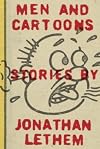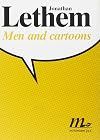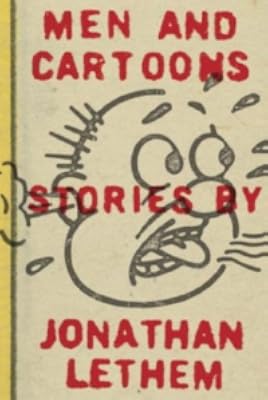
Men and Cartoons: Stories
by Jonathan Lethem
On This Page
Description
A boozy ex-military captain trapped in a mysterious vessel searches for his runaway son, an aging superhero settles into academia, and a professional "dystopianist" receives a visit from a suicidal sheep. "Men and Cartoons" contains eleven fantastical, amusing, and moving stories written in a dizzying array of styles that shows the remarkable range and power of Lethem's vision. Sometimes firmly grounded in reality, and other times spinning off into utterly original imaginary worlds, this show more book brings together marvelous characters with incisive social commentary and thought provoking allegories. A visionary and creative collection that only Jonathan Lethem could have produced, the Vintage edition features two stories not published in the hardcover edition, "The Shape We're In" and "Interview with the Crab. show lessTags
Recommendations














Member Reviews
I didn't learn to like short stories until midway through my senior year of college. I'm still not sure I do. I don't like how we get snapshots instead of full length feature films. I don't like how they come to an abrupt end just as we're beginning to know the characters. I don't even like how tight and focused they are. Most of the time.
But midway through my senior year in college, I noticed something different. They started to grow on me. It began in the creative writing class I was taking. Then I started reading the New Yorker's short fiction. Then I started buying short story collections.
Which brings us to my first book for 2006.
Jonathan Lethem is one of a handful of Jonathans, along with Jonathan Franzen, Jonathan Safran Foer, show more and Jonathan Harr, who occasionally get called "the potential voice of his generation." (Ok, maybe not Jonathan Harr).
But more so than the other three, Lethem has failed to move away from the settings and the themes of his childhood, both real and imagined. And in Men and Cartoons, which has just been released in paperback, Lethem is singing the same song, but he's playing it 9 different ways.
Lethem's stories aren't what you'd call powerful. And his characters aren't what you'd call sympathetic (the sole example being the titular character from the story "Super Goat Man," which I first read in the New Yorker). But on the whole, this collection of stories is rather affecting, each in its own quirky, slightly off-balance way. Lethem has a good ear for dialogue and a good eye for detail, but it's his imagination that carries the day. And it only takes a paragraph or two for the reader to find himself wrapped up in that imagination.
Rather than summarize each story, I'll leave it at this:
One day, I'll be ready for Lethem to grow up. But I'm not there yet.
-1/4/06 show less
But midway through my senior year in college, I noticed something different. They started to grow on me. It began in the creative writing class I was taking. Then I started reading the New Yorker's short fiction. Then I started buying short story collections.
Which brings us to my first book for 2006.
Jonathan Lethem is one of a handful of Jonathans, along with Jonathan Franzen, Jonathan Safran Foer, show more and Jonathan Harr, who occasionally get called "the potential voice of his generation." (Ok, maybe not Jonathan Harr).
But more so than the other three, Lethem has failed to move away from the settings and the themes of his childhood, both real and imagined. And in Men and Cartoons, which has just been released in paperback, Lethem is singing the same song, but he's playing it 9 different ways.
Lethem's stories aren't what you'd call powerful. And his characters aren't what you'd call sympathetic (the sole example being the titular character from the story "Super Goat Man," which I first read in the New Yorker). But on the whole, this collection of stories is rather affecting, each in its own quirky, slightly off-balance way. Lethem has a good ear for dialogue and a good eye for detail, but it's his imagination that carries the day. And it only takes a paragraph or two for the reader to find himself wrapped up in that imagination.
Rather than summarize each story, I'll leave it at this:
One day, I'll be ready for Lethem to grow up. But I'm not there yet.
-1/4/06 show less
It's a collection of short stories, loosely held together by a sort of comic book theme. Each story presents an interesting conceit that promises some food for thought, but Lethem generally doesn't develop those kernels. It was like Lethem repeatedly started what promised to be an interesting conversation, only to run away before the conversation could go anywhere.
In The Spray, for example, a couple comes to possess a spray that reveals lost objects. They struggle over whether to use it on themselves, and when that happens the spray reveals another partner for each of them. And that's where the story ends.
In the end I would say I liked 2 or 3 of the 7 or 8 stories collected in the volume--a quick read, but not really my cup of tea.
In The Spray, for example, a couple comes to possess a spray that reveals lost objects. They struggle over whether to use it on themselves, and when that happens the spray reveals another partner for each of them. And that's where the story ends.
In the end I would say I liked 2 or 3 of the 7 or 8 stories collected in the volume--a quick read, but not really my cup of tea.
Deft characterizations, deadpan delivery of outlandish premises, fun cover art
- There's not much wrong with it. The last story seems weak as an anchor for the collection.
This is my 4th Lethem and the most delightful short story collection I've read recently. Lethem's focus here is on relationships--with oneself, with others--and the failure of communication. In many of the stories, intrusive encounters and unwitting coincidental meetings (with people previously known and unknown) provide the painful and sometimes humiliating impetus for the conclusion, which is often the narrator's awareness that he has disconnected or failed. This sounds grimmer than the collection actually is. Lethem's environments, as always, are fascinating and show more deceptively easily established; his dialogue is clever and wry without being offputting; his characters seem genuinely surprised or merely bewildered by their own lives. The conflicts that befall them are emotionally universal, yet at the narrative level bizarre. While none of us is likely to encounter the Sylvia Plath Sheep, we are all too familiar with the existential consequences brought on by that encounter. Even when they behave badly, Lethem's protagonists are likeable schlubs, and familiar schlubs at that.
A unifying theme present in many of these stories is the comicbook superhero, some of whose avatars are more successful than others. In addition, the collection uses minor images and motifs to bridge the stories. Some are thematic similarities ("The Spray" makes missing objects visible, then in "Planet Big Zero" the narrator comments, "so much of life becomes invisible"); others are more like puns (Toscanini's glasses in "Planet Big Zero" foreshadow "The Glasses").
Though I enjoyed the whole collection as a group, "The Spray" and "Big Planet Zero" were my favorites. "The Glasses" is the most poignant, and the only story that seemed to demonstrate the triumph of connection over isolation, albeit subtlely. "The National Anthem" is the anchor story and the weakest in the collection. It seemed too self-conscious and I was not engaged by it. Perhaps it was too reflective in a collection that otherwise used more eventful narratives. Perhaps it would have been more satisfying if it had reprised the comics motif. Whatever the reason, it is unsatisfying, and the only low point in an otherwise fine and sophisticated collection.
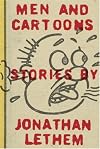
The back cover art on the hardback edition is in the form of the ad pages that used to run in comic books (think "X-Ray Spex!"). Some are blurbs about the stories; some are spoofs of ads ("Raise Fun-Loving AQUA CHIMPS/JUST ADD WATER!/Or mustard or vermouth or Drano or whatever. It's never too early to learn how fleeting love can be...."). You can see it using Amazon's Search Inside feature. show less
- There's not much wrong with it. The last story seems weak as an anchor for the collection.
This is my 4th Lethem and the most delightful short story collection I've read recently. Lethem's focus here is on relationships--with oneself, with others--and the failure of communication. In many of the stories, intrusive encounters and unwitting coincidental meetings (with people previously known and unknown) provide the painful and sometimes humiliating impetus for the conclusion, which is often the narrator's awareness that he has disconnected or failed. This sounds grimmer than the collection actually is. Lethem's environments, as always, are fascinating and show more deceptively easily established; his dialogue is clever and wry without being offputting; his characters seem genuinely surprised or merely bewildered by their own lives. The conflicts that befall them are emotionally universal, yet at the narrative level bizarre. While none of us is likely to encounter the Sylvia Plath Sheep, we are all too familiar with the existential consequences brought on by that encounter. Even when they behave badly, Lethem's protagonists are likeable schlubs, and familiar schlubs at that.
A unifying theme present in many of these stories is the comicbook superhero, some of whose avatars are more successful than others. In addition, the collection uses minor images and motifs to bridge the stories. Some are thematic similarities ("The Spray" makes missing objects visible, then in "Planet Big Zero" the narrator comments, "so much of life becomes invisible"); others are more like puns (Toscanini's glasses in "Planet Big Zero" foreshadow "The Glasses").
Though I enjoyed the whole collection as a group, "The Spray" and "Big Planet Zero" were my favorites. "The Glasses" is the most poignant, and the only story that seemed to demonstrate the triumph of connection over isolation, albeit subtlely. "The National Anthem" is the anchor story and the weakest in the collection. It seemed too self-conscious and I was not engaged by it. Perhaps it was too reflective in a collection that otherwise used more eventful narratives. Perhaps it would have been more satisfying if it had reprised the comics motif. Whatever the reason, it is unsatisfying, and the only low point in an otherwise fine and sophisticated collection.
The back cover art on the hardback edition is in the form of the ad pages that used to run in comic books (think "X-Ray Spex!"). Some are blurbs about the stories; some are spoofs of ads ("Raise Fun-Loving AQUA CHIMPS/JUST ADD WATER!/Or mustard or vermouth or Drano or whatever. It's never too early to learn how fleeting love can be...."). You can see it using Amazon's Search Inside feature. show less
Lethem's second short story collection isn't a bad effort at all, but funnily enough (considering how good an essayist he is), I'm not sure the format suits him. Several of the pieces here feel like outtakes from a longer story, that sacrifice the character and thematic developments of a novel but don't quite pack the punch of a great short story. If you've read Fortress of Solitude (and you should) there's really not much new in stories like The Vision or Planet Big Zero, and sci-fi stories like Access Fantasy may be entertaining but come across as too obviously Vonnegut-meets-Bradbury without the sharp observations of either. That said, The Spray is a brilliant idea done very well (a couple are robbed, the police use a mystical spray show more to identify what's missing from their apartment, and the couple then turn the spray on each other to see what's unspoken between them...), The Dystopianist, Thinking of his Rival, is Interrupted by a Knock on the Door is not just a great title, and Super Goat Man makes the perhaps best use yet of Lethem's fascination with comic book heroes by featuring a jaded and retired superhero trying to make a living as a college teacher in Nixon's America - and then showing us exactly why heroes retire, and what happens to those who trusted in them; superhero deconstructions are a thirteen per dozen these days, but Super Goat Man is one of the better.
Lethem is never not entertaining, and when he gets it right, that Pynchon-lite walk through an America built as much by Stan Lee as by Abraham Lincoln, populated by people trying to pick up the world their forebears handed them in bright colours promising caped baddies and upstanding heroes that somehow never delivered, works very well in short story form as well. But Men And Cartoons is a little too slight, with one or two stories too many that just fizzle out without going neither SPLAT nor POW. show less
Lethem is never not entertaining, and when he gets it right, that Pynchon-lite walk through an America built as much by Stan Lee as by Abraham Lincoln, populated by people trying to pick up the world their forebears handed them in bright colours promising caped baddies and upstanding heroes that somehow never delivered, works very well in short story form as well. But Men And Cartoons is a little too slight, with one or two stories too many that just fizzle out without going neither SPLAT nor POW. show less
As always with a collection of short stories, these are hit and miss. As always with Lethem, is a mix of fantasy with memoir with a sprinkling of superheros and baseball. A find them to a be a bit too dark, a bit too absurdist. Most of these stories are about longing for something else - a love long past, a childhood wrapped in super heros. They are well written, but not really my cup of tea.
This collection has been tagged as both sci-fi and fantasy, but it is really too eclectic and too strange to be defined as a whole in such a way. The eleven stories range from a tale of a commercial dystopian future to a long letter about a failed affair, and several even odder places in between. Though they cover a great array of characters and themes, they all have the same feel of strangeness and discomfort. Lethem can make a suburban family or college house party feel foreign. Unfortunately, a few of these stories are so strange, their point becomes elusive, if it exists at all.
Lethem gives the appearance of being a great disciple of Philip K. Dick, which these few stories exemplify. This reviewer feels that part of his ultimate show more goal is to make the reader approach common situations with greater awareness by turning them into absurdities. A couple of the stories fall flat, with no great effect, but with no great flaw either; however, several more are real gems that exhibit a virtuosity in strangeness and a keen perception in the bizarreness of life. show less
Lethem gives the appearance of being a great disciple of Philip K. Dick, which these few stories exemplify. This reviewer feels that part of his ultimate show more goal is to make the reader approach common situations with greater awareness by turning them into absurdities. A couple of the stories fall flat, with no great effect, but with no great flaw either; however, several more are real gems that exhibit a virtuosity in strangeness and a keen perception in the bizarreness of life. show less
This is a collection of bizarre short stories.
I really don’t like to read short stories. I usually find them unsatisfying. That notwithstanding, Lethem is an interesting writer who isn’t afraid to experiment, and sometimes the short story can be the best medium for experimentation. In some cases, such as the stories “Access Fantasy” and “Super Goat Man,” he pulls it off. In others, I was left wondering what the point was. But in general, this is a more interesting and therefore readable collection than most.
I really don’t like to read short stories. I usually find them unsatisfying. That notwithstanding, Lethem is an interesting writer who isn’t afraid to experiment, and sometimes the short story can be the best medium for experimentation. In some cases, such as the stories “Access Fantasy” and “Super Goat Man,” he pulls it off. In others, I was left wondering what the point was. But in general, this is a more interesting and therefore readable collection than most.
Members
- Recently Added By
Lists

Books Read in 2006
421 works; 8 members

Short Story and Novella Collections
47 works; 6 members

Speculative Fiction: Slipstream Literature
166 works; 16 members
Author Information

100+ Works 24,650 Members
Jonathan Lethem was born in Brooklyn, New York on February 19, 1964. His first novel, Gun, with Occasional Music was published in 1994. His other works include As She Climbed across the Table (1997), Amnesia Moon (1995), The Fortress of Solitude (2003), You Don't Love Me Yet (2007), Chronic City (2009), and Dissident Gardens (2013). He won the show more National Book Critics Circle Award for Motherless Brooklyn (1999). He also writes short stories, comics and essays. His work has appeared in The New Yorker, Harper's, Rolling Stone, Esquire, The New York Times, The Paris Review, McSweeney's and other periodicals and anthologies. (Bowker Author Biography) show less
Some Editions
Series
Belongs to Publisher Series
Common Knowledge
- Original publication date
- 2004-11-02
- Dedication
- For Thomas Berger
- First words
- I first met the kid known as The Vision at second base, during a kickball game in the P.S. 29 gymnasium, fifth grade.
- Last words
- (Click to show. Warning: May contain spoilers.)I promised the crab I would try.
Classifications
Statistics
- Members
- 940
- Popularity
- 28,266
- Reviews
- 23
- Rating
- (3.35)
- Languages
- English, German, Italian, Russian
- Media
- Paper, Audiobook, Ebook
- ISBNs
- 16
- ASINs
- 5