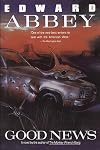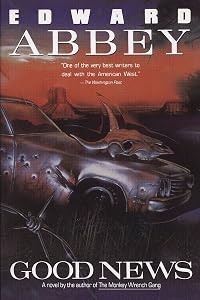
Good News: A Novel (Plume)
by Edward Abbey
On This Page
Description
Jack, an old man in search of his son, and Sam, a Harvard-educated Indian, face the dictator and his nasty band of killers who are taking over the South.Tags
Recommendations







Member Reviews
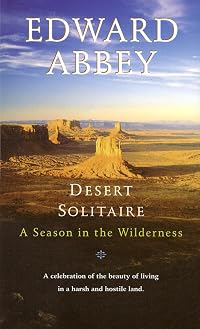
I have to read Edward Abbey when I'm in the desert. What could be better? Well, maybe any of his other books. I prefer his nonfiction, especially [Desert Solitaire], his best. Good News is another of his anarchist romps through the desert, man against the establishment, kind of fun but not his best. Lots of philosophizing: the main protagonist, a man attempting to reestablish government control in this dystopian story, in defending a sidekick who is a criminal who likes to torture people, "....An historical note: Without criminal and torturers like Sergeant Brock--there could be no gentlemen like us."
Three stars - only for Abbey completists.
Three stars - only for Abbey completists.
I love most of the works of Edward Abbey, but after Good News I'm glad this was his only foray into science fiction. The story is a lot like the movies Mad Max and The Postman combined, in that you have a dystopian future where violent para-military types rule what is left of humankind.
Of course Abbey locates Good News in his beloved Southwest, where an old cowboy rides into chaotic Phoenix looking for his long-lost son who presumably has joined the para-military group. The story is sprinkled with native Americans, liberal college professors, despotic commanders and more.
My advice is that this book is only for loyal Abbey followers wanting to read all of his works.
Of course Abbey locates Good News in his beloved Southwest, where an old cowboy rides into chaotic Phoenix looking for his long-lost son who presumably has joined the para-military group. The story is sprinkled with native Americans, liberal college professors, despotic commanders and more.
My advice is that this book is only for loyal Abbey followers wanting to read all of his works.
The action here is fast-paced and like many westerns there is little ambiguity about who the white and black hats are. It explores the mentality responsible for organized assaults on the environment. It sees hope in a combination of rebellion and mysticism.
Ed Abbey never disappoints me. I found this one at The Free Book Thing. It was a particularly unsettling read, given the current state of the world. Without much of a stretch of the imagination, I could see something like this happening in my lifetime.
Ratings
Members
- Recently Added By
Published Reviews
With his novel Good News, Edward Abbey seems to have abandoned his harmonious vision of the world that characterized his earlier works. The vision evinced in Good News is of a world falling apart, where both personal and societal disintegration reign. This shift in Abbey's writing toward a dystopian vision is not easy to follow for the reader because, unlike Abbey's previous works, Good News show more does not present a clear vision of hope and harmony that may lie beyond this world of self-destructiveness and chaos, nor does the novel follow any discernible pattern or form. Almost a parody of Abbey's former novels, which follow the form of a romance, Good News is characterized by an absence of this kind of patterning; its organizing principle is irony, a form, as Ann Ronald points out, "whose only real constant is an imaginative and provocative inversion of the reader's preconceptions and expectations." show less
added by cmwilson101
Author Information

42+ Works 14,009 Members
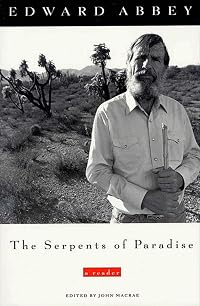
Edward Abbey was born January 29, 1927 in Indiana, Pennsylvania, and grew up in nearby Home. After military service in Naples, Italy, from 1945-47, he enrolled in Indiana University of Pennsylvania for a year before traveling to the West. He fell in love with the desert Southwest and eventually attended the University of New Mexico, where he show more obtained both graduate and post-graduate degrees. Abbey was a Fulbright Fellow from 1951-52. Abbey was an anarchist and a radical environmentalist; these positions are reflected in his writings. His novel Fire on the Mountain won the Western Heritage Award for Best Novel in 1963. Desert Solitaire: A Season in the Wilderness, considered by many to be his best work, is nonfiction that reflects Abbey's love for the American Southwest and draws on his experiences as a park ranger. Among his best-known works are The Brave Cowboy (1956), The Monkey Wrench Gang (1975), and The Fool's Progress (1988). In 1966 The Brave Cowboy was made into a movie titled Lonely Are the Brave, starring Kirk Douglas. Two collections of essays have been published since his death in 1989: Confessions of a Barbarian in 1994 and The Serpents of Paradise the following year. In 1987, Abbey was offered the American Academy of Arts and Letters Award, but he declined. Abbey died in March 1989, near Tucson, Arizona, from complications following surgery. He did not want a traditional burial but rather requested to be buried in the Arizona desert, where he could nourish the earth which had been the subject of so many of his works. (Bowker Author Biography) show less
Common Knowledge
- Canonical title*
- Good news
- Original title
- Good news
- Original publication date
- 1980
*Some information comes from Common Knowledge in other languages. Click "Edit" for more information.
Classifications
Statistics
- Members
- 261
- Popularity
- 124,032
- Reviews
- 4
- Rating
- (3.51)
- Languages
- English, French
- Media
- Paper
- ISBNs
- 5