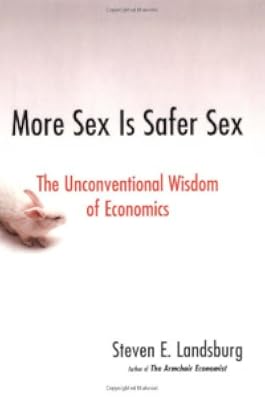
More Sex Is Safer Sex: The Unconventional Wisdom of Economics
by Steven E. Landsburg
On This Page
Description
A witty and razor-sharp look at the many ways our individually rational decisions can combine into some truly weird collective results--and some hilarious and serious ways to fix just about everything. Economics is no longer the "dismal science" dreaded by college freshmen. In recent years, a band of economists has broken away from the charts and graphs of college textbooks, and begun to explain ordinary behavior in plain and often entertaining English. Steve Landsburg was one of the first show more of the new breed, in his book The Armchair Economist and long-running "Everyday Economics" column in Slate magazine. Now he is back, and more provocative than ever. In More Sex Is Safer Sex, Landsburg shows how the rational behavior of each one of us--when combined together--produces the often bizarre, seemingly irrational behavior of crowds. We all stand up at the ballpark, so none of us can see. We avoid casual sex, from fear of disease, and we thereby make sex more dangerous. Things really get interesting when Landsburg suggests ways to change the rules, and game the system. Why not charge juries if a convicted felon is exonerated? Why not have each member of Congress represent a national subset of voters, chosen alphabetically? Why not solve the "overpopulation" problem by having more children, who will help think of ways to improve our use of resources? More Sex Is Safer Sex will make you laugh and argue--and it will make you think about the world around you in new and unforgettable ways. show lessTags
Recommendations


Member Recommendations
Member Reviews
On the bandwagon with Freakonomics. Thinking about things from an economic standpoint – i.e., from the way the world actually works as opposed to the way numerous interest groups would like it to work – is always a laudable pastime; the catch being that economists usually don’t know the way it actually works either. In this case, most of the hypotheses proposed are pretty reasonable – alas, though, they are just hypotheses and testing them by experiment ain’t gonna happen.
Ironically, the lead essay in this collection (and also the title for the whole book), More Sex is Safer Sex, is one of the weakest. It was presumably chosen on the assumption that a book with “sex” in the title will sell better; if only my first show more scientific paper had been titled “Chronostratigraphic accuracy of Ordovician ecostratigraphic correlation and sex” I might be famous today. Author Steven Landsburg clumsily explains his premise with an anecdote involving a hypothetical office Christmas party; a later explanation works somewhat better – suppose you have a community of 1000 married couples and five prostitutes. The women are all content to remain monogamous; the men, however, “need” an additional sexual partner annually. The prostitutes will get a workout and potentially infect everybody with STDs. However, if the women or a reasonable fraction of them cheat, all the men can be satisfied and everybody will stay healthy. Landsburg comments that of course there are some assumptions; I should think so.
The remainder of the essays are similar; some ideas that make you think; many unstated assumptions or failures to account for confounding factors. An interesting one involved a way of thinking about outsourcing jobs overseas; suppose John Doe invents software to perform some valuable service – the example Landsburg uses is automatically analyze MRI scans. People who were previously employed analyzing MRI scans lose their jobs, but for everybody else MRI scan analysis is now cheaper. On investigation, however, it turns out that there’s no fancy software in John Doe’s setup at all; all it does is send the MRI scans to doctors in Mumbai who analyze them and send back the results. In one case, John Doe is a clever inventor and consumer benefactor; in the other he’s an evil and unscrupulous business owner sending American jobs overseas. However, the two situations are economically identical. Landsburg expands somewhat by commenting that John Kerry’s website contained references to keeping “American” jobs for “Americans”, presumably to the enthusiastic approval of his supporters; if, however, Kerry had stated he wanted to keep “white” jobs for “whites”, there would have been a different reaction. The conclusion is “Think Globally” only applies to polar bears, not jobs.
Landsburg’s comment on Third World child labor will also raise hackles among the politically correct; the issue is not one of 13-year old Egyptian girls working all day weaving carpets versus 13-year old Egyptian girls going to school; it’s between weaving carpets and starving. Landsburg is especially hard on American college students with expensive educations and high-tech gadgets “protecting” children in Third World countries from earning enough to eat.
Pretty good overall except for the unfortunate title essay; these were originally written for magazine or newspaper consumption and are thus short and to the point, with the caveat that this sometimes leaves some of the assumptions unstated. Picked mine up in the remainder bin at Barnes and Noble for $2.70 and well worth it. show less
Ironically, the lead essay in this collection (and also the title for the whole book), More Sex is Safer Sex, is one of the weakest. It was presumably chosen on the assumption that a book with “sex” in the title will sell better; if only my first show more scientific paper had been titled “Chronostratigraphic accuracy of Ordovician ecostratigraphic correlation and sex” I might be famous today. Author Steven Landsburg clumsily explains his premise with an anecdote involving a hypothetical office Christmas party; a later explanation works somewhat better – suppose you have a community of 1000 married couples and five prostitutes. The women are all content to remain monogamous; the men, however, “need” an additional sexual partner annually. The prostitutes will get a workout and potentially infect everybody with STDs. However, if the women or a reasonable fraction of them cheat, all the men can be satisfied and everybody will stay healthy. Landsburg comments that of course there are some assumptions; I should think so.
The remainder of the essays are similar; some ideas that make you think; many unstated assumptions or failures to account for confounding factors. An interesting one involved a way of thinking about outsourcing jobs overseas; suppose John Doe invents software to perform some valuable service – the example Landsburg uses is automatically analyze MRI scans. People who were previously employed analyzing MRI scans lose their jobs, but for everybody else MRI scan analysis is now cheaper. On investigation, however, it turns out that there’s no fancy software in John Doe’s setup at all; all it does is send the MRI scans to doctors in Mumbai who analyze them and send back the results. In one case, John Doe is a clever inventor and consumer benefactor; in the other he’s an evil and unscrupulous business owner sending American jobs overseas. However, the two situations are economically identical. Landsburg expands somewhat by commenting that John Kerry’s website contained references to keeping “American” jobs for “Americans”, presumably to the enthusiastic approval of his supporters; if, however, Kerry had stated he wanted to keep “white” jobs for “whites”, there would have been a different reaction. The conclusion is “Think Globally” only applies to polar bears, not jobs.
Landsburg’s comment on Third World child labor will also raise hackles among the politically correct; the issue is not one of 13-year old Egyptian girls working all day weaving carpets versus 13-year old Egyptian girls going to school; it’s between weaving carpets and starving. Landsburg is especially hard on American college students with expensive educations and high-tech gadgets “protecting” children in Third World countries from earning enough to eat.
Pretty good overall except for the unfortunate title essay; these were originally written for magazine or newspaper consumption and are thus short and to the point, with the caveat that this sometimes leaves some of the assumptions unstated. Picked mine up in the remainder bin at Barnes and Noble for $2.70 and well worth it. show less
Steven Landsburg's writings are living proof that economics need not be "the dismal science". Readers of The Armchair Economist and his columns in Slate magazine know that he can make economics not only fun but fascinating, as he searches for the reasons behind the odd facts we face in our daily lives. In More Sex is Safer Sex, he brings his witty and razor-sharp analysis to the many ways that our individually rational decisions can combine into some truly weird collective results -- and he proposes hilarious and serious ways to fix just about everything.
When you stand up at the ballpark in order to see better, you make a rational decision. When everyone else does it too, the results, of course, are lousy. But this is just the tip of show more the iceberg of individual sanity and collective madness. Did you know that some people may actually increase the spread of sexually transmitted diseases when they avoid casual sex? Do you know why tall people earn more money than shorter competitors? (Hint: it isn't just unfair, unconscious prejudice.) Do you know why it makes no sense for you to give charitable donations to more than one organization?
Landsburg's solutions to the many ways that modern life is unfair or inefficient are both jaw-dropping and maddeningly defensible. We should encourage people to cut in line at water fountains on hot days. We should let firefighters keep any property they rescue from burning houses. We should encourage more people to act like Scrooge, because misers are just as generous as philanthropists.
Best of all are Landsburg's commonsense solutions to the political problems that plague our democracy. We should charge penalties to jurors if they convict a felon who is later exonerated. We should let everyone vote in two congressional districts: their own, and any other one of their choice. While we're at it, we should redraw the districts according to the alphabetical lists of all voters, rather than by geography. We should pay FDA commissioners with shares of pharmaceutical-company stocks, and pay our president with a diversified portfolio of real estate from across the country.
Why do parents of sons stay married more often than parents who have only daughters? Why does early motherhood not only correlate with lower income, but actually CAUSE it? Why do we execute murderers but not the authors of vicious computer viruses? The lesson of this fascinating, fun, and endlessly provocative book is twofold: many apparently very odd behaviors have logical explanations, and many apparently logical behaviors make no sense whatsoever. show less
When you stand up at the ballpark in order to see better, you make a rational decision. When everyone else does it too, the results, of course, are lousy. But this is just the tip of show more the iceberg of individual sanity and collective madness. Did you know that some people may actually increase the spread of sexually transmitted diseases when they avoid casual sex? Do you know why tall people earn more money than shorter competitors? (Hint: it isn't just unfair, unconscious prejudice.) Do you know why it makes no sense for you to give charitable donations to more than one organization?
Landsburg's solutions to the many ways that modern life is unfair or inefficient are both jaw-dropping and maddeningly defensible. We should encourage people to cut in line at water fountains on hot days. We should let firefighters keep any property they rescue from burning houses. We should encourage more people to act like Scrooge, because misers are just as generous as philanthropists.
Best of all are Landsburg's commonsense solutions to the political problems that plague our democracy. We should charge penalties to jurors if they convict a felon who is later exonerated. We should let everyone vote in two congressional districts: their own, and any other one of their choice. While we're at it, we should redraw the districts according to the alphabetical lists of all voters, rather than by geography. We should pay FDA commissioners with shares of pharmaceutical-company stocks, and pay our president with a diversified portfolio of real estate from across the country.
Why do parents of sons stay married more often than parents who have only daughters? Why does early motherhood not only correlate with lower income, but actually CAUSE it? Why do we execute murderers but not the authors of vicious computer viruses? The lesson of this fascinating, fun, and endlessly provocative book is twofold: many apparently very odd behaviors have logical explanations, and many apparently logical behaviors make no sense whatsoever. show less
I read The Armchair Economist and More Sex is Safer Sex back to back and remember them both as cost/benefit analysis stretched to its utmost. Which can be fun if you do not take it too seriously. There are also some suggestions for establishing added incentives for judges and juries, as well as firemen, that reminds me of Rube Goldberg contraptions and are all good for a broad smile. In short I think Landsburg is good, very good, with a tongue in his cheek that I suspect he just might not have - well maybe he has.
Questo libro parla (anche) di sesso, perchè fa vendere. Per il resto, parla della parola "autocompiacimento" nelle sue diverse declinazioni, associata alla parola "speculazione da tavola calda" che raggiunge vette insperate. A questa, la consuetudine del "relativismo intellettuale" declinata ad ogni conclusione rende superflua la lettura.
Irritante come una zanzara tigre intrappolata in un bagno pubblico, e altrettanto utile.
Irritante come una zanzara tigre intrappolata in un bagno pubblico, e altrettanto utile.
I don't know if I agree with some of the conclusions that the author reaches, but I definitely like him expounding how he reached them.
* Explaining why parents are 10% more likely to be divorced if they have 3 girls vs. 3 boys
* The idea that citizens should have two votes, one for their district, and another for whatever district they want (to cut down on pork spending)
* The idea that if non-promiscuous people had more casual sex could lower the number of STD infections.
(The author didn't mention it, but it seems like it'd be worth investigating if boys are more likely if the woman climaxes. That could be a cause for both the marriage succeeding and the boy being born)
* Explaining why parents are 10% more likely to be divorced if they have 3 girls vs. 3 boys
* The idea that citizens should have two votes, one for their district, and another for whatever district they want (to cut down on pork spending)
* The idea that if non-promiscuous people had more casual sex could lower the number of STD infections.
(The author didn't mention it, but it seems like it'd be worth investigating if boys are more likely if the woman climaxes. That could be a cause for both the marriage succeeding and the boy being born)
I still have not read Freakonomics but this book is supposededly similiar. I absolutely loved this book! I really liked the section on "how to fix everything else". It just seems like such simple solutions to everyday economics, but sometimes it is so radical that it doesn't seem like it would work.
Interesting, if you like economics you must read Freakonomics !
Members
- Recently Added By
Author Information

13+ Works 1,585 Members
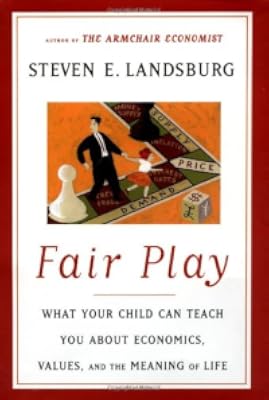
Steven E. Landsburg is a professor of economics at the University of Rochester. He is the author of Fair Play, More Sex is Safer Sex, The Big Questions, two textbooks on economics, a textbook on general relativity and cosmology, and more than thirty journal articles on mathematics, economics, and philosophy. For more than ten years he wrote the show more monthly Everyday Economics column in Slate magazine. He has written regularly for Forbes and occasionally for the New York Times, the Wall Street Journal, and the Washington Post. He blogs at www.TheBigQuestions.com. show less
Common Knowledge
- Canonical title*
- Questo libro non parla (solo) di sesso (solo)
- Original title
- More Sex Is Safer Sex: The Unconventional Wisdom of Economics
- Original publication date
- 2007
- People/Characters
- Gordon Dahl; Tirhas Habtegiris; Michael Kremer; Enrico Moretti
- Important places
- University of Pennsylvania
- Dedication
- To Homeport
in all its manifestations
and
to Lisa
the best surprise of my life - First words
- PREFACE:
Unconventional Wisdom
Common sense tells you that promiscuity spreads AIDS, population growth threatens prosperity, and misers make bad neighbors. I wrote this book to assault your common sense. - Blurbers
- Levitt, Steven D.; O'Rourke, P. J.; Mankiw, Greg
*Some information comes from Common Knowledge in other languages. Click "Edit" for more information.
Classifications
Statistics
- Members
- 416
- Popularity
- 74,297
- Reviews
- 9
- Rating
- (3.64)
- Languages
- English, Italian, Portuguese, Spanish
- Media
- Paper, Ebook
- ISBNs
- 8
- ASINs
- 3