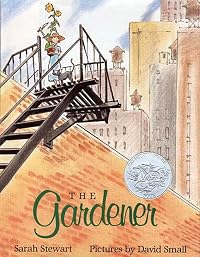
The Gardener
by Sarah Stewart
On This Page
Description
A series of letters relating what happens when, after her father loses his job, Lydia Grace goes to live with her Uncle Jim in the city but takes her love for gardening with her.Tags
Recommendations















Member Reviews
Author Sarah Stewart and illustrator David Small - the same team behind such picture-books as The Library, The Friend and The Journey - turn to the Great Depression in this lovely tale of Lydia Grace Finch, a young girl sent to live with her Uncle Jim in the city when her father loses his job, and her mother is unable to take in much work as a dress-maker. Helping out in Uncle Jim's bakery, and befriending his two assistants, Ed and Emma Beech, Lydia Grace finds herself longing for two things: the abundant gardens of her rural home, and a way to make Uncle Jim smile. Eventually, she hits on a plan that will, she hopes, accomplish both...
Chosen as a Caldecott Honor Book in 1998, The Gardener is (not surprisingly) a book with immense show more visual charm. It is also a book with a strong story, engaging characters - particularly its flower-mad heroine, Lydia Grace! - and an interesting historical setting. Gently, subtly, without any apparent straining after effect, both author and artist convince the reader that she is in 1930s America, traveling by rail with young Lydia Grace, and seeing the city for the first time. The transformation that she works, in the tiny corner of the metropolis that she comes to call home (however temporarily) is good to see, and reminded me of a little-known children's novel from the 1950s, The Hidden Garden, that I greatly enjoyed reading. Something about this kind of narrative, in which the ugly is made beautiful, and the barren, bountiful, is just so very satisfying! Highly recommended, both to young gardeners and garden-lovers, and to fans of this author/illustrator team! show less
Chosen as a Caldecott Honor Book in 1998, The Gardener is (not surprisingly) a book with immense show more visual charm. It is also a book with a strong story, engaging characters - particularly its flower-mad heroine, Lydia Grace! - and an interesting historical setting. Gently, subtly, without any apparent straining after effect, both author and artist convince the reader that she is in 1930s America, traveling by rail with young Lydia Grace, and seeing the city for the first time. The transformation that she works, in the tiny corner of the metropolis that she comes to call home (however temporarily) is good to see, and reminded me of a little-known children's novel from the 1950s, The Hidden Garden, that I greatly enjoyed reading. Something about this kind of narrative, in which the ugly is made beautiful, and the barren, bountiful, is just so very satisfying! Highly recommended, both to young gardeners and garden-lovers, and to fans of this author/illustrator team! show less
No one can prove I cried reading this book about a little girl with flowers in her soul who goes to live with her taciturn uncle in the city during her families time of financial stress.
Lydia Grace is sent to live with her uncle due to hard conditions during the Great Depression. He doesn't smile much, but she sets about cheerfully helping him in the bakery and bringing her passion for gardening to the big city. Eventually, she surprises him with a lucious rooftop garden. Her father gets a job, and she's able to return home.
I liked this Depression-era look at a young country girl, Lydia, who goes to live in the city with her Uncle Jim. The story is communicated via letters she writes - first to her Uncle Jim, and then to her mother, father, and grandmother back on the farm.
Lydia has arrived in the city with a present of seeds from her grandmother and immediately begins utlizing Uncle Jim's flower boxes to begin her garden. Lydia works in her Uncle's bakery, goes to school, and gardens. Soon her garden begins overflowing - from the window boxes, to the apartment, to the bakery, and finally to the roof - where she is planning to surprise her Uncle Jim with a beautiful garden.
I loved how the illustrations did so much of the storytelling - the letters do the show more job of telling what Lydia wants her family to know, but the illustrations amplify the story - we see the never-smiling Uncle Jim, the hopefulness of Lydia, her aloneness, and then the warmth in the illustrations starts to build as Lydia grows her garden and attracts a community/substitute family of people around her. Really really good job of a sort-of dual-storytelling method. show less
Lydia has arrived in the city with a present of seeds from her grandmother and immediately begins utlizing Uncle Jim's flower boxes to begin her garden. Lydia works in her Uncle's bakery, goes to school, and gardens. Soon her garden begins overflowing - from the window boxes, to the apartment, to the bakery, and finally to the roof - where she is planning to surprise her Uncle Jim with a beautiful garden.
I loved how the illustrations did so much of the storytelling - the letters do the show more job of telling what Lydia wants her family to know, but the illustrations amplify the story - we see the never-smiling Uncle Jim, the hopefulness of Lydia, her aloneness, and then the warmth in the illustrations starts to build as Lydia grows her garden and attracts a community/substitute family of people around her. Really really good job of a sort-of dual-storytelling method. show less
The gardener is written entirely in letters from a young girl sent to live with her uncle in the city during the Great Depression. The beautiful pictures change from dark to bright, marking a change in mood as the young girl finds a way to cheer up her grumpy uncle.This is a touching story that teaches endurance, history, and finding good in hard places.
Another book where the illustrations communicate essential parts of the story, and not merely the words. It has beautiful illustrations, theme similar to Miss Rumphius, but has a letter format that may not be as well liked by independent child readers. Adults will love it, though, and children will not hate it.
Written and illustrated by the wife and husband team, Sarah Stewart and David Small, The Gardener is a book that resembles classics of years past, but was in reality published in 1997. Consequently, historical fiction does not adequately describe this picture book that transports the reader back to the hard scrabble life of the Great Depression. Lydia Grace Finch, the author of the letters that narrate this story, is a farm girl sent to live in the big city with her Uncle Jim, the baker. Lydia Grace’s perseverance and optimism lift the story and its characters out of the doldrums of the depression with her kindheartedness and gardening acuity. David Small’s pen and ink, and pastel illustrations with occasional washes of watercolor show more are poignant depictions of each of Lydia Grace’s letters; the urban images are reminiscent of hand painted tintypes and rural representatives picture sun-filled bucolic prospects. For young readers, The Gardener is charming introduction to the dying art of letter-writing and the vicissitudes of life during the Great Depression. show less
Members
- Recently Added By
Lists

Caldecott Honor Books
296 works; 23 members

Honey For a Child's Heart
1,152 works; 25 members

Youth: Personal Values
252 works; 1 member

Garden
23 works; 2 members

Books Read in 2022
5,168 works; 114 members

Five in a Row
174 works; 2 members
Author Information

7+ Works 5,279 Members
All Editions
Awards and Honors
Awards
Distinctions
Common Knowledge
- Original publication date
- 1997
- People/Characters
- Lydia Grace Finch; Uncle Jim
- Important events
- Great Depression
- First words
- August 27, 1935
Dear Uncle Jim, - Last words
- (Click to show. Warning: May contain spoilers.)We gardeners never retire.
Classifications
Statistics
- Members
- 2,641
- Popularity
- 7,105
- Reviews
- 91
- Rating
- (4.36)
- Languages
- 5 — Chinese, English, French, Japanese, Spanish
- Media
- Paper, Audiobook, Ebook
- ISBNs
- 32
- UPCs
- 1
- ASINs
- 5