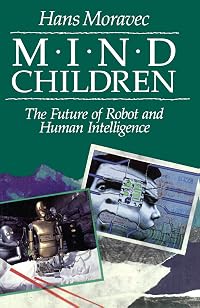
Mind Children: The Future of Robot and Human Intelligence
by Hans Moravec
On This Page
Description
Imagine attending a lecture at the turn of the twentieth century in which Orville Wright speculates about the future of transportation, or one in which Alexander Graham Bell envisages satellite communications and global data banks. Mind Children, written by an internationally renowned roboticist, offers a comparable experience--a mind-boggling glimpse of a world we may soon share with our artificial progeny. Filled with fresh ideas and insights, this book is one of the most engaging and show more controversial visions of the future ever written by a serious scholar. Hans Moravec convincingly argues that we are approaching a watershed in the history of life--a time when the boundaries between biological and postbiological intelligence will begin to dissolve. Within forty years, Moravec believes, we will achieve human equivalence in our machines, not only in their capacity to reason but also in their ability to perceive, interact with, and change their complex environment. The critical factor is mobility. A computer rooted to one place is doomed to static iterations, whereas a machine on the prowl, like a mobile organism, must evolve a richer fund of knowledge about an ever-changing world upon which to base its actions. In order to achieve anything near human equivalence, robots will need, at the least, the capacity to perform ten trillion calculations per second. Given the trillion-fold increase in computational power since the end of the nineteenth century, and the promise of exotic technologies far surpassing the now-familiar lasers and even superconductors, Moravec concludes that our hardware will have no trouble meeting this forty-year timetable. But human equivalence is just the beginning, not an upper bound. Once the tireless thinking capacity of robots is directed to the problem of their own improvement and reproduction, even the sky will not limit their voracious exploration of the universe. In the concluding chapters Moravec challenges us to imagine with him the possibilities and pitfalls of such a scenario. Rather than warning us of takeover by robots, the author invites us, as we approach the end of this millennium, to speculate about a plausible, wonderful postbiological future and the ways in which our minds might participate in its unfolding. show lessTags
Recommendations









Member Recommendations

Member Reviews
Hans Moravec is director of the Mobile Robot Laboratory of Carnegie Mellon University and has spent his time from his days as a graduate student investigating artificial intelligence. Specifically he was attracted by the debate about the possibility of replacing the human nervous system with a more durable artificial equivalent. His essays turned into articles and his articles eventually turned into this book.
Of course the idea is not accepted by many people but Moravec doesn't go into the moral question. In his view the new world will be one in which "the human race has been swept away by the tide of cultural change, usurped by its own artificial progeny". In other words given the rate of improvement in artificial intelligence, robots show more in the not too distant future will be able outperform human beings and so they won't need them anymore.
At first the idea seems bizarre but so would the technology of the late 20th century looking from the vantage point of the 19th. Moravec collects all the evidence throughout the book. He presents very clearly data on the increases in computing power running from electro-mechanical machines, vacuum tubes, transistors to integrated circuits and shows how a top down approach (system design) and bottom up approach (learning evolving systems) are gradually chipping away at "humans only" areas.
Interestingly computers in medicine can already offer reliable diagnosis and they can play chess at grand-master level. They are everywhere in process control and are taking the first steps in learning by being given likes and dislikes and the capacity for boredom (the gradual fade of learnt and recorded tasks in favour of new ones).
Moravec builds up a convincing picture and along the way the reader gets to look at the 1972 ARPAnet breakdown caused by a spontaneous error (mutation) in a piece of data that went on to infect the whole network. Or alternatively the direction that the evolution of duplicating speciating data objects might take. He expects digital wildlife to reproduce sexually as this is the optimum way to provide the variety needed to fill the niches in their new world.
He plays a robotic version of Axelrod's prisoners dilemma and concludes that the "tit for tat" result applies (i.e. robots would find it in their interests to cooperate between themselves-but not necessarily with us).
Essentially the book follows Dawkins idea of human evolution having switched from genes to memes (stored knowledge evolution or evolution in the library) and takes it to its logical conclusion when knowledge abandons its human hosts.
This is a very surprising book worth looking out for. show less
Of course the idea is not accepted by many people but Moravec doesn't go into the moral question. In his view the new world will be one in which "the human race has been swept away by the tide of cultural change, usurped by its own artificial progeny". In other words given the rate of improvement in artificial intelligence, robots show more in the not too distant future will be able outperform human beings and so they won't need them anymore.
At first the idea seems bizarre but so would the technology of the late 20th century looking from the vantage point of the 19th. Moravec collects all the evidence throughout the book. He presents very clearly data on the increases in computing power running from electro-mechanical machines, vacuum tubes, transistors to integrated circuits and shows how a top down approach (system design) and bottom up approach (learning evolving systems) are gradually chipping away at "humans only" areas.
Interestingly computers in medicine can already offer reliable diagnosis and they can play chess at grand-master level. They are everywhere in process control and are taking the first steps in learning by being given likes and dislikes and the capacity for boredom (the gradual fade of learnt and recorded tasks in favour of new ones).
Moravec builds up a convincing picture and along the way the reader gets to look at the 1972 ARPAnet breakdown caused by a spontaneous error (mutation) in a piece of data that went on to infect the whole network. Or alternatively the direction that the evolution of duplicating speciating data objects might take. He expects digital wildlife to reproduce sexually as this is the optimum way to provide the variety needed to fill the niches in their new world.
He plays a robotic version of Axelrod's prisoners dilemma and concludes that the "tit for tat" result applies (i.e. robots would find it in their interests to cooperate between themselves-but not necessarily with us).
Essentially the book follows Dawkins idea of human evolution having switched from genes to memes (stored knowledge evolution or evolution in the library) and takes it to its logical conclusion when knowledge abandons its human hosts.
This is a very surprising book worth looking out for. show less
A great read, thought-provoking and my go-to reference when it comes to AI. Keeps me in the check when I'm out there shaping behaviors with new technology.
A great read, thought-provoking and my go-to reference when it comes to AI. Keeps me in the check when I'm out there shaping behaviors with new technology.
Published 1988. CMU robotics professor. Prediction that computer intelligence will exceed human intelligenge around 2020. Along with Drexler and Kurzweill: robotics/AI visionary.
Ratings
Members
- Recently Added By
Lists

Mind Expanding Books by hackerkid
581 works; 8 members
Author Information

6+ Works 496 Members
Some Editions
Common Knowledge
- Canonical title*
- L'avenir des robots et l'intelligence humaine
- Original title
- Mind children. The future of robot and human intelligence
- Alternate titles*
- Une vie après la vie
- Original publication date
- 1988 (1e édition originale américaine ∙ Harvard University Press ∙ 1e édition originale américaine ∙ Harvard University Press) (1e édition originale américaine ∙ Harvard University Press ∙ 1e édition originale américaine ∙ Harvard University Press); 1992 (1e traduction et édition française sous le titre 'Une vie après la vie' ∙ Odile Jacob) (1e traduction et édition française sous le titre 'Une vie après la vie' ∙ Odile Jacob); 2019 (Réédition française sous le titre 'L'avenir des robots et l'intelligence humaine' ∙ Odile Jacob) (Réédition française sous le titre 'L'avenir des robots et l'intelligence humaine' ∙ Odile Jacob)
- Dedication*
- En souvenir de mon père, qui m’a appris à bricoler.
À ma mère, qui m’a appris à lire.
À Ella, qui a fait de moi un tout. - First words*
- Prologue
Engagés depuis des milliards d’années dans une implacable course aux armements, nos gènes ont fini par se montrer plus malins. Ils ont fabriqué une arme si puissante que dans cette lutte il n’y aura ni... (show all) gagnants ni perdants. Il ne s’agit pas de la bombe à hydrogène, car un conflit nucléaire généralisé ne ferait que retarder ce qui se trame et qui est immensément plus intéressant. Ce qui nous attend, ce n’est pas l’anéantissement. [...]
CHAPITRE 1
L’esprit en mouvement
Je crois que les robots doués d’une intelligence humaine seront courants d’ici une cinquantaine d’années. En comparaison, les esprits des meilleures machines d’aujourd'hui s’apparentent plutôt à ceux d’insectes. Pourtant, ce seul résultat représente déjà une avancée prodigieuse qui a pris quelques dizaines d’années à peine.
[...] - Original language*
- Anglais (USA) (USA)
- Canonical DDC/MDS
- 006.3
*Some information comes from Common Knowledge in other languages. Click "Edit" for more information.
Classifications
- Genres
- Technology, Nonfiction, Science & Nature, General Nonfiction
- DDC/MDS
- 006.3 — Computer science, information & general works Computer science, knowledge & systems Special computer methods (AI, barcoding, VR, web design, social media) Artificial Intelligence
- LCC
- Q335 .M65 — Science Science (General) Cybernetics
- BISAC
Statistics
- Members
- 265
- Popularity
- 122,599
- Reviews
- 4
- Rating
- (3.77)
- Languages
- 5 — English, French, German, Portuguese, Spanish
- Media
- Paper
- ISBNs
- 8