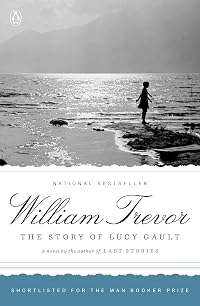
The Story of Lucy Gault
by William Trevor
On This Page
Description
Summer, 1921. Eight-year-old Lucy Gault clings to the glens and woods above Lahardane the home her family is being forced to abandon. She knows the Gaults, as Protestants, are no longer welcome in Ireland and that danger threatens. She is headstrong and decides that somehow she must force her parents into staying.Tags
Recommendations











Member Recommendations

by Cariola

Member Reviews
This is not a ghost story. But all the characters are haunted.
Haunted by loved ones lost, by opportunities not seized, paths untrod, and lives not lived. A house where the only portrait is of “a distant ancestor whose identity had been unknown for as long as anyone of the present could remember” and neighbouring woods silently echo to the memories of those who are there no more. The strand bears shadows of footprints of those who once walked beside the sea, and keening shipwrecks make “a forlorn echo of a terrible time returning in a time that was terrible also”.
Melancholy hues saturate the pages, and drip off individual words. I emerged, damp, blinking, and haunted. Haunted by this story, and also by the words it brought to show more mind, oft heard and recited in childhood:
“We have left undone those things which we ought to have done,
And we have done those things which we ought not to have done.
And there is no health in us.”
From the Book of Common Prayer (Anglican)
Which is the cause of greater regret, greater guilt: the things we do, or the things we dare not?
Image source of girl in white dress, alone in woods, here.
Just a child
In 1921, a child not yet nine (I find myself writing lots of “not”s and “un-”s in this review; it feels apt), lives in a comfortable house in rural Ireland. She’s loved by her parents, though perhaps not quite as much as they love each other. She enjoys her own company, exploring the nearby woods and swimming in the sea. She’s loyal, passionate, imaginative, and independent. But from the first page, shadows gather and hover over this happy family, in the beautiful place they love.
I have been a wilful, exploring child, and had one too: relishing secret places, unconcerned about consequences. But one childish bad choice, compounded by a glint of bad luck, and lives unravel down the years. That is the essence of The Story of Lucy Gault. I could have been that child or that child’s mother; I am glad to be neither.
Who’s to blame?
The backdrop of sectarian strife and world wars parallels, and indirectly triggers, domestic and personal tragedy. Yet the child gets the blame. Takes the blame. Lives the blame. Unbeknown to her, another also takes and lives the blame, haunted to the brink of madness by it.
In a litigious age, embracing responsibility has an air of eccentric nobility. But it’s not necessarily right. Perhaps there is another path to recovery and reparations for those who truly seek it - and it needn’t be religious. (Despite the Irish Catholic versus English Protestant troubles, religion is scenery, rather than spotlighted in this book.)
How long should hope last?
Several characters postpone and surrender the possibility of happiness for honourable but misguided reasons. Guilt in part, but hope as well; both misplaced or disproportionate. Hope sounds positive, but hope can cause as much pain as joy. It’s elusive and unpredictable. Therein lies more confusion and potential agony. But it’s hope we crave. It’s hope we live for. Whatever the price? Till the end of our lives?
The final section is suddenly, sharply, in the present tense. The pain is more acute that way.
Quotes
• “The surf of the sea was a dappled sheen streaked with the last faint afterglow of sunset.”
• “As the surface of the seashore rocks was pitted by the waves and gathered limpets that further disguised what lay beneath, so time made truth of what appeared to be... All memory was regret, all thought empty of consolation.”
• “Borrowed facts, sewn in where there was a dearth, gathered authority with repetition.”
• “They were companions on their journeys; and yet on days like this one, she belonged only to herself.”
• Raindrops “sliding monotonously down the glass”.
• “The early morning light, gauzy and then becoming brash.”
• "'What shall we do today?' They would walk in the hills where sour black cherries grew near marble quarries now exhausted."
• “I am not someone to love... Loving me will make you unhappy.” (I thought of Estella in Great Expectations, though it’s Vanity Fair and Jane Eyre that get explicit mentions.)
• Her “brooding years had created something… wrapping her like a fog that chilled”.
• “Wasn’t it enough that things had settled in the end?” No!
Be careful what you wish for
The tragic message of Lucy Gault is to be careful of what you wish for: the world can be transformed by one small, careless attempt to seize a dream. Its price may be unimaginably high, and resolution too little and too late. show less
Haunted by loved ones lost, by opportunities not seized, paths untrod, and lives not lived. A house where the only portrait is of “a distant ancestor whose identity had been unknown for as long as anyone of the present could remember” and neighbouring woods silently echo to the memories of those who are there no more. The strand bears shadows of footprints of those who once walked beside the sea, and keening shipwrecks make “a forlorn echo of a terrible time returning in a time that was terrible also”.
Melancholy hues saturate the pages, and drip off individual words. I emerged, damp, blinking, and haunted. Haunted by this story, and also by the words it brought to show more mind, oft heard and recited in childhood:
“We have left undone those things which we ought to have done,
And we have done those things which we ought not to have done.
And there is no health in us.”
From the Book of Common Prayer (Anglican)
Which is the cause of greater regret, greater guilt: the things we do, or the things we dare not?
Image source of girl in white dress, alone in woods, here.
Just a child
In 1921, a child not yet nine (I find myself writing lots of “not”s and “un-”s in this review; it feels apt), lives in a comfortable house in rural Ireland. She’s loved by her parents, though perhaps not quite as much as they love each other. She enjoys her own company, exploring the nearby woods and swimming in the sea. She’s loyal, passionate, imaginative, and independent. But from the first page, shadows gather and hover over this happy family, in the beautiful place they love.
I have been a wilful, exploring child, and had one too: relishing secret places, unconcerned about consequences. But one childish bad choice, compounded by a glint of bad luck, and lives unravel down the years. That is the essence of The Story of Lucy Gault. I could have been that child or that child’s mother; I am glad to be neither.
Who’s to blame?
The backdrop of sectarian strife and world wars parallels, and indirectly triggers, domestic and personal tragedy. Yet the child gets the blame. Takes the blame. Lives the blame. Unbeknown to her, another also takes and lives the blame, haunted to the brink of madness by it.
In a litigious age, embracing responsibility has an air of eccentric nobility. But it’s not necessarily right. Perhaps there is another path to recovery and reparations for those who truly seek it - and it needn’t be religious. (Despite the Irish Catholic versus English Protestant troubles, religion is scenery, rather than spotlighted in this book.)
How long should hope last?
Several characters postpone and surrender the possibility of happiness for honourable but misguided reasons. Guilt in part, but hope as well; both misplaced or disproportionate. Hope sounds positive, but hope can cause as much pain as joy. It’s elusive and unpredictable. Therein lies more confusion and potential agony. But it’s hope we crave. It’s hope we live for. Whatever the price? Till the end of our lives?
The final section is suddenly, sharply, in the present tense. The pain is more acute that way.
Quotes
• “The surf of the sea was a dappled sheen streaked with the last faint afterglow of sunset.”
• “As the surface of the seashore rocks was pitted by the waves and gathered limpets that further disguised what lay beneath, so time made truth of what appeared to be... All memory was regret, all thought empty of consolation.”
• “Borrowed facts, sewn in where there was a dearth, gathered authority with repetition.”
• “They were companions on their journeys; and yet on days like this one, she belonged only to herself.”
• Raindrops “sliding monotonously down the glass”.
• “The early morning light, gauzy and then becoming brash.”
• "'What shall we do today?' They would walk in the hills where sour black cherries grew near marble quarries now exhausted."
• “I am not someone to love... Loving me will make you unhappy.” (I thought of Estella in Great Expectations, though it’s Vanity Fair and Jane Eyre that get explicit mentions.)
• Her “brooding years had created something… wrapping her like a fog that chilled”.
• “Wasn’t it enough that things had settled in the end?” No!
Be careful what you wish for
The tragic message of Lucy Gault is to be careful of what you wish for: the world can be transformed by one small, careless attempt to seize a dream. Its price may be unimaginably high, and resolution too little and too late. show less
9.5/10
Only the debris of wreckage, and not much of that, was left behind by the sharks who fed on tragedy: the fishermen, too, mourned the death of a living child.
The debris of wreckage pulls through this novel like a strong current -- again and again, the circular flow of the whirlpool sucks one soul, and then another, and another, down into its depths.
In all its permutations, it is an absurd tale of loss and woe -- unbelievable in every aspect, and yet so believable it will haunt me and follow me for a very long time, possibly for the rest of my life.
I see the lost, wilful child; I see the wasted lives; I see those lives only half-lived, and while it becomes a tragedy on a very personal, familial level, I see it too as a metaphor for show more Ireland itself.
It is Yeats who comes to mind, the terrible beauty that is Lucy Gault, who changes things -- changes them utterly -- for family, for friends, for all those who dwell in her shadow, for all those who hear her name.
Like Yeats's terrible beauty, Lucy is whispered about, and reviled, and then ignored and finally beatified for her patience; for her endurance and humility. It seems that at every step, they read her wrong: while deserving neither blame nor praise, she is the beneficiary of each -- no one understanding her, or her tragedy, any more than she understands herself.
But, it is the second coming which sings the stronger in my mind,
Turning and turning in the widening gyre
The falcon cannot hear the falconer;
Things fall apart; the centre cannot hold;
Mere anarchy is loosed upon the world,
The blood-dimmed tide is loosed, and everywhere
The ceremony of innocence is drowned;
The best lack all conviction, while the worst
Are full of passionate intensity.
Surely some revelation is at hand;
Surely the Second Coming is at hand.
The Second Coming! Hardly are those words out
When a vast image out of Spiritus Mundi
Troubles my sight: somewhere in sands of the desert
A shape with lion body and the head of a man,
A gaze blank and pitiless as the sun,
Is moving its slow thighs, while all about it
Reel shadows of the indignant desert birds.
The darkness drops again; but now I know
That twenty centuries of stony sleep
Were vexed to nightmare by a rocking cradle,
And what rough beast, its hour come round at last,
Slouches towards Bethlehem to be born?
Yeats pre-supposes Trevor; or Trevor embodies Yeats, one could have it either way, for myths and legends live in that magic of never-here-never-there world.
Line for line for line, I read the tragedy of Lucy Gault, for while Yeats writes of the bigger sins of society that loomed darkly over him, Lucy Gault is the metaphor-in-miniature of the doom we carry within us, with each thoughtless misstep.
The single sandal found among the rocks became a sodden image of death; and as the keening on the pier at Kilauran traditionally marked distress brought by the sea, so did silence at Lahardane. show less
Only the debris of wreckage, and not much of that, was left behind by the sharks who fed on tragedy: the fishermen, too, mourned the death of a living child.
The debris of wreckage pulls through this novel like a strong current -- again and again, the circular flow of the whirlpool sucks one soul, and then another, and another, down into its depths.
In all its permutations, it is an absurd tale of loss and woe -- unbelievable in every aspect, and yet so believable it will haunt me and follow me for a very long time, possibly for the rest of my life.
I see the lost, wilful child; I see the wasted lives; I see those lives only half-lived, and while it becomes a tragedy on a very personal, familial level, I see it too as a metaphor for show more Ireland itself.
It is Yeats who comes to mind, the terrible beauty that is Lucy Gault, who changes things -- changes them utterly -- for family, for friends, for all those who dwell in her shadow, for all those who hear her name.
Like Yeats's terrible beauty, Lucy is whispered about, and reviled, and then ignored and finally beatified for her patience; for her endurance and humility. It seems that at every step, they read her wrong: while deserving neither blame nor praise, she is the beneficiary of each -- no one understanding her, or her tragedy, any more than she understands herself.
But, it is the second coming which sings the stronger in my mind,
Turning and turning in the widening gyre
The falcon cannot hear the falconer;
Things fall apart; the centre cannot hold;
Mere anarchy is loosed upon the world,
The blood-dimmed tide is loosed, and everywhere
The ceremony of innocence is drowned;
The best lack all conviction, while the worst
Are full of passionate intensity.
Surely some revelation is at hand;
Surely the Second Coming is at hand.
The Second Coming! Hardly are those words out
When a vast image out of Spiritus Mundi
Troubles my sight: somewhere in sands of the desert
A shape with lion body and the head of a man,
A gaze blank and pitiless as the sun,
Is moving its slow thighs, while all about it
Reel shadows of the indignant desert birds.
The darkness drops again; but now I know
That twenty centuries of stony sleep
Were vexed to nightmare by a rocking cradle,
And what rough beast, its hour come round at last,
Slouches towards Bethlehem to be born?
Yeats pre-supposes Trevor; or Trevor embodies Yeats, one could have it either way, for myths and legends live in that magic of never-here-never-there world.
Line for line for line, I read the tragedy of Lucy Gault, for while Yeats writes of the bigger sins of society that loomed darkly over him, Lucy Gault is the metaphor-in-miniature of the doom we carry within us, with each thoughtless misstep.
The single sandal found among the rocks became a sodden image of death; and as the keening on the pier at Kilauran traditionally marked distress brought by the sea, so did silence at Lahardane. show less
"Memories can be everything if we choose to make them so."
This novel spans some 70 years and looks at how the future is shaped by "the sins of the past". Yet in reality the 'sins' are minor compared with the punishment that they engender.
The story begins in the summer of 1921, in County Cork, when local Protestant landowners were subject to attacks by members of the IRA in their battle against the British Army as they sought independence. Isolated farmhouses owned by Anglo-Irish families were set on fire in an attempt to drive their owners out of their homes and Ireland altogether.
Captain Everard Gault, a veteran of WWI, lives a simple life at Lahardane with his wife and young daughter when one night he shoots at a group of intruders, show more intent on burning their house down, wounding one of them. Everard hadn't actually intended to injure anyone merely to warn them off. He knows the family of the youth he shot, a boy called Horahan, and feeling remorseful attempts to apologise and offer recompense to the boy's family but meets intransigence and refusal.
Fearful of another attack Everard and his wife Heloise decide to abandon Lahardane to the care of Henry and Bridget, a pair of loyal retainers. However, in trying to shield eight-year-old Lucy from the real reasons for their departure from the home she loves she in turn she decides to run away rather than leave her home. By a series of awful chances, Lucy is thought to have drowned and grief stricken her parents reluctantly leave Ireland without her.
Sometime afterwards Lucy is found alive and attempts are made in trying to track down her parents. Racked with grief and remorse Lucy and her parents begin to live parallel lives. Whilst her parents live a nomadic life around Europe, Lucy lives an almost Sleeping Beauty like existence, living in an isolated house, looked after by Henry and Bridget rather than seven dwarfs, cut off from ordinary outside village life, reading old novels and wearing her mother's dresses,she awaits her parents return and forgiveness. Adults and child are unable to reconcile past events and are imprisoned by "what must not be spoken of". When Lucy falls in love, she refuses happiness until she is forgiven but when Heloise dies and Everard returns to Lahardane but is too late to save Lucy's happiness. Instead they must each settle for companionship rather than love.
Meanwhile, the boy Horahan, plagued by vivid dreams in which he actually burnt the house down thus killing Lucy, is gradually losing his mind racked with remorse.
On the whole I found this a really well written novel but in particular I found the middle section, which deals with Lucy's love scenes with Ralph, very poignant. Every sentence they speak has a "not" or a "never" in it: "I never want to go." "I could never not love you." When Ralph marries, he never tells his wife about Lucy, and when her father returns, they don't talk of her loss. As a child, Lucy learns deaf-and-dumb language from a fisherman, and that's what these characters speak in.
This is a novel that centres around guilt, both personal and political. How decisions and policies can have unforeseen ramifications. Both Horahan and the Gaults are victims of Ireland's 'Troubles', the Irish boy brought up to become a revolutionary and the Protestant family who were the intended victims, each then become metaphors for colonialism.
As the years pass by Lucy's tale slips into local myth and folklore with her regarded almost as a Protestant saint. Time on one hand is a destroyer, "The past was the enemy." but as the years pass by, Lucy in particular becomes much more sanguine about past events: "What happened simply did". This then is a story of memory as well as history. show less
This novel spans some 70 years and looks at how the future is shaped by "the sins of the past". Yet in reality the 'sins' are minor compared with the punishment that they engender.
The story begins in the summer of 1921, in County Cork, when local Protestant landowners were subject to attacks by members of the IRA in their battle against the British Army as they sought independence. Isolated farmhouses owned by Anglo-Irish families were set on fire in an attempt to drive their owners out of their homes and Ireland altogether.
Captain Everard Gault, a veteran of WWI, lives a simple life at Lahardane with his wife and young daughter when one night he shoots at a group of intruders, show more intent on burning their house down, wounding one of them. Everard hadn't actually intended to injure anyone merely to warn them off. He knows the family of the youth he shot, a boy called Horahan, and feeling remorseful attempts to apologise and offer recompense to the boy's family but meets intransigence and refusal.
Fearful of another attack Everard and his wife Heloise decide to abandon Lahardane to the care of Henry and Bridget, a pair of loyal retainers. However, in trying to shield eight-year-old Lucy from the real reasons for their departure from the home she loves she in turn she decides to run away rather than leave her home. By a series of awful chances, Lucy is thought to have drowned and grief stricken her parents reluctantly leave Ireland without her.
Sometime afterwards Lucy is found alive and attempts are made in trying to track down her parents. Racked with grief and remorse Lucy and her parents begin to live parallel lives. Whilst her parents live a nomadic life around Europe, Lucy lives an almost Sleeping Beauty like existence, living in an isolated house, looked after by Henry and Bridget rather than seven dwarfs, cut off from ordinary outside village life, reading old novels and wearing her mother's dresses,she awaits her parents return and forgiveness. Adults and child are unable to reconcile past events and are imprisoned by "what must not be spoken of". When Lucy falls in love, she refuses happiness until she is forgiven but when Heloise dies and Everard returns to Lahardane but is too late to save Lucy's happiness. Instead they must each settle for companionship rather than love.
Meanwhile, the boy Horahan, plagued by vivid dreams in which he actually burnt the house down thus killing Lucy, is gradually losing his mind racked with remorse.
On the whole I found this a really well written novel but in particular I found the middle section, which deals with Lucy's love scenes with Ralph, very poignant. Every sentence they speak has a "not" or a "never" in it: "I never want to go." "I could never not love you." When Ralph marries, he never tells his wife about Lucy, and when her father returns, they don't talk of her loss. As a child, Lucy learns deaf-and-dumb language from a fisherman, and that's what these characters speak in.
This is a novel that centres around guilt, both personal and political. How decisions and policies can have unforeseen ramifications. Both Horahan and the Gaults are victims of Ireland's 'Troubles', the Irish boy brought up to become a revolutionary and the Protestant family who were the intended victims, each then become metaphors for colonialism.
As the years pass by Lucy's tale slips into local myth and folklore with her regarded almost as a Protestant saint. Time on one hand is a destroyer, "The past was the enemy." but as the years pass by, Lucy in particular becomes much more sanguine about past events: "What happened simply did". This then is a story of memory as well as history. show less
“…how a stoicism had developed in her as a child when those same years failed her, how faith had still been kept, love shattered.” (page 165)
First, there is the writing – at times spare and at other times quite dense, but never needlessly so. Without a story or plot or dialogue, it would be a pleasure to read William Trevor’s words. But then there is the story: of family and love and pain and grief and forgiveness and redemption and finding peace with one’s life.
I don’t want to summarize the plot because too much will be given away; suffice it to say this story unfolds over many decades and at its center is Lahardane, an old Irish house on the cliffs above the sea. Departures from Lahardane, lives lived fully there, and show more homecomings provide the bones of the story. Trevor creates such a distinct sense of place and sense of belonging there among his characters that when they venture away, it seems almost an unmooring.
I read much of this book with a lump in my throat and a burning behind my eyes. Trevor writes of loss and dislocation so beautifully and evokes so perfectly that ache that tells us we once had something good and true which now is lost. I loved this book and relished every moment spent reading it, despite the heartache.
”Her tranquility is their astonishment. For that they come, to be amazed again that such peace is there: all they have heard, and still hear now, does not record it. Calamity shaped a life when, long ago, chance was so cruel. Calamity shapes the story that is told, and is the reason for its being: is what they know, besides, the gentle fruit of such misfortune’s harvest?
…They did not witness for themselves, but others did, the journey made to bring redemption; they only wonder why it was made, so faithfully and for so long. Why was the past belittled? Where did mercy come from when there should have been none left?
…She should have died a child; she knows that but has never said it to the nuns, has never included in the story of herself the days that felt like years when she lay among the fallen stones. It would have lowered their spirits, although it lifts her own because instead of nothing there is what there is.” (page 224-227) show less
First, there is the writing – at times spare and at other times quite dense, but never needlessly so. Without a story or plot or dialogue, it would be a pleasure to read William Trevor’s words. But then there is the story: of family and love and pain and grief and forgiveness and redemption and finding peace with one’s life.
I don’t want to summarize the plot because too much will be given away; suffice it to say this story unfolds over many decades and at its center is Lahardane, an old Irish house on the cliffs above the sea. Departures from Lahardane, lives lived fully there, and show more homecomings provide the bones of the story. Trevor creates such a distinct sense of place and sense of belonging there among his characters that when they venture away, it seems almost an unmooring.
I read much of this book with a lump in my throat and a burning behind my eyes. Trevor writes of loss and dislocation so beautifully and evokes so perfectly that ache that tells us we once had something good and true which now is lost. I loved this book and relished every moment spent reading it, despite the heartache.
”Her tranquility is their astonishment. For that they come, to be amazed again that such peace is there: all they have heard, and still hear now, does not record it. Calamity shaped a life when, long ago, chance was so cruel. Calamity shapes the story that is told, and is the reason for its being: is what they know, besides, the gentle fruit of such misfortune’s harvest?
…They did not witness for themselves, but others did, the journey made to bring redemption; they only wonder why it was made, so faithfully and for so long. Why was the past belittled? Where did mercy come from when there should have been none left?
…She should have died a child; she knows that but has never said it to the nuns, has never included in the story of herself the days that felt like years when she lay among the fallen stones. It would have lowered their spirits, although it lifts her own because instead of nothing there is what there is.” (page 224-227) show less
I have had conversations IRL and here on GR about not liking to feel manipulated by writers. I hate being told how I am supposed to feel. Sometimes people do not seem to understand what I am talking about. For those people I will say that William Trevor is the sine qua non of non-manipulative writers. I am awed both by Trevor's facility and economy with words. A reader needs to really pay attention when reading Trevor because it is easy to completely miss shattering events. The loss of home, life, children, dignity, peace happen in the course of a few sentences, and those events are conveyed with no more fanfare than is given a description of a tea towel laid upon a bush to dry. One example "For a moment that night he was glad they had show more tidied up the graves. Later he was aware of pain. It did not wake him." That is it, the whole death scene . (Not a spoiler, the story takes place over the course of 70 years so people die, that is just one of them). Do with it what you will. For me, I had all sorts of feeling about that death, complicated conflicting feelings, and every feeling was mine and came from the relationship Trevor built between me and the character.
I have read many of Trevor's short stories, but this is my first of his novels. Though this is wonderful and you should read it, I have liked Trevor's short stories a good deal more than I liked this. I tried to identify why I like the short stories more, and I have two theories. The first is that it is not a matter of form, but rather of Trevor being an old man when he wrote this. His standard feeling of melancholy, which has pervaded all the work I have read, is notched up from melancholy to frustration at his obsolescence and the obsolescence of his characters. My second theory is that it is not Trevor's frustration but my own that is invading the reading experience. What comes off as characters' equanimity in the stories I have read feels like the characters' plodding inertia in this novel. Is that because the increased length means I am reading about a litany of incomprehensibly terrible choices and non-choices rather than just a couple? Is this because the characters in this book just work harder to avoid conflict (thereby creating conflict) than those on earlier works? Damned if I know. Whatever the reason I was realllllly frustrated by people not doing anything, of running from understanding or resolution as fast as they could. That is why this is a 4-star rather than a 5-star for me. When people talk the language is peppered with "I can't not" and other phrases that imply an intense desire to not act, to not feel. I don't want to spoil the book so I won't say more, but I will say the central event in the book could have been resolved simply through letting anyone in the world know where characters were living. This is something that pretty much anyone with any connections (and these people had connections), even people with depression and/or PTSD, would do. A large property is left in the care of caretakers, and yet for a lifetime the property owners do not contact the caretakers or even provide their contact information in case of emergency. There is a passing reference at the very end of the book to this now old person seeing people walk down the streets with their phones, and to her hearing about the internet and having no idea what that meant, and maybe that is my problem here. Having lived so long in this age I cannot get my mind around people disappearing -- disappearing is something that is pretty hard to do these days. Maybe this frustration is entirely my fault. In any event, it does not at all ruin the read, it just changes it.
One more note, when I read this the song Delta Dawn kept playing in my head. While I really like music, I have never been much of a Helen Reddy fangirl, but that totally came up. This vision of a girl, then a woman, caught up by the regrets of rejecting love and spending her days waiting for something unattainable while wearing the old abandoned dresses of her old abandoning mother just got me there. I need to start reading more books that make me think of action like Party in the USA or Hot in Here, or even Lust for Life. show less
I have read many of Trevor's short stories, but this is my first of his novels. Though this is wonderful and you should read it, I have liked Trevor's short stories a good deal more than I liked this. I tried to identify why I like the short stories more, and I have two theories. The first is that it is not a matter of form, but rather of Trevor being an old man when he wrote this. His standard feeling of melancholy, which has pervaded all the work I have read, is notched up from melancholy to frustration at his obsolescence and the obsolescence of his characters. My second theory is that it is not Trevor's frustration but my own that is invading the reading experience. What comes off as characters' equanimity in the stories I have read feels like the characters' plodding inertia in this novel. Is that because the increased length means I am reading about a litany of incomprehensibly terrible choices and non-choices rather than just a couple? Is this because the characters in this book just work harder to avoid conflict (thereby creating conflict) than those on earlier works? Damned if I know. Whatever the reason I was realllllly frustrated by people not doing anything, of running from understanding or resolution as fast as they could. That is why this is a 4-star rather than a 5-star for me. When people talk the language is peppered with "I can't not" and other phrases that imply an intense desire to not act, to not feel. I don't want to spoil the book so I won't say more, but I will say the central event in the book could have been resolved simply through letting anyone in the world know where characters were living. This is something that pretty much anyone with any connections (and these people had connections), even people with depression and/or PTSD, would do. A large property is left in the care of caretakers, and yet for a lifetime the property owners do not contact the caretakers or even provide their contact information in case of emergency. There is a passing reference at the very end of the book to this now old person seeing people walk down the streets with their phones, and to her hearing about the internet and having no idea what that meant, and maybe that is my problem here. Having lived so long in this age I cannot get my mind around people disappearing -- disappearing is something that is pretty hard to do these days. Maybe this frustration is entirely my fault. In any event, it does not at all ruin the read, it just changes it.
One more note, when I read this the song Delta Dawn kept playing in my head. While I really like music, I have never been much of a Helen Reddy fangirl, but that totally came up. This vision of a girl, then a woman, caught up by the regrets of rejecting love and spending her days waiting for something unattainable while wearing the old abandoned dresses of her old abandoning mother just got me there. I need to start reading more books that make me think of action like Party in the USA or Hot in Here, or even Lust for Life. show less
What a beautiful novel is Trevor’s paean to loss, regret and life itself. I can’t tell you how it cleansed the palate after the first three books of Updike’s Rabbit series. It restored my faith in the novel as a vehicle for the expression of human sensitivity.
Lucy is young when her parents, fearful of the turning political tide, make plans to leave the only home she has known on the beautiful Irish coast. But tragedy strikes, and the novel enters a period of mourning, separation and loss which William Trevor’s prose paints perfectly.
In fact, it is a testament to Trevor’s skill as a writer that the novel does not descend into utter melodrama, such is the tragedy you are faced with. I’m not sure anyone but an Irish writer show more could have portrayed such depth of loss with such subtle prose. It’s enchanting.
I’ll admit that there are a couple of contrivancies in the plot to make the story work as it does, but you’re so enthralled, you really don’t notice them. Like a Bronte fan reading Jane Eyre, you’re willing to forgive the author at least this much.
According to Wikipedia, Trevor’s characters are "Those who cannot accept the reality of their lives create their own alternative worlds into which they retreat."
Lucy Gault perfectly fits this mould and finds the world that she creates cannot sustain the penetration of the realities of those who love her. There is a tremendous sadness in these episodes, and it makes you yearn to comfort her.
Lucy’s life is a lesson to those of us who fear fear itself. It can be a big bad world out there, but it can also be wonderful, and to fear the former is a surefire way to ensure you never make it far enough to see the latter.
As all good novels, it makes you wonder who around you embodies the non-fiction version of the fiction you’ve read. How many Lucy Gaults do we know who long for love but cannot receive it for fear it will disturb their safety? Trevor’s novel has raised my awareness and, hopefully, helped me to trust that to love and be loved is worth the risk. Let me never say, like Lucy, "I am not somebody to love." show less
Lucy is young when her parents, fearful of the turning political tide, make plans to leave the only home she has known on the beautiful Irish coast. But tragedy strikes, and the novel enters a period of mourning, separation and loss which William Trevor’s prose paints perfectly.
In fact, it is a testament to Trevor’s skill as a writer that the novel does not descend into utter melodrama, such is the tragedy you are faced with. I’m not sure anyone but an Irish writer show more could have portrayed such depth of loss with such subtle prose. It’s enchanting.
I’ll admit that there are a couple of contrivancies in the plot to make the story work as it does, but you’re so enthralled, you really don’t notice them. Like a Bronte fan reading Jane Eyre, you’re willing to forgive the author at least this much.
According to Wikipedia, Trevor’s characters are "Those who cannot accept the reality of their lives create their own alternative worlds into which they retreat."
Lucy Gault perfectly fits this mould and finds the world that she creates cannot sustain the penetration of the realities of those who love her. There is a tremendous sadness in these episodes, and it makes you yearn to comfort her.
Lucy’s life is a lesson to those of us who fear fear itself. It can be a big bad world out there, but it can also be wonderful, and to fear the former is a surefire way to ensure you never make it far enough to see the latter.
As all good novels, it makes you wonder who around you embodies the non-fiction version of the fiction you’ve read. How many Lucy Gaults do we know who long for love but cannot receive it for fear it will disturb their safety? Trevor’s novel has raised my awareness and, hopefully, helped me to trust that to love and be loved is worth the risk. Let me never say, like Lucy, "I am not somebody to love." show less
The Story of Lucy Gault by William Trevor is a subdued, beautiful and haunting novel of Ireland revolving around the fate of one little girl and the circumstances that shaped not only her life, but the life of her family and others. It opens in the summer of 1921 when Lucy is eight years old but the book travels through her life showing us the consequences of history and time.
I was quickly drawn into this story, but for me, there was also something elusive missing. I read the story but never felt much compassion or concern for the characters. What I really felt was that pretty much all the characters all needed a good shaking and felt very frustrated by the silence and secrets that shaped this story.
This strange, isolated feeling show more persisted throughout the story and most probably was the author’s intention. Conversations do not happen in this book, rather there is subtle interplay, gestures to show emotion and feelings of guilt and loneliness. The Story of Lucy Gault felt very much like a fairy tale about an enchanted princess but told in a quiet, impersonal manner. This is a very difficult book to give a rating to as although I cannot say that I loved this book, I suspect it will be a book that I long remember. show less
I was quickly drawn into this story, but for me, there was also something elusive missing. I read the story but never felt much compassion or concern for the characters. What I really felt was that pretty much all the characters all needed a good shaking and felt very frustrated by the silence and secrets that shaped this story.
This strange, isolated feeling show more persisted throughout the story and most probably was the author’s intention. Conversations do not happen in this book, rather there is subtle interplay, gestures to show emotion and feelings of guilt and loneliness. The Story of Lucy Gault felt very much like a fairy tale about an enchanted princess but told in a quiet, impersonal manner. This is a very difficult book to give a rating to as although I cannot say that I loved this book, I suspect it will be a book that I long remember. show less
Members
- Recently Added By
Lists

1001 Books You Must Read Before You Die
1,448 works; 1,134 members

Top Five Books of 2013
1,562 works; 721 members

Booker Prize
491 works; 62 members
Booker Prize Shortlist: Titles Read
103 works; 10 members

A Novel Cure
742 works; 23 members

Man Booker Prize Longlist 2002
20 works; 2 members

Tonikat reading completed on Librarything journals
329 works; 2 members

Recommended Reading : 600 Classics Reviewed, Editors of Salem Press, 2015
634 works; 6 members
Author Information

120+ Works 13,490 Members
William Trevor Cox was born in Mitchelstown, County Cork, Ireland on May 24, 1928. He received a degree in history from Trinity College in 1950. Before becoming a full-time author in 1965, he worked as a sculptor, a teacher, and a copywriter at an advertising agency. He exhibited his sculptures in Dublin and England and was joint winner of the show more International Year of the Political Prisoner art competition in 1952. His first novel, A Standard of Behaviour, was published in 1958. His other novels include Other People's Worlds, Nights at the Alexandra, The Silence in the Garden, The Story of Lucy Gault, My House in Umbria, and Love and Summer. He won the Hawthornden Prize in 1964 for The Old Boys, the Whitbread Award in 1976 for The Children of Dynmouth, the Whitbread Award in 1983 for Fools of Fortune, and the Whitbread Award in 1994 for Felicia's Journey. His short story collections include The Day We Got Drunk on Cake and Other Stories, The Ballroom of Romance and Other Stories, Beyond the Pale, A Bit on the Side, Cheating at Canasta, and The Mark-2 Wife. The Hill Bachelors received the 2001 Irish Times Irish Literature Prize for Fiction and the PEN/Macmillan Silver Pen Award for Short Stories. He received the Allied Irish Banks' Prize in 1976, The Sunday Times Award for Literary Excellence in 1992, the David Cohen British Literature Prize in 1999, and the Bob Hughes Lifetime Achievement Award in Irish Literature in 2008. In 1977, he was awarded an honorary CBE in recognition of his services to literature. He died on November 20, 2016 at the age of 88. (Bowker Author Biography) show less
Awards and Honors
Awards
Distinctions
Common Knowledge
- Canonical title*
- Het verhaal van Lucy Gault
- Original title
- The Story of Lucy Gault
- Original publication date
- 2002; 2003 (Nederlandse vertaling) (Nederlandse vertaling)
- People/Characters
- Lucy Gault; Captain Everard Gault; Heloise Gault; Bridget; Henry; Ralph (show all 7); Horahan
- Important places
- Lahardane, County Cork, Ireland; Enniseala, County Cork, Ireland; Kilauran, County Cork, Ireland; Montemarmoreo, Liguria, Italy; Bellinzona, Ticino, Switzerland
- Important events
- Irish Revolution
- Dedication
- For Jane
- First words
- Captain Everard Gault wounded the boy in the right shoulder on the night of June the twenty-first, nineteen twenty-one.
- Quotations
- The past was the enemy.
- Last words
- (Click to show. Warning: May contain spoilers.)The rooks come down to scrabble in the grass as every evening at this time they do, her companions while she watches the fading of the day.
- Original language
- English
*Some information comes from Common Knowledge in other languages. Click "Edit" for more information.
Classifications
Statistics
- Members
- 1,852
- Popularity
- 11,707
- Reviews
- 69
- Rating
- (3.74)
- Languages
- 7 — Dutch, English, French, German, Italian, Portuguese, Spanish
- Media
- Paper, Audiobook, Ebook
- ISBNs
- 38
- ASINs
- 12