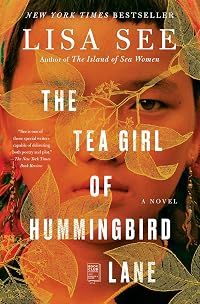
The Tea Girl of Hummingbird Lane
by Lisa See
On This Page
Description
From #1 New York Times bestselling author Lisa See, "one of those special writers capable of delivering both poetry and plot" (The New York Times Book Review), a moving novel about tradition, tea farming, and the bonds between mothers and daughters.In their remote mountain village, Li-yan and her family align their lives around the seasons and the farming of tea. For the Akha people, ensconced in ritual and routine, life goes on as it has for generations—until a stranger appears at the show more village gate in a jeep, the first automobile any of the villagers has ever seen.
The stranger's arrival marks the first entrance of the modern world in the lives of the Akha people. Slowly, Li-yan, one of the few educated girls on her mountain, begins to reject the customs that shaped her early life. When she has a baby out of wedlock—conceived with a man her parents consider a poor choice—she rejects the tradition that would compel her to give the child over to be killed, and instead leaves her, wrapped in a blanket with a tea cake tucked in its folds, near an orphanage in a nearby city.
As Li-yan comes into herself, leaving her insular village for an education, a business, and city life, her daughter, Haley, is raised in California by loving adoptive parents. Despite her privileged childhood, Haley wonders about her origins. Across the ocean Li-yan longs for her lost daughter. Over the course of years, each searches for meaning in the study of Pu'er, the tea that has shaped their family's destiny for centuries.
A powerful story about circumstances, culture, and distance, The Tea Girl of Hummingbird Lane paints an unforgettable portrait of a little known region and its people and celebrates the bond of family. show less
Tags
Recommendations










Member Reviews
Book on CD narrated by Ruthie Ann Miles and Kamiko Green
This work of historical fiction focuses on the indigenous Akha people who make their living harvesting tea in the mountains near the borders with Laos and Myanmar. Li-yan is a young girl who follows her family tradition, but dreams of more. She is encouraged by her teacher who recognizes her intelligence, but she is soon derailed by love.
Lisa See has crafted a marvelous story of perseverance, cultural difference, and the enduring bonds of the mother-daughter relationship! Li-yan and her A-ma (mother) are wonderful characters. It’s interesting to watch the push/pull as Li-yan asserts her independence, and to see how, as she matures, she comes to appreciate (and even adopt) the show more traditions her mother holds so dear and against which Li-yan fought.
I also really liked the way See dealt with the drive towards capitalism that many of the Chinese embraced, not always with the desired result. Li-yan had to learn some hard lessons about real worth vs monetary reward.
There is a dual storyline, with an adopted Chinese child being raised by white Americans. Her journey of discovery and find a way to embrace both her American upbringing and her traditional culture was enlightening to me. I have friends who have adopted a Chinese girl, and they have taken a “heritage roots tour” to help her discover where she comes from. I could not help but wonder what she would make of this story.
The audiobook is well performed by two talented voice artists: Ruthie Ann Miles and Kamiko Green. I’m not sure who voices which character, but both are equally good and effective at bringing the characters to life. show less
This work of historical fiction focuses on the indigenous Akha people who make their living harvesting tea in the mountains near the borders with Laos and Myanmar. Li-yan is a young girl who follows her family tradition, but dreams of more. She is encouraged by her teacher who recognizes her intelligence, but she is soon derailed by love.
Lisa See has crafted a marvelous story of perseverance, cultural difference, and the enduring bonds of the mother-daughter relationship! Li-yan and her A-ma (mother) are wonderful characters. It’s interesting to watch the push/pull as Li-yan asserts her independence, and to see how, as she matures, she comes to appreciate (and even adopt) the show more traditions her mother holds so dear and against which Li-yan fought.
I also really liked the way See dealt with the drive towards capitalism that many of the Chinese embraced, not always with the desired result. Li-yan had to learn some hard lessons about real worth vs monetary reward.
There is a dual storyline, with an adopted Chinese child being raised by white Americans. Her journey of discovery and find a way to embrace both her American upbringing and her traditional culture was enlightening to me. I have friends who have adopted a Chinese girl, and they have taken a “heritage roots tour” to help her discover where she comes from. I could not help but wonder what she would make of this story.
The audiobook is well performed by two talented voice artists: Ruthie Ann Miles and Kamiko Green. I’m not sure who voices which character, but both are equally good and effective at bringing the characters to life. show less
This historical fiction novel, that crosses from China to America exploring the tea industry and cross-cultural adoption, was engaging and interesting to read. Lisa See writes very smoothly. She incorporates many cultural and historical details from China that seem well researched, and she doesn't shy away from difficult topics.
This novel focuses on the Akha people, a small isolated group that lives in the mountains harvesting tea, living simply, and ensconced in their traditions and customs that seem unusual to modern Americans (and Chinese!). Li-Yan, a young woman in the village, is different. She is singled out for her intelligence by a teacher who was sent to their village during the Cultural Revolution. But her life takes a turn show more when she falls in love and has a baby out of wedlock. She gives up this daughter anonymously to an orphanage, later finding out her daughter was sold to an American couple in adoption.
Li-Yan's life ends up taking a fairy tale turn as she learns the tea trade and finds true love, but even with her resources it's unlikely that she'll ever be reunited with her daughter. The daughter's life story and experience is being simultaneously explored in America.
All historical fiction needs to be taken with a grain of salt. Lisa See manages to make me feel like she understands this. She writes with confidence, but at the same time I feel like she leaves a lot of room for a reader to know that she's not trying to be an ultimate authority on any of this. Her books are a great window into different cultures and experience that hopefully lead to further curiosity and contribute to an overall understanding of a different way of life. show less
This novel focuses on the Akha people, a small isolated group that lives in the mountains harvesting tea, living simply, and ensconced in their traditions and customs that seem unusual to modern Americans (and Chinese!). Li-Yan, a young woman in the village, is different. She is singled out for her intelligence by a teacher who was sent to their village during the Cultural Revolution. But her life takes a turn show more when she falls in love and has a baby out of wedlock. She gives up this daughter anonymously to an orphanage, later finding out her daughter was sold to an American couple in adoption.
Li-Yan's life ends up taking a fairy tale turn as she learns the tea trade and finds true love, but even with her resources it's unlikely that she'll ever be reunited with her daughter. The daughter's life story and experience is being simultaneously explored in America.
All historical fiction needs to be taken with a grain of salt. Lisa See manages to make me feel like she understands this. She writes with confidence, but at the same time I feel like she leaves a lot of room for a reader to know that she's not trying to be an ultimate authority on any of this. Her books are a great window into different cultures and experience that hopefully lead to further curiosity and contribute to an overall understanding of a different way of life. show less
Maybe 3.5 stars. Lisa See references an old Chinese aphorism in her final acknowledgements - No coincidence, no story. This turns out to be the key to much of her new novel, which follows the story of two women. The more minor one is of Haley Davis, an abandoned Chinese girl happily adopted by two childless scientists living in California. Haley is the tea girl of Hummingbird Lane of the book's title. From her story, there is a lot to understand about the difficulties faced by the thousands of "grateful but angry" Chinese adoptees currently living in the United States. Theirs are complicated feelings that shift throughout their lives.
Most of the book however, centers on Li-yan. She is the Chinese mother who abandoned her daughter, in show more part, to take advantage of the widening opportunities for women in a rapidly expanding Chinese economy. Both mother and daughter long to meet each other, though for very different reasons.
This was not my favorite Lisa See novel, though I've read a number of them. This one felt a bit clunkier. See moves back and forth between the two stories but it felt to me that parts of Haley's story were more "stuck in," in an almost random fashion. Luckily I found Li-yan's story the more interesting one since hers involves the shifting culture of the Chinese countryside as it moves from widespread isolation and ancient superstitions toward wider integration with the "advances" brought by Communism and entrepreneurship.
There is also a lot of detail about the study and science of tea-making included within this novel, perhaps a bit too much for my taste (no pun intended). It certainly lent authenticity but I personally prefer reading about characters. show less
Most of the book however, centers on Li-yan. She is the Chinese mother who abandoned her daughter, in show more part, to take advantage of the widening opportunities for women in a rapidly expanding Chinese economy. Both mother and daughter long to meet each other, though for very different reasons.
This was not my favorite Lisa See novel, though I've read a number of them. This one felt a bit clunkier. See moves back and forth between the two stories but it felt to me that parts of Haley's story were more "stuck in," in an almost random fashion. Luckily I found Li-yan's story the more interesting one since hers involves the shifting culture of the Chinese countryside as it moves from widespread isolation and ancient superstitions toward wider integration with the "advances" brought by Communism and entrepreneurship.
There is also a lot of detail about the study and science of tea-making included within this novel, perhaps a bit too much for my taste (no pun intended). It certainly lent authenticity but I personally prefer reading about characters. show less
I drink tea, cold in the summer and hot in the winter, but I never gave much thought to where it comes from other than whether it's a flavor I like. I have little to no idea about the lives of the people who grow, harvest, or sell the tea. Lisa See's most recent novel not only introduces one group of these people, the Akha minority in China, to readers, but also examines the ways in which their culture and their relationships are changing as the tea trade itself is changing.
Li-yan is a young Akha woman growing up in a remote mountain village in the Yunnan Province, bound by the long held beliefs and customs of her people. Li-yan's family has harvested Pu'er tea for generations, the women of the family carefully guarding the location of show more their prized "mother" tree from the men and all outsiders. Li-yan is caught straddling the past and the changing future where things like banishing those who bear twins will no longer hold sway over her culture. Falling in love, she commits the terrible sin of having a child out of wedlock, a sin punished by the death of the baby. Having no other choice, she gives her tiny daughter up for adoption even as she has almost immediate second thoughts. Her journey through life is not an easy one and the shadow of her missing daughter follows her always. An ocean away in America, Haley is the much loved, adopted Chinese daughter of an educated, white couple. She has forever wondered about her birth mother and why she was given up for adoption. Part of her identity is completely unknown, unknown except for the unusual pressed tea cake tucked into her baby blanket. It is her search for answers about her origins and about this tea that sets her on her own journey back to China.
This is a dual narrative weaving Li-yan and Haley's stories. Li-yan's tale takes up the bulk of the beginning (and in truth the whole novel) and is told in the first person while Haley's tale is told through the many documents others write about her during her childhood, doctor's notes, her mother's letters to family, Haley's own school work. Haley's story only becomes a traditional narrative at the end of the novel. Although Haley's search for self and the identity politics involved are important, Li-yan's life and the trials she overcomes are far more interesting to the reader, offering a history of minorities in China, a glimpse at an evolving minority culture, insight into all the levels of the tea industry, and the treatment and ultimate power of women. No reader will doubt where the novel is headed but the coincidences required to reach that point can be a little unbelievable. See does an amazing job with the culture of the Akha and with the quiet power and will of the women in this story. Haley's desire to know her own past is well done and believable and it's lovely to see her parents' support for her need for information. Those who like a goodly dose of history and anthropology with their fiction will definitely enjoy this story of mothers and daughters, identity, what is gained and what is lost through globalization, and the changing landscape of the tea world, culturally, economically, and ecologically.
A 2017 National Reading Group Month Great Group Read show less
Li-yan is a young Akha woman growing up in a remote mountain village in the Yunnan Province, bound by the long held beliefs and customs of her people. Li-yan's family has harvested Pu'er tea for generations, the women of the family carefully guarding the location of show more their prized "mother" tree from the men and all outsiders. Li-yan is caught straddling the past and the changing future where things like banishing those who bear twins will no longer hold sway over her culture. Falling in love, she commits the terrible sin of having a child out of wedlock, a sin punished by the death of the baby. Having no other choice, she gives her tiny daughter up for adoption even as she has almost immediate second thoughts. Her journey through life is not an easy one and the shadow of her missing daughter follows her always. An ocean away in America, Haley is the much loved, adopted Chinese daughter of an educated, white couple. She has forever wondered about her birth mother and why she was given up for adoption. Part of her identity is completely unknown, unknown except for the unusual pressed tea cake tucked into her baby blanket. It is her search for answers about her origins and about this tea that sets her on her own journey back to China.
This is a dual narrative weaving Li-yan and Haley's stories. Li-yan's tale takes up the bulk of the beginning (and in truth the whole novel) and is told in the first person while Haley's tale is told through the many documents others write about her during her childhood, doctor's notes, her mother's letters to family, Haley's own school work. Haley's story only becomes a traditional narrative at the end of the novel. Although Haley's search for self and the identity politics involved are important, Li-yan's life and the trials she overcomes are far more interesting to the reader, offering a history of minorities in China, a glimpse at an evolving minority culture, insight into all the levels of the tea industry, and the treatment and ultimate power of women. No reader will doubt where the novel is headed but the coincidences required to reach that point can be a little unbelievable. See does an amazing job with the culture of the Akha and with the quiet power and will of the women in this story. Haley's desire to know her own past is well done and believable and it's lovely to see her parents' support for her need for information. Those who like a goodly dose of history and anthropology with their fiction will definitely enjoy this story of mothers and daughters, identity, what is gained and what is lost through globalization, and the changing landscape of the tea world, culturally, economically, and ecologically.
A 2017 National Reading Group Month Great Group Read show less
2.5 stars. Honestly I was going to rate this three stars, but then the story just abruptly ended when my Kindle said I was 86% done, and I felt SO RELIEVED that I realised this probably wasn't a three-star book for me, unfortunately.
The Tea Girl of Hummingbird Lane starts in rural China in the early 1990s, following a young girl, Li-yan, who belongs to the Akha ethnic minority. Her early life is thoroughly miserable, with her elders reminding her constantly that she's a worthless, unwanted nuisance because she's female, and her mother exasperated and frustrated because she can't even get on board with the ritual murder of babies she'll be required to perform if she's to succeed her as a midwife. In her adolescence, she's supposed to be show more concentrating on school because her teacher thinks she could be the first person from her village – or even from the general area – to ever make it to university. However, she gets distracted when a tea merchant from Hong Kong arrives in her village, seeking out a particularly exquisite brew from the area. She helps him out, translating for her non-Mandarin-speaking village and even providing extra-special tea leaves from a super-secret grove that her mother tells her not to pluck for this man. She also gets distracted from school by a boy in her class, San-pa, on whom she has a crush and who she manages to get pregnant with before he leaves to look for work in Thailand.
She can't raise a baby out of wedlock – only a few years earlier, her mum would have made her sacrifice it in a ritual baby murder – so she surrenders it to an orphanage in a nearby, bigger town. That baby goes on to be adopted by a white American couple and raised in Los Angeles, under the name of Haley. As for Li-yan, things with San-pa don't work out, but she does become a highly successful businesswoman in the tea industry, and ends up moving out to Los Angeles herself.
There are some good things about this book, so don't let my lack of enthusiasm discourage you if you think this book is a great fit for your interests. My own favourite aspect was probably how it depicted the rapid changes in rural China between about 1990 and 2010. Li-yan goes from spending her childhood in abject poverty to being able to make webcam calls over her laptop when she visits her village, as one example. It's the kind of thing where like, sure you could read a Wikipedia article or something about China's economic growth, but reading concrete examples of how people's lives have changed, even in fictional form like this, helps to drive it home.
But unfortunately, there were also parts of this book that I found kind of displeasing, for lack of a better word, and the good things about this book just weren't enough to overcome that. Clearly I found the murder of babies really distasteful (I know there are reasons why small human societies faced with overwhelming, harsh scarcity had such practices, but it doesn't mean I'm chomping at the bit to read visceral accounts of it!), and the vehement hatred of women and girls shown by the village elders in the early part of the book was pretty tough to stomach, too. Then later on, the book acquires a very different problem of existing in a world where everyone is a multi-millionaire with multi-millionaire concerns. There was a romance that just didn't have enough meat on it to be enticing, and even the central plotline – Li-yan's separation from her biological daughter, and their attempts to find each other – just felt underwhelming. The last chapter randomly being from Haley's perspective also felt befuddling, and I had no real sense that the book was winding its way to its ending earlier than like, one page before that end.
Overall, I felt like the other Lisa See book I read recently, The Island of Sea Women, was just a lot better, even though I wasn't in the right frame of mind to read it when I did. The story was tighter, and the historical detail (or… information about tea, in this case) struck me as more interesting. I'm not trying to say this was a bad book though, just one I personally didn't find the most enjoyable. show less
The Tea Girl of Hummingbird Lane starts in rural China in the early 1990s, following a young girl, Li-yan, who belongs to the Akha ethnic minority. Her early life is thoroughly miserable, with her elders reminding her constantly that she's a worthless, unwanted nuisance because she's female, and her mother exasperated and frustrated because she can't even get on board with the ritual murder of babies she'll be required to perform if she's to succeed her as a midwife. In her adolescence, she's supposed to be show more concentrating on school because her teacher thinks she could be the first person from her village – or even from the general area – to ever make it to university. However, she gets distracted when a tea merchant from Hong Kong arrives in her village, seeking out a particularly exquisite brew from the area. She helps him out, translating for her non-Mandarin-speaking village and even providing extra-special tea leaves from a super-secret grove that her mother tells her not to pluck for this man. She also gets distracted from school by a boy in her class, San-pa, on whom she has a crush and who she manages to get pregnant with before he leaves to look for work in Thailand.
She can't raise a baby out of wedlock – only a few years earlier, her mum would have made her sacrifice it in a ritual baby murder – so she surrenders it to an orphanage in a nearby, bigger town. That baby goes on to be adopted by a white American couple and raised in Los Angeles, under the name of Haley. As for Li-yan, things with San-pa don't work out, but she does become a highly successful businesswoman in the tea industry, and ends up moving out to Los Angeles herself.
There are some good things about this book, so don't let my lack of enthusiasm discourage you if you think this book is a great fit for your interests. My own favourite aspect was probably how it depicted the rapid changes in rural China between about 1990 and 2010. Li-yan goes from spending her childhood in abject poverty to being able to make webcam calls over her laptop when she visits her village, as one example. It's the kind of thing where like, sure you could read a Wikipedia article or something about China's economic growth, but reading concrete examples of how people's lives have changed, even in fictional form like this, helps to drive it home.
But unfortunately, there were also parts of this book that I found kind of displeasing, for lack of a better word, and the good things about this book just weren't enough to overcome that. Clearly I found the murder of babies really distasteful (I know there are reasons why small human societies faced with overwhelming, harsh scarcity had such practices, but it doesn't mean I'm chomping at the bit to read visceral accounts of it!), and the vehement hatred of women and girls shown by the village elders in the early part of the book was pretty tough to stomach, too. Then later on, the book acquires a very different problem of existing in a world where everyone is a multi-millionaire with multi-millionaire concerns. There was a romance that just didn't have enough meat on it to be enticing, and even the central plotline – Li-yan's separation from her biological daughter, and their attempts to find each other – just felt underwhelming. The last chapter randomly being from Haley's perspective also felt befuddling, and I had no real sense that the book was winding its way to its ending earlier than like, one page before that end.
Overall, I felt like the other Lisa See book I read recently, The Island of Sea Women, was just a lot better, even though I wasn't in the right frame of mind to read it when I did. The story was tighter, and the historical detail (or… information about tea, in this case) struck me as more interesting. I'm not trying to say this was a bad book though, just one I personally didn't find the most enjoyable. show less
I love Lisa See's multi-generational Chinese sagas - well-researched, generally historically accurate, and she paints beautiful, intimate pictures of lives, never shying away from the more painful aspects of things like foot binding or infanticide.
Yes, infanticide. The start of this book had me in my car (where most of my audiobook-listening gets done) with my hand over my mouth in agony. Even so, I was wrapped up in the saga from then on out, loving the exploration of an area I will likely never have the opportunity to visit. I went on more than one rabbit hole looking at traditional Akha clothing and headdresses online and learning more about pu ehr tea.
With a start like that, I definitely needed a happy ending though, and I'm glad show more it was delivered in a way that wasn't completely over-the-top cheesy, even with a scenario that would likely never happen in real life.
Only one thing annoyed me, and it was just a personal thing that not everyone will see the same way, I realize: the casual and supportive mentions of Chinese real estate investments in North America rubbed me all the wrong ways. This is a major issue in many cities (take a look at Vancouver, B.C.) as it drives up real estate and rental costs, and these properties often sit vacant. In the years since this book was written, however, that has slowed quite a bit, but still... show less
Yes, infanticide. The start of this book had me in my car (where most of my audiobook-listening gets done) with my hand over my mouth in agony. Even so, I was wrapped up in the saga from then on out, loving the exploration of an area I will likely never have the opportunity to visit. I went on more than one rabbit hole looking at traditional Akha clothing and headdresses online and learning more about pu ehr tea.
With a start like that, I definitely needed a happy ending though, and I'm glad show more it was delivered in a way that wasn't completely over-the-top cheesy, even with a scenario that would likely never happen in real life.
Only one thing annoyed me, and it was just a personal thing that not everyone will see the same way, I realize: the casual and supportive mentions of Chinese real estate investments in North America rubbed me all the wrong ways. This is a major issue in many cities (take a look at Vancouver, B.C.) as it drives up real estate and rental costs, and these properties often sit vacant. In the years since this book was written, however, that has slowed quite a bit, but still... show less
I can always rely on author Lisa See to provide an interesting and engaging read and while The Tea Girl of Hummingbird Lane had a few flaws, it was a book that totally engrossed me. Although a little overly sentimental and relying on a huge coincidence to make her plot work, this story about a woman from the Akha tribe of China’s Yunnan province who becomes a tea entrepreneur while searching for the daughter that she had to give up for adoption was both a remarkable and immersive reading experience.
Lisa See is well known for how she explores various aspects of Chinese culture and traditions. Her research is extensive and her story telling is vivid. In this book she introduces us to an ethnic minority group in China who are governed show more by their beliefs in spirits, cleansing rituals, taboos and the dictates of village shamans. When Li-Yan discovers she is pregnant by her absent fiance, she has no choice but to hide the pregnancy, give birth in secret and with her mother’s help, place the child in an adoption centre. The child is adopted by an American couple and grows up in California as Haley. Li-Yan goes on to educate herself and, as her people are tea growers, she becomes a tea expert and eventually marries a wealthy Chinese businessman. But even with money and position behind her, finding her daughter is an impossible task. At the same time, Haley, now a grown young woman herself is also trying to find her birth mother with little success.
The Tea Girl of Hummingbird Lane celebrates the bonds of family, heritage and culture. I felt the plot suffered somewhat from the author’s extensive information on tea growing and producing as well as her research about the Akha people, but this was still a very satisfying read. show less
Lisa See is well known for how she explores various aspects of Chinese culture and traditions. Her research is extensive and her story telling is vivid. In this book she introduces us to an ethnic minority group in China who are governed show more by their beliefs in spirits, cleansing rituals, taboos and the dictates of village shamans. When Li-Yan discovers she is pregnant by her absent fiance, she has no choice but to hide the pregnancy, give birth in secret and with her mother’s help, place the child in an adoption centre. The child is adopted by an American couple and grows up in California as Haley. Li-Yan goes on to educate herself and, as her people are tea growers, she becomes a tea expert and eventually marries a wealthy Chinese businessman. But even with money and position behind her, finding her daughter is an impossible task. At the same time, Haley, now a grown young woman herself is also trying to find her birth mother with little success.
The Tea Girl of Hummingbird Lane celebrates the bonds of family, heritage and culture. I felt the plot suffered somewhat from the author’s extensive information on tea growing and producing as well as her research about the Akha people, but this was still a very satisfying read. show less
Members
- Recently Added By
Lists

Books Read in 2023
5,547 works; 145 members

To Read
617 works; 7 members

Asian American Literature
46 works; 6 members

Llibres que he llegit el 2025
81 works; 2 members
Author Information

20+ Works 33,122 Members
Lisa See was born in Paris but grew up in Los Angeles, spending much of her time in Chinatown. She is of Chinese decent. Her first book, On Gold Mountain: The One Hundred Year Odyssey of My Chinese-American Family (1995), was a national bestseller and a New York Times Notable Book. The book traces the journey of Lisa's great-grandfather, Fong See. show more Her first fiction novel, Flower Net (1997) was a national bestseller, a New York Times Notable Book, and on the Los Angeles Times Best Books List for 1997. Flower Net was also nominated for an Edgar award for best first novel. In addition to writing books, Ms. See was the Publishers Weekly West Coast Correspondent for 13 years. Her bestselling novels, all inspired by her Chinese heritage, include Snow Flower and the Secret Fan, A Peony in Love, Shanghi Girls, Dreams of Joy and China Dolls. Among her awards and recognitions are the Organization of Chinese Americans Women's 2001 award as National Woman of the Year and the 2003 History Makers Award presented by the Chinese American Museum. See serves as a Los Angeles City Commissioner. (Bowker Author Biography) show less
Some Editions
Awards and Honors
Awards
Distinctions
Common Knowledge
- Canonical title
- The Tea Girl of Hummingbird Lane
- Original title
- The Tea Girl of Hummingbird Lane
- Original publication date
- 2017-03
- People/Characters
- Li-yan / Tina Chang; Haley Davis / Yan-yeh; Sha-li 'a-ba'; So-sa 'a-ma'; San-pa; Ci-teh (show all 19); Ci-do; Deh-ja; Teacher Zhang; Benyu 'John' Huang; Xian-rong Huang / Sean Wong; Dan Davis; Constance Davis; Tea Master Sun; Mrs. Chang; Jin Chang; Director Zhou; Paul William Chang 'Jin-ba'; Annabeth Ho
- Important places
- Spring Well Village, China; Nannuo Mountain; Menghai, Yunnan Province, China; Pasadena, California, USA; Thailand; Kunming, Yunnan Province, China (show all 7); Guangzhou, Guangdong Province, China
- Epigraph
- When a son is born,
Let him sleep on the bed,
Clothe him with fine clothes,
And give him jade to play . . .
When a daughter is born,
Let her sleep on the ground,
Wrap her in common wrappings,
And give her... (show all) broken tiles to play . . .
Book of Songs (1000-700 B.C.) - Dedication
- In memory of my mother, Carolyn See
- First words
- "No coincidence, no story," my a-ma recites, and that seems to settle everything, as it usually does, after First Brother finishes telling us about the dream he had last night.
- Quotations
- A spark lights a fire. Water sprouts a seed. The Akha way tells us that a single moment changes destinies.
- Last words
- (Click to show. Warning: May contain spoilers.)My mother. My a-ma.
- Original language*
- Engels
*Some information comes from Common Knowledge in other languages. Click "Edit" for more information.
Classifications
Statistics
- Members
- 2,212
- Popularity
- 9,146
- Reviews
- 126
- Rating
- (4.08)
- Languages
- 7 — Catalan, Czech, Dutch, English, French, Italian, Spanish
- Media
- Paper, Audiobook, Ebook
- ISBNs
- 27
- ASINs
- 8