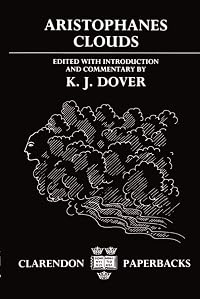
The Clouds [Greek text]
by Aristophanes, W. M. Geldart, F. W. Hall
On This Page
Description
The reality is that little is known of Aristophanes actual life but eleven of his forty plays survive intact and upon those rest his deserved reputation as the Father of Comedy or, The Prince of Ancient Comedy. Accounts agree that he was born sometime between 456BC and 446 BC. Many cities claim the honor of his birthplace and the most probable story makes him the son of Philippus of gina, and therefore only an adopted citizen of Athens, a distinction which, at times could be cruel, though he show more was raised and educated in Athens. His plays are said to recreate the life of ancient Athens more realistically than any other author could. Intellectually his powers of ridicule were feared by his influential contemporaries; Plato himself singled out Aristophanes' play The Clouds as a slander that contributed to the trial and condemning to death of Socrates and although other satirical playwrights had also caricatured the philosopher his carried the most weight. His now lost play, The Babylonians, was denounced by the demagogue Cleon as a slander against the Athenian polis. Aristophanes seems to have taken this criticism to heart and thereafter caricatured Cleon mercilessly in his subsequent plays, especially The Knights. His life and playwriting years were undoubtedly long though again accounts as to the year of his death vary quite widely. What can be certain is that his legacy of surviving plays is in effect both a treasured legacy but also in itself the only surviving texts of Ancient Greek comedy. show lessTags
Recommendations

















Member Reviews
That had way more fart jokes than I was expecting, given the august stature of Aristophanes, but I guess comedy in 5th century BC Athens is not so different from the comedy of today. I suppose that the difference is that a fart from Socrates is an insight about justice or virtue whereas a fart from Jim Carrey is just a fart.
Puerile comparisons aside, I did find The Clouds to be enjoyable. Funny is not exactly the term I would use, but I can see how it was intended to be funny and maybe why it was funny to audiences. Honestly, a lot of humor is a bit lost on me, so don't take my word for it.
I read The Clouds because I wanted to read a send up of then-contemporary intellectual traditions floating about in the agora. And I think we get show more this. Although Aristophanes mocks Socrates a bit it's not without some love and adoration. The comic turn in the play has to do with Strepsiades wanting to learn how to argue his way out of his debts and wants training in sophistic argumentation to learn how to make this argument persuasively. It seems irresponsible but harmless enough (except to the debt collectors) until (after a few turns) Strepsiades' son, Pheidippides gives this manner of argumentation a more sinister edge, arguing why he has a right to beat his parents, showing at once that argumentation can be made to serve ill purposes. show less
Puerile comparisons aside, I did find The Clouds to be enjoyable. Funny is not exactly the term I would use, but I can see how it was intended to be funny and maybe why it was funny to audiences. Honestly, a lot of humor is a bit lost on me, so don't take my word for it.
I read The Clouds because I wanted to read a send up of then-contemporary intellectual traditions floating about in the agora. And I think we get show more this. Although Aristophanes mocks Socrates a bit it's not without some love and adoration. The comic turn in the play has to do with Strepsiades wanting to learn how to argue his way out of his debts and wants training in sophistic argumentation to learn how to make this argument persuasively. It seems irresponsible but harmless enough (except to the debt collectors) until (after a few turns) Strepsiades' son, Pheidippides gives this manner of argumentation a more sinister edge, arguing why he has a right to beat his parents, showing at once that argumentation can be made to serve ill purposes. show less
What a pleasant surprise this drama was! I picked this ancient Greek play up in anticipation of an intellectual muscle stretcher and ended up laughing out loud. Who knew Aristophanes could be so wonderfully entertaining! That silly old Socrates! This drama was entered into a competition in roughly 423 B.C. as an attempt to regain the playwright's standing as the champion. Excellent choice! He poked fun at the Sophists quite well! Very readable too!
“Well, what do the slanderers say? They shall be my prosecutors, and I will sum up their words in an affidavit: 'Socrates is an evil-doer, and a curious person, who searches into things under the earth and in heaven, and he makes the worse appear the better cause; and he teaches the aforesaid doctrines to others.' Such is the nature of the accusation: it is just what you have yourselves seen in the comedy of Aristophanes (Aristoph., Clouds.), who has introduced a man whom he calls Socrates, going about and saying that he walks in air, and talking a deal of nonsense concerning matters of which I do not pretend to know either much or little—not that I mean to speak disparagingly of any one who is a student of natural philosophy...... show more As little foundation is there for the report that I am a teacher, and take money; this accusation has no more truth in it than the other... a man who is good for anything ought not to calculate the chance of living or dying; he ought only to consider whether in doing anything he is doing right or wrong—acting the part of a good man or of a bad."
Plato’s version of Socrates’ confession during the latter’s death trial (399BC) insinuates Aristophanes to be a conservative thinker, an affirmation later established during the play. Although several of Aristophanes’ works are a philosophical think-tank debating the validity of orthodoxy dogmas, his rebuttal to Socrates’ Western philosophy stemmed from the argument discourse on atheism (a grave offence in the 5th century) and deficient holistic theoretical rearing. Aristophanes’ dismissal of the ‘sophists’ philosophy outweighing traditional values by means of scientific reasons was acutely delineated through lampooning caricatures of Socrates and his school of reasoning. Thus, portraying Socrates as a dangerously hypnotic figure of modern values which could be detrimental to a just society; the complete idea of “one man’s virtue, other man’s vice” being ridiculed.
Despair, without which happiness would never be the nectar of the heart, is a demon mocking melancholic cries; a curse to human soul. The burden of his son’s gallivanting debts deprives Strepsiades from peaceful nightly reveries. He laments the day he got married, the root of his misery –Phidippides, his son. Anxious about his escalating financial woes, Strepsiades relentlessly pleads his son to acquire eloquent verbal skills as a plausible defensive method to escape the problematical debt. In a turn of unfortunate events, Strepsiades takes utmost responsibility of eradicating the prevailing misery by enrolling in the “thinking” school presided by Socrates himself.
Kierkegaard in his moralistically aesthetic tome articulates, “Aren’t people absurd! They never use freedom they do have but demand those they don’t have; they have freedom of thought they demand freedom of speech”. How truthfully one can assert these words to be, rightfully in the case of Strepsiades! A man ridden with monetary obligations to his lenders chooses to escape his moral responsibility by sheltering his shortcomings in the veil of eloquent orations; Strepsiades comes forth as a desperate man, yet, a coward to own up to his follies and chooses the art of glib as his weapon to envelop the quarters of corrupt thoughts. When questioned by Socrates on how would he win his case without any witnesses, Strepsiades resorts to the absurdity of abducting the moon through witchcraft; an obnoxious notion of lunacy and if vulnerably cornered he would kill himself as no can prosecute a dead man. Aristophanes satire screams the deviant tactics used by numerous scamming actors in various walks of life. The bankruptcy claims filed by corporate giants and public figures in bid to escape grave punishments are personified through Strep’s each irresponsible procedures. The question of suicide being the remedy of a defenseless acquittal however is debatable over humane grounds of self- sacrifice, though not escaping the cowardice stigma. On the other hand Phidippides, the carefree youth who initially mocks the Sophists for their preposterous sermons, ultimately succumbs to sophistry fluency exercising the training on his own father. Aristophanes’ handling of Phidi’s education as a metaphor exposes the intricacies of Socrates’ Western philosophy; the assault of Strep by Phidi rationalizing the violence as a equalized moralistic chastisement affirms Aristophanes’ fear of scholastic radicalism despite the fact that it implies the Aristophanes very proposal of challenging stagnated principles.
Soren Kierkegaard in Conspiracy of Irony esteems Aristophanes for his meticulous portrayal of a sardonic Socrates;" It is of importance first of all to be satisfied that the Socrates brought on stage by Aristophanes is the actual Socrates. Just as ancient tradition fortifies this conviction, there are various traits found in this play that either are historically certain or at least prove to be altogether analogous to what we otherwise know about Socrates." This seems a bit incongruous as both these thinkers stand under the same existentialists umbrellas. Further, the scene where Strepsiades derides Socrates for hanging mid-air cuddled in a basket questioning the validity of GOD ;uttering the inferential ‘Clouds’ to be superior (as events of thunderstorms, rains, etc...are scientifically proven to be the effects of evaporation rather than miracles) affirms the skepticism over Socrates ironical works. As Kierkegaard surmises,“The ironist, to be sure, is lighter than the world, but on the other hand he still belongs to the world like Mohammed’s coffin, he is suspended between the two magnets”; a perfect case for Socrates mid-air illusion of looking down on Gods yet somehow he remains attached to the ground- earth. Speaking of ironical suppositions, one cannot overlook the emphasis on the Socratic Method used in the initial stages of Strepsiades enrollment in the “thinking” school; two opposite views pitted against in a series of debates to extract the beliefs and stance on an exacting issue.
Soc. And for what did you come?
Strep. Wishing to learn to speak; for by reason of
usury, and most ill-natured creditors, I am pillaged and
plundered, and have my goods seized for debt.
Soc. How did you get in debt without observing it?
Strep. A horse-disease consumed me—terrible at eating.
But teach me the other one of your two causes, that
which pays nothing; and I will swear by the gods, I will
pay down to you whatever reward you exact of me.
Soc. By what gods will you swear? For, in the first
place, gods are not a current coin with us.
Strep. By what do you swear? By iron money, as in
Byzantium?
Soc. Do you wish to know clearly celestial matters, what
they rightly are?
Strep. Yes, by Jupiter, if it be possible!
Similar concept is applied in the powering dispute between the ‘Just’ and ‘Unjust’ regarding the establishment of the education system. At this juncture, Aristophanes does not fail to impress the reader with his strong views on a holistic education. Rationalizing the need for a traditional yet, liberal education, he addresses his ideas through the ‘Just’ mouthpieces criticizing the “new unjust education” of slippery rhetoric and murky morals. Satirizing orthodox teachings Aristophanes elucidates the dire need to challenge longstanding societal decree, whilst adhering to moralistic virtues, an ignorant aspect with the sophist’s radicalism. Strepsiades setting fire to the school, the flea ridden bed onto which Socrates shoves Strepsiades, the thrashing of a father by his son on moralistic grounds, speaks volumes of Aristophanes’ disdain for scientifically rationalized atheist edification. Thus, it can be carefully deduced that the lampooning of Socrates and his methods was for the very reason of Aristophanes dreading that “know thyself” existentialism might take a sinister turn; a fear of sinners becoming saints. Aristophanes not only subjects Socrates’ philosophical teachings to logical reasoning, but criticizes his contemporary methods to impart the virtues of good and evil. The satire which now seems more to be a battle between the sophists and realists rather than a frantic solution to a father’s debt problems, encircles each controversial issue from religion, education and moralistic corruption.
Lastly, ‘The Chorus of Clouds’; the finality of Aristophanes’ hypothetical dogma. The symbolism of clouds bore utmost responsibility in diagnosis of Socrates atheist beliefs debating the eternal dilemma of religion v/s science as well become the voice of the writer; primarily being the voice of scientific validation, and in due course substituting as a virtuous mediator imparting the repercussions of ‘karma’; a boomeranging bitch that chants the "reap what you sow" hymn.
Cho. What a thing it is to love evil courses! For this
old man, having loved them, wishes to withhold the money
that he borrowed. And he will certainly meet with
something today, which will perhaps cause this sophist
to suddenly receive some misfortune, in return for the
knaveries he has begun. For I think that he will
presently find what has been long boiling up, that his
son is skillful to speak opinions opposed to justice, so
as to overcome all with whomsoever he holds converse,
even if he advance most villainous doctrines; and
perhaps, perhaps his father will wish that he were even
speechless.
“A choice is a radical one. And its radicalness still lies in the total redefining of the values of a human life. It is important to realize the compass of the redefinition. It isn't a matter simply of turning over a new leaf; the choice of oneself means rewriting the whole book.”
Taking Kierkegaard’s expressions in perspective I wonder if it is ever possible to live an aesthetically moral life or we as human are compelled to make a choice weighing the pros and cons that life throws at us. And, if undermining traditional values was detrimental to a well-organized social order then saints would eventually become sinners.
show less
Plato’s version of Socrates’ confession during the latter’s death trial (399BC) insinuates Aristophanes to be a conservative thinker, an affirmation later established during the play. Although several of Aristophanes’ works are a philosophical think-tank debating the validity of orthodoxy dogmas, his rebuttal to Socrates’ Western philosophy stemmed from the argument discourse on atheism (a grave offence in the 5th century) and deficient holistic theoretical rearing. Aristophanes’ dismissal of the ‘sophists’ philosophy outweighing traditional values by means of scientific reasons was acutely delineated through lampooning caricatures of Socrates and his school of reasoning. Thus, portraying Socrates as a dangerously hypnotic figure of modern values which could be detrimental to a just society; the complete idea of “one man’s virtue, other man’s vice” being ridiculed.
Despair, without which happiness would never be the nectar of the heart, is a demon mocking melancholic cries; a curse to human soul. The burden of his son’s gallivanting debts deprives Strepsiades from peaceful nightly reveries. He laments the day he got married, the root of his misery –Phidippides, his son. Anxious about his escalating financial woes, Strepsiades relentlessly pleads his son to acquire eloquent verbal skills as a plausible defensive method to escape the problematical debt. In a turn of unfortunate events, Strepsiades takes utmost responsibility of eradicating the prevailing misery by enrolling in the “thinking” school presided by Socrates himself.
Kierkegaard in his moralistically aesthetic tome articulates, “Aren’t people absurd! They never use freedom they do have but demand those they don’t have; they have freedom of thought they demand freedom of speech”. How truthfully one can assert these words to be, rightfully in the case of Strepsiades! A man ridden with monetary obligations to his lenders chooses to escape his moral responsibility by sheltering his shortcomings in the veil of eloquent orations; Strepsiades comes forth as a desperate man, yet, a coward to own up to his follies and chooses the art of glib as his weapon to envelop the quarters of corrupt thoughts. When questioned by Socrates on how would he win his case without any witnesses, Strepsiades resorts to the absurdity of abducting the moon through witchcraft; an obnoxious notion of lunacy and if vulnerably cornered he would kill himself as no can prosecute a dead man. Aristophanes satire screams the deviant tactics used by numerous scamming actors in various walks of life. The bankruptcy claims filed by corporate giants and public figures in bid to escape grave punishments are personified through Strep’s each irresponsible procedures. The question of suicide being the remedy of a defenseless acquittal however is debatable over humane grounds of self- sacrifice, though not escaping the cowardice stigma. On the other hand Phidippides, the carefree youth who initially mocks the Sophists for their preposterous sermons, ultimately succumbs to sophistry fluency exercising the training on his own father. Aristophanes’ handling of Phidi’s education as a metaphor exposes the intricacies of Socrates’ Western philosophy; the assault of Strep by Phidi rationalizing the violence as a equalized moralistic chastisement affirms Aristophanes’ fear of scholastic radicalism despite the fact that it implies the Aristophanes very proposal of challenging stagnated principles.
Soren Kierkegaard in Conspiracy of Irony esteems Aristophanes for his meticulous portrayal of a sardonic Socrates;" It is of importance first of all to be satisfied that the Socrates brought on stage by Aristophanes is the actual Socrates. Just as ancient tradition fortifies this conviction, there are various traits found in this play that either are historically certain or at least prove to be altogether analogous to what we otherwise know about Socrates." This seems a bit incongruous as both these thinkers stand under the same existentialists umbrellas. Further, the scene where Strepsiades derides Socrates for hanging mid-air cuddled in a basket questioning the validity of GOD ;uttering the inferential ‘Clouds’ to be superior (as events of thunderstorms, rains, etc...are scientifically proven to be the effects of evaporation rather than miracles) affirms the skepticism over Socrates ironical works. As Kierkegaard surmises,“The ironist, to be sure, is lighter than the world, but on the other hand he still belongs to the world like Mohammed’s coffin, he is suspended between the two magnets”; a perfect case for Socrates mid-air illusion of looking down on Gods yet somehow he remains attached to the ground- earth. Speaking of ironical suppositions, one cannot overlook the emphasis on the Socratic Method used in the initial stages of Strepsiades enrollment in the “thinking” school; two opposite views pitted against in a series of debates to extract the beliefs and stance on an exacting issue.
Soc. And for what did you come?
Strep. Wishing to learn to speak; for by reason of
usury, and most ill-natured creditors, I am pillaged and
plundered, and have my goods seized for debt.
Soc. How did you get in debt without observing it?
Strep. A horse-disease consumed me—terrible at eating.
But teach me the other one of your two causes, that
which pays nothing; and I will swear by the gods, I will
pay down to you whatever reward you exact of me.
Soc. By what gods will you swear? For, in the first
place, gods are not a current coin with us.
Strep. By what do you swear? By iron money, as in
Byzantium?
Soc. Do you wish to know clearly celestial matters, what
they rightly are?
Strep. Yes, by Jupiter, if it be possible!
Similar concept is applied in the powering dispute between the ‘Just’ and ‘Unjust’ regarding the establishment of the education system. At this juncture, Aristophanes does not fail to impress the reader with his strong views on a holistic education. Rationalizing the need for a traditional yet, liberal education, he addresses his ideas through the ‘Just’ mouthpieces criticizing the “new unjust education” of slippery rhetoric and murky morals. Satirizing orthodox teachings Aristophanes elucidates the dire need to challenge longstanding societal decree, whilst adhering to moralistic virtues, an ignorant aspect with the sophist’s radicalism. Strepsiades setting fire to the school, the flea ridden bed onto which Socrates shoves Strepsiades, the thrashing of a father by his son on moralistic grounds, speaks volumes of Aristophanes’ disdain for scientifically rationalized atheist edification. Thus, it can be carefully deduced that the lampooning of Socrates and his methods was for the very reason of Aristophanes dreading that “know thyself” existentialism might take a sinister turn; a fear of sinners becoming saints. Aristophanes not only subjects Socrates’ philosophical teachings to logical reasoning, but criticizes his contemporary methods to impart the virtues of good and evil. The satire which now seems more to be a battle between the sophists and realists rather than a frantic solution to a father’s debt problems, encircles each controversial issue from religion, education and moralistic corruption.
Lastly, ‘The Chorus of Clouds’; the finality of Aristophanes’ hypothetical dogma. The symbolism of clouds bore utmost responsibility in diagnosis of Socrates atheist beliefs debating the eternal dilemma of religion v/s science as well become the voice of the writer; primarily being the voice of scientific validation, and in due course substituting as a virtuous mediator imparting the repercussions of ‘karma’; a boomeranging bitch that chants the "reap what you sow" hymn.
Cho. What a thing it is to love evil courses! For this
old man, having loved them, wishes to withhold the money
that he borrowed. And he will certainly meet with
something today, which will perhaps cause this sophist
to suddenly receive some misfortune, in return for the
knaveries he has begun. For I think that he will
presently find what has been long boiling up, that his
son is skillful to speak opinions opposed to justice, so
as to overcome all with whomsoever he holds converse,
even if he advance most villainous doctrines; and
perhaps, perhaps his father will wish that he were even
speechless.
“A choice is a radical one. And its radicalness still lies in the total redefining of the values of a human life. It is important to realize the compass of the redefinition. It isn't a matter simply of turning over a new leaf; the choice of oneself means rewriting the whole book.”
Taking Kierkegaard’s expressions in perspective I wonder if it is ever possible to live an aesthetically moral life or we as human are compelled to make a choice weighing the pros and cons that life throws at us. And, if undermining traditional values was detrimental to a well-organized social order then saints would eventually become sinners.
show less
(Original Review, 2002-06-20)
In Taoism the idea of the relativity of judgement is important. So to describe something as heavy is neither true nor false since in different contexts any particular object could be usefully described as both heavy and light.
Language uses binary oppositions like heavy/light whereas in the real world there is a continuum of weight and so heavy and light are relative terms. But ordinary people make these kind of judgments all the time and often believe they are right. Hence in this context it is an important step towards wisdom to give up making these judgments as if they expressed anything solid.
In the field of science, Kant showed that this system does not hook onto the world-in-itself only the world as show more present to our senses. So the world-in-itself could be very different in reality to the system that we have developed to model it. It could be that the universe is infinitely complex so that quarks break down into smaller pieces and those break down further and this goes on ad infinitum. There is no way to tell! Science is a useful tool but not a system of knowledge about reality - it can't get at the reality behind appearances.
Consider also the way science branches out into finer and finer specialisations, so that as time goes on the number of unanswered questions actually increases rather than decreases. The more we 'know' the more we realise we don't know. Look at the current state of fundamental physics, what a mess philosophically, it's a time of great confusion and uncertainty (string theory, etc.).
In maths of course we know about Godel's uncertainty theorem. Also consider model theory; 'Model Theory is the part of mathematics which shows how to apply logic to the study of structures in pure mathematics. On the one hand it is the ultimate abstraction; on the other, it has immediate applications to every-day mathematics. The fundamental tenet of Model Theory is that mathematical truth, like all truth, is relative. A statement may be true or false, depending on how and where it is interpreted. This isn't necessarily due to mathematics itself, but is a consequence of the language that we use to express mathematical ideas. ' (source here.)
So I think that when Socrates says that I know nothing except that I know nothing, I am sure there is something to this.
Just to leave you with a question. If a picture is worth a thousand words, wouldn't it be amazing if there was a consciousness that could think in pictures in the way we think in binary symbols?. Would this consciousness be a thousand times more intelligent? Aristophanes, in his play "Clouds", which is blamed by Plato in the Apology for the public's low opinion of Socrates, makes the idea that Socrates is teaching a new religion to young citizens a central plank of his satire. The character Socrates in the play says there are no goddesses except the Clouds, who are spun around by Flux (Dinos), and that even Zeus doesn't exist. His "Thinkery" is a school for learning about these new gods and rejecting the traditional ones. When Strespiades has been "initiated" into Socrates' alternative mystery cult, he swears by the new gods of Chaos, Clouds, and Chatter.
Another thing that hasn't been paid much attention so far in these threads is the political aspect. His most serious problem as an Athenian is surely that some of his most celebrated and successful supporters and pupils are traitors and tyrants, anti-democracy, pro-Sparta. In 411 his associate Alcibiades attempts to mount an oligarchic coup with Persian support, after being exiled. In 404 his former pupil Kritias is one of the bloodiest leaders of the "thirty tyrants" who are installed by Sparta's generals after Athens loses the war. The Apology addresses these issues by trying to disassociate Socrates from these excesses and show that he refused to participate in at least one treason trial. But people were adding up: Socrates + New Thinking = Kritias and Tyranny.
Presenting Socrates as a universal guru ignores the deeply ambiguous political position he and his followers held at the time. Mark can present him to us as if he were an inspiring Oxford don, a bit unworldly, dedicated to academic inquiry: yes, perhaps, but among his favourite pupils were the Bullingdon Club of the day, and what they seem to have taken from his teachings was a corrosive contempt for democracy. show less
In Taoism the idea of the relativity of judgement is important. So to describe something as heavy is neither true nor false since in different contexts any particular object could be usefully described as both heavy and light.
Language uses binary oppositions like heavy/light whereas in the real world there is a continuum of weight and so heavy and light are relative terms. But ordinary people make these kind of judgments all the time and often believe they are right. Hence in this context it is an important step towards wisdom to give up making these judgments as if they expressed anything solid.
In the field of science, Kant showed that this system does not hook onto the world-in-itself only the world as show more present to our senses. So the world-in-itself could be very different in reality to the system that we have developed to model it. It could be that the universe is infinitely complex so that quarks break down into smaller pieces and those break down further and this goes on ad infinitum. There is no way to tell! Science is a useful tool but not a system of knowledge about reality - it can't get at the reality behind appearances.
Consider also the way science branches out into finer and finer specialisations, so that as time goes on the number of unanswered questions actually increases rather than decreases. The more we 'know' the more we realise we don't know. Look at the current state of fundamental physics, what a mess philosophically, it's a time of great confusion and uncertainty (string theory, etc.).
In maths of course we know about Godel's uncertainty theorem. Also consider model theory; 'Model Theory is the part of mathematics which shows how to apply logic to the study of structures in pure mathematics. On the one hand it is the ultimate abstraction; on the other, it has immediate applications to every-day mathematics. The fundamental tenet of Model Theory is that mathematical truth, like all truth, is relative. A statement may be true or false, depending on how and where it is interpreted. This isn't necessarily due to mathematics itself, but is a consequence of the language that we use to express mathematical ideas. ' (source here.)
So I think that when Socrates says that I know nothing except that I know nothing, I am sure there is something to this.
Just to leave you with a question. If a picture is worth a thousand words, wouldn't it be amazing if there was a consciousness that could think in pictures in the way we think in binary symbols?. Would this consciousness be a thousand times more intelligent? Aristophanes, in his play "Clouds", which is blamed by Plato in the Apology for the public's low opinion of Socrates, makes the idea that Socrates is teaching a new religion to young citizens a central plank of his satire. The character Socrates in the play says there are no goddesses except the Clouds, who are spun around by Flux (Dinos), and that even Zeus doesn't exist. His "Thinkery" is a school for learning about these new gods and rejecting the traditional ones. When Strespiades has been "initiated" into Socrates' alternative mystery cult, he swears by the new gods of Chaos, Clouds, and Chatter.
Another thing that hasn't been paid much attention so far in these threads is the political aspect. His most serious problem as an Athenian is surely that some of his most celebrated and successful supporters and pupils are traitors and tyrants, anti-democracy, pro-Sparta. In 411 his associate Alcibiades attempts to mount an oligarchic coup with Persian support, after being exiled. In 404 his former pupil Kritias is one of the bloodiest leaders of the "thirty tyrants" who are installed by Sparta's generals after Athens loses the war. The Apology addresses these issues by trying to disassociate Socrates from these excesses and show that he refused to participate in at least one treason trial. But people were adding up: Socrates + New Thinking = Kritias and Tyranny.
Presenting Socrates as a universal guru ignores the deeply ambiguous political position he and his followers held at the time. Mark can present him to us as if he were an inspiring Oxford don, a bit unworldly, dedicated to academic inquiry: yes, perhaps, but among his favourite pupils were the Bullingdon Club of the day, and what they seem to have taken from his teachings was a corrosive contempt for democracy. show less
I laughed. So much.
Rated: B+
The New Lifetime Reading Plan: Number 11a
The New Lifetime Reading Plan: Number 11a
Ratings
Members
- Recently Added By
Lists

Favourite Books
1,819 works; 316 members

100 Books to Read in a Lifetime (That Are Older Than 200 Years)
415 works; 173 members

Favourite Greek Books
97 works; 1 member
Author Information

536 Works 20,758 Members
Aristophanes, 448 b.c. - 385 b.c. Aristophanes is considered to be one of the greatest comedic writers ever to have taken to the stage. He was born in Athens, Greece, in the town of Cydathenaeum. Aristophanes is believed to have been well educated, which would explain his propensity towards words. It is also believed that he owned land on the show more island of Aegina. Aristophanes was first a satirist, he was well known for attacking anything from politics to poets, mainly the war between Sparta and Athens and the poet Euripides. He wrote more than 40, eleven of which are still being acted today. "The Acharnians" was his first play, written in 425, B.C.. This was the first of his plays in reaction to the war, as well as the play "Peace." But perhaps Aristophanes most famous play, Lysistrata, made his true feelings of the war known. In this play, the women seek peace by claiming celibacy until the fighting is stopped. It is the play that he is most famous for, for capturing the feeling of the people in a way that was both lighthearted and poignant. Aristophanes died three years after the war ended, in 385, B.C.,but left behind a legacy that has lasted to the present day. (Bowker Author Biography) show less
11+ Works 934 Members
11+ Works 848 Members
Some Editions
Series
Belongs to Publisher Series
Common Knowledge
- Canonical title
- The Clouds [Greek text]
- Original title
- Νεφέλαι
- Alternate titles
- Clouds
- Disambiguation notice
- This is an edition of Aristophanes' comedy 'the Clouds in ancient Greek Do not combine with editions in translation only.
Classifications
- Genre
- Fiction and Literature
- DDC/MDS
- 882.01 — Literature & rhetoric Classical & modern Greek literatures Classical Greek dramatic poetry and drama standard subdivisions; collections; history, description, critical appraisal; Specific periods Ancient period to ca. 499
- LCC
- PA3875 .N8 — Language and Literature Greek language and literature. Latin language and literature Greek literature Individual authors
- BISAC
Statistics
- Members
- 292
- Popularity
- 110,083
- Reviews
- 6
- Rating
- (3.45)
- Languages
- English, Greek (Ancient), Greek, Italian
- Media
- Paper, Ebook
- ISBNs
- 12
- ASINs
- 5