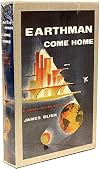
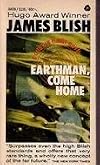
Earthman, Come Home
by James Blish
Cities in Flight: Publication order (1), Villes Nomades (Collections and Selections — 03), Cities in Flight: Chronological order (3)
On This Page
Tags
Recommendations








Member Reviews
In this, the third book in the Cities in Flight series—but the first one to be published—Mayor John Amalfi leads the city of Manhattan through several adventures.
Early on, we learn the fate of Chris, the main character from A Life for the Stars. I have to say that it was a disappointment. Considering what we learned here, Blish should've kept going with Chris's story until said fate occurred.
Anyway, Chris's replacement as City Manager is Mark Hazelton, but this story is strictly told from Amalfi's POV, which is a shame. Hazelton is much younger than Amalfi (by a few centuries) and hasn't grown too cynical to love or dream. It would've been more enjoyable had we got to read about Hazelton's experiences and motivations rather than show more have Amalfi explain them to Hazelton and us.
Despite the fact that we only get Amalfi's POV, we never truly get to know Amalfi. When he gets passionate about something (good or bad), it seems like it comes out of left field. Blish leaves the reader (and Hazelton) hopelessly in the dark on Amalifi's plans. It isn't until things are already in motion that we have any idea that Amalfi is prepared for the plot twists. Maybe if we were allowed to get in his head, Amalfi wouldn't have seemed like such a jerk at times.
Another thing that bothered me was the passage of time. Blish doesn't offer any clues that it's happening. He lays out the development of a project or the travels of a city but doesn't offer us any signposts. A year passes in the blink of an eye on a mining project when it seemed like it had just started. And decades can pass when the city travels from point A to point B, but there's no indication the journey took nearly that long.
Despite my grumblings, I did enjoy this story. The technological shortcomings (slide rule, Saturn's rings thought to be solid) were easy to overlook when compared to other ideas: AI, energy weapons, anti-agathics. The adventures were entertaining, and Blish put down the cultures that practiced misogyny and aggressive serfdom. For a story published in 1955, it's aged fairly well. I just wish the actual storytelling had been better.
3.5 stars rounded down to 3 because of Amalfi. show less
Early on, we learn the fate of Chris, the main character from A Life for the Stars. I have to say that it was a disappointment. Considering what we learned here, Blish should've kept going with Chris's story until said fate occurred.
Anyway, Chris's replacement as City Manager is Mark Hazelton, but this story is strictly told from Amalfi's POV, which is a shame. Hazelton is much younger than Amalfi (by a few centuries) and hasn't grown too cynical to love or dream. It would've been more enjoyable had we got to read about Hazelton's experiences and motivations rather than show more have Amalfi explain them to Hazelton and us.
Despite the fact that we only get Amalfi's POV, we never truly get to know Amalfi. When he gets passionate about something (good or bad), it seems like it comes out of left field. Blish leaves the reader (and Hazelton) hopelessly in the dark on Amalifi's plans. It isn't until things are already in motion that we have any idea that Amalfi is prepared for the plot twists. Maybe if we were allowed to get in his head, Amalfi wouldn't have seemed like such a jerk at times.
Another thing that bothered me was the passage of time. Blish doesn't offer any clues that it's happening. He lays out the development of a project or the travels of a city but doesn't offer us any signposts. A year passes in the blink of an eye on a mining project when it seemed like it had just started. And decades can pass when the city travels from point A to point B, but there's no indication the journey took nearly that long.
Despite my grumblings, I did enjoy this story. The technological shortcomings (slide rule, Saturn's rings thought to be solid) were easy to overlook when compared to other ideas: AI, energy weapons, anti-agathics. The adventures were entertaining, and Blish put down the cultures that practiced misogyny and aggressive serfdom. For a story published in 1955, it's aged fairly well. I just wish the actual storytelling had been better.
3.5 stars rounded down to 3 because of Amalfi. show less
I really don't quite know what to make of this book, now. 'Earthman come home' was, as far as I recollect, the fifth sf novel I ever read (don't worry, I don't list them all in the order of reading! It's just that the first five sf novels I read are fairly fixed in my memory for a number of reasons...). This means that I first read it at the age of about 13 and then re-read it fairly regularly up to the age of 21, since when I haven't picked it up at all - so that's at least 37 years that have gone by since I last looked at it, until I started a re-read of the whole 'Cities in flight' sequence earlier this year.
I found the first two novels uneven going, to say the least. I was relieved when I got onto this book, which I note was written show more the year before I was born. The odd thing was that I went straight back into the story, with the text proceeding as though I was re-acquainting myself with an old friend - but a friend whose motives I thought I understood once but now no longer do. The events of the book flowed past, with plot milestones passing by with great regularity. Yet it had exactly the same resonance as driving a familiar road;. no shocks, no surprises but no excitement either.
Along the way, I noticed odd things. The dialogue is very 1950s; the one major female character is sort of well-drawn for the time but plays the role of the newcomer to the Okie city who needs everything explained to her. I had completely missed the fact that a black character is introduced towards the end of the book, and he is moderately well done, although the plot requires him to play the role of stupid serf, though Amalfi, the main protagonist, knows that this is deliberate, so we might let the author off a bit there. (But what happened to New York's black population between 1956 and the distant future?) I still have the images I had of the main characters from my youth, but there were a lot of expository lumps (though not as bad as in the first volume of the series), and some surprisingly cyberpunkish dropping of trade names (although they are all future trade names and so mean nothing to us - Dinwiddie pickups and Bethé blasters). Amalfi seems to take a cavalier attitude to loss of life, whether it's his own citizens or others. And a lot of the plot seems to happen because Mayor Amalfi guesses lucky, or even just plucks the right answer out of thin air.
The technology is badly out of date, of course - one minute, we're talking about anti-gravity devices and instantaneous Dirac transmitters, the next Amalfi is putting down what sounds like a very 1950s Bakelite telephone whilst his navigators are picking up their slide rules. Yet there's a bidding session for a work contract that is done by video link which was very easy to visualise in 2015 terms, and by and large the obsolete tech didn't get in my way. And there is an AI, the 'City Fathers', though they are not so much a character as a plot device, as they only seem to advance information or advice when asked, although later on, when the Okies have mobilised the planet Hern VI, it turns out that the City Fathers are actually doing most of the flying, though this is not reflected elsewhere in the novel - they are not credited with running that much of the city's autonomous systems. Oddly, most of the rest of the Okie cities appear to have equivalent systems, but there is little penetration of computerised systems into everyday life.
There are humourous asides - the so-called 'Emperor of Space' who appears to have learnt his English from Liverpudlians is particularly smile-provoking - but what really surprised me was the extent of Blish's erudition on a range of subjects, from literature and history to economics and (some of the) science. My teenaged self must have done a lot of skimming in this novel, though I'm not conscious of that - or perhaps what I thought was super-science in the late 1960s/early 1970s was actually sound knowledge that I hadn't yet discovered.
So not too bad a brush with the Suck Fairy, that magical creature that touches all the things we loved in our youth and makes them awful when we pick them up again as adults. The invention makes up for many of the faults, and the style of the writing itself has no major infelicities. But I suspect I'll leave a further re-read for a good few years, because too much further exposure would most probably make things go seriously bad for me and this book. show less
I found the first two novels uneven going, to say the least. I was relieved when I got onto this book, which I note was written show more the year before I was born. The odd thing was that I went straight back into the story, with the text proceeding as though I was re-acquainting myself with an old friend - but a friend whose motives I thought I understood once but now no longer do. The events of the book flowed past, with plot milestones passing by with great regularity. Yet it had exactly the same resonance as driving a familiar road;. no shocks, no surprises but no excitement either.
Along the way, I noticed odd things. The dialogue is very 1950s; the one major female character is sort of well-drawn for the time but plays the role of the newcomer to the Okie city who needs everything explained to her. I had completely missed the fact that a black character is introduced towards the end of the book, and he is moderately well done, although the plot requires him to play the role of stupid serf, though Amalfi, the main protagonist, knows that this is deliberate, so we might let the author off a bit there. (But what happened to New York's black population between 1956 and the distant future?) I still have the images I had of the main characters from my youth, but there were a lot of expository lumps (though not as bad as in the first volume of the series), and some surprisingly cyberpunkish dropping of trade names (although they are all future trade names and so mean nothing to us - Dinwiddie pickups and Bethé blasters). Amalfi seems to take a cavalier attitude to loss of life, whether it's his own citizens or others. And a lot of the plot seems to happen because Mayor Amalfi guesses lucky, or even just plucks the right answer out of thin air.
The technology is badly out of date, of course - one minute, we're talking about anti-gravity devices and instantaneous Dirac transmitters, the next Amalfi is putting down what sounds like a very 1950s Bakelite telephone whilst his navigators are picking up their slide rules. Yet there's a bidding session for a work contract that is done by video link which was very easy to visualise in 2015 terms, and by and large the obsolete tech didn't get in my way. And there is an AI, the 'City Fathers', though they are not so much a character as a plot device, as they only seem to advance information or advice when asked, although later on, when the Okies have mobilised the planet Hern VI, it turns out that the City Fathers are actually doing most of the flying, though this is not reflected elsewhere in the novel - they are not credited with running that much of the city's autonomous systems. Oddly, most of the rest of the Okie cities appear to have equivalent systems, but there is little penetration of computerised systems into everyday life.
There are humourous asides - the so-called 'Emperor of Space' who appears to have learnt his English from Liverpudlians is particularly smile-provoking - but what really surprised me was the extent of Blish's erudition on a range of subjects, from literature and history to economics and (some of the) science. My teenaged self must have done a lot of skimming in this novel, though I'm not conscious of that - or perhaps what I thought was super-science in the late 1960s/early 1970s was actually sound knowledge that I hadn't yet discovered.
So not too bad a brush with the Suck Fairy, that magical creature that touches all the things we loved in our youth and makes them awful when we pick them up again as adults. The invention makes up for many of the faults, and the style of the writing itself has no major infelicities. But I suspect I'll leave a further re-read for a good few years, because too much further exposure would most probably make things go seriously bad for me and this book. show less
This third volume of the Cities in Flight series focuses on the Okie City New York, New York as it crosses the galaxy on a profiteering venture, seeking out employment wherever such may be found in order to find its fortune - or better yet, to find a home.
What a strange bird this is. As the first written in the series, I expected this progenitor to be a bit different than the preceding two. I wasn't ready for quite this large a difference in writing style or approach to story. The plot here is very episodic, a series of loosely interconnected adventures. Some of these stretch the boundaries of credibility, although it never comes entirely off the rails and the story always obeys its own rules. Many of the action sequences left me a bit show more lost as to what exactly was happening. Transitions seemed to be entirely missing in places, and scene breaks went entirely unmarked. I wasn't always sure whether it was a fault of the text or a fault in my attentiveness that kept throwing me off. Regardless, I stayed for the whole ride and found it satisfying, even if some of the bad scrapes the city found itself in were resolved a little too easily.
The story largely follows the city's mayor and his city manager. The mayor receives a sympathetic portrayal, and yet between the lines you'll see an odd disdain for the lives of his citizens that I couldn't quite reconcile with the rest of his character. Mr. Blish goes downhill in his portrayal of women over the course of this series. The first book featured a strong (though unattractive) female character. The second had no women at all. Here in the third, he drifts almost into Heinlein territory, I'm sorry to say, especially during one segment in particular on the planet "He".
This volume isn't the standout series highlight that I assumed it would be, but for entertainment quality it's at least on par. show less
What a strange bird this is. As the first written in the series, I expected this progenitor to be a bit different than the preceding two. I wasn't ready for quite this large a difference in writing style or approach to story. The plot here is very episodic, a series of loosely interconnected adventures. Some of these stretch the boundaries of credibility, although it never comes entirely off the rails and the story always obeys its own rules. Many of the action sequences left me a bit show more lost as to what exactly was happening. Transitions seemed to be entirely missing in places, and scene breaks went entirely unmarked. I wasn't always sure whether it was a fault of the text or a fault in my attentiveness that kept throwing me off. Regardless, I stayed for the whole ride and found it satisfying, even if some of the bad scrapes the city found itself in were resolved a little too easily.
The story largely follows the city's mayor and his city manager. The mayor receives a sympathetic portrayal, and yet between the lines you'll see an odd disdain for the lives of his citizens that I couldn't quite reconcile with the rest of his character. Mr. Blish goes downhill in his portrayal of women over the course of this series. The first book featured a strong (though unattractive) female character. The second had no women at all. Here in the third, he drifts almost into Heinlein territory, I'm sorry to say, especially during one segment in particular on the planet "He".
This volume isn't the standout series highlight that I assumed it would be, but for entertainment quality it's at least on par. show less
Did-not-finish. (Read to page 118.)
Usually, I'd give only one star to a did-not-finish, but there's nothing about this book that has aggravated me; I have no strong criticism. It just has failed to hold my interest. I started reading some Haruki Murakami short stories and can't bring myself to pick this back up.
I hadn't read any Blish in probably 25 years - since I was really into reading Star Trek novelizations. As far as I recall, his Star Trek books were OK - some of the first ones - but not the best ones, even back then.
I rather feel that when people criticize science fiction as a genre, they're talking about books like this (if they know what they're talking about.) It features lack of significant characterization, a plot that's a show more series of events rather than a dramatic structure, and a concentration on ideas rather than story. And they're some quite half-baked ideas too. Socially, it also feels extremely dated (as if everyone in the future is still living in an imaginary 1950's). I'd blame the time period - but I just read some Theodore Sturgeon, written around the same time period, and the guy doesn't fall victim to that trap in the slightest, so... yeah, this book just isn't very good.
The concept is that anti-gravity is invented, which causes cities (as a group) to lift themselves off the face of the earth and to function as mercenary spaceships-for hire. This means that the Mayor of New York (just Manhattan) is now essentially a spaceship captain. Interstellar travel and adventures ensue. Eh. show less
Usually, I'd give only one star to a did-not-finish, but there's nothing about this book that has aggravated me; I have no strong criticism. It just has failed to hold my interest. I started reading some Haruki Murakami short stories and can't bring myself to pick this back up.
I hadn't read any Blish in probably 25 years - since I was really into reading Star Trek novelizations. As far as I recall, his Star Trek books were OK - some of the first ones - but not the best ones, even back then.
I rather feel that when people criticize science fiction as a genre, they're talking about books like this (if they know what they're talking about.) It features lack of significant characterization, a plot that's a show more series of events rather than a dramatic structure, and a concentration on ideas rather than story. And they're some quite half-baked ideas too. Socially, it also feels extremely dated (as if everyone in the future is still living in an imaginary 1950's). I'd blame the time period - but I just read some Theodore Sturgeon, written around the same time period, and the guy doesn't fall victim to that trap in the slightest, so... yeah, this book just isn't very good.
The concept is that anti-gravity is invented, which causes cities (as a group) to lift themselves off the face of the earth and to function as mercenary spaceships-for hire. This means that the Mayor of New York (just Manhattan) is now essentially a spaceship captain. Interstellar travel and adventures ensue. Eh. show less
I'm gradually making my way through the Cities in Flight tetralogy, and just finished Earthman, Come Home (third in sequence, but first published, I believe), winner of the 2004 "retro-Hugo" for best novelette (since the whole thing is definitely novel length, I can only assume that this award went to the last of the four sections that make up the novel--the book certainly has the feel of a "fix-up" of previously published novelettes).
It tells a series of four only vaguely related stories about a nomadic space-going Manhattan that flits from star to star in a distant future, looking for work and trying to avoid entanglements with the cops. Frankly the stories all fell into the "moderately entertaining, but awfully dated and not even show more remotely thought-provoking" category. I didn't find Mayor Amalfi to be a particularly likable protagonist, and the Amalfi-Dee-Hazleton romantic triangle was far from convincing. Add to that lots of "surprises" that were not particularly surprising, and you have a fairly ho-hum read.
In many ways, it's hard to avoid a comparison to some of the not particularly compelling episodes from Star Trek, the Original Series. But, just as I will occasionally devote my time to watching exactly such episodes, I suppose I will move on fairly soon to the final book of this series. show less
It tells a series of four only vaguely related stories about a nomadic space-going Manhattan that flits from star to star in a distant future, looking for work and trying to avoid entanglements with the cops. Frankly the stories all fell into the "moderately entertaining, but awfully dated and not even show more remotely thought-provoking" category. I didn't find Mayor Amalfi to be a particularly likable protagonist, and the Amalfi-Dee-Hazleton romantic triangle was far from convincing. Add to that lots of "surprises" that were not particularly surprising, and you have a fairly ho-hum read.
In many ways, it's hard to avoid a comparison to some of the not particularly compelling episodes from Star Trek, the Original Series. But, just as I will occasionally devote my time to watching exactly such episodes, I suppose I will move on fairly soon to the final book of this series. show less
Another really good book. The book follows the "series of vignettes" style of the last book, but with more of a serialized tone instead of an episodic one.
There are a few things I'm wondering though, which might not be answered in future books - in particular, what City was Interstellar Master Traders supposed to be, exactly? Florence? Rome? Jerusalem? Goodness knows that last one would have some serious Unfortunate Implications if that was the case.
Also, the comments about New York's subways in the story also kind of makes me wonder - when New York lifted for the first time, was it just Manhattan Island? Did some of the other boroughs come along as well? Inquiring minds want to know?
There are a few things I'm wondering though, which might not be answered in future books - in particular, what City was Interstellar Master Traders supposed to be, exactly? Florence? Rome? Jerusalem? Goodness knows that last one would have some serious Unfortunate Implications if that was the case.
Also, the comments about New York's subways in the story also kind of makes me wonder - when New York lifted for the first time, was it just Manhattan Island? Did some of the other boroughs come along as well? Inquiring minds want to know?
Earthman, Come Home is the longest book in the Cities in Flight series, even so it is still a relatively spritely 266 pages making it a fairly quick read.
The story gains even more scale in this book with New York continuing it's adventures and travels through the universe, times get harder for them in this book and they're forced to make some tough decisions in some rather adverse conditions.
Certainly builds upon the foundations laid out in the earlier books of the series (although interestingly this was written first in 1955, the first in 1956 then the second in 1962 as a bridge between this and the first) and paints quite a vivid universe.
The story gains even more scale in this book with New York continuing it's adventures and travels through the universe, times get harder for them in this book and they're forced to make some tough decisions in some rather adverse conditions.
Certainly builds upon the foundations laid out in the earlier books of the series (although interestingly this was written first in 1955, the first in 1956 then the second in 1962 as a bridge between this and the first) and paints quite a vivid universe.
Members
- Recently Added By
Lists

Books Read in 2021
5,361 works; 114 members

Les 100 principaux titres de la science-fiction (1981)
126 works; 3 members
Author Information

267+ Works 24,424 Members
James Benjamin Blish was born on May 23, 1921 in East Orange, N.J. Blish trained as a biologist at Rutgers and Columbia University, and spent 1942 - 1944 as a medical technician in the United States Army. After the war he became the science editor for the Pfizer pharmaceutical company. His first published story appeared in 1940, and his writing show more career progressed until he gave up his job to become a professional writer. From 1962 to 1968, he worked for the Tobacco Institute. Between 1967 and his death from lung cancer in 1975, Blish wrote authorized short story collections based upon the 1960s TV series Star Trek. He wrote 11 volumes adapting episodes of the series. He died midway through writing Star Trek 12. Perhaps Blish's most famous works were the "Okies" stories, known collectively as Cities in Flight, published in the science-fiction digest magazine Astounding Science Fiction. Some of James Blish's other works include The Vanished Jet, And All the Stars a Stage, The Quincunx of Time, and Flight of Eagles. (Bowker Author Biography) show less
Some Editions
Series

Cities in Flight: Publication order
6 works (1)

Villes Nomades
1 works (Collections and Selections — 03)

Cities in Flight: Chronological order
6 works (3)
Belongs to Publisher Series
Work Relationships
Is contained in
Common Knowledge
- Canonical title*
- Stadt zwischen den Planeten
- Original title
- Earthman, Come Home
- Original publication date
- 1955
- People/Characters
- John Amalfi; Mark Hazleton
- Important places
- Okie Cities
- Dedication
- To John W. Campbell, Jr.
- First words
- Space flight got its start as a war weapon amid the collapse of the great Western culture of Earth.
- Last words
- (Click to show. Warning: May contain spoilers.)"Earth isn't a place. It's an idea."
- Original language*
- Englisch
- Disambiguation notice
- There are at least 3 versions of this story: a short story/novelette, a novel, and an abridged novel published by Avon (T-225) that does not have the chapters "Utopia" or "Gort".
*Some information comes from Common Knowledge in other languages. Click "Edit" for more information.
Classifications
Statistics
- Members
- 459
- Popularity
- 66,265
- Reviews
- 10
- Rating
- (3.42)
- Languages
- English, French, German, Portuguese
- Media
- Paper, Ebook
- ISBNs
- 5
- ASINs
- 29