On This Page
Description
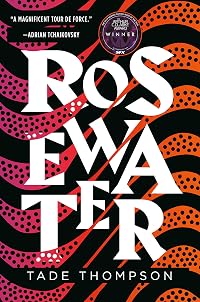
"Rosewater is a town on the edge. A community formed around the edges of a mysterious biodome, its residents comprise the hopeful, the hungry, and the helpless--people eager for a glimpse inside the dome or a taste of its rumored healing powers. Kaaro is a government agent with a criminal past. A sensitive, he can navigate the massive psychic space created by the dome. But when something within the dome begins killing other sensitives, Kaaro must defy his masters to avert a horrifying show more future."--Back cover. show lessTags
Recommendations






Member Recommendations
Member Reviews
I’d heard so much about this, and it was shortlisted for the BSFA Award this year (despite being originally published in 2016, but never mind), and it was 99p on Kindle… so I bought it. And I read it. And… There’s a good story in Rosewater, but it throws too much in, like a writer not sure which of their ideas have real merit so they chuck them all in hoping that at least one makes the grade… And because there’s so much going on, the story doesn’t seem to have much of a clue where it’s heading for much of its length. Is it about the titular city and the alien entity around which it has grown, and the regular frenzies of miracle healing it creates? Or perhaps it’s about Kaaro, who works for the Nigerian intelligence show more service (or a side-branch of it) and has telepathic powers – as do many others – also created by the alien entity? Or maybe it’s about Bicycle Girl, a semi-mythical figure who seems to be associated with a village that disappeared and now exists in an alternate dimension or pocket universe, created by entirely human tech? There is currently something of a feeding frenzy in sf about African genre fiction, which is all a bit white man’s tears as the various African nations – Africa is not a country – have literary traditions going back centuries or longer and many of them have had their best writers and works translated into English for decades. They just don’t happen to be category genre. So sf from a Nigerian writer – as Thompson is – should, were the genre not so overwhelmingly white- and Americo-centric, not really be cause for celebration. But sf is as it is, and Thompson’s origin and the setting of Rosewater play a major part in reviews of the book. That’s just as racist as ignoring the book because of the author’s race. There’s no doubt Thompson could be a major voice in UK sf – he’s based in London – and Rosewater amply demonstrates that. This is a strong debut, but it’s a messy piece of work to make an award shortlist. A few years from now, Thompson will be churning out award-worthy books. But that’s more a criticism of awards than it is the author. show less
"Rosewater" is a startlingly original piece of Science Fiction, set in Nigeria in 2066.
It's been a long time since I've encountered a powerful new voice in Science Fiction that combines new ideas with a distinctive storytelling style.
Tade Thompson takes a fresh look at the concept of alien invasion and how people in Nigeria would react to it.
His aliens are genuinely alien in how they think and behave. The concept of an alien-generated Xenosphere that enhances the ability of some humans in an almost supernatural way is original and intriguing. The society reacting to the aliens seems to be a plausible extrapolation of modern-day Nigeria.
Reading "Rosewater" reminded me of reading William Gibson's "Neuromancer" for the first time, way back show more in the nineteen-eighties: the excitement of finding and immersing myself in something so fresh it was overwhelming, something that subtly subverted traditional science fiction views on everything from what heroes do through to how people and technology interact; something which, while being innovative and strange seemed rooted in an understanding of how the world really works on a day to day basis.
Tade Thompson's Xenosphere is as revolutionary as Gibson's Cyberspace. His hero is not a hero at, just a man trying to stay alive and make sense of his gifts. His world is venal, violent and vigorous. It's a wonderful mix.
The non-linear storytelling moves effortlessly back and forth along the timeline, carrying current events forward at a pace while slowly revealing the past that shaped the main character.
Much of the strength of the book comes from the main character, an uneducated man, with a violent past, slowly losing his taste for the fleshly pleasures that drove his younger self, he has a distinctive thinking style, at once reflective and pragmatic. Here's an example of how he describes suddenly becoming aware that he knows something:
It is a certainty, not just a conviction, the way believing in God is a conviction, but believing in gravity is a certainty .
This is a book that is packed with ideas and violence in almost equal measure. It's about realism and struggle rather than optimism and escape.
I think Tade Thompson is a talent to watch in SF in general and in the current wave of Future Africa Fiction in particular. I'll be checking out the rest of his work.
Here's an interview with him in Interview in Short Story Day Africa show less
It's been a long time since I've encountered a powerful new voice in Science Fiction that combines new ideas with a distinctive storytelling style.
Tade Thompson takes a fresh look at the concept of alien invasion and how people in Nigeria would react to it.
His aliens are genuinely alien in how they think and behave. The concept of an alien-generated Xenosphere that enhances the ability of some humans in an almost supernatural way is original and intriguing. The society reacting to the aliens seems to be a plausible extrapolation of modern-day Nigeria.
Reading "Rosewater" reminded me of reading William Gibson's "Neuromancer" for the first time, way back show more in the nineteen-eighties: the excitement of finding and immersing myself in something so fresh it was overwhelming, something that subtly subverted traditional science fiction views on everything from what heroes do through to how people and technology interact; something which, while being innovative and strange seemed rooted in an understanding of how the world really works on a day to day basis.
Tade Thompson's Xenosphere is as revolutionary as Gibson's Cyberspace. His hero is not a hero at, just a man trying to stay alive and make sense of his gifts. His world is venal, violent and vigorous. It's a wonderful mix.
The non-linear storytelling moves effortlessly back and forth along the timeline, carrying current events forward at a pace while slowly revealing the past that shaped the main character.
Much of the strength of the book comes from the main character, an uneducated man, with a violent past, slowly losing his taste for the fleshly pleasures that drove his younger self, he has a distinctive thinking style, at once reflective and pragmatic. Here's an example of how he describes suddenly becoming aware that he knows something:
It is a certainty, not just a conviction, the way believing in God is a conviction, but believing in gravity is a certainty .
This is a book that is packed with ideas and violence in almost equal measure. It's about realism and struggle rather than optimism and escape.
I think Tade Thompson is a talent to watch in SF in general and in the current wave of Future Africa Fiction in particular. I'll be checking out the rest of his work.
Here's an interview with him in Interview in Short Story Day Africa show less
Tade Thompson’s novel gripped me from the first page. He painted the environment so well - this bustling metropolis that had sprung up around the alien biodome, that people had so quickly accepted as normal, seemed completely real. Kaaro is such an intriguing character - and unreliable narrator who is aware of his own flaws, but still not as clever as he thinks he is.
Like if Octavia Butler wrote Neuromancer. An absolutely amazing, gonzo, bleakly hilarious, alienating, gritty, and horrifying take on both the alien invasion and cyberpunk genres that desperately needed the updates. It was also just damn satisfying to read a cyberpunk novel that defocuses Western and Asian cultural inspiration. Thompson worked himself to the bone to invigorate this novel with his native culture of Nigeria, and any good reader could tell.
I really enjoyed this one. The somewhat clinical, almost simplistic narration style of the main character Kaaro, almost belies the reader into thinking it is a simple story, but it is not. It is a rich, layered story, with much symbolism that will take another reading to unpack. This story is not told linearly, and there are multiple storylines being told concurrently, and I usually hate that, but the reason I hate it is that it feels lazy or like a cheap trick to pad a story, but here it is done masterfully. I think one problem readers may have with this book is that the main character and narrator, Kaaro, is not all that likable, he's a but unreliable, and he can be sexist. I found it interesting that the author chose to present the show more first part of this story from Kaaro's perspective, with all of his faults. But it works for the story, as an introduction to the main conflict, from a source who is a bit detached from it. He wants to take an outsider's approach, and isn't motivated by higher ideals. In his youth, Kaaro was a thief, and as he develops abilities, his thievery transforms from the physical, to the mental, where he can steal a person's privacy by reading their minds and inner thoughts. He finds missing things, but doesn't fully understand how his abilities work, or know what he's capable of if he applied himself.
The near-future Nigerian setting is very interesting and worked very well for the story. The overarching story took a bit of time to reveal itself, but all of the tidbits and details in the lead-up were enough to keep me interested. I would read this again and I will continue the series because despite Kaaro not being a "save-the-world" type of person, I want to see how this conflict is going to play out. show less
The near-future Nigerian setting is very interesting and worked very well for the story. The overarching story took a bit of time to reveal itself, but all of the tidbits and details in the lead-up were enough to keep me interested. I would read this again and I will continue the series because despite Kaaro not being a "save-the-world" type of person, I want to see how this conflict is going to play out. show less
I read speculative fiction in the undying hope that something will come along and surprise and make me find a new perspective on the world. It doesn't happen often, but it's electric every time. Rosewater is that book - I loved everything about this new take on alien encounters, psychics and oppressive governments. It's clear that Dr. Thompson has a firm grounding in science (he's a psychiatrist), with decently well-thought out explanations for how alien physiology works and impacts human cognition in this world. The sociology of the aliens and their motivations are...alien -- distinct from other first encounter books I've read, and I enjoyed the futuristic Nigerian setting. If I had a complaint (and I always do), I would say many of show more the sex scenes are gratuitous and a little uncomfortable, but that was a minor annoyance. I liked the time-skipping back and forth as each time jump revealed a little bit more of the global setting and Kaaro's backstory and motivations (the perspective shifting is also something I've encountered from a number of Nigerian writers show less
Rosewater offers a fresh perspective on the alien contact sub-genre. It takes place in Nigeria with a cast of characters who are locals. America has gone dark, and no one knows why. The remaining world powers keep their distance, though at least one would like to learn more about the alien biodome. But they're on the periphery at best. Instead, it's the Nigerian government that has a vested interest in this strange visitor that appears to be both benevolent and threatening.
The story is completely told from Kaaro's POV. He's a sensitive, someone who can read minds thanks to the xenosphere, an effect created by microbes and spores emanating from the biodome. There are a couple of timelines that the narrative switches back and forth from, show more and one of them involves Kaaro's youth when he stumbled upon his abilities. It turned him into a thief. We learn how he honed his abilities, his recruitment into a government spy agency (S45), and his day job in xeno-security where he defends a bank from criminals who use their sensitivity to hack bank accounts.
I usually don't enjoy stories involving any super-mental capabilities (telepathy, telekinesis, teleportation, etc.), but the way Thompson establishes how sensitives work with the xenosphere, the limitations placed on it, and countermeasures, it was something that I could get behind.
Kaaro is not without his flaws. In the oldest timeline, we endure his thieving. During the recruitment process, he's a coward and a womanizer. In the "current" timeline, he's a jaded, dour man in his 40s. We root for the younger Kaaro to grow up and the older Kaaro to stop being so cynical. Thompson does a great job with Kaaro's evolution, though I wanted one timeline to resolve itself before going to the next. But the way Thompson has the story structured, waiting for the big reveals turns out to be the best move.
I look forward to reading the rest of the series. show less
The story is completely told from Kaaro's POV. He's a sensitive, someone who can read minds thanks to the xenosphere, an effect created by microbes and spores emanating from the biodome. There are a couple of timelines that the narrative switches back and forth from, show more and one of them involves Kaaro's youth when he stumbled upon his abilities. It turned him into a thief. We learn how he honed his abilities, his recruitment into a government spy agency (S45), and his day job in xeno-security where he defends a bank from criminals who use their sensitivity to hack bank accounts.
I usually don't enjoy stories involving any super-mental capabilities (telepathy, telekinesis, teleportation, etc.), but the way Thompson establishes how sensitives work with the xenosphere, the limitations placed on it, and countermeasures, it was something that I could get behind.
Kaaro is not without his flaws. In the oldest timeline, we endure his thieving. During the recruitment process, he's a coward and a womanizer. In the "current" timeline, he's a jaded, dour man in his 40s. We root for the younger Kaaro to grow up and the older Kaaro to stop being so cynical. Thompson does a great job with Kaaro's evolution, though I wanted one timeline to resolve itself before going to the next. But the way Thompson has the story structured, waiting for the big reveals turns out to be the best move.
I look forward to reading the rest of the series. show less
Members
- Recently Added By
Lists

NPR Summer 2021: 50 Favorite Sci-Fi And Fantasy Books Of The Past Decade
50 works; 8 members

Must-Read Books by Black Authors
114 works; 92 members

Top Five Books of 2020
982 works; 350 members

Recommended Speculative Fiction by Women and People of Color
298 works; 45 members

2017 Hugo Eligible Novels
145 works; 14 members

Amazon best fictional genre picks monthly for 2018
418 works; 9 members

Speculative Fiction from around the World
610 works; 18 members

Arthur C. Clarke Award Winners and Shortlisted Books
219 works; 14 members

Books With Water Words in the Title
186 works; 12 members

Books Read in 2022
5,226 works; 115 members

At the Library
217 works; 1 member

Book Club: There aren’t any [Blank] authors in Sci Fi/Fantasy!
12 works; 1 member
Author Information

28+ Works 3,348 Members
Some Editions
Awards and Honors
Awards
Distinctions
Series

Common Knowledge
- Canonical title
- Rosewater
- Original publication date
- 2016; 2018 (UK) (UK)
- People/Characters
- Kaaro; Aminat
- Important places
- Nigeria; Rosewater, Nigeria
- Dedication
- For David; welcome home
- First words
- I'm at the Integrity Bank job for forty minutes before the anxieties kick in.
- Last words
- (Click to show. Warning: May contain spoilers.)For this we will all have front row seats.
- Publisher's editor
- Hill, Jenni; Guan, Sarah
- Blurbers
- Elliott, Kate; Tchaikovsky, Adrian
- Original language
- English
- Canonical DDC/MDS
- 823.92
- Canonical LCC
- PR6120.H6653
Classifications
Statistics
- Members
- 1,517
- Popularity
- 15,293
- Reviews
- 72
- Rating
- (3.75)
- Languages
- English, French, German, Spanish
- Media
- Paper, Audiobook, Ebook
- ISBNs
- 20
- ASINs
- 8
