
On This Page
Description
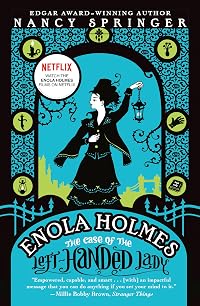
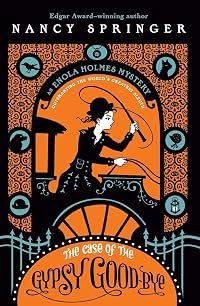
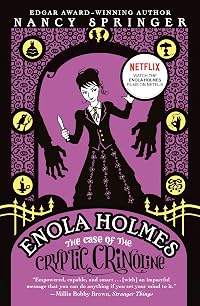
Pursued by her much older brother, famed detective Sherlock Holmes, fourteen-year-old Enola, disguised and using false names, attempts to solve the kidnapping of a baronet's sixteen-year-old daughter in nineteenth-century London.Tags
Recommendations






















Member Reviews
Enola Holmes, younger sister of Mycroft and Sherlock, has holed up in London with money left her by her mother. Enola was raised by her mother to be independent (as you might expect from somebody with a name that spells “alone” backward), and she creates a secret identity through which she can solve crimes. Her first case is the disappearance of Lady Cecily Alistair, who is believed to have eloped. But did she, or did something worse happen? And while Enola tries to solve this case, her brothers are on her own case…
I enjoyed this very much. It was full of action, tension, and atmosphere. The portrayal of Holmes was sympathetic, and I liked seeing Dr. Watson and Mrs. Hudson. The storyline is probably predictable for adult readers, show more but this adult had a lot of fun following Enola on her adventures and has already requested the third book in the series. They make good escapist reads, especially necessary at the moment (January 2021). show less
I enjoyed this very much. It was full of action, tension, and atmosphere. The portrayal of Holmes was sympathetic, and I liked seeing Dr. Watson and Mrs. Hudson. The storyline is probably predictable for adult readers, show more but this adult had a lot of fun following Enola on her adventures and has already requested the third book in the series. They make good escapist reads, especially necessary at the moment (January 2021). show less
'The Case Of The Left-Handed Lady', the second Enola Holmes book, was as much fun as the first book, 'The Case Of The Missing Marquess' and had a few surprises along the way.
The mystery at the heart of the story was improbable in a very Sherlock Holmes sort of way. It made full use of the threatening streets of London's East End, was driven by an evil genius, required more than one party to wear a disguise and drew some of its menace from popular 'dark' topics of the time: anarchism and mesmerism. I enjoyed the imagery and was carried through the plot by Enola's passion for finding out what was going on.
As in the first book, Enola is the main source of energy in the book. I like her drive, her independence and her bravery but it's show more her loneliness and her anxieties and her anger that make her more than a plot device.
The main surprise in the book was in the way Nancy Springer presented Victorian England. In many books, particularly cosy mysteries written by American authors, Victorian London is sanitised. Yes, it's a dark and dangerous place but in a theme park, soft focus sort of way that doesn't match the social and economic realities of the time. Nancy Springer doesn't do that. She confronts Enola Holmes with the reality of the repressive nature of the class system, the consequences of dire poverty, the suppression of protest and the ubiquity of misogyny.
I liked the way that these themes were filtered through Enola's eyes. She has no difficulty seeing the misogyny. She was raised by a mother who was a committed suffragist and strongly independent. She's also willing to play a spooky version of Lady Bountiful, walking through the nighttime streets of the East End in winter, doing what she can to prevent people from dying of cold or hunger. Yet, when she listens to a talented orator rousing the workers to anger about their inability to control the hours that they work or what they get paid and use of the police to bludgeon them into submission when they march in protest, she remains true to her class and dismisses the complaints as nonsense.
I'm hooked on this series now, so I went looking for the rest of the books and found that Audible has included a number of them in my membership, which means I could download them for free. They're narrated by Katherine Kellgren, who narrated the 'Her Royal Spyness' series. show less
The mystery at the heart of the story was improbable in a very Sherlock Holmes sort of way. It made full use of the threatening streets of London's East End, was driven by an evil genius, required more than one party to wear a disguise and drew some of its menace from popular 'dark' topics of the time: anarchism and mesmerism. I enjoyed the imagery and was carried through the plot by Enola's passion for finding out what was going on.
As in the first book, Enola is the main source of energy in the book. I like her drive, her independence and her bravery but it's show more her loneliness and her anxieties and her anger that make her more than a plot device.
The main surprise in the book was in the way Nancy Springer presented Victorian England. In many books, particularly cosy mysteries written by American authors, Victorian London is sanitised. Yes, it's a dark and dangerous place but in a theme park, soft focus sort of way that doesn't match the social and economic realities of the time. Nancy Springer doesn't do that. She confronts Enola Holmes with the reality of the repressive nature of the class system, the consequences of dire poverty, the suppression of protest and the ubiquity of misogyny.
I liked the way that these themes were filtered through Enola's eyes. She has no difficulty seeing the misogyny. She was raised by a mother who was a committed suffragist and strongly independent. She's also willing to play a spooky version of Lady Bountiful, walking through the nighttime streets of the East End in winter, doing what she can to prevent people from dying of cold or hunger. Yet, when she listens to a talented orator rousing the workers to anger about their inability to control the hours that they work or what they get paid and use of the police to bludgeon them into submission when they march in protest, she remains true to her class and dismisses the complaints as nonsense.
I'm hooked on this series now, so I went looking for the rest of the books and found that Audible has included a number of them in my membership, which means I could download them for free. They're narrated by Katherine Kellgren, who narrated the 'Her Royal Spyness' series. show less
Reread (again), 2025, still 5 stars. Still I will never watch the series because a) I love the books too much and don't want to alter my perception of them in any way, and b) I cannot accept Henry Cavill as Sherlock Holmes.
---------------------------------------
2021 - I am so glad the upcoming (or current?) Netflix series reminded me of these books. I never know if I can trust my own years-ago opinions, or even my opinions from two days ago, so I am very pleased to report that I love this series even more than I did upon first reading it. It's fun to read about the stern, serious, and somewhat misogynistic Sherlock from the perspective of his much younger but equally brilliant sister. I hope the television series lives up to the books. show more
In this entry Enola, like her mother, wants nothing more than the freedom to do as she chooses in life (a freedom denied to women in Victorian England, legally and otherwise). What I love about her the most is how she takes the ridiculous limits placed on females, and uses them to her full advantage. She's still wearing her bust enhancer stuffed with cash, for instance, and her loosely tied corset houses a dagger. She outsmarts Sherlock at every turn, but never in a way that contradicts his reputation as the most distinguished and astute detective of his time. And her observations, about herself and others, are spot-on and often quite funny.
Long story short, I love this series and wish it were longer than 6 fairly slim books. show less
---------------------------------------
2021 - I am so glad the upcoming (or current?) Netflix series reminded me of these books. I never know if I can trust my own years-ago opinions, or even my opinions from two days ago, so I am very pleased to report that I love this series even more than I did upon first reading it. It's fun to read about the stern, serious, and somewhat misogynistic Sherlock from the perspective of his much younger but equally brilliant sister. I hope the television series lives up to the books. show more
In this entry Enola, like her mother, wants nothing more than the freedom to do as she chooses in life (a freedom denied to women in Victorian England, legally and otherwise). What I love about her the most is how she takes the ridiculous limits placed on females, and uses them to her full advantage. She's still wearing her bust enhancer stuffed with cash, for instance, and her loosely tied corset houses a dagger. She outsmarts Sherlock at every turn, but never in a way that contradicts his reputation as the most distinguished and astute detective of his time. And her observations, about herself and others, are spot-on and often quite funny.
Long story short, I love this series and wish it were longer than 6 fairly slim books. show less
Not for the East End were the carriage lamps and flambeaux of the well-to-do, nor the brand-new electric features of the very rich. Here, the feeble and wavering lights floated, or rather drowned, in a sea of brown smut; London crouched frigid in its own peculiar, choking way. Here, midnight's chill was made of chimney soot, coal fumes, wood smoke, and dank disease wafting up from the Thames; it was as if one swam in a fog colder than ice yet never frozen, forever soaking through one's clothing and into one's bones.
This second Enola Holmes mystery is extremely solid! While the first novel established characters, this book really delves into the setting (London in 1889), tying in differences in classes and areas of London, Marxist and show more anarchist influences, etc. The historical detail is impressive, especially how smoothly Ms Springer incorporates it into the plot.
And what a plot! Posing as the secretary to the elusive (and indeed fictitious) Dr. Leslie T. Ragostin, Scientific Perditorian (finder of lost things), Enola learns about a lost teenage girl (Lady Cecily), who she becomes determined to find, especially as she discovers details about the titular left-handed lady that make her think they could be kindred spirits. Her investigation will place her in danger -- both on the crime-ridden streets of London and of being found by her persistent and clever brother, Sherlock. show less
This second Enola Holmes mystery is extremely solid! While the first novel established characters, this book really delves into the setting (London in 1889), tying in differences in classes and areas of London, Marxist and show more anarchist influences, etc. The historical detail is impressive, especially how smoothly Ms Springer incorporates it into the plot.
And what a plot! Posing as the secretary to the elusive (and indeed fictitious) Dr. Leslie T. Ragostin, Scientific Perditorian (finder of lost things), Enola learns about a lost teenage girl (Lady Cecily), who she becomes determined to find, especially as she discovers details about the titular left-handed lady that make her think they could be kindred spirits. Her investigation will place her in danger -- both on the crime-ridden streets of London and of being found by her persistent and clever brother, Sherlock. show less
I read this entirely because, after my first two books of the year were unexpected gut punches, I figured this one would be a good palate cleanser. And it was. Enola and Sherlock continue their battle of wits and Enola tries to find her feet in the investigation business.
I just deeply, deeply wish this book's mystery didn't rest on weird pseudoscience of several different brands. It took away from an otherwise engaging plot, and made me sideeye several of the author's choices.
Otherwise: a fun book doing some very interesting stuff with the status and rights of women and poor people in the period.
I just deeply, deeply wish this book's mystery didn't rest on weird pseudoscience of several different brands. It took away from an otherwise engaging plot, and made me sideeye several of the author's choices.
Otherwise: a fun book doing some very interesting stuff with the status and rights of women and poor people in the period.
Really enjoying this series - this is the second and as good as the first. Sherlock Holmes' much younger sister, 14-year old Enola Holmes, has left home without a trace, trying to locate her mother, who has also disappeared. With financial help from her missing mother she has set up a business in London as a "scientific perditorian," which is a finder of things and people. Using costumes and disguises, she is able to elude her brother's efforts to find her while at the same time trying to locate the missing Lady Cecily, another young woman who Enola believes feels the same as she does about women's rights, freedom, and independence. The book skillfully incorporates the dank and despairing atmosphere of late 1800's London, with the show more customs of class and culture of the time. The story includes action, suspense, and a good chase scene. I enjoyed her meeting up with Dr. Watson as well as Sherlock Holmes - Enola is as clever as her brother. Looking forward to the next book! show less
Enola is still in London, and has thus far still managed to stay free of her brothers and the restrictions they'd impose upon her. Granted, only Sherlock is looking for her very hard.
Enola now cycles between three different identities: Ivy Meshle, the secretary of the fictitious Dr. Ragostin, who supposedly specializes in finding missing people; Mrs. Ragostin, the naive child-bride of Dr. Ragostin; and the "Sister of the Streets," a mute nun who walks the poorest parts of London at night, giving out blankets, food, and occasional coins. An encounter with Dr. Watson reveals that Sherlock knows more about her current situation than she expected, so she attempts to contact her mother for advice and tries to find out what else Sherlock show more might know. In addition, she investigates a case that Sherlock rejected, the disappearance of Lady Cecily, daughter of Sir Eustace Alistair.
Despite what the title says, the true focus of this book wasn't really the mystery of Lady Cecily's disappearance. Instead, far more of the book was devoted to detailing Enola's disguises and other efforts to stay out of her brothers' grasps, as well as her yearning for familial affection she couldn't have. In the end, the mystery aspect felt more like a bit of background color, something to add action and danger to the last few chapters.
This was quick and easy to read, just what I needed after a very terrible last few days. Enola's various disguises were reasonably well thought out and interesting, and Enola continues to be a relatively believable intelligent but young and occasionally naive girl. I wasn't expecting the mystery itself to take up so little of the narrative, however, and Springer's Sherlock continues to be a bit of a disappointment. Enola has now, in disguise, crossed paths with Sherlock at least twice since running away, Sherlock was able todecipher at least some of Enola's messages to her mother (but not the easiest ones, for some reason?) , and yet he still couldn't track her down. I understand that Enola needs to be smart enough to evade him so that she can stay free and the series can continue, but the solution to that shouldn't be to make Sherlock an idiot.
I suspect I'll continue this series - the books are quick reads, and I like Enola and want to see how her family situation works out. Springer's Sherlock at least works well for me as a character, if not as a character I'm supposed to believe is the Sherlock Holmes. I do wonder if the mystery aspect will ever get stronger, though.
(Original review posted on A Library Girl's Familiar Diversions.) show less
Enola now cycles between three different identities: Ivy Meshle, the secretary of the fictitious Dr. Ragostin, who supposedly specializes in finding missing people; Mrs. Ragostin, the naive child-bride of Dr. Ragostin; and the "Sister of the Streets," a mute nun who walks the poorest parts of London at night, giving out blankets, food, and occasional coins. An encounter with Dr. Watson reveals that Sherlock knows more about her current situation than she expected, so she attempts to contact her mother for advice and tries to find out what else Sherlock show more might know. In addition, she investigates a case that Sherlock rejected, the disappearance of Lady Cecily, daughter of Sir Eustace Alistair.
Despite what the title says, the true focus of this book wasn't really the mystery of Lady Cecily's disappearance. Instead, far more of the book was devoted to detailing Enola's disguises and other efforts to stay out of her brothers' grasps, as well as her yearning for familial affection she couldn't have. In the end, the mystery aspect felt more like a bit of background color, something to add action and danger to the last few chapters.
This was quick and easy to read, just what I needed after a very terrible last few days. Enola's various disguises were reasonably well thought out and interesting, and Enola continues to be a relatively believable intelligent but young and occasionally naive girl. I wasn't expecting the mystery itself to take up so little of the narrative, however, and Springer's Sherlock continues to be a bit of a disappointment. Enola has now, in disguise, crossed paths with Sherlock at least twice since running away, Sherlock was able to
I suspect I'll continue this series - the books are quick reads, and I like Enola and want to see how her family situation works out. Springer's Sherlock at least works well for me as a character, if not as a character I'm supposed to believe is the Sherlock Holmes. I do wonder if the mystery aspect will ever get stronger, though.
(Original review posted on A Library Girl's Familiar Diversions.) show less
Members
- Recently Added By
Lists

Books Read in 2021
5,361 works; 114 members

Books Read in 2015
3,299 works; 129 members
Author Information

120+ Works 14,511 Members
Nancy Springer was born in Montclair, New Jersey on July 5, 1948. She received a degree in English literature from Gettysburg College in 1970. She has written about 40 books for children, young adults, and adults including the Sea King Trilogy, the Tales of Rowan Hood series, the Book of Isle Trilogy, and the Enola Holmes Mystery series. She has show more won numerous awards including the James Tiptree, Jr. Award, the Joan Fassler Memorial Book Award, and two Edgar Allen Poe Awards. (Bowker Author Biography) show less
Some Editions
Awards and Honors
Series

Work Relationships
Is contained in
Has the adaptation
Common Knowledge
- Canonical title
- The Case of the Left-Handed Lady
- Original publication date
- 2007-01-18
- People/Characters
- Enola Holmes (and assorted disguises, incl: Miss Ivy Meshle, Dr. Ragostin, Dr. Leslie T. Ragostin, Sister of the Streets); Sherlock Holmes; Lady Cecily Alistair; Mr. Alexander Finch (masquerades as Cameron Shaw); John H. Watson (M.D.); Mycroft Holmes (show all 15); Joddy; Mrs. Tupper; Mrs. Bailey; Mrs. Fitzsimmons; Sir Eustace Alistair; Lady Theodora Alistair; Lily; Mr. Ebenezer Finch; Mrs. Hudson
- Important places
- London, England, UK
- Dedication
- For my mother
- First words
- "We would not be in this deplorable situation," declares the younger and taller of the two men in the small club-room, "if you had not tried to bully her into boarding school!"
- Last words
- (Click to show. Warning: May contain spoilers.)Because she will attend to it.
- Original language
- English
Classifications
Statistics
- Members
- 1,225
- Popularity
- 20,159
- Reviews
- 44
- Rating
- (4.00)
- Languages
- 8 — Catalan, English, French, German, Italian, Korean, Polish, Spanish
- Media
- Paper, Audiobook, Ebook
- ISBNs
- 41
- ASINs
- 11