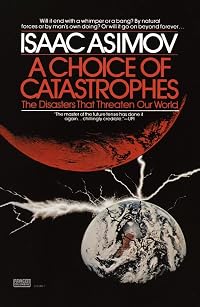
A Choice of Catastrophes: The Disasters That Threaten Our World
by Isaac Asimov
On This Page
Description
The author examines various kinds of potential disasters that threaten the existence of life on Earth, including changes in the sun or other parts of the universe, man-made destruction, and changes within the Earth itself.Tags
Recommendations


















Member Reviews
Despite the title of this book and Asimov’s guide through the possible disasters that could lead to the extinction of human life he remains optimistic and upbeat. He concludes:
“There is nothing that that threatens us with imminent destruction in such a fashion that we are helpless to do something about it. If we behave rationally and humanely, rather than emotionally on such nineteenth century matters as national security and local pride; if we recognise that it is not one’s neighbour who are the enemy, but misery, ignorance, and cold indifference of natural law - then we can solve all the problems that face us. We can deliberately choose to have no catastrophes at all.
And if we do that over the next century we can spread into show more space and lose our vulnerabilities”
A Choice of Catastrophes was first published in 1979 and has not been updated. It reads at times like a basic primer in the fundamentals of science that holds the universe together and so we are treated to the laws of thermodynamics, gravity and the causes of natural disasters. These are used to back up Asimov’s ideas of how it all works, some of this I had to take on trust because of my limited ability to cope with basic science, however it is written with the average science fiction reader in mind and it would appeal to those readers who want some basic science as a background to their reading. Popular science written by a science fiction author.
Asimov ranks his catastrophes into five classes: starting with the truly cosmic idea of the destruction of the universes. Asimov is a believer in the expanding contracting universe theory, but as the contraction stage will not happen for trillions of years in the future there is no need for us to worry. The second class is a more local cosmic catastrophe that could render our solar system inhabitable; black holes, the death of our sun are explained, again with some basic science to underpin the theories. The third class is the misadventures of the earth itself, for example; the bombardment of extraterrestrial objects, the slowing of the earth, removal of magnetism and changes in climatic conditions. The fourth class is dangers that threaten humanity specifically, although general life would continue: competition with other life forms on earth, and conflicts of intelligence with other species make up this section. The fifth class is man’s capacity to engineer his own destruction.
Asimov introduces his ideas with some brief history of scientific theories before bringing his readers up to date with the latest ideas (that is 1970’s). His method of working is to set up possible catastrophic interventions and then to estimate their risks. This can feel a little repetitive and Asimov is not the most concise of authors when dealing with fact rather than fiction and he does stray at times into over optimistic ideas of mans capacity to expand in the universe. However I found his fifth class of possible catastrophes the most interesting as he briefly covers computerisation, education and the depletion of resources. I learnt a few things, checked up on others (google) and so the book held my interest and so 3.5 stars. show less
“There is nothing that that threatens us with imminent destruction in such a fashion that we are helpless to do something about it. If we behave rationally and humanely, rather than emotionally on such nineteenth century matters as national security and local pride; if we recognise that it is not one’s neighbour who are the enemy, but misery, ignorance, and cold indifference of natural law - then we can solve all the problems that face us. We can deliberately choose to have no catastrophes at all.
And if we do that over the next century we can spread into show more space and lose our vulnerabilities”
A Choice of Catastrophes was first published in 1979 and has not been updated. It reads at times like a basic primer in the fundamentals of science that holds the universe together and so we are treated to the laws of thermodynamics, gravity and the causes of natural disasters. These are used to back up Asimov’s ideas of how it all works, some of this I had to take on trust because of my limited ability to cope with basic science, however it is written with the average science fiction reader in mind and it would appeal to those readers who want some basic science as a background to their reading. Popular science written by a science fiction author.
Asimov ranks his catastrophes into five classes: starting with the truly cosmic idea of the destruction of the universes. Asimov is a believer in the expanding contracting universe theory, but as the contraction stage will not happen for trillions of years in the future there is no need for us to worry. The second class is a more local cosmic catastrophe that could render our solar system inhabitable; black holes, the death of our sun are explained, again with some basic science to underpin the theories. The third class is the misadventures of the earth itself, for example; the bombardment of extraterrestrial objects, the slowing of the earth, removal of magnetism and changes in climatic conditions. The fourth class is dangers that threaten humanity specifically, although general life would continue: competition with other life forms on earth, and conflicts of intelligence with other species make up this section. The fifth class is man’s capacity to engineer his own destruction.
Asimov introduces his ideas with some brief history of scientific theories before bringing his readers up to date with the latest ideas (that is 1970’s). His method of working is to set up possible catastrophic interventions and then to estimate their risks. This can feel a little repetitive and Asimov is not the most concise of authors when dealing with fact rather than fiction and he does stray at times into over optimistic ideas of mans capacity to expand in the universe. However I found his fifth class of possible catastrophes the most interesting as he briefly covers computerisation, education and the depletion of resources. I learnt a few things, checked up on others (google) and so the book held my interest and so 3.5 stars. show less
Avl. free to borrow on openlibrary.org.
I don't care so much about the first class of catastrophes, but the ones that an SF writer might use as inspiration are interesting. Starting at about p. 110 (of 377) I therefore am closely skimming some of the sections, instead of basically just paging through.
I do appreciate that Asimov does express "we don't know" often enough. One reason that's good is simply because 'doing science' is active, there are no 100% final answers. The other reason is that it means that the book is not outdated. Any time a reader sees Asimov explain something incompletely, or has a question, s/he can use other resources to update or clarify, yes. But meanwhile, this is a good introduction to a lot of ideas.
In fact, show more even though it's not worth a careful read, it's def. worth a careful skim for the fascinating way the man predicted so much of what is going on now. Climate change, the graying of the population, plague, Google, ennui, genetic engineering and varieties of intelligence, etc. etc. If only more leaders and influencers had read this and taken action based on his theories!
I liked the afterword, in which he exhorts us to choose *none* of the catastrophes.
There is also an extensive index, so you can choose the topics that most interest you, as you read a sample to decide if you want more.
Now, the only thing that would be better, for me, if it were a themed short story anthology, instead.... ;) show less
I don't care so much about the first class of catastrophes, but the ones that an SF writer might use as inspiration are interesting. Starting at about p. 110 (of 377) I therefore am closely skimming some of the sections, instead of basically just paging through.
I do appreciate that Asimov does express "we don't know" often enough. One reason that's good is simply because 'doing science' is active, there are no 100% final answers. The other reason is that it means that the book is not outdated. Any time a reader sees Asimov explain something incompletely, or has a question, s/he can use other resources to update or clarify, yes. But meanwhile, this is a good introduction to a lot of ideas.
In fact, show more even though it's not worth a careful read, it's def. worth a careful skim for the fascinating way the man predicted so much of what is going on now. Climate change, the graying of the population, plague, Google, ennui, genetic engineering and varieties of intelligence, etc. etc. If only more leaders and influencers had read this and taken action based on his theories!
I liked the afterword, in which he exhorts us to choose *none* of the catastrophes.
There is also an extensive index, so you can choose the topics that most interest you, as you read a sample to decide if you want more.
Now, the only thing that would be better, for me, if it were a themed short story anthology, instead.... ;) show less
Reading a dozen ways our universe, planet, civilization can come to an end could not not be fascinating.
A nerdy-fun read.
Ratings
Members
- Recently Added By
Author Information

2,396+ Works 292,727 Members
Isaac Asimov was born in Petrovichi, Russia, on January 2, 1920. His family emigrated to the United States in 1923 and settled in Brooklyn, New York, where they owned and operated a candy store. Asimov became a naturalized U.S. citizen at the age of eight. As a youngster he discovered his talent for writing, producing his first original fiction at show more the age of eleven. He went on to become one of the world's most prolific writers, publishing nearly 500 books in his lifetime. Asimov was not only a writer; he also was a biochemist and an educator. He studied chemistry at Columbia University, earning a B.S., M.A. and Ph.D. In 1951, Asimov accepted a position as an instructor of biochemistry at Boston University's School of Medicine even though he had no practical experience in the field. His exceptional intelligence enabled him to master new systems rapidly, and he soon became a successful and distinguished professor at Columbia and even co-authored a biochemistry textbook within a few years. Asimov won numerous awards and honors for his books and stories, and he is considered to be a leading writer of the Golden Age of science fiction. While he did not invent science fiction, he helped to legitimize it by adding the narrative structure that had been missing from the traditional science fiction books of the period. He also introduced several innovative concepts, including the thematic concern for technological progress and its impact on humanity. Asimov is probably best known for his Foundation series, which includes Foundation, Foundation and Empire, and Second Foundation. In 1966, this trilogy won the Hugo award for best all-time science fiction series. In 1983, Asimov wrote an additional Foundation novel, Foundation's Edge, which won the Hugo for best novel of that year. Asimov also wrote a series of robot books that included I, Robot, and eventually he tied the two series together. He won three additional Hugos, including one awarded posthumously for the best non-fiction book of 1995, I. Asimov. "Nightfall" was chosen the best science fiction story of all time by the Science Fiction Writers of America. In 1979, Asimov wrote his autobiography, In Memory Yet Green. He continued writing until just a few years before his death from heart and kidney failure on April 6, 1992. (Bowker Author Biography) show less
Common Knowledge
- Canonical title
- A Choice of Catastrophes: The Disasters That Threaten Our World
- Original title
- A Choice of Catastrophes
- Original publication date
- 1979
- Important places
- Betelgeuse
- Dedication
- To Robyn and Bill, may they find Fortune's face a smiling one always
- First words
- The word "catastrophe" is from the Greek and it means "to turn upside down."
- Last words
- (Click to show. Warning: May contain spoilers.)May we gain it!
- Original language
- English
Classifications
Statistics
- Members
- 293
- Popularity
- 109,462
- Reviews
- 4
- Rating
- (3.71)
- Languages
- 9 — Chinese, Dutch, English, German, Italian, Portuguese, Russian, Spanish, Swedish
- Media
- Paper
- ISBNs
- 16
- ASINs
- 3