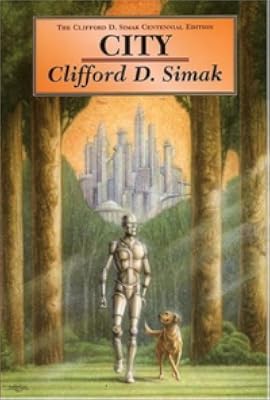
City
by Clifford D. Simak
On This Page
Description
This award-winning science fiction classic explores a far-future world inhabited by intelligent canines who pass down the tales of their human forefathers. Thousands of years have passed since humankind abandoned the city-first for the countryside, then for the stars, and ultimately for oblivion-leaving their most loyal animal companions alone on Earth. Granted the power of speech centuries earlier by the revered Bruce Webster, the intelligent, pacifist dogs are the last keepers of human show more history, raising their pups with bedtime stories, passed down through generations, of the lost "websters" who gave them so much but will never return. With the aid of Jenkins, an ageless service robot, the dogs live in a world of harmony and peace. But they now face serious threats from their own and other dimensions, perhaps the most dangerous of all being the reawakened remnants of a warlike race called "Man." In the Golden Age of Isaac Asimov and Robert A. Heinlein, Clifford D. Simak's writing blazed as brightly as anyone's in the science fiction firmament. Winner of the International Fantasy Award, City is a magnificent literary metropolis filled with an astonishing array of interlinked stories and structures-at once dystopian, transcendent, compassionate, and visionary. show lessTags
Recommendations





















Member Reviews
This book could almost be retitled The World According To Simak because it seems to sum up his view of his fellow humans: one way and another, that’s what all the dogs, robots, mutants and ants in City are—various pictures of us.
The dogs, I think, are the way Simak wished humans could be: uncomplicated, intelligent but amiable, content (like him) to just sit on the porch in the sun listening to the birds singing. Then there are the ‘robots’, who aren’t robots at all; these are humans too, but servile ones this time who do all the work. There are the ‘mutants’, which are Simak’s picture of experts of all kinds—or intellectuals rather, smart-asses, know-it-alls, wiseguys smirking and sniggering from behind their show more hands, people (in Simak’s view) too clever for their own good. And lastly there are the ants: these are us yet again, but seen from above in a sort of bird’s-eye view of humanity: scurrying and teeming everywhere, building cities, mindlessly covering the green of his beloved Wisconsin in brick and concrete. Meanwhile, all the actual humans in City vanish in one way or another, and I got the impression that this was wishful thinking on the author’s part: Simak’s understated way of saying to the rest of us, ‘I wish you’d all just shove off and leave me in peace.’
I didn’t dislike City because it’s strange (I love surreal and strange) or incoherent (which it is, particularly scientifically). I didn’t even baulk at most of Simak’s pictures of humanity—I’ve spent much of my own life watching with the same dismay the woods and meadows of England being tarmacked and concreted over. But then the penny finally dropped. One glaring thing about the Websters, the human family whose story we’re largely following here, is that we never once see any of them cleaning a kitchen say, doing the laundry, weeding the garden or lugging heavy bags of groceries up the steep gravel drive to the Big House. The ‘robots’ (i.e. the servants, the drudges—the staff) do all that sort of thing. ‘Leave me in peace’ really means ‘Leave me in peace to sit out here on my porch, glass of whiskey balanced on my knee, watching the world go by, setting the world straight, while my loyal and obedient staff of lesser mortals do all the work.’ It’s an unpleasant, and all-too-familiar, picture of an ‘ideal’ world. show less
The dogs, I think, are the way Simak wished humans could be: uncomplicated, intelligent but amiable, content (like him) to just sit on the porch in the sun listening to the birds singing. Then there are the ‘robots’, who aren’t robots at all; these are humans too, but servile ones this time who do all the work. There are the ‘mutants’, which are Simak’s picture of experts of all kinds—or intellectuals rather, smart-asses, know-it-alls, wiseguys smirking and sniggering from behind their show more hands, people (in Simak’s view) too clever for their own good. And lastly there are the ants: these are us yet again, but seen from above in a sort of bird’s-eye view of humanity: scurrying and teeming everywhere, building cities, mindlessly covering the green of his beloved Wisconsin in brick and concrete. Meanwhile, all the actual humans in City vanish in one way or another, and I got the impression that this was wishful thinking on the author’s part: Simak’s understated way of saying to the rest of us, ‘I wish you’d all just shove off and leave me in peace.’
I didn’t dislike City because it’s strange (I love surreal and strange) or incoherent (which it is, particularly scientifically). I didn’t even baulk at most of Simak’s pictures of humanity—I’ve spent much of my own life watching with the same dismay the woods and meadows of England being tarmacked and concreted over. But then the penny finally dropped. One glaring thing about the Websters, the human family whose story we’re largely following here, is that we never once see any of them cleaning a kitchen say, doing the laundry, weeding the garden or lugging heavy bags of groceries up the steep gravel drive to the Big House. The ‘robots’ (i.e. the servants, the drudges—the staff) do all that sort of thing. ‘Leave me in peace’ really means ‘Leave me in peace to sit out here on my porch, glass of whiskey balanced on my knee, watching the world go by, setting the world straight, while my loyal and obedient staff of lesser mortals do all the work.’ It’s an unpleasant, and all-too-familiar, picture of an ‘ideal’ world. show less
Some trips into the past do not go so well. You revisit old haunts and all that exists are the creaky ghosts. You see old friends, the memories don’t gibe, and you remember why you left in the first place. And you reread books you hold with fond memory (revisiting the old haunt and seeing old friends within) and the clunks and chains of old age drip from the page.
Put more simply, books remembered fondly do not often age well.
And then…and then…and then. Then there are those times when you are reminded why a book was a classic when it came out and why it should still be considered one. City is one of those books. Yes, there are a very few parts that creak, but they creak very softly. And that still makes it better than the majority show more of books that clunk upon the first reading. And the overall story (and storytelling) does more than hold up – they hold their own against anything else currently being written.
The story seems simple. Man helps dogs evolve, man runs off into the stars (kind of), and the dogs take control of the natural earth…for a while. But that is short shrift, a glancing blow at what is going on here. The novel shows us the evolution of multiple species in a series of eight tales – stories the dogs tell around the fire. And each story contains volumes of information, all plotted and played out simply, but containing deep concepts and idea – some pursued; some left for us to ponder on our own.
In a style Simak uses in many of his stories and novels, ideas are buried within ideas. Some are explored and some questions are left unanswered. What is really going on in Jupiter? Where did the mutants go, and why? What are the cobblies and how do they exist in the alternate worlds? What are the robots doing? And what about the ants?
All of the above would probably cause you to expect a 900-page doorstop of a book. But that is what is so amazing about this novel. It tells this broad, sweeping story in just 255 pages. There is much to explore. And each section could easily have been its own book. But that is not what Simak is doing here. (And, back when this was written, it couldn’t have been done.) Thousands of years pass, uncountable changes occur, and Simak holds it all together in the eight tales the dogs tell.
Yes, I know part of this is a function of the business side of science fiction in the 40s – serialization and writing short stories that could be brought together as a novel. But this is an example of how it can work to the good.
There is a good chance anyone actually reading this review already knows of City. But if you do not, or you’ve heard about it and always wondered, then do yourself the favor of visiting this City. And, if you have read it before and wonder if the old neighborhood is still the same, well, actually it is. The changes have all come from you. And that only makes it better. show less
Put more simply, books remembered fondly do not often age well.
And then…and then…and then. Then there are those times when you are reminded why a book was a classic when it came out and why it should still be considered one. City is one of those books. Yes, there are a very few parts that creak, but they creak very softly. And that still makes it better than the majority show more of books that clunk upon the first reading. And the overall story (and storytelling) does more than hold up – they hold their own against anything else currently being written.
The story seems simple. Man helps dogs evolve, man runs off into the stars (kind of), and the dogs take control of the natural earth…for a while. But that is short shrift, a glancing blow at what is going on here. The novel shows us the evolution of multiple species in a series of eight tales – stories the dogs tell around the fire. And each story contains volumes of information, all plotted and played out simply, but containing deep concepts and idea – some pursued; some left for us to ponder on our own.
In a style Simak uses in many of his stories and novels, ideas are buried within ideas. Some are explored and some questions are left unanswered. What is really going on in Jupiter? Where did the mutants go, and why? What are the cobblies and how do they exist in the alternate worlds? What are the robots doing? And what about the ants?
All of the above would probably cause you to expect a 900-page doorstop of a book. But that is what is so amazing about this novel. It tells this broad, sweeping story in just 255 pages. There is much to explore. And each section could easily have been its own book. But that is not what Simak is doing here. (And, back when this was written, it couldn’t have been done.) Thousands of years pass, uncountable changes occur, and Simak holds it all together in the eight tales the dogs tell.
Yes, I know part of this is a function of the business side of science fiction in the 40s – serialization and writing short stories that could be brought together as a novel. But this is an example of how it can work to the good.
There is a good chance anyone actually reading this review already knows of City. But if you do not, or you’ve heard about it and always wondered, then do yourself the favor of visiting this City. And, if you have read it before and wonder if the old neighborhood is still the same, well, actually it is. The changes have all come from you. And that only makes it better. show less
3rd read (30/7/23):
Third time is the charm it seems, because City finally clicked with me. Not to say some of my old criticisms don't still niggle (the Juwain philosophy is problematic and other aspects are dated enough to throw my investment in the story), but I can comfortably say that I like the whole span of City quite a lot. I think it helped to go in knowing what I was getting, and I think on my second read I was let down quite a bit by a very grating audiobook narrator. Good ol' paper steered me well this time though and I was in love with the more contemplative, almost fable-like direction the second half of the book took. Aspects were also interesting in light of me dipping back into Wells' The Island of Dr Moreau recently, show more with City having a much more idealistic and quaint take on vivisection. "Aesop", I think, has a nearly all-animal cast, with the dogs having made other animals in their own image, much as a certain Webster once operated on dogs in the hopes of provoking a genetic trend that would put the two species "hand in paw". "No spill blood" echoed in my mind as the bear and the wolf contemplate the origin of a dead body, each quick to ensure the other that they would never dare break the "no kill" rule ("Are we not dogs?").
I read a review that deemed the framing canine editorial notes to be redundant, but I wholeheartedly disagree. While they may not explicitly add anything to the narrative (and, indeed, the stories stood alone when originally published) they certainly contribute a ton to the atmosphere and put the whole work into a certain context. In a way, much of the appeal of City for me comes from the idea of truth and history dissolving over time and being reduced to legendary status. Much, in the same way, you might argue over whether there is any historical value in something like, say, the Hebrew bible, here you have the dogs holding "Man" up as a mythical god-like figure that a minority of scholars find value in clinging to and a majority find insulting. Simak's introduction to my edition was also an essential touch for me, reflecting on the context in which the stories were written, some towards the end of WWII and others in the wake of nuclear paranoia.
The apocryphal "Epilog" was included in my edition. In isolation, it's a decent story, if a little thinly spread. As an extended end to the City canon though, it falls a bit flat.
Old review (2nd read), May 2021:
This was a slow, casual re-read in the form of an audiobook. The narrator sounded like an AI and had the most stilted voice, but I tried not to let that mar the experience too much.
I initially read this 6 years ago and still agree with most of my qualms from back then, though I thought the way that I expressed it in my original review was pretty poor, so I've removed it. Here are my original scores for the individual stories though:
City - 3
Huddling Place - 4.5
Census - 3.5
Desertion - 4
Paradise - 3.5
Hobbies - 2.5
Aesop - 1
The Simple Way - 2.5
Epilog - 2
(I think these have changed a bit, but not by much. It's not fresh in my mind, so I'll leave them be.)
City has a great premise, but you do have to suspend your disbelief. It is a collection of stories that can stand alone but essentially function as a novel, having an overarching narrative/themes/characters that occur throughout. It progresses chronologically over a span of many generations, and I would liken it to something like Asimov's Foundation - although this is certainly not hard sci-fi and much more whimsical. The premise is both epic and quaint, Simak often being credited as the father of "pastoral" science fiction. It's small-town, soft and fluffy sci-fi, but taken to a grand scale. It's the fall of man, with the rise of dogs, ants and remnants of robots left behind to aid the former.
Each story connects in some way to the former and all are divided by "notes on the text", where we have canine philosophers speculating on the story's origins and whether or not "man" as a species is more than a myth.
There are two main narrative problems I have with City: So much hinges on something called "The Juwain Philosophy", this moral plan that is supposed to carry mankind to the next age. I won't go into detail, as I'm keeping this relatively spoiler-free (or at least vague), but the stakes of this fall apart both due to aspects that are dated, as well as by what can only be regarded as either incredible character incompetence or the author's own negligence. There is also a certain character who is practically made out to be the hero of the novel, and yet could easily be traced back as being single-handedly responsible for the destruction of mankind. Again, I put this down to an oversight of the author's.
While the first half of the book is fairly solid, things meander a lot toward the back end, becoming overly pensive and indulgent. Characters wandering around, speculating on life, the universe, everything... it's very tiresome and the execution is verbose and repetitive. It's not often I say these things of a man like Simak, who I believe was a humble and modest man, and generally wrote some very short, tight stories that touched on profundities quite naturally. But there you have it. This, easily his most acclaimed work alongside Way Station, is not his best in my book.
However, I do think City has its moments and is worth reading. At the very least, I would recommend "Huddling Place" as a standalone short story (though I seem to be in the minority for highlighting it). show less
Third time is the charm it seems, because City finally clicked with me. Not to say some of my old criticisms don't still niggle (the Juwain philosophy is problematic and other aspects are dated enough to throw my investment in the story), but I can comfortably say that I like the whole span of City quite a lot. I think it helped to go in knowing what I was getting, and I think on my second read I was let down quite a bit by a very grating audiobook narrator. Good ol' paper steered me well this time though and I was in love with the more contemplative, almost fable-like direction the second half of the book took. Aspects were also interesting in light of me dipping back into Wells' The Island of Dr Moreau recently, show more with City having a much more idealistic and quaint take on vivisection. "Aesop", I think, has a nearly all-animal cast, with the dogs having made other animals in their own image, much as a certain Webster once operated on dogs in the hopes of provoking a genetic trend that would put the two species "hand in paw". "No spill blood" echoed in my mind as the bear and the wolf contemplate the origin of a dead body, each quick to ensure the other that they would never dare break the "no kill" rule ("Are we not dogs?").
I read a review that deemed the framing canine editorial notes to be redundant, but I wholeheartedly disagree. While they may not explicitly add anything to the narrative (and, indeed, the stories stood alone when originally published) they certainly contribute a ton to the atmosphere and put the whole work into a certain context. In a way, much of the appeal of City for me comes from the idea of truth and history dissolving over time and being reduced to legendary status. Much, in the same way, you might argue over whether there is any historical value in something like, say, the Hebrew bible, here you have the dogs holding "Man" up as a mythical god-like figure that a minority of scholars find value in clinging to and a majority find insulting. Simak's introduction to my edition was also an essential touch for me, reflecting on the context in which the stories were written, some towards the end of WWII and others in the wake of nuclear paranoia.
The apocryphal "Epilog" was included in my edition. In isolation, it's a decent story, if a little thinly spread. As an extended end to the City canon though, it falls a bit flat.
Old review (2nd read), May 2021:
This was a slow, casual re-read in the form of an audiobook. The narrator sounded like an AI and had the most stilted voice, but I tried not to let that mar the experience too much.
I initially read this 6 years ago and still agree with most of my qualms from back then, though I thought the way that I expressed it in my original review was pretty poor, so I've removed it. Here are my original scores for the individual stories though:
City - 3
Huddling Place - 4.5
Census - 3.5
Desertion - 4
Paradise - 3.5
Hobbies - 2.5
Aesop - 1
The Simple Way - 2.5
Epilog - 2
(I think these have changed a bit, but not by much. It's not fresh in my mind, so I'll leave them be.)
City has a great premise, but you do have to suspend your disbelief. It is a collection of stories that can stand alone but essentially function as a novel, having an overarching narrative/themes/characters that occur throughout. It progresses chronologically over a span of many generations, and I would liken it to something like Asimov's Foundation - although this is certainly not hard sci-fi and much more whimsical. The premise is both epic and quaint, Simak often being credited as the father of "pastoral" science fiction. It's small-town, soft and fluffy sci-fi, but taken to a grand scale. It's the fall of man, with the rise of dogs, ants and remnants of robots left behind to aid the former.
Each story connects in some way to the former and all are divided by "notes on the text", where we have canine philosophers speculating on the story's origins and whether or not "man" as a species is more than a myth.
There are two main narrative problems I have with City: So much hinges on something called "The Juwain Philosophy", this moral plan that is supposed to carry mankind to the next age. I won't go into detail, as I'm keeping this relatively spoiler-free (or at least vague), but the stakes of this fall apart both due to aspects that are dated, as well as by what can only be regarded as either incredible character incompetence or the author's own negligence. There is also a certain character who is practically made out to be the hero of the novel, and yet could easily be traced back as being single-handedly responsible for the destruction of mankind. Again, I put this down to an oversight of the author's.
While the first half of the book is fairly solid, things meander a lot toward the back end, becoming overly pensive and indulgent. Characters wandering around, speculating on life, the universe, everything... it's very tiresome and the execution is verbose and repetitive. It's not often I say these things of a man like Simak, who I believe was a humble and modest man, and generally wrote some very short, tight stories that touched on profundities quite naturally. But there you have it. This, easily his most acclaimed work alongside Way Station, is not his best in my book.
However, I do think City has its moments and is worth reading. At the very least, I would recommend "Huddling Place" as a standalone short story (though I seem to be in the minority for highlighting it). show less
City is a fix-up: it was originally published as a series of short stories chronicling a future history, mostly in Astounding, from 1944 to 1951. In 1952, Simak collected them in a book, adding introductions to each story written by some scholar from the far far future, making it into a work that exists in the future history. Simak wrote one extra City story in 1973, which was incorporated into editions of the book published in 1981 onward, including my 2011 Gollancz edition.
It's certainly of its era: I feel like a lot of sf writers in this period wrote series of short stories covering vast swathes of human history. In that sense, City reminded me of Isaac Asimov, Robert Heinlein, and especially Cordwainer Smith. But what is different show more than those other future histories is the scope of City: while Asimov, Heinlein, and even Smith chronicle the history of humanity, Simak considers what comes after humanity... and then what comes after that. The only person who really matches Simak for scope is Wells. This is a series of vignettes, linked by some common characters and some related ones, that take us from the abandonment of the cities to the abandonment of the planet Earth itself.
Simak's futurism isn't always right, but the futurism isn't the point, so it doesn't matter. There's a lot to like here, but my favorite was "Hobbies," which I wrote about on its own here. The story focuses on the dogs and robots left on Earth by humanity. Both were created to serve humanity; even though dogs have been raised to sapience, that's still what a dog is. There are also a last few humans. But all of these beings have no work to do—there is nothing left but the "hobbies" of the title. Simak is often praised for his pastoral style, and this thoughtful story is it at its moving best. The last couple stories point toward the fact that things never stop developing. Watch out for the ants!
I also really enjoyed the introductions to each story, written by the dog scholars of the far future attempting to put each story into its original context... but they are from so far in the future that they are not convinced any such creature as man actually existed. Surely he is just part of a creation myth? I'm often a sucker for this kind of faux apparatus, and this is a good example of it, extending the distance between the world of the text and ours. show less
It's certainly of its era: I feel like a lot of sf writers in this period wrote series of short stories covering vast swathes of human history. In that sense, City reminded me of Isaac Asimov, Robert Heinlein, and especially Cordwainer Smith. But what is different show more than those other future histories is the scope of City: while Asimov, Heinlein, and even Smith chronicle the history of humanity, Simak considers what comes after humanity... and then what comes after that. The only person who really matches Simak for scope is Wells. This is a series of vignettes, linked by some common characters and some related ones, that take us from the abandonment of the cities to the abandonment of the planet Earth itself.
Simak's futurism isn't always right, but the futurism isn't the point, so it doesn't matter. There's a lot to like here, but my favorite was "Hobbies," which I wrote about on its own here. The story focuses on the dogs and robots left on Earth by humanity. Both were created to serve humanity; even though dogs have been raised to sapience, that's still what a dog is. There are also a last few humans. But all of these beings have no work to do—there is nothing left but the "hobbies" of the title. Simak is often praised for his pastoral style, and this thoughtful story is it at its moving best. The last couple stories point toward the fact that things never stop developing. Watch out for the ants!
I also really enjoyed the introductions to each story, written by the dog scholars of the far future attempting to put each story into its original context... but they are from so far in the future that they are not convinced any such creature as man actually existed. Surely he is just part of a creation myth? I'm often a sucker for this kind of faux apparatus, and this is a good example of it, extending the distance between the world of the text and ours. show less
Simak, Clifford D. City. 1952. Introduction by Gwyneth Jones. Gollancz, 2011.
Clifford D. Simak’s City is a fix-up of a fix-up, and it should not hold together, but it does. It began as magazine stories during World War II and was turned into a book with interludes that tied the stories together in 1952. A final story, written in honor of John W. Campbell in 1973, was added as an epilog in 1980. For me, the book is a decades-long conversation with Simak’s friend and younger contemporary, Isaac Asimov. Both treated robots as good and faithful servants, and both were interested in the ultimate fate of humanity. City has the historical sweep of Asimov’s Foundation series, but Simak is not so much interested in social evolution as in show more the vanity of human wishes. City is not really a story about cities. Rather, it is about what happens after cities, when, in an obvious but unavoidable pun, the city has literally gone to the dogs. Cities are abandoned, Simak says, when land is no longer needed to produce food, industry is totally automated, and travel is easy. In this post-scarcity world, cities have outlived their usefulness, and only the city of Geneva and the Webster family hangs on. They advance the evolution of dogs by giving them speech. Indestructible robots to give them the dexterity they need to build their own peaceful civilization. This sounds idyllic, but Simak says it results from the breakdown of all human social ties and the absence of purposeful work that makes life meaningful. Human beings, he says, cannot live by hobbies alone. His point is one that current writers of virtual utopias should remember. In the end, Simak says, the human race will vanish, as will their successors—here, dogs and ants. Asimov saves us with the well-meaning Robots of Dawn, but for Simak, the faithful robot who cannot weep will be left to tell our tale to no one. A classic. 5 stars. show less
Clifford D. Simak’s City is a fix-up of a fix-up, and it should not hold together, but it does. It began as magazine stories during World War II and was turned into a book with interludes that tied the stories together in 1952. A final story, written in honor of John W. Campbell in 1973, was added as an epilog in 1980. For me, the book is a decades-long conversation with Simak’s friend and younger contemporary, Isaac Asimov. Both treated robots as good and faithful servants, and both were interested in the ultimate fate of humanity. City has the historical sweep of Asimov’s Foundation series, but Simak is not so much interested in social evolution as in show more the vanity of human wishes. City is not really a story about cities. Rather, it is about what happens after cities, when, in an obvious but unavoidable pun, the city has literally gone to the dogs. Cities are abandoned, Simak says, when land is no longer needed to produce food, industry is totally automated, and travel is easy. In this post-scarcity world, cities have outlived their usefulness, and only the city of Geneva and the Webster family hangs on. They advance the evolution of dogs by giving them speech. Indestructible robots to give them the dexterity they need to build their own peaceful civilization. This sounds idyllic, but Simak says it results from the breakdown of all human social ties and the absence of purposeful work that makes life meaningful. Human beings, he says, cannot live by hobbies alone. His point is one that current writers of virtual utopias should remember. In the end, Simak says, the human race will vanish, as will their successors—here, dogs and ants. Asimov saves us with the well-meaning Robots of Dawn, but for Simak, the faithful robot who cannot weep will be left to tell our tale to no one. A classic. 5 stars. show less
Clifford Simak attempted to create a cohesive universe in his City stories, collected in this volume with a frame narrative to boot. He tells the tale of humanity’s decline, and the rise of those species that will replace us- most notably the dog and the robot. Simak’s ambition is commendable, but in practice this universe doesn’t feel cohesive. It’s highly compartmentalized, with different races and technologies appearing for a single story and then disappearing entirely, or for long stretches. Additionally, the framing narrative adds absolutely nothing to the book. At the end of the day, therefore, City doesn’t really work as a series or single segmented piece, but instead serves as a short story collection with a shared show more cast of characters. Simak as much as acknowledges this in the frame narrative, the notes stating that “the Webster family once again may be no more than a mark of good storytelling, a device used to establish a link of continuity in a series of tales which otherwise are not too closely linked.” As a collection of independent stories the result is a mixed bag: most of them are fine, one or two are bad, but I didn’t find any to be a standout. Simak had ambitions with his City stories, and the stories themselves are okay on average, but there are authors who did what Semak was trying to do more successfully, and it’s those stories that I would recommend reading. Below is my analysis of the stories as a series, skip to my final paragraph to avoid them.
The collection starts out with City, the story that gave the collection its title, and in my opinion the worst story of the entire collection. City presents a world where the introduction of private aircraft, cheap home construction, and a couple other factors have resulted in people leaving the cities and living out in the country in solitude, the few population centers left struggling to survive. While the depopulation of the cities is a fine premise to start with, the way in which Simak has that happen is unimpressive. By Simak’s logic, the introduction of the personal automobile should have led to the end of cities as well- obviously it didn’t. Simak’s story never addresses the fact that cities don’t just exist for protection, but as social hubs. How do people date in this future of super diffuse population? Simak hasn’t put any thought into questions like that. Also, the idea that each family will have a 40 acre parcel and that will somehow lead to the end of community and social interaction is patently absurd given how farmers have lived for hundreds and hundreds of years. Are cities no longer economic hubs for some reason? Simak mentions but never adequately addresses the economic aspect of cities. Moving beyond the execution of the premise, which is bad, the story itself isn’t impressive either. Cliché characters are introduced, like the old people who think that the new ways are bad, and the old ways are better. There’s a corrupt politician that espouses rugged individualism. Ugh. Everything in the story is also simplified to the point of stupidity: laws, property values, even how artillery works is presented in a way that had me rolling my eyes. The middle of the story devolves into ham-fisted social commentary that doesn’t reflect well on Simak. None of the characters are sympathetic, and by the end it’s hard to care whether these tiny cities survive or whether people will keep moving out into the new suburbs. This is a subpar pulp sci-fi story, and an unimpressive start to the collection. It’s made worse by the fact that the rest of the stories render this one all but superfluous- its lone contribution is the title.
The second story is Huddling Place, and in my mind it represents the actual start of the universe that Simak was trying to build. It introduces robots, which are essentially just metal people that think in an almost identical fashion to human beings, who have their own emotions and judgments. The idea of people submitting to the judgment of robots instead of making judgments of their own because they find it easier is an interesting concept (I believe explored in the Culture series of Iain M. Banks), but it’s merely touched upon at the end of this story and never explored: Simak’s robots are portrayed as entirely benevolent. Huddling Place again gives us a world where mankind is in decline, this time because of its tendency to isolate itself on its country estates. Again, no dating for the Webster family I suppose. As for the arts, the story explains that with new technology you can experience things like an orchestra performance from the comfort of your own home, so why would you ever leave? Again, unconvincing reasoning: had Simak never heard of a turntable? Whatever. The story presents us with the Webster family being highly agoraphobic, and states that such agoraphobia is spreading throughout mankind. In the climax this agoraphobia causes the main character to be unable to perform surgery on his friend, a Martian, leading to the Martian’s death and thus the loss of the philosophical breakthrough that he was going to make. You see Martian philosophy is USEFUL and LOGICAL, as opposed to foolish human philosophy. How so? Simak never tells us, as he obviously has no idea. When the philosophy is finally revealed it's entirely underwhelming. This story highlights Simak’s tendency to introduce a concept in what is intended to be a cohesive universe, only to forget it entirely: in this story we meet the Martian Juwain. He is the only Martian we ever meet. In fact Martians are never mentioned again, except in the context of Juwain’s philosophy. Later stories forget Martians entirely when characters list intelligent species, and we never learn about the fate of the Martians. This story is better than the first, but it made me realize that a book is perhaps one of the least interesting mediums for depicting agoraphobia.
The third story is Census, a story that largely ignores the spread of agoraphobia that Huddling Place introduced. A census taker in a world where people feared strangers would be an interesting concept, instead here we get a census taker whose job is only difficult because people live so spread out. Census introduces two important new factions to the universe, the talking dog and the super intelligent mutant. A character in this story laments that humanity never had a second intelligent species to bounce ideas off of, and hopes that talking dogs can fulfill that role- apparently forgetting the Martians exist. The fact that dogs gain the ability to talk through Lamarckian evolution is something I’ll ignore, though Semak really should have known better. Dogs make fine protagonists to several stories going forward, but they’re rarely given much depth. Dogs are dogs. The mutants are potentially a far more interesting faction, geniuses with incredibly long lifespans that live in the backwoods and don’t care for social benefits like people do, but just like the Martians we are only ever introduced to a single mutant: Joe. He plays a trickster role, sort of, and while the rest of the mutants are at times portrayed as a threat, the narrative never introduces them and therefore most of the tension about them that it tries to develop falls flat. At the end of this story Joe is painted as the antagonist because he won’t help the census taker decipher Juwain’s philosophy. Joe takes the position of “why should I,” and the census taker’s offers of money and fame don’t work. Neither does the appeal to the benefit of the species. When Joe pooh-poohs the idea of species loyalty the census taker identifies him as evil, and Simak’s narrative takes that stance as well- but I found the argument unconvincing. There are plenty of people in the world who wouldn’t do something for the nebulous reason of “benefiting the species,” so the fact that Joe won’t do it either hardly categorizes him as evil. Instead it’s his lack of need for other people that seems to really differentiate him, and despite the narrative’s attempt it’s hard to think of him as a villain because of that. Thus, when the census taker asks the first talking dog to watch over mankind and protect against the mutants, it doesn’t have the weight that Simak obviously intended it to. At this point in the collection it became clear to me that Simak expects us to just go along with the ideas he throws out, not actually analyze them.
The fourth and fifth stories, Desertion and Paradise, are really one longer story cut up for what I can only assume are financial reasons. Here Simak introduces technology that allows people to transfer their consciousness into another body, nearly any type of body. Of course you’d expect that the people of this future would be immortal now, transferring their consciousness into younger bodies that were always being improved upon. Except not, because Simak wasn’t interested in thinking through the implications of this technology, he just needed it to tell this story- a story with a huge number of similarities to the likewise narratively unimpressive movie Avatar. The body transfer device is being used to allow people to explore the surface of Jupiter, despite the technician operating the machine apparently being both strongly against it and essential to the process. Whatever. Anyway, the twist is that the reason why previous attempts have failed isn’t because people in these new bodies have died, or been driven crazy, but because the new bodies are so great that no one wanted to become human again. The main character manages to force himself back into his human body, and wants to bring the good news of this new Eden to the rest of humanity. The “Paradise” half of this story reveals that it is occurring sometime a few generations later than Census, (initially the timeline is far from clear), and thus a descendent of Webster is trying to stop the news of Jovian paradise from getting out. He fails because the mutant Joe shows up again, and reveals the solution to Juwain’s philosophy: this solution allows a person to consider another person’s point of view. I’m genuinely intensely curious about whether Simak thought that people lacked such an ability. Was Simak highly autistic and undiagnosed? Because considering someone else’s point of view, even doing it very well, isn’t exactly a rare skill. It’s a necessity for being a good teacher, psychotherapist, lawyer, consultant, etc. Apparently these are not occupations in this universe, and unbeknownst to the reader Semak has populated all of the previous stories with characters completely unable to consider any position but their own. A mind-boggling twist that adds nothing, or a completely unsatisfying development that reveals a personal characteristic of the author: whichever one it is, it adds nothing to the story, and in fact retroactively makes all the fuss about the Juwain philosophy more pointless.
Imagine a city populated only by people who had the fortitude to resist an offer of an earthly paradise, who turned down a chance to live thousands of years in bliss, and instead remain in their human bodies, for whatever reason. Furthermore they are left behind as most of humanity accepts the offer and leaves forever. What type of people would those be, and what would their descendants be like? People with an unwavering faith in human ingenuity? Or those with grand artistic ambitions? Or religious zealots? Or nihilists? At the very least, they’d be interesting, I expect. Semak disagrees, as in the sixth story, Hobbies, Semak portrays a city of people who don’t go in for the pleasures of Jupiter and instead opt a life on Earth, and whose defining characteristic is apparently being bored all the time. Despite putting humanity in a variety of vastly different situations, Semak writes them all in the exact same way, and never shows himself capable (at least in this collection) of capturing a different personality on paper. Hobbies focuses on dog characters as much as human ones, and this story introduces the idea that dogs can sense things in parallel dimensions and also cure warts. Whatever. The story reintroduces an idea introduced in Census that dogs are in many ways superior to man, as they lack man’s skepticism, among other things. Personally I don’t identify skepticism as that detrimental of a characteristic, especially in moderation, but Semak identifies its lack as a boon to canines. One of the last humans left decides that to give dogs a chance he’s going to bottle up what’s left of humanity, since man is just wandering around not doing anything anymore, and if they figure out how to escape they’ll have earned the right to reconquer the world (ignoring the fact that no people seem to hold that desire, and forgetting entirely that these are people that didn’t go to Jupiter and instead remain on Earth- which would surely earn them the right to a life on Earth if anything could). What especially annoyed me about this story is that it negates the importance of the first three stories almost entirely: the dispersion of the human race, the rise of agoraphobia and the isolation of people are all ignored here. Instead the ending of the story only works because people have congregated into a city once more. Semak’s downfall of man could have been the offer of Jovian paradise followed by the bottling of survivors, but instead Semak had to include the early stories that are almost entirely superfluous and not particularly impressive.
The seventh story is Aesop, perhaps the most nonsensical story when it comes to how the story is ended. The few people that are left live around the old Webster estate, and are taken care of by the dogs and the robot butler Jenkins, who has appeared in almost all the stories but who has only been important before this in Huddling Place and Hobbies. He here becomes the main character, and remains so throughout the rest of the stories. Through their exploration of other dimensions the dogs have let a ghoul (cobbly) into our universe, and since they’re all pacifists they are presumably powerless to stop it. Elsewhere the humans, who have had their memory wiped by Jenkins, are rediscovering weapons and violence. Jenkins goes to the mutant castles (why they have castles isn’t much clear, unless they’re purely for interplanetary gateways) to find out how to stop men from being violent, and finds that all the mutants have left. While returning from the castle Jenkins finds a man driving off the ghoul with his violence and hatred, thus saving all of the helpless animals that the ghoul would have killed in the future. The clear message that this course of events implies is that sometimes man’s violent nature and his feeling of hatred is necessary to avert worse outcomes, but the narrative ends with Jenkins exiling humanity forever from their home dimension. Thus leaving dogs helpless if another ghoul comes, but Jenkins is apparently doing all this to give dog society a chance. At this point I decided that Semak largely didn’t know what he was doing.
The last story of the original series is The Simple Way, where it is revealed that the industrialized ants introduced way back in Census have evolved to the point where they can control robots and build structures hundreds of miles in size. As I previously said, the stories of City don’t so much feel like a coherent universe as they do a place where Semak pulls something out for the sake of a story and then shoves it away in a drawer somewhere until remembering it again years later. This conflict with the ants doesn’t feel at all organic. Here, at least, the moral of the story is clear instead of muddled like it was in Aesop. The lesson presented is that Man’s method of violence might be the only way to succeed, sometimes, but success at that price is too high. Why does Jenkins think that man’s ancient solution of poison syrup would work against these super advanced ants, with buildings miles and miles long? Stop trying to analyze a Semak story.
The Simple Way is the last story in the collection to use the frame narrative, as the final story was written much later. Put simply, the frame narrative adds absolutely nothing. The main through line of the frame narrative is whether man was real or merely a myth, and because as a reader we know man existed, that question does nothing for us. The frame narrative also sets up these tales as legends, myths told around campfires, but there’s no effort in the stories proper to occupy the role. They’re written just like every other piece of sci-fi pulp, and we’re asked to believe that dogs just repeat words that they don’t understand and don’t ascribe meaning to. The Book of the New Sun gives us descriptions of things that we understand and the narrator doesn’t, allowing us to catch things that he misses and thereby adding to both the world and the narrator as a character. Semak’s writing offers no such pleasure or accomplishment. By the end of the stories proper the frame narrative has done nothing but occasionally preach to us about man’s pointless search for progress and power- as if most people seek those in the abstract without clear concrete goals. It’s poorly done.
The final story is Epilog, where we learn that the ants were no more successful than any of the other species. While man is criticized in the frame narrative for lacking stability, here is depicted a perfectly stable society that has somehow failed. It’s an alright ending story, it gives some closure and lets Jenkins escape the house that he’s become so attached to. In this there’s perhaps a callback to the agoraphobia of the Websters, something Jenkins overcomes that his masters couldn’t, but given the quality of Semak’s writing before this I doubt such a reference was intentional. Overall there was no theme that recurred throughout all the stories, no message that was clear and consistent, so this story could only be so successful as an ending to the City collection. To the extent it could be successful, however, it was.
Welp, that was a much longer review than I thought it would be.
So as a series, City isn’t very successful. Some parts render others unnecessary, concepts and species are dropped and picked back up at Semak’s convenience, and there is not a consistent theme or message here to draw everything together. As individual stories, however, I think they fare better. The first story is the only one I’d call bad, while the rest are all serviceable, especially Epilog, however I expect the final story would lose something if you weren’t aware of the universe’s progress up to that point. Actually, I’m not at all sure how the stories would hold up in isolation, but regardless I didn’t find them that bad as I was reading them- the flaws only snapped into focus when I stopped to think about what Semak had written. For a better attempt to write a cohesive universe I’d point you to Cordwainer Smith’s Rediscovery of Man. It has its own flaws, but between the two he’s clearly superior to Semak. show less
The collection starts out with City, the story that gave the collection its title, and in my opinion the worst story of the entire collection. City presents a world where the introduction of private aircraft, cheap home construction, and a couple other factors have resulted in people leaving the cities and living out in the country in solitude, the few population centers left struggling to survive. While the depopulation of the cities is a fine premise to start with, the way in which Simak has that happen is unimpressive. By Simak’s logic, the introduction of the personal automobile should have led to the end of cities as well- obviously it didn’t. Simak’s story never addresses the fact that cities don’t just exist for protection, but as social hubs. How do people date in this future of super diffuse population? Simak hasn’t put any thought into questions like that. Also, the idea that each family will have a 40 acre parcel and that will somehow lead to the end of community and social interaction is patently absurd given how farmers have lived for hundreds and hundreds of years. Are cities no longer economic hubs for some reason? Simak mentions but never adequately addresses the economic aspect of cities. Moving beyond the execution of the premise, which is bad, the story itself isn’t impressive either. Cliché characters are introduced, like the old people who think that the new ways are bad, and the old ways are better. There’s a corrupt politician that espouses rugged individualism. Ugh. Everything in the story is also simplified to the point of stupidity: laws, property values, even how artillery works is presented in a way that had me rolling my eyes. The middle of the story devolves into ham-fisted social commentary that doesn’t reflect well on Simak. None of the characters are sympathetic, and by the end it’s hard to care whether these tiny cities survive or whether people will keep moving out into the new suburbs. This is a subpar pulp sci-fi story, and an unimpressive start to the collection. It’s made worse by the fact that the rest of the stories render this one all but superfluous- its lone contribution is the title.
The second story is Huddling Place, and in my mind it represents the actual start of the universe that Simak was trying to build. It introduces robots, which are essentially just metal people that think in an almost identical fashion to human beings, who have their own emotions and judgments. The idea of people submitting to the judgment of robots instead of making judgments of their own because they find it easier is an interesting concept (I believe explored in the Culture series of Iain M. Banks), but it’s merely touched upon at the end of this story and never explored: Simak’s robots are portrayed as entirely benevolent. Huddling Place again gives us a world where mankind is in decline, this time because of its tendency to isolate itself on its country estates. Again, no dating for the Webster family I suppose. As for the arts, the story explains that with new technology you can experience things like an orchestra performance from the comfort of your own home, so why would you ever leave? Again, unconvincing reasoning: had Simak never heard of a turntable? Whatever. The story presents us with the Webster family being highly agoraphobic, and states that such agoraphobia is spreading throughout mankind. In the climax this agoraphobia causes the main character to be unable to perform surgery on his friend, a Martian, leading to the Martian’s death and thus the loss of the philosophical breakthrough that he was going to make. You see Martian philosophy is USEFUL and LOGICAL, as opposed to foolish human philosophy. How so? Simak never tells us, as he obviously has no idea. When the philosophy is finally revealed it's entirely underwhelming. This story highlights Simak’s tendency to introduce a concept in what is intended to be a cohesive universe, only to forget it entirely: in this story we meet the Martian Juwain. He is the only Martian we ever meet. In fact Martians are never mentioned again, except in the context of Juwain’s philosophy. Later stories forget Martians entirely when characters list intelligent species, and we never learn about the fate of the Martians. This story is better than the first, but it made me realize that a book is perhaps one of the least interesting mediums for depicting agoraphobia.
The third story is Census, a story that largely ignores the spread of agoraphobia that Huddling Place introduced. A census taker in a world where people feared strangers would be an interesting concept, instead here we get a census taker whose job is only difficult because people live so spread out. Census introduces two important new factions to the universe, the talking dog and the super intelligent mutant. A character in this story laments that humanity never had a second intelligent species to bounce ideas off of, and hopes that talking dogs can fulfill that role- apparently forgetting the Martians exist. The fact that dogs gain the ability to talk through Lamarckian evolution is something I’ll ignore, though Semak really should have known better. Dogs make fine protagonists to several stories going forward, but they’re rarely given much depth. Dogs are dogs. The mutants are potentially a far more interesting faction, geniuses with incredibly long lifespans that live in the backwoods and don’t care for social benefits like people do, but just like the Martians we are only ever introduced to a single mutant: Joe. He plays a trickster role, sort of, and while the rest of the mutants are at times portrayed as a threat, the narrative never introduces them and therefore most of the tension about them that it tries to develop falls flat. At the end of this story Joe is painted as the antagonist because he won’t help the census taker decipher Juwain’s philosophy. Joe takes the position of “why should I,” and the census taker’s offers of money and fame don’t work. Neither does the appeal to the benefit of the species. When Joe pooh-poohs the idea of species loyalty the census taker identifies him as evil, and Simak’s narrative takes that stance as well- but I found the argument unconvincing. There are plenty of people in the world who wouldn’t do something for the nebulous reason of “benefiting the species,” so the fact that Joe won’t do it either hardly categorizes him as evil. Instead it’s his lack of need for other people that seems to really differentiate him, and despite the narrative’s attempt it’s hard to think of him as a villain because of that. Thus, when the census taker asks the first talking dog to watch over mankind and protect against the mutants, it doesn’t have the weight that Simak obviously intended it to. At this point in the collection it became clear to me that Simak expects us to just go along with the ideas he throws out, not actually analyze them.
The fourth and fifth stories, Desertion and Paradise, are really one longer story cut up for what I can only assume are financial reasons. Here Simak introduces technology that allows people to transfer their consciousness into another body, nearly any type of body. Of course you’d expect that the people of this future would be immortal now, transferring their consciousness into younger bodies that were always being improved upon. Except not, because Simak wasn’t interested in thinking through the implications of this technology, he just needed it to tell this story- a story with a huge number of similarities to the likewise narratively unimpressive movie Avatar. The body transfer device is being used to allow people to explore the surface of Jupiter, despite the technician operating the machine apparently being both strongly against it and essential to the process. Whatever. Anyway, the twist is that the reason why previous attempts have failed isn’t because people in these new bodies have died, or been driven crazy, but because the new bodies are so great that no one wanted to become human again. The main character manages to force himself back into his human body, and wants to bring the good news of this new Eden to the rest of humanity. The “Paradise” half of this story reveals that it is occurring sometime a few generations later than Census, (initially the timeline is far from clear), and thus a descendent of Webster is trying to stop the news of Jovian paradise from getting out. He fails because the mutant Joe shows up again, and reveals the solution to Juwain’s philosophy: this solution allows a person to consider another person’s point of view. I’m genuinely intensely curious about whether Simak thought that people lacked such an ability. Was Simak highly autistic and undiagnosed? Because considering someone else’s point of view, even doing it very well, isn’t exactly a rare skill. It’s a necessity for being a good teacher, psychotherapist, lawyer, consultant, etc. Apparently these are not occupations in this universe, and unbeknownst to the reader Semak has populated all of the previous stories with characters completely unable to consider any position but their own. A mind-boggling twist that adds nothing, or a completely unsatisfying development that reveals a personal characteristic of the author: whichever one it is, it adds nothing to the story, and in fact retroactively makes all the fuss about the Juwain philosophy more pointless.
Imagine a city populated only by people who had the fortitude to resist an offer of an earthly paradise, who turned down a chance to live thousands of years in bliss, and instead remain in their human bodies, for whatever reason. Furthermore they are left behind as most of humanity accepts the offer and leaves forever. What type of people would those be, and what would their descendants be like? People with an unwavering faith in human ingenuity? Or those with grand artistic ambitions? Or religious zealots? Or nihilists? At the very least, they’d be interesting, I expect. Semak disagrees, as in the sixth story, Hobbies, Semak portrays a city of people who don’t go in for the pleasures of Jupiter and instead opt a life on Earth, and whose defining characteristic is apparently being bored all the time. Despite putting humanity in a variety of vastly different situations, Semak writes them all in the exact same way, and never shows himself capable (at least in this collection) of capturing a different personality on paper. Hobbies focuses on dog characters as much as human ones, and this story introduces the idea that dogs can sense things in parallel dimensions and also cure warts. Whatever. The story reintroduces an idea introduced in Census that dogs are in many ways superior to man, as they lack man’s skepticism, among other things. Personally I don’t identify skepticism as that detrimental of a characteristic, especially in moderation, but Semak identifies its lack as a boon to canines. One of the last humans left decides that to give dogs a chance he’s going to bottle up what’s left of humanity, since man is just wandering around not doing anything anymore, and if they figure out how to escape they’ll have earned the right to reconquer the world (ignoring the fact that no people seem to hold that desire, and forgetting entirely that these are people that didn’t go to Jupiter and instead remain on Earth- which would surely earn them the right to a life on Earth if anything could). What especially annoyed me about this story is that it negates the importance of the first three stories almost entirely: the dispersion of the human race, the rise of agoraphobia and the isolation of people are all ignored here. Instead the ending of the story only works because people have congregated into a city once more. Semak’s downfall of man could have been the offer of Jovian paradise followed by the bottling of survivors, but instead Semak had to include the early stories that are almost entirely superfluous and not particularly impressive.
The seventh story is Aesop, perhaps the most nonsensical story when it comes to how the story is ended. The few people that are left live around the old Webster estate, and are taken care of by the dogs and the robot butler Jenkins, who has appeared in almost all the stories but who has only been important before this in Huddling Place and Hobbies. He here becomes the main character, and remains so throughout the rest of the stories. Through their exploration of other dimensions the dogs have let a ghoul (cobbly) into our universe, and since they’re all pacifists they are presumably powerless to stop it. Elsewhere the humans, who have had their memory wiped by Jenkins, are rediscovering weapons and violence. Jenkins goes to the mutant castles (why they have castles isn’t much clear, unless they’re purely for interplanetary gateways) to find out how to stop men from being violent, and finds that all the mutants have left. While returning from the castle Jenkins finds a man driving off the ghoul with his violence and hatred, thus saving all of the helpless animals that the ghoul would have killed in the future. The clear message that this course of events implies is that sometimes man’s violent nature and his feeling of hatred is necessary to avert worse outcomes, but the narrative ends with Jenkins exiling humanity forever from their home dimension. Thus leaving dogs helpless if another ghoul comes, but Jenkins is apparently doing all this to give dog society a chance. At this point I decided that Semak largely didn’t know what he was doing.
The last story of the original series is The Simple Way, where it is revealed that the industrialized ants introduced way back in Census have evolved to the point where they can control robots and build structures hundreds of miles in size. As I previously said, the stories of City don’t so much feel like a coherent universe as they do a place where Semak pulls something out for the sake of a story and then shoves it away in a drawer somewhere until remembering it again years later. This conflict with the ants doesn’t feel at all organic. Here, at least, the moral of the story is clear instead of muddled like it was in Aesop. The lesson presented is that Man’s method of violence might be the only way to succeed, sometimes, but success at that price is too high. Why does Jenkins think that man’s ancient solution of poison syrup would work against these super advanced ants, with buildings miles and miles long? Stop trying to analyze a Semak story.
The Simple Way is the last story in the collection to use the frame narrative, as the final story was written much later. Put simply, the frame narrative adds absolutely nothing. The main through line of the frame narrative is whether man was real or merely a myth, and because as a reader we know man existed, that question does nothing for us. The frame narrative also sets up these tales as legends, myths told around campfires, but there’s no effort in the stories proper to occupy the role. They’re written just like every other piece of sci-fi pulp, and we’re asked to believe that dogs just repeat words that they don’t understand and don’t ascribe meaning to. The Book of the New Sun gives us descriptions of things that we understand and the narrator doesn’t, allowing us to catch things that he misses and thereby adding to both the world and the narrator as a character. Semak’s writing offers no such pleasure or accomplishment. By the end of the stories proper the frame narrative has done nothing but occasionally preach to us about man’s pointless search for progress and power- as if most people seek those in the abstract without clear concrete goals. It’s poorly done.
The final story is Epilog, where we learn that the ants were no more successful than any of the other species. While man is criticized in the frame narrative for lacking stability, here is depicted a perfectly stable society that has somehow failed. It’s an alright ending story, it gives some closure and lets Jenkins escape the house that he’s become so attached to. In this there’s perhaps a callback to the agoraphobia of the Websters, something Jenkins overcomes that his masters couldn’t, but given the quality of Semak’s writing before this I doubt such a reference was intentional. Overall there was no theme that recurred throughout all the stories, no message that was clear and consistent, so this story could only be so successful as an ending to the City collection. To the extent it could be successful, however, it was.
Welp, that was a much longer review than I thought it would be.
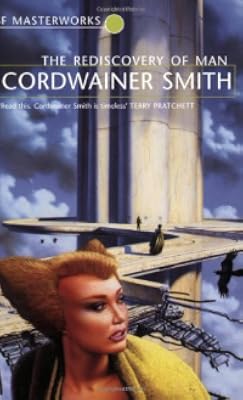
So as a series, City isn’t very successful. Some parts render others unnecessary, concepts and species are dropped and picked back up at Semak’s convenience, and there is not a consistent theme or message here to draw everything together. As individual stories, however, I think they fare better. The first story is the only one I’d call bad, while the rest are all serviceable, especially Epilog, however I expect the final story would lose something if you weren’t aware of the universe’s progress up to that point. Actually, I’m not at all sure how the stories would hold up in isolation, but regardless I didn’t find them that bad as I was reading them- the flaws only snapped into focus when I stopped to think about what Semak had written. For a better attempt to write a cohesive universe I’d point you to Cordwainer Smith’s Rediscovery of Man. It has its own flaws, but between the two he’s clearly superior to Semak. show less
Simak used a framing device to link eight existing stories as a fix-up novel in 1951, and City has proven to be one of the enduring such efforts. Later he wrote an Epilog, a ninth story missing from my edition; it isn't clear it adds much to the significance of the original story cycle. The eight were each published in Astounding under editorial direction of John Campbell, curious how much Simak envisioned them of a piece, rather than being unrelated stories forcibly retrofitted. For example, the dogs don't appear until the third story -- odd for what seems so central an element in the overall scenario.
Simak's descriptions of Jupiter involve domes set on firm ground and with crystalline cliffs nearby, none of which exist according to show more current science. Evidently Simak imagined the ammonia atmosphere hid a solid planet, rather than the gas giant with (perhaps) an ocean of liquid hydrogen behaving like molten metal. As with most science fiction, though, the bits he got wrong are trivial when assessing the work overall. City is a novel of ideas, more about what it is to be a person and part of humanity, what is unavoidably caught up in the species and what might be changed, than anything in the literal environment or technology.
In the Foreward, Simak claims the fix-up was written as no sort of protest, but as means of escape, given the disillusion (his word) attending World War II. Fitting then, that the novel ends with the sentient dogs escaping from this world into another. Humans may not be able to escape our fate, defined by innate aggression and an attendant loss of purpose once our post-scarcity civilization provides for all our essential needs -- but it seems we may enable others to escape. In this way, perhaps, human culture outlasts humanity itself. Or that's one scenario that Simak paints for us. show less
Simak's descriptions of Jupiter involve domes set on firm ground and with crystalline cliffs nearby, none of which exist according to show more current science. Evidently Simak imagined the ammonia atmosphere hid a solid planet, rather than the gas giant with (perhaps) an ocean of liquid hydrogen behaving like molten metal. As with most science fiction, though, the bits he got wrong are trivial when assessing the work overall. City is a novel of ideas, more about what it is to be a person and part of humanity, what is unavoidably caught up in the species and what might be changed, than anything in the literal environment or technology.
In the Foreward, Simak claims the fix-up was written as no sort of protest, but as means of escape, given the disillusion (his word) attending World War II. Fitting then, that the novel ends with the sentient dogs escaping from this world into another. Humans may not be able to escape our fate, defined by innate aggression and an attendant loss of purpose once our post-scarcity civilization provides for all our essential needs -- but it seems we may enable others to escape. In this way, perhaps, human culture outlasts humanity itself. Or that's one scenario that Simak paints for us. show less
Members
- Recently Added By
Lists

Best Science Fiction Novels
816 works; 430 members
Survey of Classic Science Fiction
171 works; 48 members

Bibliography for Among Others
159 works; 15 members

501 Must-Read Books
529 works; 72 members

S.F. Masterworks (Complete)
229 works; 15 members

SF Masterworks
193 works; 8 members

BingoDOG - Animals in Adult Fiction
78 works; 20 members

Blue Pyramid 1,276 Best Books of All Time
1,248 works; 32 members

Books Read in 2020
4,379 works; 123 members

Mustich's 1000 Books to Read Before You Die: A Life Changing List
1,001 works; 19 members

Books Read in 2023
5,547 works; 145 members

La Bibliothèque idéale de la SF (Éditions Albin Michel, 1988)
52 works; 1 member
Les 100 principaux titres de la science-fiction (1981)
126 works; 3 members
Favorite Science Fiction
456 works; 218 members
Author Information

389+ Works 25,350 Members
Some Editions
Awards and Honors
Awards
Distinctions
Notable Lists
Series
Belongs to Publisher Series
Delta Pocket (1)
Ursan scifi-sarja (18)
Goldmann Science Fiction (036 / 23036)
Urania [Mondadori] (157)
J'ai lu (373)
Lanterne (L 106)
SF Masterworks (New design)
Science Fiction Book Club (3372)
Work Relationships
Is contained in
Contains
Common Knowledge
- Canonical title*
- Demain les chiens
- Original title
- City
- Original publication date
- 1952-05
- People/Characters
- William Stevens (Gramp); John J. Webster; Jerome A. Webster; Thomas Webster; Richard Grant; Bruce Webster (show all 27); Joe; Kent Fowler; Towser; Tyler Webster; Jon Webster; Ebenezer; Peter Webster; Homer; Andrew; Henry Allen; Miss Stanley; Nathaniel; Bounce; Tige; Juwain; Rover; Jenkins Webster; Shadow; Oscar; Sara; Tom
- Important places
- USA; Jupiter; Geneva, Geneva, Switzerland
- Dedication
- In Memory of Scootie, Who Was Nathaniel
- First words
- Gramp Stevens sat in a lawn chair, watching the mower at work, feeling the warm, soft sunshine seep into his bones.
- Last words
- (Click to show. Warning: May contain spoilers.)Terribly disappointed when he found the websters had no way of dealing with the ants...
(Click to show. Warning: May contain spoilers.)Jenkins tried to say goodbye, but he could not say goodbye. If he could only weep, he thought, but a robot could not weep. (Epilog) - Original language
- English
*Some information comes from Common Knowledge in other languages. Click "Edit" for more information.
Classifications
Statistics
- Members
- 2,886
- Popularity
- 6,245
- Reviews
- 89
- Rating
- (3.96)
- Languages
- 23 — Bulgarian, Catalan, Czech, Danish, Dutch, English, Estonian, Finnish, French, German, Hebrew, Hungarian, Italian, Lithuanian, Norwegian (Bokmål), Norwegian, Polish, Portuguese, Romanian, Russian, Spanish, Swedish, Turkish
- Media
- Paper, Audiobook, Ebook
- ISBNs
- 54
- ASINs
- 67