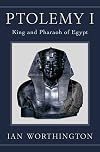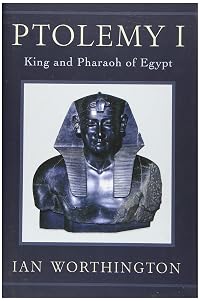
Ptolemy I: King and Pharaoh of Egypt
by Ian Worthington
On This Page
Description
Cleopatra of Egypt is one of history's most famous rulers, but who was responsible for founding the Ptolemaic dynasty from which she came, how, and when? For the answers we go back 300 years before Cleopatra's time, to Ptolemy of Macedonia. He was a friend of Alexander the Great, fighting withhim in the epic battles and sieges, which toppled the Persian Empire, and after Alexander's death took over Egypt after the dead king's commanders carved up his vast empire among themselves.They were show more soon at war with each other, the so-called Wars of the Successors, as each man fought to increasehis share of the spoils.They made and broke alliances with each other cynically and effortlessly, with Ptolemy showing himself no different from the others.But unlike them he had patience and cunning that arguably made him the greatest of the Successors. He built up his power base in Egypt, introduced administrative and economic reforms that made him fabulously wealthy, and as a conscious imperialist he boldly attempted to seize Greece and Macedoniaand be a second Alexander. As well as his undoubted military prowess, Ptolemy was an intellectual. He founded the great Library and Museum at Alexandria, making that city the intellectual center of the entire Hellenistic age, and even patronized the mathematician Euclid.Ptolemy ruled Egypt first as satrap and then as its king and Pharaoh for forty years, until he died of natural causes in his early eighties. On his death, his son, Ptolemy II, succeeded him and the Ptolemaic dynasty was thus established. It was the longest-lived of all the Hellenistic dynasties,falling with Cleopatra three centuries later. As a king, soldier, statesman, and intellectual, Ptolemy was one of a kind, but, unlike Alexander, he never forgot his Macedonian roots.Against all odds, Ptolemy fought off invasions, invaded opponents' territories and established an Egyptian empire, making his adopted country a power with which to be reckoned. His achievements shaped both Egypt's history and that of the early Hellenistic world. show lessTags
Recommendations





















Member Reviews
A well-researched work of narrative history about Ptolemy I, the founder of the most long-lasting and successful of the successor kingdoms carved out of the Macedonian empire founded by Alexander. The book does an excellent job of teasing out the surprisingly scant amounts of information about Ptolemy and fleshing it out to bring the man to life. The research is top-notch, although the writing can be a bit pedestrian at times. It's well worth reading if you're at all interested in the aftermath of Alexander the Great's conquests.
Members
- Recently Added By
Lists

Kindle Non-Fiction
221 works; 1 member
Author Information

23+ Works 572 Members
Ian Worthington is Curators' Professor of History and Adjunct Professor of Classical Studies at the University of Missouri. He is the author of numerous books about ancient Greece, including, most recently, Demosthenes of Athens and the Fall of Classical Greece and Ptolemy I: King and Pharaoh of Egypt.
Common Knowledge
- People/Characters
- Ptolemy I Soter
Classifications
- Genres
- History, Nonfiction, Biography & Memoir, General Nonfiction
- DDC/MDS
- 932.021092 — History & geography History of ancient world (to ca. 499) Egypt to 640 Hellenistic, Roman, Byzantine periods, 332 b.c-640 ad. Hellenistic period, 332-30 b.c.
- LCC
- DT92 .W67 — History of Europe, Asia, Africa and Oceania Africa History of Africa Egypt History
- BISAC
Statistics
- Members
- 32
- Popularity
- 838,164
- Reviews
- 1
- Rating
- (4.00)
- Languages
- English
- Media
- Paper, Ebook
- ISBNs
- 3
- ASINs
- 1