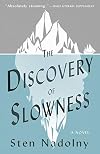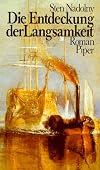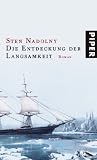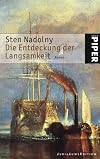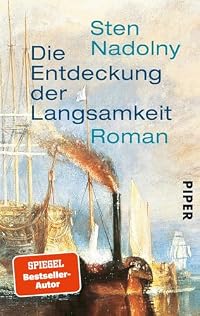
The Discovery of Slowness
by Sten Nadolny
On This Page
Description
In The Discovery of Slowness, German novelist Sten Nadolny recounts the life of the nineteenth-century British explorer Sir John Franklin (1786-1847). The reader follows Franklin's development from awkward schoolboy and ridiculed teenager to expedition leader, governor of Tasmania, and icon of adventure. Everyone with whom he came into contact sensed that he was a rare man, one who was "out of his time" and who moved to a different, grander beat. That beat eventually led Franklin to sail show more once more--on his final, fateful voyage--into the Arctic in search of the Northwest Passage. The Discovery of Slowness is both a riveting account of a remarkable and varied life, and a profound and thought-provoking meditation on time. show lessTags
Recommendations




































Member Recommendations

MissBrangwen While Nadolny's novel is a fictionalized account of Franklin's life, Wiebe deals with the story of Hood and Greenstockings, but in a very different way.
Member Reviews
It's been a long time since I last read a German book, the last one being [b:Die Tage der Sintflut - Roman über die Belagerung Aachens 1248|35905603|Die Tage der Sintflut - Roman über die Belagerung Aachens 1248|Günter Krieger|https://i.gr-assets.com/images/S/compressed.photo.goodreads.com/books/1501766164l/35905603._SY75_.jpg|57430292] by [a:Günter Krieger|6551385|Günter Krieger|https://s.gr-assets.com/assets/nophoto/user/m_50x66-82093808bca726cb3249a493fbd3bd0f.png], in 2017. Read, not heard, in which case [b:QualityLand|36422870|QualityLand|Marc-Uwe Kling|https://i.gr-assets.com/images/S/compressed.photo.goodreads.com/books/1508164790l/36422870._SX50_.jpg|57851826] by [a:Marc-Uwe Kling|2863757|Marc-Uwe show more Kling|https://images.gr-assets.com/authors/1358872253p2/2863757.jpg] would be the last, in 2019.
'Die Entdeckung der Langsamkeit' (translated as 'The Discovery of Slowness') is a book I bought a few years ago while being on a short holiday in Aachen, Germany. I had seen the book recommended here and elsewhere on the WWW. The blurb was something that spoke to me.
I won't go into detail about the book, there are many other reviewers who've done a very good job at that. It's important to note that this historical fiction revolves around Royal Navy officer and Arctic explorer John Franklin, who lived in the 19th century. See Wikipedia for more information on his life, his experiences, his travels, etc.
As I read in one review, part of the story is based on historical facts, another part (Sir John Franklin having been slow in movement and in thought) is fiction. As such, this book isn't so much about John Franklin as it is about the concept of slowness. Slowness in (re)acting, slowness in thinking, slowness in approaching and living life.
From when he was a child, John Franklin was slow, couldn't catch a ball, let alone realise the game was already in a different phase. And so it was when he joined the navy, where he had to learn to adjust to the real world, the world of fast decisions, fast actions, fast talking. Where he had to learn... to stand up for himself, to acknowledge his "problem" or better, try to reverse the roles: instead of him having to adapt to other people's fast behaviour, he would make them adapt to his, otherwise he wouldn't make it in life and when fulfilling certain roles, those other people wouldn't make it either or fail to execute his orders (when he became officer) correctly.
Standing his ground, proving his worth, despite or thanks to his slowness and thus decisions that were well thought through, John Franklin would become one of Britain's most-respected men. As governor of Tasmania he would try to turn the tide for prisoners and perpetrators: re-integrate them into the local society, among the settlers, so that they could improve their lives. Everyone deserves a chance, so was his conviction. Of course, during his years of exploration as well as his years of governing, he would encounter hard resistance and learn how the game of politics is played.
He passed away on his final journey to find the Northwest passage (Wikipedia) in 1847, not the first time he would suffer from the cold and hardship, despite better preparations for his third undertaking.
The book is divided into three parts, starting with Franklin's youth, written in a way that makes you have sympathy for the boy and feel his struggles, how he's an outsider and his friends (or "friends") don't really understand him, mock him. In the later years of his life, he would prove them wrong.
Sten Nadolny has written the story in such a way that it corresponds with the title: this is a not a fast-paced thriller. At all. Read too fast and you'll miss a lot of the subtlety and the message Mr Nadolny tried to convey with regards to slowness.
Especially in this day and age, where our lives are for the most part dominated and regulated by technology, time, clocks, apps, ... a story like this one is an eye-opener or maybe a reminder that each of us needs to slow down every now and then to avoid exhaustion, burn-out, taking the wrong decisions (or deciding to hastily). Fast isn't always good, doesn't always serve the greater good. As Franklin said, when he tried to reform society in Tasmania: not everyone is fast, we all have our own clocks, our own rhythm. This has an impact on how we perceive the world, how "fast" we pick up new things, new skills, new information. Such a characteristic is to be taken into account in school, in workplaces, ...
Long story short: A beautiful story not only about Sir John Franklin, but also tickling you to do some introspection, and reconsider your personal plans/desires/endeavours, the world, society, as it's going through some crises at the moment. show less
'Die Entdeckung der Langsamkeit' (translated as 'The Discovery of Slowness') is a book I bought a few years ago while being on a short holiday in Aachen, Germany. I had seen the book recommended here and elsewhere on the WWW. The blurb was something that spoke to me.
I won't go into detail about the book, there are many other reviewers who've done a very good job at that. It's important to note that this historical fiction revolves around Royal Navy officer and Arctic explorer John Franklin, who lived in the 19th century. See Wikipedia for more information on his life, his experiences, his travels, etc.
As I read in one review, part of the story is based on historical facts, another part (Sir John Franklin having been slow in movement and in thought) is fiction. As such, this book isn't so much about John Franklin as it is about the concept of slowness. Slowness in (re)acting, slowness in thinking, slowness in approaching and living life.
From when he was a child, John Franklin was slow, couldn't catch a ball, let alone realise the game was already in a different phase. And so it was when he joined the navy, where he had to learn to adjust to the real world, the world of fast decisions, fast actions, fast talking. Where he had to learn... to stand up for himself, to acknowledge his "problem" or better, try to reverse the roles: instead of him having to adapt to other people's fast behaviour, he would make them adapt to his, otherwise he wouldn't make it in life and when fulfilling certain roles, those other people wouldn't make it either or fail to execute his orders (when he became officer) correctly.
Standing his ground, proving his worth, despite or thanks to his slowness and thus decisions that were well thought through, John Franklin would become one of Britain's most-respected men. As governor of Tasmania he would try to turn the tide for prisoners and perpetrators: re-integrate them into the local society, among the settlers, so that they could improve their lives. Everyone deserves a chance, so was his conviction. Of course, during his years of exploration as well as his years of governing, he would encounter hard resistance and learn how the game of politics is played.
He passed away on his final journey to find the Northwest passage (Wikipedia) in 1847, not the first time he would suffer from the cold and hardship, despite better preparations for his third undertaking.
The book is divided into three parts, starting with Franklin's youth, written in a way that makes you have sympathy for the boy and feel his struggles, how he's an outsider and his friends (or "friends") don't really understand him, mock him. In the later years of his life, he would prove them wrong.
Sten Nadolny has written the story in such a way that it corresponds with the title: this is a not a fast-paced thriller. At all. Read too fast and you'll miss a lot of the subtlety and the message Mr Nadolny tried to convey with regards to slowness.
Especially in this day and age, where our lives are for the most part dominated and regulated by technology, time, clocks, apps, ... a story like this one is an eye-opener or maybe a reminder that each of us needs to slow down every now and then to avoid exhaustion, burn-out, taking the wrong decisions (or deciding to hastily). Fast isn't always good, doesn't always serve the greater good. As Franklin said, when he tried to reform society in Tasmania: not everyone is fast, we all have our own clocks, our own rhythm. This has an impact on how we perceive the world, how "fast" we pick up new things, new skills, new information. Such a characteristic is to be taken into account in school, in workplaces, ...
Long story short: A beautiful story not only about Sir John Franklin, but also tickling you to do some introspection, and reconsider your personal plans/desires/endeavours, the world, society, as it's going through some crises at the moment. show less
Interesting story of the life of a man who was told he was slow to learn, when in fact he was thoughtful. He achieved a great deal, had strange attitude to women and his wives, taking them or leaving them, the sea was what he loved, well written, but not sentimental
Lebensgeschichte der realen Figur John Franklin, eines Seefahrers und Polarforschers. Der Autor hat biografische Elemente übernommen, und sie mit den fiktiven Eigenschaften, beispielsweise der fast schon behindernden Langsamkeit seines Charakters und Wesens ergänzt. Von der Kindheit über die jugenlichen Erfahrungen in Seeschlachten bis hin zu seinen Expeditionen lernt man als Leser selbst, wie Langsamkeit die Wahrnehmung positiv beeinflussen kann.
»Die Entdeckung der Langsamkeit« ist Seefahrer-, Abenteuer- und Entwicklungsroman zugleich. Unnachahmlich erzählt er von der Langsamkeit als Lebensprinzip. Zum 65. Geburtstag Sten Nadolnys in neuer Ausstattung und mit ausführlichem Nachwort des Autors. Sten Nadolnys vielfach preisgekrönter Roman über den Arktisfahrer John Franklin ist seit seinem Erscheinen 1983 zum Weltbestseller und modernen Klassiker geworden. »Die Entdeckung der Langsamkeit« erzählt die abenteuerliche Lebensgeschichte des Seefahrers John Franklin, der von der Entdeckung der legendären Nordwestpassage träumt und dem die Bedächtigkeit zum erfolgreichen Lebensprinzip wird. Bis heute fand Nadolnys zeitloser Roman über die Kunst der Langsamkeit allein in show more Deutschland mehr als 1,5 Millionen Leser. show less
...è bello e basta...
Magical experience--wonderful storytelling.
German literature, seafaring, John Franklin, north pole
Members
- Recently Added By
Lists

German Literature
514 works; 51 members

Explorers in fiction
31 works; 3 members

Arctic novels
35 works; 5 members
Author Information

Novelist Sten Nadolny was born in Berlin, Germany, on July 29, 1942. He has been a teacher and TV movie production manager. His novel, The Discovery of Slowness, won the Ingeborg Bachmann Prize of Kagenfurt. (Bowker Author Biography)
Awards and Honors
Series
Belongs to Publisher Series
Serie Piper (700)
Work Relationships
Has as a student's study guide
Common Knowledge
- Canonical title
- The Discovery of Slowness
- Original title
- Die Entdeckung der Langsamkeit
- Original publication date
- 1983
- People/Characters
- John Franklin; Eleanor Porden; Dr. Ormen; Peele; John Barrow; Sherard Lound (show all 10); Nelson; Tom Baker; Matthew Flinders; George Back
- Important places
- North Pole; Spilsby, Lincolnshire, England, UK; Lissabon, Portugal; Copenhagen, Denmark; Cape of Good Hope, South Africa; Portsmouth, Hampshire, England, UK (show all 9); Australia; Cape Trafalgar, Andalusia, Spain; New Orleans, Louisiana, USA
- Important events
- Battle of Trafalgar (1805); Battle of Copenhagen (1801); Battle of New Orleans (1815); Franklin's Lost Expedition (1845)
- Dedication*
- Meinem Vater Burkhard Nadolny (1905-1968)
- First words
- John Franklin war schon zehn Jahre alt und noch immer so langsam, daß er keinen Ball fangen konnte.
- Quotations
- Planen und Handeln war der Beruf einer Freundschaft, alles andere verfälschte sie nur.
ein Streit, bei dem einer dem anderen erklärte, worum es ging, war ausweglos. - Last words
- (Click to show. Warning: May contain spoilers.)Der einzige, der ihm nicht zuhörte, war der Photograph der "Illustrated London News", der eilends seinen Apparat, System Talbot, in Stellung brachte, im den Zustand der Skelette im Bild festzuhalten.
- Original language*
- Deutsch
*Some information comes from Common Knowledge in other languages. Click "Edit" for more information.
Classifications
- Genres
- Fiction and Literature, General Fiction, Historical Fiction
- DDC/MDS
- 833.914 — Literature & rhetoric German & related literatures German fiction 1900- 1900-1990 1945-1990
- LCC
- PT2674 .A313 .E5813 — Language and Literature German, Dutch and Scandinavian literatures German literature Individual authors or works 1961-2000
- BISAC
Statistics
- Members
- 920
- Popularity
- 28,784
- Reviews
- 16
- Rating
- (3.97)
- Languages
- 14 — Chinese, Danish, Dutch, English, Estonian, Finnish, French, German, Italian, Lithuanian, Russian, Slovenian, Spanish, Swedish
- Media
- Paper, Audiobook, Ebook
- ISBNs
- 48
- ASINs
- 9