On This Page
Description
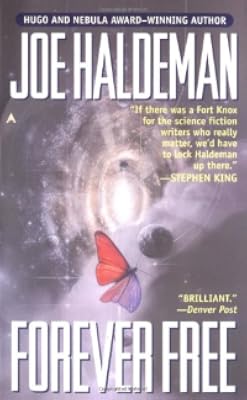
Veterans of the intergalactic Forever War must brave an alien universe to escape mind-control slavery in this thrilling far-future sci-fi adventure. On virtually every list of the greatest military science fiction adventures ever written, Joe Haldeman's Hugo and Nebula Award-winning classic, The Forever War, is ranked at the very top. In Forever Free, the Science Fiction Writers of America Grand Master and author of the acclaimed Worlds series returns to that same volatile universe where show more human space marines once engaged the alien Taurans in never-ending battle. While loyal soldier William Mandella was fighting for the survival of the human race in a distant galaxy, thousands of years were passing on his home planet, Earth. Then, with the end of the hostilities came the shocking realization that humanity had evolved into something he did not recognize. Offered the choice of retaining his individuality or becoming part of the genetically modified shared Human hive-mind, Mandella chose exile, joining other veterans of the Forever War seeking a new life on a wasteland world they called Middle Finger. Making a home for themselves in this half-frozen hell, Mandella and his life partner, Marygay, have survived into middle age, raising a son and a daughter in the process. Now, the dark truth about the colonists' ultimate role in the continuation of the Human group mind will force Mandella and Marygay to take desperate action as they hijack an interstellar vessel and set off on a frantic escape across space and time. But what awaits them upon their return is a mystery far beyond all human, or Human, comprehension . . . In Forever Free, Joe Haldeman's stunning vision of humankind's far future reaches its enthralling conclusion in a masterwork of speculation from the mind and heart of one of the undisputed champions of hard science fiction. show lessTags
Recommendations









Member Reviews
The last quarter of Forever Free ruins all the good qualities of this otherwise enjoyable sequel. The Forever War, not quite my cup of tea, was a fun, if dated, classic of '70s sci-fi; a hard anti-war response to America's involvement in Vietnam. It was a novel of brilliant ideas stilted by a mediocre execution -- shallow characters and hippie naivete / sexuality. Forever Free is...not really needed, but creates a thick atmosphere on the planet Middle Finger, one not even the classic prequel could match. Man (with a capital M) and the Taurans, both hive-mind species of the future, have pushed the surviving remnants of humanity to the planet of Middle Finger, where they live in relative isolation and freedom. Some of the surviving show more soldiers, including William Mandella, decide to hijack an FTL ship and escape 40,000 years into the future. That's the setup -- and I'm interested. The climax takes a left turn into a new mystery: Their fuel effectively disappears and they're forced to leave their trip only 25 years after they left (or a few months on their end). They return to an empty world, though -- Man is gone, the Taurans, and even the remnants of humanity left on Middle Finger have all vanished. It's a bit out of left field, but still intriguing enough to keep me reading. The atmosphere up to this point is great, but the pacing is uneven, evidenced by a back-to-back flip into two additional new directions at the 80% point. We arrive back on Earth, investigating the apparent disappearance of everyone, only to discover that the entire history of humanity *and* the Taurans (including the Forever War) were orchestrated by a species of shape-shifting aliens called the Omni. They live around us right now, disguised as trees and leaves and dogs and bears and grass and soda machines and Mickey Mouse holograms, watching us and studying our behavior. Why? Who knows! Who cares?! The Omni make no sense. None of this make sense. And, after a 20-page conversation explaining all this bizarre bullshit to the reader and the survivors of the Forever War, characters begin exploding in clouds of blood and guts and bones. Why? Because *another* alien species -- the nameless, i.e., God -- decided they/he wanted to end the Human Experiment for daring to travel outside the study area. It's explained in one final excruciating, expository conversation that Mandella et al., in trying to travel into the future, would have traveled outside the bounds of the world set aside for then, and this god has decided to put all self-aware beings into cold storage...except for the crew trying to escape...and the Omni. Those he decided to keep around and start exploding in masses of gore only after they travel for many more months to Earth and started asking questions of an Omni John Wayne / Walt Disney that decided at this point, of all points, to show itself and explain things. With a scowl, god decides to restore the world to the way it was, and everyone lives happily ever after. At the 80% point, Forever Free feels like it changed hands from a skilled writer with many books under their belt, to a teenage boy who both a) has never written anything in his life, and b) absolutely gives zero fucks about anything. I went from thinking these negative reviews were all crazy to being utterly flabbergasted by how this travesty ever got published. E-book progress report breakdown: 1-80%: 6/10 81-90%: 3/10 91-100%: 1/10 show less
Haldeman’s Forever War is a classic of the sci-fi genre, with its clear metaphors for the Vietnam War and warnings about the cost of war itself to us as people. It’s thematic, though certainly not narrative, sequel Forever Peace may have lacked some of the punch of its forebear, but presented as an essentially stand alone novel it also provided some interesting thoughts on the costs of peace (what might we have to sacrifice in order to ensure a lasting peace).
This final installment, I think, tried not only to hint at elements unifying those two stories (though only characters from Forever War are directly involved), but to provide a similar perspective on what the potential cost of true ‘freedom’ might be. What it means to truly show more be ‘free’ have been examined extensively by everyone from existentialist philosophers, to theologians, to political pundits, to anime and genre literature. Unfortunately, if I am correct about that being the intention of this ebook, Haldeman fails pretty spectacularly at it.
For the first half to three quarters of the book we have a pretty engaging, slightly crunchy, sci-fi story in Haldeman’s enjoyable style. Once we get past some of the initial points of conflict within the story though, it takes a turn for the inexplicable and weird...and really never recovers. It bounces to a bit of libertarian survivalism through communist living ala farnahm’s freehold, then makes a move for the even stranger as in the last quarter a variety of different elements are tossed in with very little explanation serving mostly as exposition all outlets and duex ex machina was to wrap up the plot.
I’m not sure if the writer was under time pressure to get this done, or perhaps a hack job was done on it in editing to cause a reasonably promising beginning to go so awry, or if he set out without a clear picture of what he wanted to do to get from beginning to end points in his plot or simply didn’t have an end goal in mind. Regardless, if you’re a fan of Haldeman i’d skip this, unless you’re just a completionist. show less
This final installment, I think, tried not only to hint at elements unifying those two stories (though only characters from Forever War are directly involved), but to provide a similar perspective on what the potential cost of true ‘freedom’ might be. What it means to truly show more be ‘free’ have been examined extensively by everyone from existentialist philosophers, to theologians, to political pundits, to anime and genre literature. Unfortunately, if I am correct about that being the intention of this ebook, Haldeman fails pretty spectacularly at it.
For the first half to three quarters of the book we have a pretty engaging, slightly crunchy, sci-fi story in Haldeman’s enjoyable style. Once we get past some of the initial points of conflict within the story though, it takes a turn for the inexplicable and weird...and really never recovers. It bounces to a bit of libertarian survivalism through communist living ala farnahm’s freehold, then makes a move for the even stranger as in the last quarter a variety of different elements are tossed in with very little explanation serving mostly as exposition all outlets and duex ex machina was to wrap up the plot.
I’m not sure if the writer was under time pressure to get this done, or perhaps a hack job was done on it in editing to cause a reasonably promising beginning to go so awry, or if he set out without a clear picture of what he wanted to do to get from beginning to end points in his plot or simply didn’t have an end goal in mind. Regardless, if you’re a fan of Haldeman i’d skip this, unless you’re just a completionist. show less
Haldeman, Joe. Forever Free. Forever War No. 2. Millennium, 1999.
Joe Haldeman’s The Forever War was a groundbreaking work of military science fiction and arguably, of Vietnam era fiction. Forever Free, a sequel published 25 years later, is disappointingly routine. After more than a thousand years of time-dilated combat, William Mandella has raised a family on the primitive colony planet Middle Finger. Mandella and his veteran buddies are chafing under the supervision of the cloned hive-mind that humanity has become. They plan to fly a starship outside the galactic plane at near light speed in hopes that things will change for the better. No such luck. Things get worse. This may be a spoiler, but I wonder how much Haldeman was show more influenced by Stephen King’s 1990 novella The Langoliers and the 1995 miniseries it inspired. 4 weak stars. show less
Joe Haldeman’s The Forever War was a groundbreaking work of military science fiction and arguably, of Vietnam era fiction. Forever Free, a sequel published 25 years later, is disappointingly routine. After more than a thousand years of time-dilated combat, William Mandella has raised a family on the primitive colony planet Middle Finger. Mandella and his veteran buddies are chafing under the supervision of the cloned hive-mind that humanity has become. They plan to fly a starship outside the galactic plane at near light speed in hopes that things will change for the better. No such luck. Things get worse. This may be a spoiler, but I wonder how much Haldeman was show more influenced by Stephen King’s 1990 novella The Langoliers and the 1995 miniseries it inspired. 4 weak stars. show less
I liked this one a lot less than the other two (though it was still an enjoyable read).
The society we saw this time around was very interesting in how civilization had spread across multiple planets and that Man and Taurans were living "peacefully" with regular humans. That aspect also made me sad because the main character and his wife were really the only people left from a world that would have been recognizable to us readers. They stood, as the characters themselves put it, like crumbling ruins of a lost world.
I also found the whole Tauran and Man thing to be super creepy and could not understand why regular humans would volunteer to become one of them.
Overall, the story, though enjoyable, seemed a bit rushed and a little too heavy show more handed with the science. The ending was building up to such an amazing final scene/scene, but it ultimately fell flat. show less
The society we saw this time around was very interesting in how civilization had spread across multiple planets and that Man and Taurans were living "peacefully" with regular humans. That aspect also made me sad because the main character and his wife were really the only people left from a world that would have been recognizable to us readers. They stood, as the characters themselves put it, like crumbling ruins of a lost world.
I also found the whole Tauran and Man thing to be super creepy and could not understand why regular humans would volunteer to become one of them.
Overall, the story, though enjoyable, seemed a bit rushed and a little too heavy show more handed with the science. The ending was building up to such an amazing final scene/scene, but it ultimately fell flat. show less
It's been twenty-some years since the last survivors of the Forever War set up home on Middle Finger which serves as sort of a genetic preserve run by the smug and superior clone groupmind known as Man. William Mandella, wife Marygay, and many of the other old veterans are getting tired of their relatively primitive life on that planet. And they find Man disconcertingly alien and fear that the clones will someday decide to rid themselves of their inferiors. They hatch a plan to fly a starship fast enough to take advantage of relativistic effects and return to Middle Finger 40,000 years in its future. A future where they hope Man will be absent or have evolved to the point of leaving them alone.
Tauran representatives and Man put show more obstacles in their way, but old human cunning wins out, and they embark for the future. But things are just getting under way when very odd things began to happen. Antimatter begins inexplicably disappearing from their ship. And even odder things have happened to the people back on Middle Finger and Earth . . .
Haldeman can't be faulted for not wanting to make this sequel to The Forever War a war story. Instead, he gives us a mystery story. Unfortunately, the novel is unbalanced by the payoff he gives us at the end. It's too glib, too metaphysical to justify the length of the story before it nor is the idea that new. On the other hand, Haldeman could have explored the consequences of his solution more fully which would have lead to a better and longer novel.
The novel opens with a poem about men assuming the powers of gods to bring about peace. Haldeman doesn't really develop that theme much or make any coherent thematic statements about war and violence and freedom as I hoped he would. show less
Tauran representatives and Man put show more obstacles in their way, but old human cunning wins out, and they embark for the future. But things are just getting under way when very odd things began to happen. Antimatter begins inexplicably disappearing from their ship. And even odder things have happened to the people back on Middle Finger and Earth . . .
Haldeman can't be faulted for not wanting to make this sequel to The Forever War a war story. Instead, he gives us a mystery story. Unfortunately, the novel is unbalanced by the payoff he gives us at the end. It's too glib, too metaphysical to justify the length of the story before it nor is the idea that new. On the other hand, Haldeman could have explored the consequences of his solution more fully which would have lead to a better and longer novel.
The novel opens with a poem about men assuming the powers of gods to bring about peace. Haldeman doesn't really develop that theme much or make any coherent thematic statements about war and violence and freedom as I hoped he would. show less
This is a direct sequel to The Forever War. Twenty years have passed since William and Marygay were reunited on Middle Finger, the "garden planet" where Man resettled the heterosexuals at the end of the Forever War. They've raised a son and a daughter, and they are restless, unhappy with Middle Finger (which has very long, very cold winters), and unhappy with Man. With some of the other war veterans, who are now a small minority of the population on Middle Finger, they plot to steal the ship that served as the time shuttle to reunite separated couples after the war. (It's still in orbit around Middle Finger, after a forced sale to Man, who has never done anything with it.) They have some excitement in the process, and make the show more interesting discovery that Man has more individuality amongst its members than Man would prefer to have anyone believe. And then the weird stuff starts happening. Disappearing antimatter. Whole populations vanishing. As in, whole populations of planets, such as Middle Finger and Earth.
Unfortunately, the explanation for the weirdness turns out to be not one deus ex machina, but two. This was an enjoyable visit with an old friend, but if you're expecting a story with any substance or punch, you will be disappointed, and might endanger breakables and small animals with a high-speed book. show less
Unfortunately, the explanation for the weirdness turns out to be not one deus ex machina, but two. This was an enjoyable visit with an old friend, but if you're expecting a story with any substance or punch, you will be disappointed, and might endanger breakables and small animals with a high-speed book. show less
A few remaining true humans, veterans of the Forever War, live along with their offspring on the planet of Middle Finger near a collapsar called Mizar. Most of humanity has become Man, a hive mind similar to that of the Taurans, their former enemies. The inhabitants of Middle Finger live in a kind of sufferance, their activities monitored by a Man sheriff and a Tauran. As in The Forever War, relativistic effects are important in this universe. Radio messages from or to Earth take 80 years to arrive but faster messaging and travel can be achieved via a collapsar jump.
Tired of their existence, a few inhabitants of Middle Finger plot to take a spaceship on a forty thousand year trip round the galaxy. The Tauran and Man hive minds refuse show more permission but they steal the ship anyway. While only a few months out weird things start to happen.
At this point we seemed to lurch into a different book entirely. The tone may not have altered much but the background did. Forced to turn back to Middle Finger our adventurers find the population there and on Earth has disappeared. They use the collapsar to return to Earth to find out what's happened.
Even before this story shift the characters were far from convincing, being almost indistinguishable one from the other. After it the narrative failed to suspend disbelief and in the denouement, two dei ex machina popped up in quick succession as Haldeman off-handedly pulled the rug from under the scenario underpinning his Forever War/Peace setting - not to mention all of human history.
While Haldeman's The Forever War was an important milestone in the history of SF Forever Free most certainly isn't - unsurorising given that it's a 25 year later (second) sequel. It's not tripe nor exceptionally badly written but neither is it a good example of the satisfactions that the genre can deliver. show less
Tired of their existence, a few inhabitants of Middle Finger plot to take a spaceship on a forty thousand year trip round the galaxy. The Tauran and Man hive minds refuse show more permission but they steal the ship anyway. While only a few months out weird things start to happen.
At this point we seemed to lurch into a different book entirely. The tone may not have altered much but the background did. Forced to turn back to Middle Finger our adventurers find the population there and on Earth has disappeared. They use the collapsar to return to Earth to find out what's happened.
Even before this story shift the characters were far from convincing, being almost indistinguishable one from the other. After it the narrative failed to suspend disbelief and in the denouement, two dei ex machina popped up in quick succession as Haldeman off-handedly pulled the rug from under the scenario underpinning his Forever War/Peace setting - not to mention all of human history.
While Haldeman's The Forever War was an important milestone in the history of SF Forever Free most certainly isn't - unsurorising given that it's a 25 year later (second) sequel. It's not tripe nor exceptionally badly written but neither is it a good example of the satisfactions that the genre can deliver. show less
Members
- Recently Added By
Lists

Simulated Reality in Fiction
124 works; 7 members

Books Read in 2021
5,361 works; 114 members
Author Information

191+ Works 30,831 Members
Joe Haldeman has uniquely blended a strong interest in astronomy and with his love for writing to publish numerous novels, anthologies and short stories over three decades. He holds a B.S. in astronomy from the University of Maryland (1967), and an M.F.A. in English from the Iowa Writers Workshop (1975). An adjunct professor at Massachusetts show more Institute of Technology, Haldeman has also taught at Michigan State, Larion West Seattle, SUNY Buffalo, Princeton, University of North Dakota, Kent State and the University of North Florida Haldeman's works include War Year (1972), The Forever War (1975), Worlds (1981), Worlds Apart (1983), Tools of the Trade (1987), and The Hemingway Hoax (1990). He has also co-authored and edited numerous works of science fiction. Born in Oklahoma on June 9, 1943, Haldeman grew up in Puerto Rico, New Orleans, Washington D.C., and Alaska. He was drafted into the military in 1967, fighting in the Central Highlands of Vietnam as a combat engineer with the 4th Division (1/22nd Airmobile Battalion), for which he received the Purple Heart, among other medals. (Bowker Author Biography) show less
Some Editions
Series

Belongs to Publisher Series
Work Relationships
Is contained in
Common Knowledge
- Canonical title*
- La liberté éternelle
- Original publication date
- 1999
- People/Characters
- William Mandella; Marygay Potter
- Canonical DDC/MDS
- 813.087623
*Some information comes from Common Knowledge in other languages. Click "Edit" for more information.
Classifications
- Genres
- Science Fiction, Fiction and Literature
- DDC/MDS
- 813.087623 — Literature & rhetoric American literature in English American fiction in English By type Genre fiction Adventure fiction Speculative fiction Science fiction Military science fiction
- LCC
- PS3558 .A353 .F59 — Language and Literature American literature American literature Individual authors 1961-
- BISAC
Statistics
- Members
- 1,386
- Popularity
- 17,116
- Reviews
- 27
- Rating
- (3.22)
- Languages
- 7 — Czech, English, French, German, Hungarian, Polish, Spanish
- Media
- Paper, Audiobook, Ebook
- ISBNs
- 25
- UPCs
- 1
- ASINs
- 10