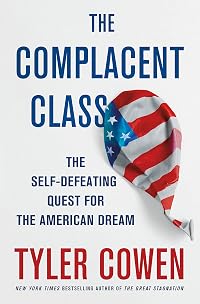
The Complacent Class: The Self-Defeating Quest for the American Dream
by Tyler Cowen
On This Page
Description
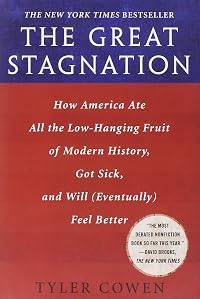
Since Alexis de Tocqueville, restlessness has been accepted as a signature American trait. Our willingness to move, take risks, and adapt to change have produced a dynamic economy and a tradition of innovation from Ben Franklin to Steve Jobs.The problem, according to legendary blogger, economist and best selling author Tyler Cowen, is that Americans today have broken from this tradition--we're working harder than ever to avoid change. We're moving residences less, marrying people more like show more ourselves and choosing our music and our mates based on algorithms that wall us off from anything that might be too new or too different. Match.com matches us in love. Spotify and Pandora match us in music. Facebook matches us to just about everything else.Of course, this "matching culture" brings tremendous positives: music we like, partners who make us happy, neighbors who want the same things. We're more comfortable. But, according to Cowen, there are significant collateral downsides attending this comfort, among them heightened inequality and segregation and decreased incentives to innovate and create.The Complacent Class argues that this cannot go on forever. We are postponing change, due to our near-sightedness and extreme desire for comfort, but ultimately this will make change, when it comes, harder. The forces unleashed by the Great Stagnation will eventually lead to a major fiscal and budgetary crisis: impossibly expensive rentals for our most attractive cities, worsening of residential segregation, and a decline in our work ethic. The only way to avoid this difficult future is for Americans to force themselves out of their comfortable slumber--to embrace their restless tradition again. show lessTags
Recommendations























Member Reviews
This is an interesting (and short) book about economic and social stagnation in the US -- making the case that it in fact exists, and some plausible reasons for why (supported with evidence), and then general depressing consequences of that. Then, a final chapter of why this can't continue and why something worse is likely.
I actually think something entirely different is much more plausible (something approaching speciation; a remnant of humanity remaining ossified and eventually dying miserably, while something new reaches escape velocity), but the "mass destruction and end of the world" seems like a plausible alternative. Cowen's "soft" return to dynamism seems very implausible, however -- things can continue on the current path for show more many more decades, but the change will come from fracture or destruction. show less
I actually think something entirely different is much more plausible (something approaching speciation; a remnant of humanity remaining ossified and eventually dying miserably, while something new reaches escape velocity), but the "mass destruction and end of the world" seems like a plausible alternative. Cowen's "soft" return to dynamism seems very implausible, however -- things can continue on the current path for show more many more decades, but the change will come from fracture or destruction. show less
Overall it was good and I did learn a few things. I'd give it 3.5 stars if I could.
Tyler Cowen describes why he thinks America is slowing down and that current elites (and non-elites) are digging themselves in to resist change. He cites a lot of factors, from the general prosperity of America to assertive mating and NIMBYism as both contributing to and being exacerbated by this trend.
American public schools, and most of the private ones I have looked into, are terrible at history. They might be particularly bad at relatively recent history. I was born in 1978 and had no idea how violent the decade of my birth had been. ROTC buildings were burned and blown up, there were thousands of domestic bombings, armed resistance groups were all show more over the map. None of my history teachers ever mentioned any of that. They generally veered in the opposite direction and characterized anti-war protests as gentle love-ins. Civil rights marches were described as triumphs of non-violence, and the race riots of the 60s and 70s went unmentioned.
I'll reveal my own ignorance, but in his discussion of "why we don't riot anymore," he brings up neo-Nazis in Skokie and Chicago, IL in the late 70s. It blew my mind a little. I had always wondered why the Blues Brothers were running from Nazis and had assumed they just made good villains; but no, there really were Nazis in Chicago at the time.
I think it’s a very interesting book and I think Tyler Cowen is a really smart guy. I am not sure I have thought about the problems he discusses enough to agree with him. His basic thesis is that America is becoming more cautious and less dynamic than it has been in the past.
He blames much of this problem on America's success and that part I am fairly certain I agree with. It is hard to grow fast when the country is already among the wealthiest in the world. I remember another economist saying that growth comes from moving workers (citizens) from lower to higher value activities. A lot of that has been done in America and is continuing to be done. A second success related driver he cites is that we may be too comfortable and satisfied to strive for more. This could be true, but America still has many people living in poverty. If the complacent class is developing in other countries, and he offers few reasons why that wouldn't be the case, it seems that the reduction in dynamism he discusses is a global phenomenon.
He spends a lot of time discussing the general decline in American mobility. Americans are much less likely to move than they were in previous generations and are also less likely to move up or down the income distribution. I know a lot about the former and have been moving for work reasons all my adult life. I don't doubt his data and my own experience agrees that Americans don't move around much. I really don't understand why. For many Americans a move would significantly increase their income without requiring additional training.
Pointing out problems is interesting, solving them is more interesting. I think this is where the book is weak. Cowen proposes some imaginary futures where the trends he describes end or reverse themselves, but he doesn't explain how the US would get there. It's a minor flaw. show less
Tyler Cowen describes why he thinks America is slowing down and that current elites (and non-elites) are digging themselves in to resist change. He cites a lot of factors, from the general prosperity of America to assertive mating and NIMBYism as both contributing to and being exacerbated by this trend.
American public schools, and most of the private ones I have looked into, are terrible at history. They might be particularly bad at relatively recent history. I was born in 1978 and had no idea how violent the decade of my birth had been. ROTC buildings were burned and blown up, there were thousands of domestic bombings, armed resistance groups were all show more over the map. None of my history teachers ever mentioned any of that. They generally veered in the opposite direction and characterized anti-war protests as gentle love-ins. Civil rights marches were described as triumphs of non-violence, and the race riots of the 60s and 70s went unmentioned.
I'll reveal my own ignorance, but in his discussion of "why we don't riot anymore," he brings up neo-Nazis in Skokie and Chicago, IL in the late 70s. It blew my mind a little. I had always wondered why the Blues Brothers were running from Nazis and had assumed they just made good villains; but no, there really were Nazis in Chicago at the time.
I think it’s a very interesting book and I think Tyler Cowen is a really smart guy. I am not sure I have thought about the problems he discusses enough to agree with him. His basic thesis is that America is becoming more cautious and less dynamic than it has been in the past.
He blames much of this problem on America's success and that part I am fairly certain I agree with. It is hard to grow fast when the country is already among the wealthiest in the world. I remember another economist saying that growth comes from moving workers (citizens) from lower to higher value activities. A lot of that has been done in America and is continuing to be done. A second success related driver he cites is that we may be too comfortable and satisfied to strive for more. This could be true, but America still has many people living in poverty. If the complacent class is developing in other countries, and he offers few reasons why that wouldn't be the case, it seems that the reduction in dynamism he discusses is a global phenomenon.
He spends a lot of time discussing the general decline in American mobility. Americans are much less likely to move than they were in previous generations and are also less likely to move up or down the income distribution. I know a lot about the former and have been moving for work reasons all my adult life. I don't doubt his data and my own experience agrees that Americans don't move around much. I really don't understand why. For many Americans a move would significantly increase their income without requiring additional training.
Pointing out problems is interesting, solving them is more interesting. I think this is where the book is weak. Cowen proposes some imaginary futures where the trends he describes end or reverse themselves, but he doesn't explain how the US would get there. It's a minor flaw. show less
I won this in a GOODREADS giveaway. Ok, maybe I am being a bit cruel but my first thought was, "Someone got their freshman essay published!" Interesting perspective; well conveyed. One good thing: this title will look great on any office shelf.
Ratings
Members
- Recently Added By
Lists

State of the Land
5 works; 1 member
False prophets
9 works; 1 member
Author Information

36+ Works 2,653 Members
Tyler Cowen is Professor of Economics at George Mason University, where he directs the Mercatus Center and the James M. Buchanan Center for Political Economy
Classifications
- Genres
- Economics, Sociology, Nonfiction, General Nonfiction, History
- DDC/MDS
- 305.5 — Society, government, & culture Social sciences, sociology & anthropology Social group - Age, Gender, Ethnicity People by social and economic levels
- LCC
- HN90 .S65 .C69 — Social sciences Social history and conditions. Social problems. Social reform Social history and conditions. Social problems. By region or country
- BISAC
Statistics
- Members
- 249
- Popularity
- 130,696
- Reviews
- 3
- Rating
- (3.42)
- Languages
- English, Italian
- Media
- Paper, Audiobook, Ebook
- ISBNs
- 8
- ASINs
- 2