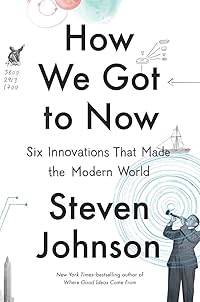
How We Got to Now: Six Innovations That Made the Modern World
by Steven Johnson
On This Page
Description
"From the New York Times-bestselling author of Where Good Ideas Come From and Everything Bad Is Good for You, a new look at the power and legacy of great ideas. In this illustrated volume, Steven Johnson explores the history of innovation over centuries, tracing facets of modern life (refrigeration, clocks, and eyeglass lenses, to name a few) from their creation by hobbyists, amateurs, and entrepreneurs to their unintended historical consequences. Filled with surprising stories of accidental show more genius and brilliant mistakes-from the French publisher who invented the phonograph before Edison but forgot to include playback, to the Hollywood movie star who helped invent the technology behind Wi-Fi and Bluetooth-How We Got to Now investigates the secret history behind the everyday objects of contemporary life. In his trademark style, Johnson examines unexpected connections between seemingly unrelated fields: how the invention of air-conditioning enabled the largest migration of human beings in the history of the species-to cities such as Dubai or Phoenix, which would otherwise be virtually uninhabitable; how pendulum clocks helped trigger the industrial revolution; and how clean water made it possible to manufacture computer chips. Accompanied by a major six-part television series on PBS, How We Got to Now is the story of collaborative networks building the modern world, written in the provocative, informative, and engaging style that has earned Johnson fans around the globe. "-- show lessTags
Recommendations









Member Recommendations
cbl_tn Both books address some of the same technological advances, such as refrigeration and electricity and artificial light, for a popular audience.
Member Reviews
Steven Johnson looks at the history of six different kinds of technologies that have been instrumental in shaping the world we live in today: glassworking, refrigeration, sound transmission and recording, sewers and hygiene improvements, timekeeping, and artificial light. But he's not simply telling us the backstories of these technologies we've come to take for granted. He also talks a bit about how innovations happen, including what it means to be an idea whose time has come (although he doesn't use that particular phrase) and how inventions like the light bulb are almost always messy endeavors involving lots of people working independently, not the lone genius eureka moments we like to imagine. (This, by the way, is a subject he goes show more on about at much greater length in his earlier book, Where Good Ideas Come From.)
More than that, though, he shows how inventions designed solely to solve one particular limited problem can have direct but unexpected consequences that lead not just to the development of still further technological developments, but also to influences on society, history, and art. To me, this weird, tangled web of causality and influence Johnson illuminates is by far the most fascinating thing about the book, whether he's drawing a direct line from Clarence Birdseye ice-fishing with Inuits to the existence of sperm banks, or outlining how the invention of the laser led to the growth and expansion of big-box retail stores.
It reminds me a little of James Burke's TV show/ book Connections and its follow-up, The Pinball Effect, but where Burke is random and rambly, Johnson is more focused and concise. Each of the chapters here is short, and the entire book is only about 200 pages. Meaning this isn't the book you want if you're looking for a really detailed and in-depth history of any of the topics it covers. But Johnson does manage to pack a lot of worthwhile thought and information into such a small amount of space, and he does it in his usual zippy, highly readable style.
I'd actually already read a fair bit about most of these subjects, and wondered going in if I were going to find some of the chapters a bit boring since they were talking about things I already knew, but Johnson includes so many odd and interesting little details that I'd either forgotten or never heard of, and he provides so many new perspectives and draws so many surprising connections between things that I never felt the least bit bored.
Rating: 4.5/5. If only just for including so many little things that made me go, "Oh, neat!" show less
More than that, though, he shows how inventions designed solely to solve one particular limited problem can have direct but unexpected consequences that lead not just to the development of still further technological developments, but also to influences on society, history, and art. To me, this weird, tangled web of causality and influence Johnson illuminates is by far the most fascinating thing about the book, whether he's drawing a direct line from Clarence Birdseye ice-fishing with Inuits to the existence of sperm banks, or outlining how the invention of the laser led to the growth and expansion of big-box retail stores.
It reminds me a little of James Burke's TV show/ book Connections and its follow-up, The Pinball Effect, but where Burke is random and rambly, Johnson is more focused and concise. Each of the chapters here is short, and the entire book is only about 200 pages. Meaning this isn't the book you want if you're looking for a really detailed and in-depth history of any of the topics it covers. But Johnson does manage to pack a lot of worthwhile thought and information into such a small amount of space, and he does it in his usual zippy, highly readable style.
I'd actually already read a fair bit about most of these subjects, and wondered going in if I were going to find some of the chapters a bit boring since they were talking about things I already knew, but Johnson includes so many odd and interesting little details that I'd either forgotten or never heard of, and he provides so many new perspectives and draws so many surprising connections between things that I never felt the least bit bored.
Rating: 4.5/5. If only just for including so many little things that made me go, "Oh, neat!" show less
How We Got to Now: Six Innovations that Made the Modern World by Steven Johnson
This book is the companion book to a new PBS series of the same name. I really wanted to give this book a five star review but am going to knock it back a star. My complaint about the book is three fold: 1) large sections of the book are verbatim from the TV show; 2) some of the connections that Johnson makes are pretty attenuated in my opinion - like he is trying to hard to make the connection between various technologies; 3) Johnson regurgitates some of his material from earlier books.
Now to the caveats on my complaints. I am a pretty big fan of Steven Johnson's work. As I noted in my review of The Invention of Air, he is an excellent writer and has a show more remarkable capacity to cast events in a different light. Johnson wrote The Ghost Map, which remains a favorite of mine. Johnson gives a synopsis of The Ghost Map in the section of How We Got to Now on water. Because Johnson did such a masterful job of explaining the discovery in The Ghost Map the discussion of the same story in How We Got to Now is a bit of a let down.
As for the book being identical to the dialogue of the TV show, this wouldn't be a complaint except that I have been watching all of the episodes of the shows (usually with my kids). This is one of the rare times where I think the TV show is better than the book. This isn't a knock on the book so much as a compliment on the show which does an excellent job illustrating some of the connections that Johnson is talking about. Bits like Johnson going to a water park on the show would feel unnecessary to me but illustrate the point to the kids in a way that makes them understand the concept he is talking about.
As for the last complaint, that some of the connections are a bit attenuated, it is a minor quibble. The advances in technology that Johnson is seeking to illustrate are fascinating even if some of the connections seem less logical than others.
If you don't watch the show the book is solid and worth your time. However, this is one of those rare times where I would encourage people to try watching the TV show first, especially if you have children who are interested in science or that you want to be interested in science. Every once in awhile the TV is the superior medium and with How We Got to Now I think that is the case here. show less
This book is the companion book to a new PBS series of the same name. I really wanted to give this book a five star review but am going to knock it back a star. My complaint about the book is three fold: 1) large sections of the book are verbatim from the TV show; 2) some of the connections that Johnson makes are pretty attenuated in my opinion - like he is trying to hard to make the connection between various technologies; 3) Johnson regurgitates some of his material from earlier books.
Now to the caveats on my complaints. I am a pretty big fan of Steven Johnson's work. As I noted in my review of The Invention of Air, he is an excellent writer and has a show more remarkable capacity to cast events in a different light. Johnson wrote The Ghost Map, which remains a favorite of mine. Johnson gives a synopsis of The Ghost Map in the section of How We Got to Now on water. Because Johnson did such a masterful job of explaining the discovery in The Ghost Map the discussion of the same story in How We Got to Now is a bit of a let down.
As for the book being identical to the dialogue of the TV show, this wouldn't be a complaint except that I have been watching all of the episodes of the shows (usually with my kids). This is one of the rare times where I think the TV show is better than the book. This isn't a knock on the book so much as a compliment on the show which does an excellent job illustrating some of the connections that Johnson is talking about. Bits like Johnson going to a water park on the show would feel unnecessary to me but illustrate the point to the kids in a way that makes them understand the concept he is talking about.
As for the last complaint, that some of the connections are a bit attenuated, it is a minor quibble. The advances in technology that Johnson is seeking to illustrate are fascinating even if some of the connections seem less logical than others.
If you don't watch the show the book is solid and worth your time. However, this is one of those rare times where I would encourage people to try watching the TV show first, especially if you have children who are interested in science or that you want to be interested in science. Every once in awhile the TV is the superior medium and with How We Got to Now I think that is the case here. show less
Perhaps not as analytical and in depth as some of his other works, but Johnson casts a wider net in this book. As a companion to a TV series, one would expect that. It's well illustrated with a lot of thought provoking images, and Johnson is at his polymath best running down some of the big trends that have shaped the modern world. It's a fun, insightful read, and I recommend it.
Author Steven Johnson takes a big picture look at six areas of scientific discovery and technological innovation that have had a major impact on civilization: glass, artificial cold, sound, cleanliness, time measurement, and artificial light. As new technologies are discovered and adopted, they trigger unintended or unexpected consequences. For example, Johnson traces the history of artificial cold from ice harvesting to refrigeration to air conditioning, which made geographic regions with inhospitably hot climates inhabitable. The population shift in the United States from the colder northern states to the warmer southern and southwestern states led to a reconfiguration of the electoral college and U.S. politics. This is popular show more science at its best. Recommended. show less
This book functions as a companion to the six-part PBS series, "How We Got To Now." I highly recommend watching that. The book is good too, though there's something impressive about actually watching the author explain his research. He's very engaging, and clearly an enthusiast for learning. Yay for PBS!
This book/series will almost certainly reveal things that the reader didn't know, untold stories behind basic innovations that make modern life possible, in these categories: glass, sound, light, time, clean, and cold.
Johnson introduced me to an interesting phrase, "the adjacent possible." It means that inventors and visionaries have to work with the tools and concepts that are already available to them, meaning that innovation happens, show more not in a lightbulb moment or with a huge jump forward, but only after a lot of other people have worked in related fields first. For instance, in the mid-1800s, ultrasound was not part of the adjacent possible. But transcription of sound waves (albeit without playback) was. Smaller developments expand the adjacent possible until you get to the memorable, world-changing inventions.
Johnson also acknowledges that the development of technology almost always leads to unforeseen uses. On the same subject of sound waves, he highlights that ultrasound is responsible for saving millions of lives in ships on the ocean, but it has also enabled millions of gender-based abortions in China.
This is a particularly somber example of the connections Johnson makes, but the book is not heavy or depressing at all. It is interesting and sometimes very unexpected, even funny!
I enjoyed the conclusion where he talks about Ada Lovelace. I knew something about her, as her story has gained a bit more notoriety in recent years, but the details were super interesting. She was the daughter of the scandalous Lord Byron, the man who was labeled "mad, bad, and dangerous to know." (A phrase that has stuck in my mind for years!) To counteract her father's profligate "romantic" influence, Ada's mother insisted she study mathematics. She had a genius aptitude for it, and when Victorian wifehood and motherhood began to pall, she made her skills available to the inventor of an "analytical engine" and basically became the world's first software programmer. The fascinating part is that the machine that could read such code wouldn't be actually built for another century. As Johnson says, it was "trying to build a digital-age computer with industrial-age mechanical parts." Like Leonardo da Vinci designing a helicopter. Not in the realm of the adjacent possible. But brilliant anyway.
Took me a while to settle into "nonfiction mode," but once I did the pages flew by. I finished four of the six sections in one day. show less
This book/series will almost certainly reveal things that the reader didn't know, untold stories behind basic innovations that make modern life possible, in these categories: glass, sound, light, time, clean, and cold.
Johnson introduced me to an interesting phrase, "the adjacent possible." It means that inventors and visionaries have to work with the tools and concepts that are already available to them, meaning that innovation happens, show more not in a lightbulb moment or with a huge jump forward, but only after a lot of other people have worked in related fields first. For instance, in the mid-1800s, ultrasound was not part of the adjacent possible. But transcription of sound waves (albeit without playback) was. Smaller developments expand the adjacent possible until you get to the memorable, world-changing inventions.
Johnson also acknowledges that the development of technology almost always leads to unforeseen uses. On the same subject of sound waves, he highlights that ultrasound is responsible for saving millions of lives in ships on the ocean, but it has also enabled millions of gender-based abortions in China.
This is a particularly somber example of the connections Johnson makes, but the book is not heavy or depressing at all. It is interesting and sometimes very unexpected, even funny!
I enjoyed the conclusion where he talks about Ada Lovelace. I knew something about her, as her story has gained a bit more notoriety in recent years, but the details were super interesting. She was the daughter of the scandalous Lord Byron, the man who was labeled "mad, bad, and dangerous to know." (A phrase that has stuck in my mind for years!) To counteract her father's profligate "romantic" influence, Ada's mother insisted she study mathematics. She had a genius aptitude for it, and when Victorian wifehood and motherhood began to pall, she made her skills available to the inventor of an "analytical engine" and basically became the world's first software programmer. The fascinating part is that the machine that could read such code wouldn't be actually built for another century. As Johnson says, it was "trying to build a digital-age computer with industrial-age mechanical parts." Like Leonardo da Vinci designing a helicopter. Not in the realm of the adjacent possible. But brilliant anyway.
Took me a while to settle into "nonfiction mode," but once I did the pages flew by. I finished four of the six sections in one day. show less
The Amazon reviewer who ranted about the section on the ancient and medieval history of glass was not wrong. Calling the glassmakers from Byzantium who settled at Murano (Venice) "Turkish" is so far beyond stupid that there is no word for it. This sort of egregious error makes me a bit suspicious of what might be wrong or misleading that I am not qualified to evaluate. I do know that there is a huge difference between leeching and leaching (the mistake occurring in the chapter on CLEAN), and had the publisher employed either a fact-checker OR a proof-reader they would have got that much right.
As far as I can tell, most of the history from the last 100 or 150 years is accurate.
If you want a superficial treatment of the history of show more technology, but plan not to remember most of it, you will find this book entertaining. show less
As far as I can tell, most of the history from the last 100 or 150 years is accurate.
If you want a superficial treatment of the history of show more technology, but plan not to remember most of it, you will find this book entertaining. show less
Wonderful book! For people who like to see the big picture the authors overarching theme of technology's role in human development illustrates connections in history that were, for the most part, new to me. The technology explanations are great for laypeople- just enough detail to get the idea but not overly long. My favorite part was the author's theory of how invention works as a collaborative affair that builds on networks of similar thoughts as they percolate through society. Having read Bill Bryson's "Home" a few months prior was very helpful as it gave more background to some of the inventions and inventors that were glossed over in How We Got To Now.
Members
- Recently Added By
Published Reviews
ThingScore 100
While we appreciate it in the abstract, few of us pause to grasp the miracles of modern life, from artificial light to air conditioning, as Steven Johnson puts it in the excellent How We Got to Now: Six Innovations That Made the Modern World, “how amazing it is that we drink water from a tap and never once worry about dying forty-eight hours later from cholera.” Understanding how these show more everyday marvels first came to be, then came to be taken for granted, not only allows us to see our familiar world with new eyes — something we are wired not to do — but also lets us appreciate the remarkable creative lineage behind even the most mundane of technologies underpinning modern life. show less
added by tim.taylor
Lists

Book Club List
8 works; 1 member

Books Read in 2016
4,666 works; 197 members

read in 2024
21 works; 1 member

The War on Cars podcast
108 works; 1 member
Author Information

19+ Works 16,019 Members
Awards and Honors
Awards
Distinctions
Work Relationships
Common Knowledge
- Canonical title
- How We Got to Now: Six Innovations That Made the Modern World
Classifications
Statistics
- Members
- 1,263
- Popularity
- 19,509
- Reviews
- 52
- Rating
- (3.97)
- Languages
- 5 — English, German, Polish, Portuguese, Spanish
- Media
- Paper, Audiobook, Ebook
- ISBNs
- 30
- UPCs
- 1
- ASINs
- 10