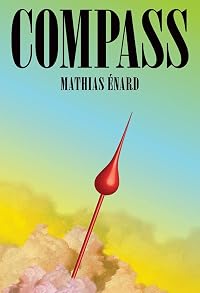
Compass
by Mathias Énard
On This Page
Description
"As night falls over Vienna, Franz Ritter, an insomniac musicologist, takes to his sickbed with an unspecified illness and spends a restless night drifting between dreams and memories, revisiting the important chapters of his life: his ongoing fascination with the Middle East and his numerous travels to Istanbul, Aleppo, Damascus, and Tehran, as well as the various writers, artists, musicians, academics, orientalists, and explorers who populate this vast dreamscape. At the center of these show more memories is his elusive, unrequited love, Sarah, a fiercely intelligent French scholar caught in the intricate tension between Europe and the Middle East"--Amazon.com. show lessTags
Recommendations


























Member Recommendations

by anonymous user
Member Reviews
Boussole, which won the 2015 Goncourt, is a complex and ambitious novel. In the course of a sleepless night, the Viennese musicologist Franz Ritter allows his mind to range freely over the history of orientalism, which he interprets broadly as the persistent and often excessive fascination European intellectuals have had for "Eastern" culture. He even goes so far as to sketch out the outline of an imaginary academic text sending up the subject, Des différentes fformes de ffolie en orient (with chapters on erotic passions, disguise, disease, decapitation and on orientalists as leaders of the Faithful).
As he discusses a long string of western intellectuals with obvious and non-obvious orientalist credentials, Franz also unpacks his own show more career as an orientalist. He has spent time in Istanbul, Damascus and Tehran studying the interchanges between the Western and Eastern musical traditions, but we come to realise that his travels were largely a cover for his erotic pursuit of Sarah, a French literary scholar with a particular interest in 19th- and early-20th-century women travellers in the Orient. As he points out himself, he is perilously close to finding himself trapped in the plot of David Lodge's satire of the international academic conference circuit, Small World...
Amongst other things, Enard, through Franz, is chipping away at Edward Said's direct identification of orientalism with colonial exploitation. (There's a hilarious moment when Sarah drops Said's name during a desert camp-fire discussion between Damascus-based European orientalists on a trip to Palmyra - ...Sarah avait lâché le Grand Nom, le loup était apparu au milieu du troupeau, dans le désert glacial : Edward Saïd. C’était comme invoquer le Diable dans un couvent de carmélites...)
Both Sarah and Franz see orientalism as part of a collaborative cultural process, in which it isn't always possible to see who's exploiting whom. So many eastern intellectuals were (partly-)trained in the west, and vice-versa; so many texts and traditions moved backwards and forwards between eastern and western cultures over the centuries. A classic example Franz cites is the popular Bosnian song Kraj tanana šadrvana, which tells the story of a slave's impossible love for the sultan's daughter and helps Balkan muslims feel connected with their Ottoman past, but turns out not to be Ottoman in its origins at all - it is a translation of a German poem by Heinrich Heine, who was of course influenced by the work of 19th-century German orientalists in translating Persian poetry. The Bosnian translator was Safvet-beg Bašagić, an orientalist born in Herzegovina, who studied Arabic and Persian at the University of Vienna under the Austro-Hungarian empire. And so it goes around...
This is an enjoyable sort of book if you are someone who doesn't mind being hit by strings of dropped names (and you have at least a vague idea of who was who in 19th century literature and music), and there are plenty of jokes, but it would probably be frustrating if you were looking for hardcore academic rigour. If you're being picky, it's perhaps also a bit too long and shapeless, and it probably does too much Sebalding - texts-within-texts-within-texts, images in the text, muddy boundaries between fiction and history, etc. show less
As he discusses a long string of western intellectuals with obvious and non-obvious orientalist credentials, Franz also unpacks his own show more career as an orientalist. He has spent time in Istanbul, Damascus and Tehran studying the interchanges between the Western and Eastern musical traditions, but we come to realise that his travels were largely a cover for his erotic pursuit of Sarah, a French literary scholar with a particular interest in 19th- and early-20th-century women travellers in the Orient. As he points out himself, he is perilously close to finding himself trapped in the plot of David Lodge's satire of the international academic conference circuit, Small World...
Amongst other things, Enard, through Franz, is chipping away at Edward Said's direct identification of orientalism with colonial exploitation. (There's a hilarious moment when Sarah drops Said's name during a desert camp-fire discussion between Damascus-based European orientalists on a trip to Palmyra - ...Sarah avait lâché le Grand Nom, le loup était apparu au milieu du troupeau, dans le désert glacial : Edward Saïd. C’était comme invoquer le Diable dans un couvent de carmélites...)
Both Sarah and Franz see orientalism as part of a collaborative cultural process, in which it isn't always possible to see who's exploiting whom. So many eastern intellectuals were (partly-)trained in the west, and vice-versa; so many texts and traditions moved backwards and forwards between eastern and western cultures over the centuries. A classic example Franz cites is the popular Bosnian song Kraj tanana šadrvana, which tells the story of a slave's impossible love for the sultan's daughter and helps Balkan muslims feel connected with their Ottoman past, but turns out not to be Ottoman in its origins at all - it is a translation of a German poem by Heinrich Heine, who was of course influenced by the work of 19th-century German orientalists in translating Persian poetry. The Bosnian translator was Safvet-beg Bašagić, an orientalist born in Herzegovina, who studied Arabic and Persian at the University of Vienna under the Austro-Hungarian empire. And so it goes around...
This is an enjoyable sort of book if you are someone who doesn't mind being hit by strings of dropped names (and you have at least a vague idea of who was who in 19th century literature and music), and there are plenty of jokes, but it would probably be frustrating if you were looking for hardcore academic rigour. If you're being picky, it's perhaps also a bit too long and shapeless, and it probably does too much Sebalding - texts-within-texts-within-texts, images in the text, muddy boundaries between fiction and history, etc. show less
I finished this some time ago, and have been letting it marinate; it certainly isn't for everyone, and it isn't flawless. If you're curious, know that you'll need a high tolerance for curious style (or at least, curious translation); for research novel information dumps ("I thought about this random orientalist nobody's ever heard of, about how he was caught in a sand-storm in 1845 and prayed to the ancient gods of the orient..."); for random pot-shots at Brahms; and for a very unfortunately written love interest (a kind of hyper-intellectualised manic pixie dream girl).
But if you can get through that, this novel is also very, very smart, moving, and just damn interesting. Did you know how interesting Robert Musil's cousin, Alois, was? show more I had no idea.
Perhaps more important is the novel's approach to the question of The Other, that great French invention of the 20th century. The blurb describes the book as an "ode to Otherness," which is about as accurate as calling To the Lighthouse an ode to the great war. I mean, it's there, sure, but an ode? Rather, it unveils the impossible complications in the concept and the way it's experienced by frankly unhinged Europeans. They have a right to be unhinged, given what 'their' people have done to the world. They wish they were something other than what they are. They try to find something else to be... and end up in grand contradictions. Less an ode to, then, and more an essay on, in the Montaigne tradition. show less
But if you can get through that, this novel is also very, very smart, moving, and just damn interesting. Did you know how interesting Robert Musil's cousin, Alois, was? show more I had no idea.
Perhaps more important is the novel's approach to the question of The Other, that great French invention of the 20th century. The blurb describes the book as an "ode to Otherness," which is about as accurate as calling To the Lighthouse an ode to the great war. I mean, it's there, sure, but an ode? Rather, it unveils the impossible complications in the concept and the way it's experienced by frankly unhinged Europeans. They have a right to be unhinged, given what 'their' people have done to the world. They wish they were something other than what they are. They try to find something else to be... and end up in grand contradictions. Less an ode to, then, and more an essay on, in the Montaigne tradition. show less
Sebald's Pernicious Influence
"Compass" is insufferable. One of the challenging properties of painting is that influences are immediately visible: there's no hiding indebtedness from Pollock or Schiele. Novels are complex in time and structure, and influences can be masked by masses of detail. But "Compass" is at first intermittently, and then forgivably, and finally overwhelmingly and depressingly indebted to W.G. Sebald. Enard has Sebald's penchant for travel in Europe, in space and in time, and he loves weaving histories of places and people together. He has Sebald's sweet melancholy, and Sebald's nostalgia mixed with pain.
But there is a signal difference: Enard is a snob. I mean that in two specific senses: he wants to enlighten his show more readers, and he wants them to know how much he knows. There is an especially delicious anecdote on pp. 109-11: Beethoven gave the premiere of his own Moonlight Sonata, Op. 27 no. 2 at a time when he was starting to go deaf; it has been recorded that his piano was out of tune, and he didn't realize it. A woman he loved was in the audience. Enard wants to say that the concert always reminds him of the "shame and embarrassment of all declarations of love that fall flat." It's a nice illustration, potentially, but to get to that point Enard needs to tell us who was present at the concert: Antoine and Therese Apponyi, the hosts, later friends, Enard notes, with Liszt, Lamartine, "the scandalous" George Sand, Balzac, Hugo, Metternich, Talleyrand (and that leads him to mention Napoleon, Goethe, Hafez, Schubert, Mendelssohn, Louis XVIII, Louis-Philippe, and Chateaubriand), the orientalist Joseph Hammer-Purgstall (not yet von Hammer-Purgstall), Chopin, Rueckert, and Mowlana Jalal ad-Din Rumi.
This doesn't add atmosphere or content, really, and it doesn't help Enard make his point about embarrassed love. It is name-dropping. More often, Enard doesn't name-drop: he really does love all his 19th century historical figures, but unfortunately his love leads him to want his readers to know as much as possible. And for me, that recurring pedagogic impulse makes the book unbearable. I often thought that his ideal reader was a combination of a young, curious European academic, avid reader, or book reviewer, eager to learn more about Europe's relation to the Orient, and Sebald himself, who I imagine Enard wanting to correct -- I picture Enard becoming annoyed at Sebald's persistent bias toward western and central Europe, and his obliviousness about eastern Europe, the Balkans, or the Middle East. My copy of "Compass" has many pages marked "lecturing Sebald."
A sign that Enard's real interests are educating ideal readers is the thinness of the novel's framing devices. The narrator is in love, and stories about his fellow scholar Sarah are threaded through the book. He is also ill with an unspecified disease, and he keeps thinking of that as well. But neither of those become much more than devices. The mentions of his disease are especially unconvincing because they come up so often, and to so little effect. Clearly Enard considered them useful strategies to keep the narrative afloat -- they are excuses and frames for the hundreds of historical, political, musical, literary, and linguistic stories he wants to tell.
All this becomes especially difficult to tolerate when his two ideal readers (the educable and somewhat star-struck younger reader or newspaper book reviewer, and Sebald himself) cannot be combined in a general mode of address -- when it becomes clear that he wants to say one sort of thing to Sebald (and other older, more knowledgeable readers) and another to reviewers (and other younger and less well-informed readers).
An example from early on in the book: on p. 29, he is thinking about Mahler's "Kindertotenlieder." First he feels he needs to tell us the title in English (French in the original):
"...and now I have Mahler and his 'Kindertotenlieder' in my head, songs for dead children..."
and then he needs to tell us about Mahler's daughter:
"...composed by a man who held his own dead daughter in his arms in Maiernigg in Carinthia three years after composing them..."
This is potted, or condensed, history: and who, exactly, is it for? If a reader knows Mahler, she knows the Kindertotenlieder, and if she knows them, she knows they are for dead children. I guess that almost everyone who knows Mahler knows his daughter died, even if only a few would know about Maiernigg, or that it's in Carinthia (the latter is important elsewhere in "Compass"). So on the one hand there's an imaginary reader who knows Mahler, and doesn't need to have this all rehearsed; on the other there's a reader who doesn't know Mahler, for whom this is a somewhat startling but essentially inexpressive or opaque passage. The former is "Sebald," and the latter is the younger reader I've been imagining. Somewhere in between is their composite: a reader who knows something about Mahler, so that the mention of "Kindertotenlieder" strikes a chord, and yet somehow doesn't know about Mahler's daughter, or hasn't thought about how the "horrible dimension" of the songs "wouldn't be understood until long after" Mahler's death in 1911.
Contrast this uneasy sense of a reader with the end of the same paragraph:
"...these 'Kindertotenlieder' are set to poems by Rueckert, the first great German Orientalist poet along with Goethe..." (p. 30)
I imagine not many people who know Mahler will know this, or appreciate the song cycle's place in the history of Orientalism: but in that case this sentence strikes a clearly pedantic tone. It's instructional, and now the reader knows better than before.
Enard can't stop himself from dropping hints that he knows a lot about these subjects. He does it through his narrator, Ritter, but those passages come across clearly as claims about his own knowledge. He has Ritter muse about just how much knowledge he has of the performance history of Beethoven, for example, and the entire of "Compass" is scattered with ideas for books Ritter (which is to say, Enard) might write. Farther down on p. 30, Ritter muses that "as a teenager" "Kindertotenlieder" "was the only piece by Mahler I could bear": a thought that also serves to remind us that it's not just the narrator who knows his Mahler backwards and forwards.
I don't mean to imply that these problems of tone and address could be easily solved. Enard wants to tell these stories, and it is not easy to know how to set them up, how to make them seem to be naturally lodged in Ritter's stream of consciousness, how to avoid interpolating explanations that Ritter would never bother to give himself. And yet that is exactly what Sebald manages to do, and that's why I think of Enard as a pedagogue, if not a snob, in a way Sebald never is.
I have two more complaints.
First regarding Enard's range of historical reference. His narrator is fascinated by the 19th century, which is the author's prerogative. But to the extent that Ritter speaks for Enard, it is unfortunate that his interest drops off so rapidly when it comes to art, music, architecture, and literature of the last hundred years. Ritter's mind is at home with Liszt, Chopin, and Beethoven, and although he mentions Part, Schoenberg, and others, they really aren't part of his imagination. Enard, the implied author, is old fashioned. He studies Orientalism, and he offers some correctives not only to the Occidentalism of Sebald, but to the prejudices and limitations of academic Orientalists. But he himself is embedded in the 19th century: an especially dire condition given that the debates about Orientalism that enable Enard's discontents are themselves late 20th century developments, and they go with a very different culture. Intellectually, Enard offers critiques of Eurocentrism that were initially enabled by Edward Said and developed in the very large literature following his work; but culturally and emotionally, Enard's world is the exact one that perpetrated all the Orientalist prejudices and projections that even the first wave of Orientalist scholarship in the 1970s clearly rejected.
Second, and last, regarding the images. Because I am making a special study of novels with images, I was intrigued to see photographs scattered through the text. But they are also disappointing. The first two are exactly apposite to the book's themes: they are pictures of open two-page spreads from Balzac's "La Peau de chagrin." The first edition has Arabic on the page, a first, as Enard says, in European literature (although I wonder about Renaissance texts: doesn't the Hypnerotomachia poliphili have Arabic?). The second omits the Arabic script. The two images fit the book's themes: they're texts, they're 19th, they're literary, they have to do with translation, and they are framed, in the novel, by a text within the text. But it's a squandered opportunity. I waited another 12 pages for the next images, and during those pages I was wondering: how did those images get into the text? Did Ritter supposedly have a copy machine? A camera? I was taken out of the narrative as I began to wonder about why Enard didn't think a reader might wonder about such things. And then, 12 pages later, on p. 102, Enard has Ritter introduce the third image with a deictic gesture that might well have made Sebald laugh: "Oh look," he writes, "in this article Sarah reproduces the engraving..." and viola, there's the engraving on the next page. show less
"Compass" is insufferable. One of the challenging properties of painting is that influences are immediately visible: there's no hiding indebtedness from Pollock or Schiele. Novels are complex in time and structure, and influences can be masked by masses of detail. But "Compass" is at first intermittently, and then forgivably, and finally overwhelmingly and depressingly indebted to W.G. Sebald. Enard has Sebald's penchant for travel in Europe, in space and in time, and he loves weaving histories of places and people together. He has Sebald's sweet melancholy, and Sebald's nostalgia mixed with pain.
But there is a signal difference: Enard is a snob. I mean that in two specific senses: he wants to enlighten his show more readers, and he wants them to know how much he knows. There is an especially delicious anecdote on pp. 109-11: Beethoven gave the premiere of his own Moonlight Sonata, Op. 27 no. 2 at a time when he was starting to go deaf; it has been recorded that his piano was out of tune, and he didn't realize it. A woman he loved was in the audience. Enard wants to say that the concert always reminds him of the "shame and embarrassment of all declarations of love that fall flat." It's a nice illustration, potentially, but to get to that point Enard needs to tell us who was present at the concert: Antoine and Therese Apponyi, the hosts, later friends, Enard notes, with Liszt, Lamartine, "the scandalous" George Sand, Balzac, Hugo, Metternich, Talleyrand (and that leads him to mention Napoleon, Goethe, Hafez, Schubert, Mendelssohn, Louis XVIII, Louis-Philippe, and Chateaubriand), the orientalist Joseph Hammer-Purgstall (not yet von Hammer-Purgstall), Chopin, Rueckert, and Mowlana Jalal ad-Din Rumi.
This doesn't add atmosphere or content, really, and it doesn't help Enard make his point about embarrassed love. It is name-dropping. More often, Enard doesn't name-drop: he really does love all his 19th century historical figures, but unfortunately his love leads him to want his readers to know as much as possible. And for me, that recurring pedagogic impulse makes the book unbearable. I often thought that his ideal reader was a combination of a young, curious European academic, avid reader, or book reviewer, eager to learn more about Europe's relation to the Orient, and Sebald himself, who I imagine Enard wanting to correct -- I picture Enard becoming annoyed at Sebald's persistent bias toward western and central Europe, and his obliviousness about eastern Europe, the Balkans, or the Middle East. My copy of "Compass" has many pages marked "lecturing Sebald."
A sign that Enard's real interests are educating ideal readers is the thinness of the novel's framing devices. The narrator is in love, and stories about his fellow scholar Sarah are threaded through the book. He is also ill with an unspecified disease, and he keeps thinking of that as well. But neither of those become much more than devices. The mentions of his disease are especially unconvincing because they come up so often, and to so little effect. Clearly Enard considered them useful strategies to keep the narrative afloat -- they are excuses and frames for the hundreds of historical, political, musical, literary, and linguistic stories he wants to tell.
All this becomes especially difficult to tolerate when his two ideal readers (the educable and somewhat star-struck younger reader or newspaper book reviewer, and Sebald himself) cannot be combined in a general mode of address -- when it becomes clear that he wants to say one sort of thing to Sebald (and other older, more knowledgeable readers) and another to reviewers (and other younger and less well-informed readers).
An example from early on in the book: on p. 29, he is thinking about Mahler's "Kindertotenlieder." First he feels he needs to tell us the title in English (French in the original):
"...and now I have Mahler and his 'Kindertotenlieder' in my head, songs for dead children..."
and then he needs to tell us about Mahler's daughter:
"...composed by a man who held his own dead daughter in his arms in Maiernigg in Carinthia three years after composing them..."
This is potted, or condensed, history: and who, exactly, is it for? If a reader knows Mahler, she knows the Kindertotenlieder, and if she knows them, she knows they are for dead children. I guess that almost everyone who knows Mahler knows his daughter died, even if only a few would know about Maiernigg, or that it's in Carinthia (the latter is important elsewhere in "Compass"). So on the one hand there's an imaginary reader who knows Mahler, and doesn't need to have this all rehearsed; on the other there's a reader who doesn't know Mahler, for whom this is a somewhat startling but essentially inexpressive or opaque passage. The former is "Sebald," and the latter is the younger reader I've been imagining. Somewhere in between is their composite: a reader who knows something about Mahler, so that the mention of "Kindertotenlieder" strikes a chord, and yet somehow doesn't know about Mahler's daughter, or hasn't thought about how the "horrible dimension" of the songs "wouldn't be understood until long after" Mahler's death in 1911.
Contrast this uneasy sense of a reader with the end of the same paragraph:
"...these 'Kindertotenlieder' are set to poems by Rueckert, the first great German Orientalist poet along with Goethe..." (p. 30)
I imagine not many people who know Mahler will know this, or appreciate the song cycle's place in the history of Orientalism: but in that case this sentence strikes a clearly pedantic tone. It's instructional, and now the reader knows better than before.
Enard can't stop himself from dropping hints that he knows a lot about these subjects. He does it through his narrator, Ritter, but those passages come across clearly as claims about his own knowledge. He has Ritter muse about just how much knowledge he has of the performance history of Beethoven, for example, and the entire of "Compass" is scattered with ideas for books Ritter (which is to say, Enard) might write. Farther down on p. 30, Ritter muses that "as a teenager" "Kindertotenlieder" "was the only piece by Mahler I could bear": a thought that also serves to remind us that it's not just the narrator who knows his Mahler backwards and forwards.
I don't mean to imply that these problems of tone and address could be easily solved. Enard wants to tell these stories, and it is not easy to know how to set them up, how to make them seem to be naturally lodged in Ritter's stream of consciousness, how to avoid interpolating explanations that Ritter would never bother to give himself. And yet that is exactly what Sebald manages to do, and that's why I think of Enard as a pedagogue, if not a snob, in a way Sebald never is.
I have two more complaints.
First regarding Enard's range of historical reference. His narrator is fascinated by the 19th century, which is the author's prerogative. But to the extent that Ritter speaks for Enard, it is unfortunate that his interest drops off so rapidly when it comes to art, music, architecture, and literature of the last hundred years. Ritter's mind is at home with Liszt, Chopin, and Beethoven, and although he mentions Part, Schoenberg, and others, they really aren't part of his imagination. Enard, the implied author, is old fashioned. He studies Orientalism, and he offers some correctives not only to the Occidentalism of Sebald, but to the prejudices and limitations of academic Orientalists. But he himself is embedded in the 19th century: an especially dire condition given that the debates about Orientalism that enable Enard's discontents are themselves late 20th century developments, and they go with a very different culture. Intellectually, Enard offers critiques of Eurocentrism that were initially enabled by Edward Said and developed in the very large literature following his work; but culturally and emotionally, Enard's world is the exact one that perpetrated all the Orientalist prejudices and projections that even the first wave of Orientalist scholarship in the 1970s clearly rejected.
Second, and last, regarding the images. Because I am making a special study of novels with images, I was intrigued to see photographs scattered through the text. But they are also disappointing. The first two are exactly apposite to the book's themes: they are pictures of open two-page spreads from Balzac's "La Peau de chagrin." The first edition has Arabic on the page, a first, as Enard says, in European literature (although I wonder about Renaissance texts: doesn't the Hypnerotomachia poliphili have Arabic?). The second omits the Arabic script. The two images fit the book's themes: they're texts, they're 19th, they're literary, they have to do with translation, and they are framed, in the novel, by a text within the text. But it's a squandered opportunity. I waited another 12 pages for the next images, and during those pages I was wondering: how did those images get into the text? Did Ritter supposedly have a copy machine? A camera? I was taken out of the narrative as I began to wonder about why Enard didn't think a reader might wonder about such things. And then, 12 pages later, on p. 102, Enard has Ritter introduce the third image with a deictic gesture that might well have made Sebald laugh: "Oh look," he writes, "in this article Sarah reproduces the engraving..." and viola, there's the engraving on the next page. show less
We Europeans see them with the horror of otherness; but this otherness is just as terrifying for an Iraqi or a Yemenite. Even what we reject, what we hate, emerges in this common imaginal world. What we identify in these atrocious decapitations as ‘other’, ‘different’, ‘Oriental’, is just as ‘other’, ‘different’, and ‘Oriental’ for an Arab, a Turk, or an Iranian,
My initial bliss digging into this rich novel soon gave way to more serious labor. Whereas Jim Gauer's masterful Novel Explosives was a fanfare of images and poetry, this is a sustained exercise , an unflinching exploration of the relations between East and West and perhaps, ultimately, what Pessoa quipped is the "East east of the East." Pessoa looms show more large here, but alas, so do ranks of figures from Cervantes and Beethoven to Balzac.
The novel is a nightlong insomniac agony of a (perhaps dying) Austrian musicologist Franz Ritter who ponders the efficacy of scholarship in our world-- while his misspent attentions and affections have crisscrossed the globe - especially towards and in the form of Sarah, a French ethnologist whom the protagonist has loved for decades and cravenly been unable to articulate.
There are lateral paths and stories revealed on nearly every page, how the vampire novel has roots in the cross-pollination of Turkish and central European music. Thomas Mann and his children wave a significant shadow over these proceedings. Leverkuhn as Nietzsche/Schoenberg proceeds, finding nurturing in Flaubert's Egyptian orgy and thus affording a mirrored reading of Leg Over Leg: Shidyaq is thusly embraced.
There are links between Rimbaud's amputation and Edward Said's piano playing -- if you look for them. Despite such erudite architecture, this is also a novel of opium, wine and unfortunately beheadings. Etymology, poetry and emancipatory politics make for cumbersome bedmates but the reader can only benefit from such congestion. Matters did appear to lose momentum but I felt it to be tremendously moving throughout. 4.5 stars show less
My initial bliss digging into this rich novel soon gave way to more serious labor. Whereas Jim Gauer's masterful Novel Explosives was a fanfare of images and poetry, this is a sustained exercise , an unflinching exploration of the relations between East and West and perhaps, ultimately, what Pessoa quipped is the "East east of the East." Pessoa looms show more large here, but alas, so do ranks of figures from Cervantes and Beethoven to Balzac.
The novel is a nightlong insomniac agony of a (perhaps dying) Austrian musicologist Franz Ritter who ponders the efficacy of scholarship in our world-- while his misspent attentions and affections have crisscrossed the globe - especially towards and in the form of Sarah, a French ethnologist whom the protagonist has loved for decades and cravenly been unable to articulate.
There are lateral paths and stories revealed on nearly every page, how the vampire novel has roots in the cross-pollination of Turkish and central European music. Thomas Mann and his children wave a significant shadow over these proceedings. Leverkuhn as Nietzsche/Schoenberg proceeds, finding nurturing in Flaubert's Egyptian orgy and thus affording a mirrored reading of Leg Over Leg: Shidyaq is thusly embraced.
There are links between Rimbaud's amputation and Edward Said's piano playing -- if you look for them. Despite such erudite architecture, this is also a novel of opium, wine and unfortunately beheadings. Etymology, poetry and emancipatory politics make for cumbersome bedmates but the reader can only benefit from such congestion. Matters did appear to lose momentum but I felt it to be tremendously moving throughout. 4.5 stars show less
Wow. Overwhelming and monumental. History, musicology, and "orientalism" encrusting a story of yearning, regret, and the distance between us. I feel like it would take months to look up his references. So I didn't and just enjoyed the tale.
I did not like this nearly as much as Énard's Annual Banquet of the Gravedigger's Guild. The entire story is contained in a single night's meandering reminiscences by Franz Ritter, an insomniac musicologist in Vienna. The mental ramblings cover much of Ritter's life and travels, particularly his study of Oriental influences on Western music, his travels in the Middle East, and his on/off dysfunctional relationship with Sarah, a French academic and Orientalist. Ritter, Sarah and their friends are self-absorbed and largely dysfunctional, often pathetic and annoying, extreme examples of the kind of people you all too often encounter among academics (I know, I spent enough time there). The narrative flags at times, often goes off on show more academic tangents that are more interesting than the fictional characters. The main characters in the story are fictional (although one wonders if it is a roman à clef), but many actual people and events pop into the story and backstory. At times is almost a potted history of orientalists and orientalism (Edward Said makes several cameos). If you aren't an academic or recovering academic, I would not recommend it. Even then it is a slog. show less
I have not read as complex, multilayered, and challenging a novel in quite a while. The sleepless musicologist Franz works through his memories and vast knowledge of Vienna, Syria, Iran, music, literature, history, memories, Paris, graveyards, colonialism, otherness, and select trivia while pining over his lost love who is just as much an expert on feminism, women in 19th century Europe traveling to Middle Eastern countries, and Buddhism. Definitely worth reading, but it will take you a while. Prepare yourself for page-long sentences.
Members
- Recently Added By
Lists

Best Campus Novels
99 works; 18 members

Kirkus Starred Fiction Reviews of Books Published in 2017
412 works; 7 members

Sleeplessness
16 works; 3 members
Author Information

22+ Works 2,505 Members
Some Editions
Awards and Honors
Awards
Notable Lists
Series
Belongs to Publisher Series
Empúries Narrativa (506)
Work Relationships
Has as a reference guide/companion
Common Knowledge
- Canonical title*
- Boussole
- Original title
- Boussole
- Important places
- France; Vienna, Austria
- Original language
- French
*Some information comes from Common Knowledge in other languages. Click "Edit" for more information.
Classifications
Statistics
- Members
- 670
- Popularity
- 43,005
- Reviews
- 19
- Rating
- (3.79)
- Languages
- 11 — Catalan, Czech, Danish, Dutch, English, French, German, Italian, Polish, Portuguese, Spanish
- Media
- Paper, Audiobook, Ebook
- ISBNs
- 31
- ASINs
- 10