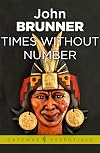
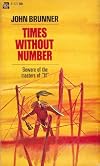
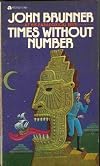
Times without number
by John Brunner
On This Page
Description
If the past is tampered with, the present might be totally transformed. So the whole fabric of reality depends on the watchful efforts of the Society of Time. Don Miguel Navarro is a junior officer in this force dedicated to defending the Spanish Empire and the mother church from the results of meddling in history by time-travellers. But he begins to wonder just how dedicated the Society really is when he has to deal with a case of corruption involving fellow officers . . . After he has to show more rescue the entire court from death at the hands of Amazon warriors brought through time, his greatest trial becomes unavoidable. Facing a threat to the most vulnerable event in his world's history, can the young Don prevent catastrophe? Or will the glorious triumph of the Spanish Armada never have occurred? (First published 1969) show lessTags
Recommendations








Member Reviews
That was a nice ride. It took me several days to read its 156pp due to a 2017 siege of thrice-damned migraines. Loaded onto your device, however, it's a long-post-office-line's worth of interruptable reading.
The ISFDB entry on the book describes it as a collection of three stories, only loosely interconnected. I don't feel argumentative, so I'll stipulate that the book started out that way and, in the 1969 edition I read, was made into a reasonable stitch-up.
Brunner wasn't the best-loved British SF writer of his day but he was popular in the US because of Stand on Zanzibar (1969 BSFA Award for Best Novel as well as the Hugo that year), and The Sheep Look Up (1972). It appears to me that the UK readership liked his third famous book, show more target="_top">The Jagged Orbit, which won the 1970 BSFA Award for Best Novel best of all, as the US reviewers simply chewed it up for continuing the typographical trickery of its elder sibling. Something got up their collective British nose, mutterings about Brunner being too American. For what, one wonders; his writing was at the peak of its development and uniformly of high quality; that seems to me to be without a nationality. What do I know, I like good wherever I find it from Gwyneth Jones (criminally underknown-to-US Welsh author) to Jo Walton (Canadian by way of Wales) to Elisabeth Vonarburg (Francophone Canadian also criminally underknown and seldom translated).
This book is a minor entry into the Brunnerverse, it's true, but it's one I'll treasure now that I've read it because I*AM*MORTALLY*SICK*OF*ALT*HIST*ABOUT*WWII (this from a big fan of THE MAN IN THE HIGH CASTLE, whether PKD's novel or his daughter Isa Dick Hackett's TV series) and/or the US Civil War. Good Kleio above us! History contains so incalculably many stories with so incalculably many potential outcomes! Get y'all's heads outta Hitler's stinkin' ass and away from fuckin' Gettysburg! It. Has. Been. Done. To. Death.
The Spanish Armada succeeding is a wonderful, refreshing change of PoD. I suspect that the idea occurred to Brunner when he needed something to fulfill a deadline, because he does not do anything like justice to the potential for the story's effects. The ending of the third part feels as though it was in his mind from the moment that the idea was born...it's a true ending, in other words, not a stopping point...but the immense amounts of fatty, yummy, bacony story left cavalierly on the butcher's block...! The merest hints of the Northern Native American nations's development without a United States resulting from Protestant pollution of these shores alone could fill a trilogy.
Well, anyway, I read it, I liked it, it's O.P. in print though not on your ereader platform of choice in the Gollancz SF Gateway series. Hunt it up, alt hist fans. Civilians...well, it's got the virtue of being short, so maybe it's a good quick intro to the idea that History isn't A Story but really and truly His Story. show less
The ISFDB entry on the book describes it as a collection of three stories, only loosely interconnected. I don't feel argumentative, so I'll stipulate that the book started out that way and, in the 1969 edition I read, was made into a reasonable stitch-up.
Brunner wasn't the best-loved British SF writer of his day but he was popular in the US because of Stand on Zanzibar (1969 BSFA Award for Best Novel as well as the Hugo that year), and The Sheep Look Up (1972). It appears to me that the UK readership liked his third famous book, show more target="_top">The Jagged Orbit, which won the 1970 BSFA Award for Best Novel best of all, as the US reviewers simply chewed it up for continuing the typographical trickery of its elder sibling. Something got up their collective British nose, mutterings about Brunner being too American. For what, one wonders; his writing was at the peak of its development and uniformly of high quality; that seems to me to be without a nationality. What do I know, I like good wherever I find it from Gwyneth Jones (criminally underknown-to-US Welsh author) to Jo Walton (Canadian by way of Wales) to Elisabeth Vonarburg (Francophone Canadian also criminally underknown and seldom translated).
This book is a minor entry into the Brunnerverse, it's true, but it's one I'll treasure now that I've read it because I*AM*MORTALLY*SICK*OF*ALT*HIST*ABOUT*WWII (this from a big fan of THE MAN IN THE HIGH CASTLE, whether PKD's novel or his daughter Isa Dick Hackett's TV series) and/or the US Civil War. Good Kleio above us! History contains so incalculably many stories with so incalculably many potential outcomes! Get y'all's heads outta Hitler's stinkin' ass and away from fuckin' Gettysburg! It. Has. Been. Done. To. Death.
The Spanish Armada succeeding is a wonderful, refreshing change of PoD. I suspect that the idea occurred to Brunner when he needed something to fulfill a deadline, because he does not do anything like justice to the potential for the story's effects. The ending of the third part feels as though it was in his mind from the moment that the idea was born...it's a true ending, in other words, not a stopping point...but the immense amounts of fatty, yummy, bacony story left cavalierly on the butcher's block...! The merest hints of the Northern Native American nations's development without a United States resulting from Protestant pollution of these shores alone could fill a trilogy.
Well, anyway, I read it, I liked it, it's O.P. in print though not on your ereader platform of choice in the Gollancz SF Gateway series. Hunt it up, alt hist fans. Civilians...well, it's got the virtue of being short, so maybe it's a good quick intro to the idea that History isn't A Story but really and truly His Story. show less
Don Miguel Navarro is a man with a most unusual job. As a Licentiate of the Society of Time, he is a time traveling agent for a Spanish Empire that continues to thrive four hundred years after the Armada successfully conquered England in 1588. Tasked with observing the past, he is always on the lookout for improper uses of time travel lest it bring about changes to the present. A casual encounter at a party results in just such a discovery, one that leads Don Miguel to a sinister conspiracy that threatens to alter history and undo the entire empire itself unless it is stopped.
John Brunner's novel is a cut above most of its counterparts. A collection of three interlocking tales that were originally published as separate short stories, show more together they offer a series of entertaining adventures in an imaginative setting. His Spanish Empire is one not much more advanced technologically than its 16th century predecessor, with time travel apparently more an accident of alchemy than science. Such a premise allows Brunner to offer some fresh approaches to the concept, most notably in the notion of the careful management of time travel by religious authorities. This serves as a springboard for some interesting metaphysical observations that, when combined with Brunner's entertaining writing style, makes for a time travel novel that any fan of the genre will enjoy. show less
John Brunner's novel is a cut above most of its counterparts. A collection of three interlocking tales that were originally published as separate short stories, show more together they offer a series of entertaining adventures in an imaginative setting. His Spanish Empire is one not much more advanced technologically than its 16th century predecessor, with time travel apparently more an accident of alchemy than science. Such a premise allows Brunner to offer some fresh approaches to the concept, most notably in the notion of the careful management of time travel by religious authorities. This serves as a springboard for some interesting metaphysical observations that, when combined with Brunner's entertaining writing style, makes for a time travel novel that any fan of the genre will enjoy. show less
What would it be like if Spain had become the imperial conquerer, instead of England? What would there be instead of the United States? Brunner creates an original idea for an alternate history. But whoever rules the empire, you can never escape the greed, cunning and hatred of his fellow man that the Species of humans claims as his own. And that is where the best laid plans of mice and men will end.
Times Without Number is a time travel story set in an alternate-history Earth. (Yes, the implications are pretty obvious. I won't comment on them until the spoiler section.) The book was originally three separate short stories. For this publishing, Brunner reworked the stories to create one narrative from them. Nevertheless, the book breaks easily into three different sections, each following a particular event in the life of "Don Miguel Navarro, Licencate in Ordinary of the Society of Time". (The alternate-history is that the Spanish Armada successfully invaded England and Spain, instead of England, became the colonial empire of the West.)
The setting seems reasonably well-thought-out, if a bit chauvinistic. Women are second-class show more citizens, though that's generally presented as a bad thing. There are slaves, which exist and are never commented on. Native Americans are all referred to as Mohawks, though some do express indignation at this. Time travel is the sole dominion of the Catholic Church; the creator of the original device didn't think anyone else would behave properly with it. This book is probably not for anyone who would get offended at any of this. (It was written 1969; the original stories are from 1962. All well before political correctness came into vogue.)
Within the story are some reasoned explorations of various aspects of time travel. The Society has strict rules governing the use of the technology; naturally, the stories tend to hinge on the breaking of various of those rules. For me, this is the main reason to read the book. There isn't too much here that hasn't been explored in other time travel stories, but this one probably predates most others. Beyond that, the writing is decent, but not excellent, and it feels a bit dated.
Spoilers below.
Okay, so the obvious happened. Someone went back in time to change the outcome of the Spanish Armada's assault on England. I did find myself hoping that such would not be the case, but I suppose the setting preordained it. As I read the last bit, the final events did surprise me. I had expected Don Miguel to go back in time and become the Earl of Barton (who was, after all, a "man about whom almost nothing was known"). Oh, well. The part about entering the "real world" wasn't too bad. show less
The setting seems reasonably well-thought-out, if a bit chauvinistic. Women are second-class show more citizens, though that's generally presented as a bad thing. There are slaves, which exist and are never commented on. Native Americans are all referred to as Mohawks, though some do express indignation at this. Time travel is the sole dominion of the Catholic Church; the creator of the original device didn't think anyone else would behave properly with it. This book is probably not for anyone who would get offended at any of this. (It was written 1969; the original stories are from 1962. All well before political correctness came into vogue.)
Within the story are some reasoned explorations of various aspects of time travel. The Society has strict rules governing the use of the technology; naturally, the stories tend to hinge on the breaking of various of those rules. For me, this is the main reason to read the book. There isn't too much here that hasn't been explored in other time travel stories, but this one probably predates most others. Beyond that, the writing is decent, but not excellent, and it feels a bit dated.
Spoilers below.
Okay, so the obvious happened. Someone went back in time to change the outcome of the Spanish Armada's assault on England. I did find myself hoping that such would not be the case, but I suppose the setting preordained it. As I read the last bit, the final events did surprise me. I had expected Don Miguel to go back in time and become the Earl of Barton (who was, after all, a "man about whom almost nothing was known"). Oh, well. The part about entering the "real world" wasn't too bad. show less
I have read only a couple of Brunner books. He's a good writer. I have yet to read one that really excites me.
This one started slow and I nearly put it down but it did get interesting.
I will try more of his books.
This one started slow and I nearly put it down but it did get interesting.
I will try more of his books.
This easily readable tale is set in quite a well-made alternative world, has an active and well-paced plot and a good range of characters, and is competently written by the standards of 1960s sf. It explores the theory of time travel interestingly and described Larry Niven’s law of time travel before Larry Niven did.
However, it feels like a minor book, and when I decided to read it I had no memory of it, although my records tell me I’ve read it twice in the past. It’s not a book that sticks in the memory. Why is this?
1. Although there’s a range of diverse characters, none of them make much impression on the reader. I’ve spent the whole book in the company of the hero, Don Miguel Navarro, loyal subject of the Spanish Emperor, show more but his personality remains elusive: I don’t feel I know him. If I compare this to Randall Garrett’s Lord Darcy stories, which have a roughly similar 1960s writing style and a roughly similar kind of scenario, Garrett had the knack of quickly establishing the distinct personality of each character and then keeping it consistent; but Brunner lacked this knack. The personalities of his characters, although somewhat different, are neither clear nor consistent: they’re blurred and seem to wander about a bit.
2. The typical writing style of 1960s sf seems by now rather dated; the state of the art has advanced since then. This is not a deterrent if the story and the characters are good enough, but it’s worth mentioning if the story or characters don’t stand out.
3. Although I take some interest in it, sometimes time-travel theory gets too technical and I just want to read the story. It’s a common hazard of sf that some authors are fascinated by technical details that are less interesting to most readers.
So, I quite liked this book, it was quite a worthy effort by the standards of the time, but in another five or ten years I’ll probably have forgotten it again. It lacks the memorable characters and dramatic scenes that make a work of fiction stick in the memory. show less
However, it feels like a minor book, and when I decided to read it I had no memory of it, although my records tell me I’ve read it twice in the past. It’s not a book that sticks in the memory. Why is this?
1. Although there’s a range of diverse characters, none of them make much impression on the reader. I’ve spent the whole book in the company of the hero, Don Miguel Navarro, loyal subject of the Spanish Emperor, show more but his personality remains elusive: I don’t feel I know him. If I compare this to Randall Garrett’s Lord Darcy stories, which have a roughly similar 1960s writing style and a roughly similar kind of scenario, Garrett had the knack of quickly establishing the distinct personality of each character and then keeping it consistent; but Brunner lacked this knack. The personalities of his characters, although somewhat different, are neither clear nor consistent: they’re blurred and seem to wander about a bit.
2. The typical writing style of 1960s sf seems by now rather dated; the state of the art has advanced since then. This is not a deterrent if the story and the characters are good enough, but it’s worth mentioning if the story or characters don’t stand out.
3. Although I take some interest in it, sometimes time-travel theory gets too technical and I just want to read the story. It’s a common hazard of sf that some authors are fascinated by technical details that are less interesting to most readers.
So, I quite liked this book, it was quite a worthy effort by the standards of the time, but in another five or ten years I’ll probably have forgotten it again. It lacks the memorable characters and dramatic scenes that make a work of fiction stick in the memory. show less
Dec 17, 2024 (Edited)English (UK)
Ratings
Members
- Recently Added By
Lists

Bibliography for Among Others
159 works; 15 members
What Makes This Book So Great
102 works; 16 members
Author Information

290+ Works 24,560 Members
Legendary science fiction author John Brunner was the winner of the Hugo award and two-time winner of the British Science Fiction Award. He was perhaps the first science fiction author to predict the Internet and coined the term "worm" to descibe computer viruses. Mr. Brunner died in 1995
Some Editions
Series
Belongs to Publisher Series
Work Relationships
Is contained in
Common Knowledge
- Canonical title
- Times without number
- Original publication date
- 1969
- People/Characters
- Don Miguel Navarro
- Important places
- Spanish Empire
- First words
- Don Miguel Navarro, Licentiate in Ordinary of the Society of Time and loyal subject of His Most Catholic Majesty Philip IX, Rey y Imperador, dodged into a quiet alcove leading off the great hall and breathed a sigh of ... (show all)relief.
- Last words
- (Click to show. Warning: May contain spoilers.)Don Miguel Navarro, formerly Licentiate in Ordinary of the Society of Time, now the most isolated of all the outcasts the human race had ever known, walked forward, into the real world.
- Original language
- English
Classifications
Statistics
- Members
- 389
- Popularity
- 80,238
- Reviews
- 6
- Rating
- (3.52)
- Languages
- 5 — Dutch, English, German, Portuguese, Romanian
- Media
- Paper, Ebook
- ISBNs
- 9
- ASINs
- 20