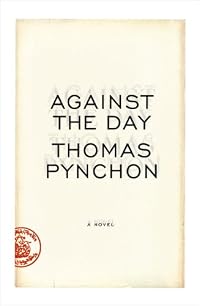
Against the Day
by Thomas Pynchon
On This Page
Description
Spanning the period between the Chicago World's Fair of 1893 and the years just after World War I, this novel moves from the labor troubles in Colorado to turn-of-the-century New York, to London and Gottingen, Venice and Vienna, the Balkans, Central Asia, Siberia at the time of the mysterious Tunguska Event, Mexico during the Revolution, postwar Paris, silent-era Hollywood, and one or two places not strictly speaking on the map at all. With a worldwide disaster looming just a few years show more ahead, it is a time of unrestrained corporate greed, false religiosity, moronic fecklessness, and evil intent in high places. No reference to the present day is intended or should be inferred. The sizable cast of characters includes anarchists, balloonists, gamblers, corporate tycoons, drug enthusiasts, innocents and decadents, mathematicians, mad scientists, shamans, psychics, and stage magicians, spies, detectives, adventuresses, and hired guns. There are cameo appearances by Nikola Tesla, Bela Lugosi, and Groucho Marx.As an era of certainty comes crashing down around their ears and an unpredictable future commences, these folks are mostly just trying to pursue their lives. Sometimes they manage to catch up; sometimes it's their lives that pursue them. Meanwhile, the author is up to his usual business. Characters stop what they're doing to sing what are for the most part stupid songs. Strange sexual practices take place. Obscure languages are spoken, not always idiomatically. Contrary-to-the-fact occurrences occur. If it is not the world, it is what the world might be with a minor adjustment or two. According to some, this is one of the main purposes of fiction. Let the reader decide, let the reader beware. Good luck. -Thomas Pynchon. show lessTags
Recommendations







Member Recommendations

tootstorm A video game that takes its nods where it wants to from Pynchon's latest monsterwork. An involving story with revolutionary AI and character development in another steampunk'd, quantum mechanix'd reimagining of the original Chicago World's Fair and all the tropes that came with the times.
04
Member Reviews
On finishing my read of Against the Day, I believe I have read all of Thomas Pynchon's published fiction--all his books, anyway: the novels and the Slow Learner collection. This one took two attempts: I halted the first circa 2007 at the midpoint of the novel, and I returned to read the whole thing this year. Straddling the 19th and 20th centuries, I think it is Pynchon's longest book. It descends from a rarified world of "boys' adventure" in airships, through anarchist struggle, family revenge, state espionage, sexual compulsion, academic intrigue, and mystical conspiracy, to meditations on light, number, and time.
It is strange that my first attempt at this book was while I was living in Chicago, and my second has been in Colorado. It show more begins in Chicago at the World's Columbian Exposition of 1893, and several characters travel from Chicago to Colorado--while Colorado is also the disseminating point for the Traverse family, whose various members trace many of the book's persistent plot threads. Ultimately, the geography of the book is all-encompassing, featuring London, Venice, Vienna, Mexico, Shambahla, and the Hollow Earth, among other locations. It includes a typically Pynchonian cast of thousands, with names like Ruperta Chirpingdon-Groin and Bevis Moistleigh.
The title phrase appears several times in the text, each with a different contextually-driven meaning. In addition to these, I understood it to be an Englishing of contre jour: the technique of giving focus to a backlit subject in photography and painting. This notion relates to inventor-character Merle Rideout's photographic career with its through-line intersecting both the early and late parts of the novel, and to the physics of light that is centered in many different passages, as well as the sense of opaque futurity in the lead up to the Great War and the subsequent totalitarianisms of the 20th century.
As always, Pynchon is very funny, littering the book with jokes to take the edge off of a palpable anger. Among the many digressive episodes, some exalt genre conventions from less "literary" species of fiction, such as the terrific weird horror passage recounted by the explorer Fleetwood Vibe (138-148). Sex is frequent enough in the early parts of the book, and somewhat surprisingly seems to increase in the later ones. Altered states of consciousness and metaphysical indeterminacy create ambiguities and introduce unreliability into the third-person omniscient narration.
Some quick notes regarding my "completed" and iterative consumption of Pynchon's works (in no particular order): Having read Inherent Vice I saw the movie during its initial release, and I think Gravity's Rainbow needs to inspire a grand piece of musical theater. V is at the top of my list of Pynchon to re-read. I have now read Mason & Dixon twice and Against the Day one-and-a-half times--they were each worth it. show less
It is strange that my first attempt at this book was while I was living in Chicago, and my second has been in Colorado. It show more begins in Chicago at the World's Columbian Exposition of 1893, and several characters travel from Chicago to Colorado--while Colorado is also the disseminating point for the Traverse family, whose various members trace many of the book's persistent plot threads. Ultimately, the geography of the book is all-encompassing, featuring London, Venice, Vienna, Mexico, Shambahla, and the Hollow Earth, among other locations. It includes a typically Pynchonian cast of thousands, with names like Ruperta Chirpingdon-Groin and Bevis Moistleigh.
The title phrase appears several times in the text, each with a different contextually-driven meaning. In addition to these, I understood it to be an Englishing of contre jour: the technique of giving focus to a backlit subject in photography and painting. This notion relates to inventor-character Merle Rideout's photographic career with its through-line intersecting both the early and late parts of the novel, and to the physics of light that is centered in many different passages, as well as the sense of opaque futurity in the lead up to the Great War and the subsequent totalitarianisms of the 20th century.
As always, Pynchon is very funny, littering the book with jokes to take the edge off of a palpable anger. Among the many digressive episodes, some exalt genre conventions from less "literary" species of fiction, such as the terrific weird horror passage recounted by the explorer Fleetwood Vibe (138-148). Sex is frequent enough in the early parts of the book, and somewhat surprisingly seems to increase in the later ones. Altered states of consciousness and metaphysical indeterminacy create ambiguities and introduce unreliability into the third-person omniscient narration.
Some quick notes regarding my "completed" and iterative consumption of Pynchon's works (in no particular order): Having read Inherent Vice I saw the movie during its initial release, and I think Gravity's Rainbow needs to inspire a grand piece of musical theater. V is at the top of my list of Pynchon to re-read. I have now read Mason & Dixon twice and Against the Day one-and-a-half times--they were each worth it. show less
Warning: core dump of brain in progress.
"Now single up all lines!"
That first line sounds like a call to battle, or like the last instruction of a band leader before he kicks into the intro of his newest composition. What it actually is is the command to launch the dirigible airship Inconvenience, manned by the boys' adventure book heroes The Chums Of Chance, forever young and Biggles-ishly intent on making the late-19th century world a better place from their vantage point on high.
The problem for them is that the band leader in question is Thomas Pynchon, who is to literature what a free jazz player with ADD (Anarchist Deconstruction Disorder) is to music. Just as we've gotten to know the Chums and their playful, Star Trek-like view of show more the world, the plot moves to someone else, the lines fray and the music starts getting chaotic. The boys' adventure book turns into a Steinbeck-on-acid-like novel about poor miners. The Steinbeck turns into a Wild West revenge tale. The Wild West revenge tale veers briefly into Lovecraft before turning into an HG Wells-ian time travel story and then a European spy thriller. The spy thriller becomes a love story, the love story becomes bisexual porn, the porn becomes a code cracker mystery, the code cracker mystery becomes a math textbook, the math textbook turns into vicious satire on the current state of the world which at the same time is a story of the search for a shangri la... etc etc. And obviously, all of these stories aren't so much sequential as they are simultaneous; they all interweave.
Pynchon is the ultimate post-modern madman; more enamoured with chance than Auster, more encyclopedic than Eco, more absurd than Vonnegut and with more bizarre guest spots (from Bela Lugosi to Elmer Fudd) and song numbers than a whole season of The Simpsons. (Yes, of course he drops a Simpsons joke or two in there.) But where Auster uses chance as the exception to the rule, the thing that jolts his character out of their lives, in Pynchon chance and chaos IS the rule. Where Eco lectures, Pynchon often seems to take for granted that his readers know as much as he does about Balkan history, advanced maths, dimensional theory or famous anarchists; if we don't, hell, look it up; every single reference he drops seems to suggest a story that could take off in another direction - like Bob Dylan once said that every line in "Hard Rain" could be turned into a song unto itself.
Which isn't necessarily in a direction we know. Against The Day is a tesseract; just like the pages of a novel are a two-dimensional representation of (hopefully) three-dimensional characters (note the overlaying fonts on the jacket of ATD), the characters of ATD are three-dimensional characters living in a four-dimensional world. Things happen which they cannot understand, just like a stick figure on a piece of paper cannot understand the three-dimensional pencil drawing him. As mankind learns to fly and conquers the third dimension and its possibilities for good and evil (Russian airships dropping bricks remarkably similar to Tetris blocks on their enemies - come to think of it, reading Pynchon is a lot like playing Tetris, you better keep up or the screen will fill up and you lose) people start to wonder what discoveries and weapons may lie in the next dimension.
And in a four-dimensional world, time is negotiable in the same sense that height is in a 3D world. When you come to a fork in the road, take it. Everything can exist at least twice; indeed, so much of the novel is about dualities, bilocations, doubles, mirror images that come to life, the way a good novel is a mirror of real life. Light refracts in a mirror, splits in two directions. Light as in progress. Light as in electricity. Light as in enlightenment. Light as in daylight. It can go either way. On the one side, we can build a better world. On the other, we're great at building machine guns, too. Prepare yourself against the day.
Five random thoughts:
1. Yes, of course Pynchon is still obsessed with secret societies, secret ways of communications, invisible train lines and stamps from post offices that never existed. You're telling me that's somehow not relevant in the Internet age? Why the hell is one of the main characters named Webb Traverse, d'ya think?
2. Ornette Coleman had a double quartet (!) when he recorded "Free Jazz".
3. There's something under Asia's deserts which is, apparently, worth going to war over. No one seems to know quite why we need it, but...
4. If everything exists in two versions, can there be a singularity? Can there be a third way?
5. "The sun would not have risen. A mere ball of flaming gas would have illuminated the world." (Terry Pratchett, Hogfather)
Reading ATD is hard work. It needs to be. Don't get me wrong, it's a lot of fun, it's exhilarating, and it don't mean a thing if it ain't got that swing, but it's so goddamn busy that it demands your undivided attention for 1085 pages straight. There were days when I was hard-pressed to manage five pages. I'm not sure if this is Pynchon's best novel. It's kinda hard to tell; it's frequently all over the place and while I'm pretty sure there's a point to all of it, I don't always see that point. Yet. If it's his last novel, it's a worthy farewell; there's enough reading here to rediscover and reinterpret more times than most readers are able to, and the logical conclusion to an authorship that has alwasy wanted to do MORE with fiction. It's chaotic, but there's method in it. Just like the difference between pure noise and really wild jazz; the swing, the humour, the flow, the way the theme suddenly pops up somewhere for a few seconds before leading into something new, the way you can almost dance to it without breaking a leg. The way one player will occasionally break away into something completely different and the others either follow him into this new and exciting tune or do everything in their power to stop him and force him back in line. And all the while, the balloon boys on board Inconvenience pop in and out of reality and the storyline like a naive jingle-jangle guitar pop song.
Mash it up, burn it down, start all over again.
And that's the only way I know how to explain it. Thus far. show less
"Now single up all lines!"
That first line sounds like a call to battle, or like the last instruction of a band leader before he kicks into the intro of his newest composition. What it actually is is the command to launch the dirigible airship Inconvenience, manned by the boys' adventure book heroes The Chums Of Chance, forever young and Biggles-ishly intent on making the late-19th century world a better place from their vantage point on high.
The problem for them is that the band leader in question is Thomas Pynchon, who is to literature what a free jazz player with ADD (Anarchist Deconstruction Disorder) is to music. Just as we've gotten to know the Chums and their playful, Star Trek-like view of show more the world, the plot moves to someone else, the lines fray and the music starts getting chaotic. The boys' adventure book turns into a Steinbeck-on-acid-like novel about poor miners. The Steinbeck turns into a Wild West revenge tale. The Wild West revenge tale veers briefly into Lovecraft before turning into an HG Wells-ian time travel story and then a European spy thriller. The spy thriller becomes a love story, the love story becomes bisexual porn, the porn becomes a code cracker mystery, the code cracker mystery becomes a math textbook, the math textbook turns into vicious satire on the current state of the world which at the same time is a story of the search for a shangri la... etc etc. And obviously, all of these stories aren't so much sequential as they are simultaneous; they all interweave.
Pynchon is the ultimate post-modern madman; more enamoured with chance than Auster, more encyclopedic than Eco, more absurd than Vonnegut and with more bizarre guest spots (from Bela Lugosi to Elmer Fudd) and song numbers than a whole season of The Simpsons. (Yes, of course he drops a Simpsons joke or two in there.) But where Auster uses chance as the exception to the rule, the thing that jolts his character out of their lives, in Pynchon chance and chaos IS the rule. Where Eco lectures, Pynchon often seems to take for granted that his readers know as much as he does about Balkan history, advanced maths, dimensional theory or famous anarchists; if we don't, hell, look it up; every single reference he drops seems to suggest a story that could take off in another direction - like Bob Dylan once said that every line in "Hard Rain" could be turned into a song unto itself.
Which isn't necessarily in a direction we know. Against The Day is a tesseract; just like the pages of a novel are a two-dimensional representation of (hopefully) three-dimensional characters (note the overlaying fonts on the jacket of ATD), the characters of ATD are three-dimensional characters living in a four-dimensional world. Things happen which they cannot understand, just like a stick figure on a piece of paper cannot understand the three-dimensional pencil drawing him. As mankind learns to fly and conquers the third dimension and its possibilities for good and evil (Russian airships dropping bricks remarkably similar to Tetris blocks on their enemies - come to think of it, reading Pynchon is a lot like playing Tetris, you better keep up or the screen will fill up and you lose) people start to wonder what discoveries and weapons may lie in the next dimension.
And in a four-dimensional world, time is negotiable in the same sense that height is in a 3D world. When you come to a fork in the road, take it. Everything can exist at least twice; indeed, so much of the novel is about dualities, bilocations, doubles, mirror images that come to life, the way a good novel is a mirror of real life. Light refracts in a mirror, splits in two directions. Light as in progress. Light as in electricity. Light as in enlightenment. Light as in daylight. It can go either way. On the one side, we can build a better world. On the other, we're great at building machine guns, too. Prepare yourself against the day.
Five random thoughts:
1. Yes, of course Pynchon is still obsessed with secret societies, secret ways of communications, invisible train lines and stamps from post offices that never existed. You're telling me that's somehow not relevant in the Internet age? Why the hell is one of the main characters named Webb Traverse, d'ya think?
2. Ornette Coleman had a double quartet (!) when he recorded "Free Jazz".
3. There's something under Asia's deserts which is, apparently, worth going to war over. No one seems to know quite why we need it, but...
4. If everything exists in two versions, can there be a singularity? Can there be a third way?
5. "The sun would not have risen. A mere ball of flaming gas would have illuminated the world." (Terry Pratchett, Hogfather)
Reading ATD is hard work. It needs to be. Don't get me wrong, it's a lot of fun, it's exhilarating, and it don't mean a thing if it ain't got that swing, but it's so goddamn busy that it demands your undivided attention for 1085 pages straight. There were days when I was hard-pressed to manage five pages. I'm not sure if this is Pynchon's best novel. It's kinda hard to tell; it's frequently all over the place and while I'm pretty sure there's a point to all of it, I don't always see that point. Yet. If it's his last novel, it's a worthy farewell; there's enough reading here to rediscover and reinterpret more times than most readers are able to, and the logical conclusion to an authorship that has alwasy wanted to do MORE with fiction. It's chaotic, but there's method in it. Just like the difference between pure noise and really wild jazz; the swing, the humour, the flow, the way the theme suddenly pops up somewhere for a few seconds before leading into something new, the way you can almost dance to it without breaking a leg. The way one player will occasionally break away into something completely different and the others either follow him into this new and exciting tune or do everything in their power to stop him and force him back in line. And all the while, the balloon boys on board Inconvenience pop in and out of reality and the storyline like a naive jingle-jangle guitar pop song.
Mash it up, burn it down, start all over again.
And that's the only way I know how to explain it. Thus far. show less
An impossible book to review and an impossible book to summarise, but a very enjoyable read and one which encompasses a complex array of characters, styles, genres, historical, scientific, political and sexual references.
Pynchon's starting point is the history that led to the Great War, but although parts of the book are true to the history, his characters are larger than life and the fiction is invention on a grand scale.
The setting mirrors our earth, but its laws of physics are rather different, if no more implausible than much 20th century science would seem to the scientists and inventors of the late 19th century. The overall plot is as complex as the political world Pynchon explores, and he can follow a character for a chapter and show more then come back to him/her 200 pages later - none of them is a conventional lead but all play their part in the tapestry.
I could say more, but that would probably get boring, and this book is rarely that. show less
Pynchon's starting point is the history that led to the Great War, but although parts of the book are true to the history, his characters are larger than life and the fiction is invention on a grand scale.
The setting mirrors our earth, but its laws of physics are rather different, if no more implausible than much 20th century science would seem to the scientists and inventors of the late 19th century. The overall plot is as complex as the political world Pynchon explores, and he can follow a character for a chapter and show more then come back to him/her 200 pages later - none of them is a conventional lead but all play their part in the tapestry.
I could say more, but that would probably get boring, and this book is rarely that. show less
I'm not going to lie, there were several times when I was reading Against the Day that I was in danger of losing the faith. There were several sections that made me wonder if Pynchon had somehow lost his touch: they were too long, too allusive, too reminiscent of past works, too boring, even. Many of the trademark songs seemed uninspired, some entire subplots pointless at first, and it was hard to avoid the sense that some themes and details were "borrowed" from earlier works. Many stretches of dialogue were cryptic to the point of seeming self-parody. And yet, after I finally finished it, all I could do was shake my head at how he'd done it again. I should have learned to trust him after the epic sweep of Mason & Dixon, but V. was a show more bit faster-paced, and I was expecting the same speed here. Against the Day was slow and subtle, unfolding at its own pace; that wasn't repetition I was seeing, exactly, Pynchon had just mixed some new themes in with his old standbys: anarchism, revolution, capitalism, power, math, music, technology, magic, time, fate, family, bilocation, resonances, love.... The traditional massive cast of characters was there, but the way that the action orbited around the central Traverse family was masterful, unlike anything I'd read from him, and his constant globe-hopping wasn't a search for a plot, it was an allegory for the birth of the 20th century that couldn't be contained in small California towns like some of his other books. After the first 200 pages I was ready to drop the book, after 500 pages I was going to continue and give it an average rating, but after finishing it all I can do is sit back and let the beautiful phrases, the cheerful humanity, and the deep affection for the foibles of the world Pynchon explores roll around in my head. Those earlier slow parts suddenly turned into clever foreshadowing, the masses of walk-ons became useful conductors of action, and the omnipresent homages to past works and Pynchon favorites revealed themselves to be the same familiar in-jokes that I'd always loved. For a while I was going to let this novel languish in the lower bracket of his works where V. and Vineland dwell, yet while it doesn't quite rise to the Olympian heights of Gravity's Rainbow, Mason & Dixon, or The Crying of Lot 49, it's a beautiful, genre-defying book packed with indelible images and brilliant vitality. Amazing. show less
No me gusta mucho el título en español, algo se pierde en la traducción del original "Against the Day", pero éste es un libro monumental, en la acepción completa de la palabra. Decenas de tramas y personajes se cruzan de maneras imprevisibles, la trama salta y las escenas se quiebran pero a la vez mantiene un curso lineal y da una visión que intenta ser completa del mundo previo, durante y tras la I Guerra Mundial.
Es de lectura obligada para cualquier escritor que quiera apuntar a hacer unanovela total, un monstruo de muchas cabezas que se coma a los lectores menos preparados, pero que quienes disfrutan de la prosa, las técnicas de narración menos comunes, y la enorme colección de datos históricos (y chistes de cultura popular show more muy bien disimulados) que conforman este tapiz, no podrán dejar pasar.
Definitivamente no decepciona. Si bien carece de un cierre argumental (son un conjunto de cierres temáticos/epocales) definitivo, el esfuerzo imaginativo y el periplo de sus múltiples personajes lo hacen de lectura indispensable, si bien algunos pueden hallarlo denso por momentos. Es un libro para disfrutar con tiempo, leyéndolo por las noches un par de páginas a la vez, disfrutándolo como un buen coñac (y si se lo acompaña con uno, mejor). show less
Es de lectura obligada para cualquier escritor que quiera apuntar a hacer unanovela total, un monstruo de muchas cabezas que se coma a los lectores menos preparados, pero que quienes disfrutan de la prosa, las técnicas de narración menos comunes, y la enorme colección de datos históricos (y chistes de cultura popular show more muy bien disimulados) que conforman este tapiz, no podrán dejar pasar.
Definitivamente no decepciona. Si bien carece de un cierre argumental (son un conjunto de cierres temáticos/epocales) definitivo, el esfuerzo imaginativo y el periplo de sus múltiples personajes lo hacen de lectura indispensable, si bien algunos pueden hallarlo denso por momentos. Es un libro para disfrutar con tiempo, leyéndolo por las noches un par de páginas a la vez, disfrutándolo como un buen coñac (y si se lo acompaña con uno, mejor). show less
Marvelous. Marvelous. Marvelous.
As in, full of marvels. There are so few novels that can re-create in us the feeling we knew as children who loved to read: that sense of awe and mystery that a great narrative could instill, the mind being stretched, the heart opened, time disappearing. Against the Day, in the happy months I’ve spent engrossed in it, did for jaded-adult me what those great reading experiences of my childhood did, at a suitably higher level of intellectual difficulty — enough that, just as in childhood, I knew I’d have to re-read, I’d want to re-read. I’d even want to start re-reading right away, to begin the marvelous journey again. Because there would always be more there that I hadn’t seen, or hadn’t seen show more in the same way, the time before.
It’s no surprise that so many folks have gone on at length trying to distill what reading Against the Day was like, what this vast book is like. I’ll just say that for those who may be leery of Pynchon’s garrulous tricksiness, and the apparent misanthropy which has made many of his characters seem little more than extremely clever cartoons, this book is informed by a generosity of spirit, a clarity of prose, and even a depth of aw-shucks compassion that’s a true revelation, AND it’s no less of a gauntlet for the gray matter for all that. But it is a heluva a lot more fun to read than Gravity’s Rainbow or V. It is a romance in the best, old fashioned sense of that word, being of course a tribute to many forms of romance: from Boys’ Own stories to westerns to spy novels and Wellesian sci-fi.
It will help to love some of the things Pynchon loves, or at least to be willing to be curious about them: abstract mathematics, modern physics, history (and arcane history), anarchism, music, wild sex, duality and non-duality, and storytelling itself. Give up on conventional plotting, a single story arc, anything like that - but you probably knew that already. And you’re never going to get microscopically detailed Jamesian psychological complexity out of him, so just forget that too– you might as well ask the man to sell Tupperware as to write like that. There will even be longueurs, how can there not be in a story this long? The encyclopaedist imagination is endlessly interested in just about everything - most of the rest of us, with our narrower vision and shorter attention spans, not so much.
But those are minor concerns. The point is, more than just about any other macrofiction I can think of, this book can enchant you. If you still love to read as much as you did as a child, but have learned a lot more about the state of the world and humankind since then, just take the journey. Single up all lines. Sail on Against the Day, sail on towards grace. show less
As in, full of marvels. There are so few novels that can re-create in us the feeling we knew as children who loved to read: that sense of awe and mystery that a great narrative could instill, the mind being stretched, the heart opened, time disappearing. Against the Day, in the happy months I’ve spent engrossed in it, did for jaded-adult me what those great reading experiences of my childhood did, at a suitably higher level of intellectual difficulty — enough that, just as in childhood, I knew I’d have to re-read, I’d want to re-read. I’d even want to start re-reading right away, to begin the marvelous journey again. Because there would always be more there that I hadn’t seen, or hadn’t seen show more in the same way, the time before.
It’s no surprise that so many folks have gone on at length trying to distill what reading Against the Day was like, what this vast book is like. I’ll just say that for those who may be leery of Pynchon’s garrulous tricksiness, and the apparent misanthropy which has made many of his characters seem little more than extremely clever cartoons, this book is informed by a generosity of spirit, a clarity of prose, and even a depth of aw-shucks compassion that’s a true revelation, AND it’s no less of a gauntlet for the gray matter for all that. But it is a heluva a lot more fun to read than Gravity’s Rainbow or V. It is a romance in the best, old fashioned sense of that word, being of course a tribute to many forms of romance: from Boys’ Own stories to westerns to spy novels and Wellesian sci-fi.
It will help to love some of the things Pynchon loves, or at least to be willing to be curious about them: abstract mathematics, modern physics, history (and arcane history), anarchism, music, wild sex, duality and non-duality, and storytelling itself. Give up on conventional plotting, a single story arc, anything like that - but you probably knew that already. And you’re never going to get microscopically detailed Jamesian psychological complexity out of him, so just forget that too– you might as well ask the man to sell Tupperware as to write like that. There will even be longueurs, how can there not be in a story this long? The encyclopaedist imagination is endlessly interested in just about everything - most of the rest of us, with our narrower vision and shorter attention spans, not so much.
But those are minor concerns. The point is, more than just about any other macrofiction I can think of, this book can enchant you. If you still love to read as much as you did as a child, but have learned a lot more about the state of the world and humankind since then, just take the journey. Single up all lines. Sail on Against the Day, sail on towards grace. show less
If you're reading this, you might want to read the book; if you're sensible, you'll be a bit wary of diving right in, because, as every review is contractually obliged to note, it's a bit long. So here are some books I'm really glad I read before this:
i) The World that Never Was, by Alex Butterworth
ii) Anarchism, by George Woodcock
iii) Hobsbawm's Age of Revolution/Capital/Empire
iv) Cormac McCarthy's Blood Meridian (American West in the 19th century)
v) Henry James, in general (for the American abroad theme)
vi) various popular science books, particularly about maths.
Here are some books I really wish I'd read:
i) The Struggle for Mastery by AJP Taylor
ii) unpopular, difficult histories of maths
iii) a history of American labor show more organizations
iv) HG Wells, The Time Machine
If you mix all of that in with previous Pynchon, you get this book. If you've read it all, I bet this thing would be a breeze. Kind of.
***************
I put off reviewing this for a long time, because I've been trying to finish the wikipedia plot summaries. But I can't put it off any longer. Those plot summaries take a *long* time.
A lot of people read this book as a more or less Manichean tract about the evils of the day/light/people who don't believe in conspiracy theories and the good of the night/darkness/people who do. Thankfully, it's much more and much better than that. There are few hard and fast good guys or bad guys: only one or two people fail to undergo some kind of enlightenment, and nobody who does undergo enlightenment becomes undeniably heroic afterward.
The book's structure is surprisingly tight. There's a kind of frame narrative, a pastiche of Boys Own adventure stories; as the novel progresses, the heroes of that story (The Chums of Chance) move from being more or less the unthinking but charming patsies of shadowy higher powers, to being autonomous, married human beings: in other words, they're little boys who grow up, and in so doing become more conscious of their own place in the world.
Within this is the main tale: a family of anarchists is being hunted and then hunting the capitalists in turn. On the book's release, much was made of its sympathy for terrorists, so it's worth noting that only *one* non-anarchist is intentionally killed by an anarchist, and that's in direct revenge for the murder of said anarchist's father. Just to complicate matters, it's unclear that the vengeance-taker is much of an anarchist anyway. On the other hand, and with historical accuracy, the capitalists murder or otherwise do away with dozens of people. The point of the book is not that terrorism is okay, it's that small acts of 'terrorism,' like bomb throwing, differ from large acts of destruction, like war or factory lockouts, in a small but important way: the bomb throwers lack the resources to do anything else. The war-makers and factory owners have all the resources they need, but want to squeeze ever more out of the rest of us.
In good picaresque fashion, a series of tales branch off from these two main tales. Most of them have in common some sort of opposition to quotidian life, which is either shown to be successful as an alternative, or (more often), unsuccessful. Characters come to realize that they're being used by powers beyond their control, and take it upon themselves to change their lives as best they can. Usually this is by travel (therefore, picaresque).
The book shows us two worlds: one that we see every day, and a kind of shadow world set slightly to the side of our own. The shadow world is sometimes good, sometimes not so good; but the moments of good that it holds are very much worth striving for. The trick is to do that without getting co-opted by capitalists or imperialists, which is no easy task at the turn of the nineteenth century.
Here the content matches up with Pynchon's form: any time the shadow world breaks through, for better or worse, the generally realistic narrative is also interrupted by surrealism, fantasy, science-fiction, horror, abstract mathematics, mysticism or philosophy. These small breaks in the novel's realistic fabric are often genuinely confusing, and that's precisely the point: thinking of another world is difficult and confusing. There's no need for conspiracy theories to explain this fact, you only need to recognize that the power and money is held in a very few hands.
Despite the huge difficulties faced by the various characters, the book ends, beautifully, with the Chums of Chance on their airship, "where any wish that can be made is at least addressed, if not always granted. For every wish to come true would mean that in the known Creation, good unsought and uncompensated would have evolved somehow, to become at least more accessible to us," and there's no sign of that. Nontheless, "they fly towards grace." Even within the book's frame, the Chums of Chance are more or less fictional. It's on board fictions like 'Against the Day' that we, too, can fly towards grace, without pretending that we've already got it. show less
i) The World that Never Was, by Alex Butterworth
ii) Anarchism, by George Woodcock
iii) Hobsbawm's Age of Revolution/Capital/Empire
iv) Cormac McCarthy's Blood Meridian (American West in the 19th century)
v) Henry James, in general (for the American abroad theme)
vi) various popular science books, particularly about maths.
Here are some books I really wish I'd read:
i) The Struggle for Mastery by AJP Taylor
ii) unpopular, difficult histories of maths
iii) a history of American labor show more organizations
iv) HG Wells, The Time Machine
If you mix all of that in with previous Pynchon, you get this book. If you've read it all, I bet this thing would be a breeze. Kind of.
***************
I put off reviewing this for a long time, because I've been trying to finish the wikipedia plot summaries. But I can't put it off any longer. Those plot summaries take a *long* time.
A lot of people read this book as a more or less Manichean tract about the evils of the day/light/people who don't believe in conspiracy theories and the good of the night/darkness/people who do. Thankfully, it's much more and much better than that. There are few hard and fast good guys or bad guys: only one or two people fail to undergo some kind of enlightenment, and nobody who does undergo enlightenment becomes undeniably heroic afterward.
The book's structure is surprisingly tight. There's a kind of frame narrative, a pastiche of Boys Own adventure stories; as the novel progresses, the heroes of that story (The Chums of Chance) move from being more or less the unthinking but charming patsies of shadowy higher powers, to being autonomous, married human beings: in other words, they're little boys who grow up, and in so doing become more conscious of their own place in the world.
Within this is the main tale: a family of anarchists is being hunted and then hunting the capitalists in turn. On the book's release, much was made of its sympathy for terrorists, so it's worth noting that only *one* non-anarchist is intentionally killed by an anarchist, and that's in direct revenge for the murder of said anarchist's father. Just to complicate matters, it's unclear that the vengeance-taker is much of an anarchist anyway. On the other hand, and with historical accuracy, the capitalists murder or otherwise do away with dozens of people. The point of the book is not that terrorism is okay, it's that small acts of 'terrorism,' like bomb throwing, differ from large acts of destruction, like war or factory lockouts, in a small but important way: the bomb throwers lack the resources to do anything else. The war-makers and factory owners have all the resources they need, but want to squeeze ever more out of the rest of us.
In good picaresque fashion, a series of tales branch off from these two main tales. Most of them have in common some sort of opposition to quotidian life, which is either shown to be successful as an alternative, or (more often), unsuccessful. Characters come to realize that they're being used by powers beyond their control, and take it upon themselves to change their lives as best they can. Usually this is by travel (therefore, picaresque).
The book shows us two worlds: one that we see every day, and a kind of shadow world set slightly to the side of our own. The shadow world is sometimes good, sometimes not so good; but the moments of good that it holds are very much worth striving for. The trick is to do that without getting co-opted by capitalists or imperialists, which is no easy task at the turn of the nineteenth century.
Here the content matches up with Pynchon's form: any time the shadow world breaks through, for better or worse, the generally realistic narrative is also interrupted by surrealism, fantasy, science-fiction, horror, abstract mathematics, mysticism or philosophy. These small breaks in the novel's realistic fabric are often genuinely confusing, and that's precisely the point: thinking of another world is difficult and confusing. There's no need for conspiracy theories to explain this fact, you only need to recognize that the power and money is held in a very few hands.
Despite the huge difficulties faced by the various characters, the book ends, beautifully, with the Chums of Chance on their airship, "where any wish that can be made is at least addressed, if not always granted. For every wish to come true would mean that in the known Creation, good unsought and uncompensated would have evolved somehow, to become at least more accessible to us," and there's no sign of that. Nontheless, "they fly towards grace." Even within the book's frame, the Chums of Chance are more or less fictional. It's on board fictions like 'Against the Day' that we, too, can fly towards grace, without pretending that we've already got it. show less
Members
- Recently Added By
Published Reviews
ThingScore 86
Thomas Pynchon's new behemoth of a book, "Against the Day," is likely to have readers responding in one of two ways; either they will think it is one of the greatest novels ever written, or they will see it as a vainglorious head trip from an author notorious for being difficult to read. The truth of the matter actually lies somewhere in between. "Against the Day" is probably the most show more brilliant book most people will never read. The reason it will probably fail to garner much of an audience is that at almost 1,100 pages it is, to put it bluntly, the novel as literary whirlwind, cryptically dense and unrelenting in its demands on the reader. show less
added by stephmo
IN “Against the Day,” his sixth, his funniest and arguably his most accessible novel, Thomas Pynchon doles out plenty of vertigo, just as he has for more than 40 years. But this time his fevered reveries and brilliant streams of words, his fantastical plots and encrypted references, are bound together by a clear message that others can unscramble without mental meltdown.
added by jlelliott
On the American literary scene – that hodgepodge – a new book by Thomas Pynchon is unarguably a major event, and here he comes again. His sixth novel, “Against the Day,” runs to 1085 pages, but never creeps and assuredly never drags. Though he has a disciple here and there, most notably David Foster Wallace, no novelist has proven more sui generis than Pynchon since his debut with show more “V.” in 1963. show less
added by stephmo
Lists

Recommend the 20 best books you've read in the last five years
2,168 works; 606 members

Great American Novels
158 works; 42 members

Favorite Long Books
330 works; 42 members

Top Five Books of 2020
982 works; 348 members

Unread books
1,063 works; 86 members

Top Five Books of 2014
1,064 works; 398 members

Pynchon ranked
10 works; 1 member

Fiction With Familiar Settings
279 works; 92 members

Thomas Pynchon books
10 works; 1 member

I Can't Finish This Book
189 works; 22 members
Author Information

31+ Works 51,217 Members
Thomas Pynchon was born in Glen Cove, New York on May 8, 1937. In 1959 he graduated with a B.A. in English from Cornell, where he had taken Vladimir Nabokov's famous course in modern literature after studying engineering physics and serving in the U.S. Navy for two years. He worked as a technical writer at Boeing for two and a half years. Pynchon show more won the Faulkner First Novel Award for V. in 1963, and in The Crying of Lot 49 (1966), again his symbolism and commentary on the United States and human isolation have been praised as intricate and masterly, though some reviewers found it to be maddeningly dense. With this book Pynchon won the Rosenthal Foundation Award. Gravity's Rainbow, winner of the National Book Award for Fiction in 1974, is in part a fictional elegy and meditation on death and an encyclopedic work that jumps through time. Pynchon has also written numerous essays, reviews, and introductions, plus the fictional works Slow Learner, Vineland, Mason & Dixon, Against the Day, and Inherent Vice. His title Bleeding Edge made The New York Times Best Seller List for 2013. He is famous for his reclusive nature, although he has made several animated appearances on The Simpsons television series. (Bowker Author Biography) show less
Some Editions
Awards and Honors
Awards
Distinctions
Work Relationships
Is contained in
Common Knowledge
- Canonical title*
- Gegen den Tag
- Original title
- Against the Day
- Original publication date
- 2006-11-21
- People/Characters
- Webb Traverse; Lew Basnight; Miles Blundell; Chick Counterfly; Lindsay Noseworth; Pugnax (show all 40); Randolph St. Cosmo; Darby Suckling; Ruperta Chirpingden-Groin; Yashmeen Halfcourt; Sloat Fresno; Rao V. Ganeshi; Kieselguhr Kid; Deuce Kindred; Cyprian Latewood; Al "Ryan Westbrook" Mar-Faud; Hunter Penhallow; Dahlia Rideout; Erlys Rideout; Merle Rideout; Professor Renfrew; Captain Sands; Lionel Swome; Nikola Tesla; Frank Traverse; Kit Traverse; Lake Traverse; Mayva Traverse; Reef Traverse; Professor Heino Vanderjuice; Colfax Vibe; Cragmont Vibe; Dittany Vibe; Edwarda Vibe; Fleetwood Vibe; Scarsdale Vibe; Wilshire Vibe; Foley Walker; Professor Werfner; Luca Zombini
- Important places
- Venice, Veneto, Italy; Telluride, Colorado, USA; Chicago, Illinois, USA; North Pole; New York, New York, USA; New Haven, Connecticut, USA (show all 32); Utah, USA; Oxford, Oxfordshire, England, UK; Long Island Sound, New York, USA; New Orleans, Louisiana, USA; Juárez, Chihuahua, Mexico; Guanajuato, Mexico; Sierra Madre, Mexico; Candelbrow University, Ohio, USA; New Mexico, USA; Decatur, Illinois, USA; Wall o' Death, Missouri, USA; London, England, UK; Ostend, West Flanders, Belgium; Bruges, West Flanders, Belgium; Göttingen, Lower Saxony, Germany; Tampico, Tamaulipas, Mexico; Vienna, Austria; Tunguska, Krasnoyarsk Krai, Russia; Nice, Alpes-Maritimes, Provence-Alpes-Côte d'Azur, France; Szeged, Hungary; Chihuahua, Mexico; Mexico City, Mexico; Counter-Earth; Los Angeles, California, USA; Paris, Île-de-France, France; Turin, Piedmont, Italy
- Important events
- World's Columbian Exposition (1893 ! Chicago, Illinois, USA); World War I (1914 | 1918)
- First words
- "Now single up all lines!"
- Last words
- (Click to show. Warning: May contain spoilers.)They will feel the turn in the wind. They will put on smoked goggles for the glory of what is coming to part the sky. They fly toward grace.
- Canonical LCC
- PS3566.Y55 A73 2006
*Some information comes from Common Knowledge in other languages. Click "Edit" for more information.
Classifications
- Genres
- Fiction and Literature, General Fiction, Science Fiction, Historical Fiction
- DDC/MDS
- 813.54 — Literature & rhetoric American literature in English American fiction in English 1900-1999 1945-1999
- LCC
- PS3566 .Y55 .A73 — Language and Literature American literature American literature Individual authors 1961-
- BISAC
Statistics
- Members
- 3,523
- Popularity
- 4,664
- Reviews
- 63
- Rating
- (4.08)
- Languages
- 12 — Catalan, English, French, German, Greek, Italian, Japanese, Norwegian (Bokmål), Norwegian, Portuguese, Spanish, Swedish
- Media
- Paper, Audiobook, Ebook
- ISBNs
- 32
- ASINs
- 14