On This Page
Description
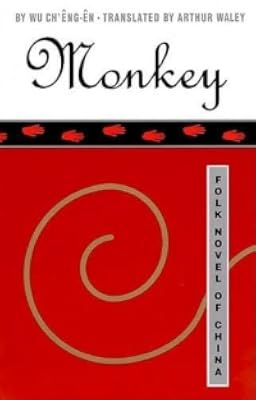
Considered one of China's great classical novels, Wu Ch'êng-ên's Monkey (also known as Journey to the West) is a riveting adventure story about a priest's quest to obtain holy Buddhist scriptures for the Tang emperor. Joining him on this rollicking journey: Sandy, Pigsy and the mischievous Monkey King, Sun Wukong, whose flying cloud and magic cudgel are never far from his infamous deeds. Arthur Waley's delightful rendition of Wu Ch'êng-ên's classic is the definitve translation: Gods, show more demons and disobedient monkey spirits all come alive in this entertaining work. show lessTags
Recommendations












Member Reviews
Written in the 1400s, China, these tales were old even then. They tell about Monkey, born of rock, and irrepressible. After being imprisoned by Buddha for his many high-spirited hi-jinks in Heaven, he is granted freedom on the condition he help a monk, Tripitaka, seek scriptures in India. These are the stories of their adventures.
So much fun to read! Some of the chapters were odd, but others were quite gripping. All of them had a fun sense of humor, especially the chapters where the journey begins and Tripitaka finds Monkey. One chapter proves that potty humor survives through the ages. Arthur Waley must have been a fine translator, because this book is delightful.
So much fun to read! Some of the chapters were odd, but others were quite gripping. All of them had a fun sense of humor, especially the chapters where the journey begins and Tripitaka finds Monkey. One chapter proves that potty humor survives through the ages. Arthur Waley must have been a fine translator, because this book is delightful.
One of the interesting things I learned reading this novel was that in ancient times, the Bodhisattva Kuan-yin was revered not just in China, but as far west as Rome, where she was known as Deus Ex Machina. Seriously, though, one of the things you have to do without in reading this novel is any dramatic tension whatsoever. You know that Tripitaka and his disciples will get out of every scrape they find themselves in, and if all else seems hopeless, Monkey will just jump on a cloud and ask Kuan-yin for help. That's not actually such a huge criticism, as this novel can't really be compared against modern literature, which operates according to a totally different set of rules, but I did find it meant I could only enjoy this book in small show more doses.
However, what did frustrate me was the lack of actual Buddhism in this story. I'm not sure if it's the abridgement, the translation or the original text, but apart from the character names, there's not much here that reflects Buddhist practices or values, at least according to my (limited) understanding. I felt as if with just a few tweaks the story could have been changed to be about a Catholic monk travelling east to India to fetch sacred scriptures, or very easily, a Hindu priest travelling north. I had hoped to find Tripitaka struggling with his demons and each aspect of his personality, represented by his disciples, helping him to overcome them. That is certainly how the classic dubbed TV show Monkey Magic was structured. Instead, Tripitaka bursts into tears every time he encounters adversity and waits for Monkey to sort things out.
I was also very frustrated by the way the main achievement of each adventure is to restore some hereditary ruler to the throne or give a landholder back his land. I didn't expect them to be spreading the word of socialism, but I would have liked it if the four pilgrims had occasionally helped out a peasant or servant.
Despite all that, Monkey's antics are pretty funny at times and the history of this story, as a 16th century novel based on the adventures of a 7th century monk, made it an enjoyable and engaging read. The edition I read would have benefited from giving each speaker a separate line, but the writing was otherwise engaging and accessible while still having an air of authenticity in representing the age and provenance of the original text. I am somewhat tempted to read an unabridged version. Not tomorrow, but maybe some time in the future, and I'm definitely going to find a good account of Hsuan Tsang's original journey. show less
However, what did frustrate me was the lack of actual Buddhism in this story. I'm not sure if it's the abridgement, the translation or the original text, but apart from the character names, there's not much here that reflects Buddhist practices or values, at least according to my (limited) understanding. I felt as if with just a few tweaks the story could have been changed to be about a Catholic monk travelling east to India to fetch sacred scriptures, or very easily, a Hindu priest travelling north. I had hoped to find Tripitaka struggling with his demons and each aspect of his personality, represented by his disciples, helping him to overcome them. That is certainly how the classic dubbed TV show Monkey Magic was structured. Instead, Tripitaka bursts into tears every time he encounters adversity and waits for Monkey to sort things out.
I was also very frustrated by the way the main achievement of each adventure is to restore some hereditary ruler to the throne or give a landholder back his land. I didn't expect them to be spreading the word of socialism, but I would have liked it if the four pilgrims had occasionally helped out a peasant or servant.
Despite all that, Monkey's antics are pretty funny at times and the history of this story, as a 16th century novel based on the adventures of a 7th century monk, made it an enjoyable and engaging read. The edition I read would have benefited from giving each speaker a separate line, but the writing was otherwise engaging and accessible while still having an air of authenticity in representing the age and provenance of the original text. I am somewhat tempted to read an unabridged version. Not tomorrow, but maybe some time in the future, and I'm definitely going to find a good account of Hsuan Tsang's original journey. show less
Review from goodreads:
kind of regret buying this book. I thought it looked like a fun little read when I saw it in the mythology section, so I picked it up (several years ago).
Why regret it when I enjoyed it? I could have enjoyed MORE of it. You see, I found out much later that Monkey is an abridged version of Journey to the West. This is one of the four classic Chinese novels. I've read (and generally loved) the other three: Romance of the Three Kingdoms, Outlaws of the Marsh, and Dream of Red Mansions. Now I've read an abridged version of the last one, when I would have much preferred to read the full unabridged text. I'll still have to do that at some point.
Still, I can recommend this book pretty enthusiastically to some people at show more there. Reading the other three books mentioned above, I undoubtedly tried to sell you on them (directly or indirectly). Perhaps you were even a bit interested.
However, I recognize that the other three, thousand+ page monsters can be pretty intimidating, particularly since they feature so many characters with names that are difficult to pronounce and keep straight if you are not particularly familiar with Chinese names. Monkey is only about three hundred pages, and style wise is a much easier read as well. There are fewer important characters, and they have more easily pronounced/remembered names (Monkey and Pigsy being two of the main four characters). This story is also quite a bit more of a folk tale than the others, so it remains noticeably simpler. That said, it retains the very classic style that I haven't seen anywhere besides these Chinese novels. The charmingly formal well that people address one another (even the taunts before battles are formalized in a very unique way). This would be a great book to use as your trial run into classic Chinese literature, and if you enjoy the general style of it, you will enjoy the style of the longer and more difficult books as well. show less
kind of regret buying this book. I thought it looked like a fun little read when I saw it in the mythology section, so I picked it up (several years ago).
Why regret it when I enjoyed it? I could have enjoyed MORE of it. You see, I found out much later that Monkey is an abridged version of Journey to the West. This is one of the four classic Chinese novels. I've read (and generally loved) the other three: Romance of the Three Kingdoms, Outlaws of the Marsh, and Dream of Red Mansions. Now I've read an abridged version of the last one, when I would have much preferred to read the full unabridged text. I'll still have to do that at some point.
Still, I can recommend this book pretty enthusiastically to some people at show more there. Reading the other three books mentioned above, I undoubtedly tried to sell you on them (directly or indirectly). Perhaps you were even a bit interested.
However, I recognize that the other three, thousand+ page monsters can be pretty intimidating, particularly since they feature so many characters with names that are difficult to pronounce and keep straight if you are not particularly familiar with Chinese names. Monkey is only about three hundred pages, and style wise is a much easier read as well. There are fewer important characters, and they have more easily pronounced/remembered names (Monkey and Pigsy being two of the main four characters). This story is also quite a bit more of a folk tale than the others, so it remains noticeably simpler. That said, it retains the very classic style that I haven't seen anywhere besides these Chinese novels. The charmingly formal well that people address one another (even the taunts before battles are formalized in a very unique way). This would be a great book to use as your trial run into classic Chinese literature, and if you enjoy the general style of it, you will enjoy the style of the longer and more difficult books as well. show less
Monkey is an English translation by Arthur Waley of the Chinese folk tale known as Journey to the West. Touted as a journey that brings the travelers to enlightenment through their trials, I found it not so much a book on facing and concurring trials as a fun romp in which a magical Monkey helps others, through his relationship with the gods and forces of nature, to reach enlightenment.
Having done some background reading on this novel, I have found that this is a much abridged version of the actual Chinese text. Much of the poetry and character background is missing. That is understandable, Having read both volumes of Romance of the Three Kingdoms, it is understandable that this tome was cut down!
Monkey, to me, is a fun read. Being show more magical and with connections in heaven and the underworld, Monkey is truly able to help his fellow travelers in their quest from China to India to retrieve sacred scriptures to bring back to China in order to propagate Buddhist understanding.
Monkey, being able to transform himself, jump on clouds and travel great distances in a blink of an eye, among other magical acts, is a fun character who does change fundamentally from a self-centered trickster to someone who cares for others and uses his abilities to help others.
There is not much of the characters having to work through their trials and tribulations because the magic takes care of situations easily.
I do think this is a great read. It is fun and there is a lot of interesting encounters. I will be looking for a more extensive translation as I would like to read more in-depth as to this folk tale. show less
Having done some background reading on this novel, I have found that this is a much abridged version of the actual Chinese text. Much of the poetry and character background is missing. That is understandable, Having read both volumes of Romance of the Three Kingdoms, it is understandable that this tome was cut down!
Monkey, to me, is a fun read. Being show more magical and with connections in heaven and the underworld, Monkey is truly able to help his fellow travelers in their quest from China to India to retrieve sacred scriptures to bring back to China in order to propagate Buddhist understanding.
Monkey, being able to transform himself, jump on clouds and travel great distances in a blink of an eye, among other magical acts, is a fun character who does change fundamentally from a self-centered trickster to someone who cares for others and uses his abilities to help others.
There is not much of the characters having to work through their trials and tribulations because the magic takes care of situations easily.
I do think this is a great read. It is fun and there is a lot of interesting encounters. I will be looking for a more extensive translation as I would like to read more in-depth as to this folk tale. show less
A whimsical, exciting, episodic, satirical Chinese epic featuring one of the very greatest trickster characters I've had the pleasure of meeting in fiction. This book was so much fun and helped me appreciate a lot of the tropes that appear in contemporary East Asian storytelling (particularly anime).
This translation is heavily abridged but beautifully told, and I appreciate that Waley leaves individual episodes fully intact in his abridgement.
This translation is heavily abridged but beautifully told, and I appreciate that Waley leaves individual episodes fully intact in his abridgement.
The story of how Monkey became a king, learned great power, earned the title of Great Sage - Equal of Heaven, caused such mischief and mayhem that he was entombed beneath a mountain for 500 years before being released to accompany and protect Tripitaka on a pilgrimage to India to bring back scriptures to lead the Chinese people on the path to true enlightenment. Can Monkey, with the help of another two rascals that are recruited along the way and a dragon who is turned into a horse, shield the young priest from the many dangers and trials that he will face on their journey to the west?
The original tale is a sprawling epic of immense length and the translator's, Arthur Waley, introduction tells how this abridged version "omits many show more episodes, but translating those that are retained almost in full, leaving out, however, most of the incidental passages in verse, which go very badly into English" and it works very well. The inclusion of more of these incidents probably would have made the tale too repetitive as many of them are quite formulaic and follow the same pattern. It is also quite episodic in nature and so could be read in small doses quite easily though some chapters end with a cliffhanger which will be resolved in the next. This is an amusing, somewhat satirical adventure story that pokes fun at the bureaucratic establishment. While some understanding of Chinese culture and allegory would add to the understanding of what is contained in this book it's not at all requisite to enjoying what is on offer. show less
The original tale is a sprawling epic of immense length and the translator's, Arthur Waley, introduction tells how this abridged version "omits many show more episodes, but translating those that are retained almost in full, leaving out, however, most of the incidental passages in verse, which go very badly into English" and it works very well. The inclusion of more of these incidents probably would have made the tale too repetitive as many of them are quite formulaic and follow the same pattern. It is also quite episodic in nature and so could be read in small doses quite easily though some chapters end with a cliffhanger which will be resolved in the next. This is an amusing, somewhat satirical adventure story that pokes fun at the bureaucratic establishment. While some understanding of Chinese culture and allegory would add to the understanding of what is contained in this book it's not at all requisite to enjoying what is on offer. show less
THE NATURE OF MONKEY IS IRREPRESSIBLE!
I bought this book because when I was in my early teens, the whole family used to enjoy watching the dubbed Japanese television series "Monkey" (and "The Water Margin" as well). The book actually starts before the Bodhisattva Kuan-yin sends Tripitaka on the long journey to India to bring Buddhist scrolls back to China, and chooses Monkey, Pigsy, Sandy and the horse that used to be a dragon to accompany him, telling the story of Monkey's eventful early life, and how governor's son Tripitaka came to be separated from his parents and grow up in a monastery.
Hsuang Tsang, aka Tripitaka, is a historical figure, who travelled to India in the 7th century A.D. to bring back Buddhist teachings to China. By show more the time Wu Ch'eng-en wrote his book in the 16th Century, many legends had grown up around Tripitaka's journey, and he turned them into a satire on Chinese bureaucracy as well as an adventurous tale full of supernatural dangers and demon-slaying. show less
I bought this book because when I was in my early teens, the whole family used to enjoy watching the dubbed Japanese television series "Monkey" (and "The Water Margin" as well). The book actually starts before the Bodhisattva Kuan-yin sends Tripitaka on the long journey to India to bring Buddhist scrolls back to China, and chooses Monkey, Pigsy, Sandy and the horse that used to be a dragon to accompany him, telling the story of Monkey's eventful early life, and how governor's son Tripitaka came to be separated from his parents and grow up in a monastery.
Hsuang Tsang, aka Tripitaka, is a historical figure, who travelled to India in the 7th century A.D. to bring back Buddhist teachings to China. By show more the time Wu Ch'eng-en wrote his book in the 16th Century, many legends had grown up around Tripitaka's journey, and he turned them into a satire on Chinese bureaucracy as well as an adventurous tale full of supernatural dangers and demon-slaying. show less
Members
- Recently Added By
Lists

100 Books to Read in a Lifetime (That Are Older Than 200 Years)
415 works; 176 members

A Novel Cure
742 works; 23 members

Good Buddhist Novels
30 works; 4 members

Read These Too
458 works; 9 members

Myth (Reuse and Retelling)
188 works; 24 members

Greatest Books, allegedly
484 works; 9 members

Philip Ward's Lifetime Reading Plan
592 works; 22 members
Talk Discussions
Past Discussions
Folio Archives 294: Monkey by Wu Ch'êng-ên.1968 in Folio Society Devotees (October 2022)
Author Information

204+ Works 5,392 Members
Wu is the reputed author of the great comic-picaresque novel Journey to the West, or Monkey, as Arthur Waley entitled his translation, which has often been compared for its content and its influence on tradition with Don Quixote in European literature. Wu was a native of Huai-an (in Kiangsu), and in the local history published there in 1625 the show more statement is made about his authorship of the work. However, this was unknown by the general reading public for over 300 years, perhaps partly because Wu died without children to perpetuate his claim to fame. Though the story of the novel is loosely based on the historical pilgrimage of a Chinese Buddhist monk, Hsuan-tsang, to India in the years 629--645 to obtain Buddhist scriptures, in fact the narrative bears little relation to what actually happened. Instead, it is fabricated from the many popular tales told by storytellers, which over the years embellished the factual chronicles left by Hsuan-tsang with many Chinese beliefs about the monsters and demons of the lands he passed through. The novel teems with humor, invention, and memorable characters, and has been a great favorite with Chinese audiences for centuries. Comic book versions of its stories can be found in Chinatowns all over the world. (Bowker Author Biography) show less
Some Editions
Awards and Honors
Series

Belongs to Publisher Series
Work Relationships
Has the adaptation
Is an abridged version of
Has as a reference guide/companion
Common Knowledge
- Canonical title
- Monkey
- Original title
- 西遊記
- Alternate titles
- Journey to the West; Adventures of the Monkey God; Monkey to the West; Monkey: [A] Folk Novel of China; The Adventures of Monkey; Dear Monkey
- Original publication date
- 1942 (English) (English); 1570 circa; 1592 (first printed edition) (first printed edition)
- People/Characters
- Sun Wu Kong (Monkey King, Great Sage Equal of Heaven); San Zang ('Tripitaka' | the priest of T'ang); Pigsy (Pigsy Bristles, Cloud-Ladder Cave, Fu-ling); Sandy; Buddha; Guanyin (Goddess of Mercy | also Kuan-yin) (show all 15); Jade Emperor; Vaisravana; Hui-yen; Queen of Heaven; Golden-headed Guardian; Eagle Grief River (Third son of the Dragon King); War Boy; Load of Gold (girl); Xuanzang (Tripitaka's historical name)
- Important places
- Ancient China; China; India
- Important events
- 7th century; Tang Dynasty
- Related movies
- Monkey (1978-1980 | Saiyûki)
- Dedication
- To Beryl and Harold
- First words
- There was a rock that since the creation of the world had been worked upon by the pure essences of Heaven and the fine savours of Earth, the vigour of sunshine and the grace of moonlight, till at last it became magically preg... (show all)nant and one day split open, giving birth to a stone egg, about as big as a playing ball.
- Quotations
- To be virtuous without instruction is superhuman. To be virtuous after instruction is reasonable. To be instructed and remain incorrigible is to be a fool.
- Last words
- (Click to show. Warning: May contain spoilers.)May all that read it or hear it read find their hearts turned towards Truth, in the end be born again in the Realms of utter Bliss, and by their common intercession requite me for the ardours of my task.
- Original language
- Chinese
- Disambiguation notice
- This is the Arthur Waley translation/abridgement of Journey to the West. Please do not combine with other verisons of the parent work. (Includes Chapters 1-15, 18-19, 22, 37-39, 44-46, 47-49, 98-100)
Classifications
- Genres
- General Fiction, Fiction and Literature, Fantasy
- DDC/MDS
- 813 — Literature & rhetoric American literature in English American fiction in English
- LCC
- PL2697 .H75 .E5 — Language and Literature Languages and literatures of Eastern Asia, Africa, Oceania Languages of Eastern Asia, Africa, Oceania Chinese language and literature Chinese literature Individual authors and works
- BISAC
Statistics
- Members
- 2,071
- Popularity
- 10,032
- Reviews
- 26
- Rating
- (4.05)
- Languages
- 8 — Chinese, Dutch, English, French, German, Italian, Japanese, Swedish
- Media
- Paper, Audiobook, Ebook
- ISBNs
- 32
- ASINs
- 32