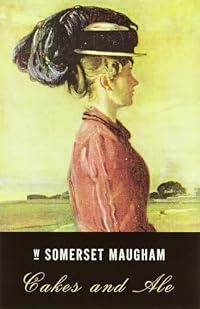
Cakes and Ale
by W. Somerset Maugham  , Dodie Masterman (Illustrator)
On This Page
Description
Cakes and Ale is a delicious satire of London literary society between the Wars. Social climber Alroy Kear is flattered when he is selected by Edward Driffield's wife to pen the official biography of her lionized novelist husband, and determined to write a bestseller. But then Kear discovers the great novelist's voluptuous muse (and unlikely first wife), Rosie. The lively, loving heroine once gave Driffield enough material to last a lifetime, but now her memory casts an embarrissing shadow show more over his career and respectable image. Wise, witty, deeply satisfying, Cakes and Ale is Maugham at his best. show lessTags
Recommendations

















Member Reviews
[Preface for The Collected Edition, Heinemann, 1934:]
It was as a short story, and not a very long one either, that I first thought of this novel. Here is the note I made when it occurred to me: “I am asked to write my reminiscences of a famous novelist, a friend of my boyhood, living at W. with a common wife, very unfaithful to him. There he writes his greatest books. Later he marries his secretary, who guards him and makes him into a figure. My wonder whether even in old age he is not slightly restive at being made into monument.” I was writing at the time a series of short stories for “The Cosmopolitan.” My contract stipulated that they were to be between twelve hundred and fifteen hundred words, so that with the illustration show more they should not occupy more than a page of the magazine, but I allowed myself some latitude and then the illustration spread across the opposite page and gave me little more space. I thought this story would do for this purpose, and put it aside for future use. But I had long had in mind the character of Rosie. I had wanted for years to write about her, but the opportunity never presented itself; I could contrive no setting in which she found a place to suit her, and I began to think I never should. I did not very much care. A character in a writer’s head, unwritten, remains a possession; his thoughts recur to it constantly, and while his imagination gradually enriches it he enjoys the singular pleasure of feeling that there, in his mind, someone is living a varied and tremulous life, obedient to his fancy and yet in a queer wilful way independent of him. But when once that character is set down on paper it belongs to the writer no more. He forgets it. It is curious how completely a person who may have occupied your reveries for many years can thus cease to be. It suddenly struck me that the little story I had jotted down offered me just the framework for this character that I had been looking for. I would make her the wife of my distinguished novelist. I saw that my story could never be got into a couple of thousand words, so I made up my mind to wait a little and use my material for one of my much longer tales, fourteen or fifteen thousand words, with which, following upon Rain, I had not been unsuccessful. But the more I thought of it the less inclined I was to waste my Rosie on a story even of that length. Old recollections returned to me. I found I had not said all I wanted to say about the W. of the note, which in Of Human Bondage I had called Blackstable. After so many years I did not see why I should not get closer to the facts. The Uncle William, Rector of Blackstable, and his wife Isabella, became Uncle Henry, Vicar, and his wife, Sophie. The Philip Carey of the earlier book became the I of Cakes and Ale.
When the book appeared I was attacked in various quarters because I was supposed in the character of Herbert Driffield[1] to have drawn a portrait of Thomas Hardy. This was not my intention. He was no more in my mind than George Meredith or Anatole France. As my note suggests, I had been struck by the notion that the veneration to which an author full of years and honour is exposed must be irksome to the little alert soul within him that is alive still to the adventures of his fancy. Many odd and disconcerting ideas must cross his mind, I thought, while he maintains the dignified exterior that his admirers demand of him. I read Tess of the D’Urbervilles when I was eighteen with such enthusiasm that I determined to marry a milkmaid, but I had never been so much taken with Hardy’s other books as were most of my contemporaries, and I did not think his English very good. I was never so much interested in him as I was at one time in George Meredith, and later in Anatole France. I knew little of Hardy’s life. I know now only enough to be certain that the points in common between his and that of Herbert Driffield are negligible. They consist only in both having been born in humble circumstances and both having had two wives. I met Thomas Hardy but once. This was at a dinner-party at Lady St. Heliers’, better known in the social history of the day as Lady Jeune, who liked to ask to her house (in a much more exclusive world than the world of to-day) everyone that in some way or another had caught the public eye. I was then a popular and fashionable playwright. It was one of those great dinner-parties that people gave before the war, with a vast number of courses, thick and clear soup, fish, a couple of entrées, sorbet (to give you a chance to get your second wind), joint, game, sweet, ice and savoury; and there were twenty-four people all of whom by rank, political eminence or artistic achievement, were distinguished. When the ladies retired to the drawing-room I found myself sitting next to Thomas Hardy. I remember a little man with an earthly face. In his evening clothes, with his boiled shirt and high collar, he had still a strange look of the soil. He was amiable and mild. It struck me at the time that there was in him a curious mixture of shyness and self-assurance. I do not remember what we talked about, but I know that we talked for three-quarters of an hour. At the end of it he paid me a great compliment: he asked me (not having heard my name) what was my profession.
I am told that two or three writers thought themselves aimed at in the character of Alroy Kear. They were under a misapprehension. This character was a composite portrait: I took the appearance from one writer, the obsession with good society from another, the heartiness from a third, the pride in athletic prowess from a fourth, and a great deal of myself. For I have a grim capacity for seeing my own absurdity and I find in myself much to excite my ridicule. I am inclined to think that this is why I see people (if I am to believe what I am frequently told and frequently read of myself) in a less flattering light than many authors who have not this unfortunate idiosyncrasy. For all the characters that we create are but copies of ourselves. It may be of course also that they really are nobler, more disinterested, virtuous and spiritual than I. It is very natural that being godlike they should create men in their own image. When I wanted to draw the portrait of a writer who used every means of advertisement possible to assist the diffusion of his works I had no need to fix my attention on any particular person. The practice is too common for that. Nor can one help feeling sympathy for it. Every year hundreds of books, many of considerable merit, pass unnoticed. Each one has taken the author months to write, he may have had it in his mind for years; he has put into it something of himself which is lost for ever, it is heart-rending to think how great are the chances that it will be disregarded in the press of matter that weighs down the critics’ tables and burdens the booksellers’ shelves. It is not unnatural that he should use what means he can to attract the attention of the public. Experience has thought him what to do. He must make himself a public figure. He must keep in the public eye. He must give interviews and get his photograph in the papers. He must write letters to “The Times,” address meetings and occupy himself with social questions; he must make after-dinner speeches; he must recommend books in the publishers’ advertisements; and he must be seen without fail at the proper places at the proper times. He must never allow himself to be forgotten. It is hard an anxious work, for a mistake may cost him dear; it would be brutal to look with anything but kindliness at an author who takes so much trouble to persuade the world at large to read books that he honestly considers so well worth reading.
But there is one form of advertisement that I deplore. This is the cocktail party that is given to launch a book. You secure the presence of a photographer. You invite the gossip writers and as many eminent people as you know. The gossip writers give you a paragraph in their columns and the illustrated papers publish the photographs, but the eminent people expect to get a signed copy of the book for nothing. This ignoble practice is not rendered less objectionable when it is presumed (sometimes no doubt with justice) to be given at the expense of the publisher. It did not flourish at the time I wrote Cakes and Ale. It would have given me the material for a lively chapter.
[Introduction for the Modern Library edition, 1950:]
When Cakes and Ale was first published a lot of fuss was made in the papers because in the character I had called Edward Driffield I was supposed to have had Thomas Hardy in mind. It was in vain that I denied it. It was in vain that I pointed out to the journalists who came to question me how different the life of my hero was from that of Thomas Hardy. It is true that both were of peasant stock, that both had written novels of life in the English countryside, that both had been twice married and that both in their old age had achieved fame. But that was the beginning and the end of the resemblance. I met Thomas Hardy but once and that was at a dinner party in London when the ladies, as is the custom in England, had retired from the dining-room to leave the men to drink their port and over coffee and brandy discuss the affairs of the nation. I found myself sitting next to him and we talked together for a while. I never saw him again. I knew neither of his wives. I believe the first, unlike the Rosie of my book, who was a barmaid, was the daughter of a minor dignitary of the Anglican church. I never visited his house. In fact, I knew no more of him than what I had learnt from his works. I have no recollection of what we talked about on that occasion and remember only that I took away with me the impression of a small, gray, tired, retiring man who was, though not in the least embarrassed to be at such a grand party as that was, no more intimately concerned with it than if he had been a member of the audience at a play. I surmised that if he had accepted the invitation of our hostess, who was something of a lion hunter, it was because he had not known how to refuse it without discourtesy. There was certainly nothing in him of the somewhat freakish and ribald attitude towards life which was characteristic in his old age of Edward Driffield.
I think the newspaper men only identified my character with Thomas Hardy because when my book was written he had recently died. Otherwise they might just as easily have thought of Tennyson or Meredith. I had had occasion to see old and eminent writers receive the homage of their admirers, and as I watched them I had sometimes asked myself whether at such moments their minds ever carried them back to their obscure and tumultuous youth and whether when they looked at the ladies who gazed at them, their eyes misty with adoration, or listened gravely to the earnest young men who told how great an influence their works had had on them, they did not chuckle within themselves and with amusement wonder what those admirers would say if they knew the whole truth about them. I asked myself whether sometimes they did not grow impatient with the reverence with which they were treated. I asked myself whether they greatly relished being perched up on a pedestal.
Sometimes it was obvious that they did. One evening at Rapallo, when I had been dining with Max Beerbohm, he suggested that we should go along and see Gerhart Hauptmann who was staying there. Gerhart Hauptmann, a German dramatist for all I know forgotten by now, was then very much of a celebrity. We found him enthroned in an armchair in the drawing-room of the hotel, an old man with white hair and a reddish, oddly naked face; and in a great circle on the little gilt chairs that people hire for a musical party were seated about twenty people, mostly men, listening intently to what he was saying. We waited to intrude till he had finished, and when he had there was a subdued murmur of appreciation. We advanced and the great man waved a greeting and bade chairs to be brought for us. Two young men ran to fetch them and the circle was enlarged to include us. We exchanged a few polite remarks, but it was impossible not to see that our arrival had thrown a constraint on the company. Silence fell. Those eager young persons gazed expectantly at the famous author. The silence continued. The silence grew embarrassing. At last a bright youth put a question to him. He considered it for a moment and then, settling himself in his armchair, replied to it at what seemed to me inordinate length. When he came to the end of his discourse there was again a subdued murmur of respectful admiration. I caught Max Beerbohm’s eye; we rose and took our leave.
Of course Gerhart Hauptmann gave his listeners what they wanted and it was evident he was at his ease on the pedestal on which they had placed him. I do not think our English-speaking authors take very comfortably to such a posture. Yeats was apt to play the bard with a certain lack of humor, and so exposed himself to the mockery of his flippant compatriots. It was an affectation which the beauty of his poetry excused. Henry James accepted with the courtesy that never failed him the adulation of the ladies, mostly middle-aged, who vied with one another to attract his undivided attention, but in private he was not unprepared to make a little gentle fun of them.
In point of fact I founded Edward Driffield on an obscure writer who settled with his wife and children in the small town of Whitstable, of which my uncle and guardian was vicar. I do not remember his name. I don’t think he ever amounted to anything and he must be long since dead. He was the first author I had ever met, and though my uncle strongly disapproved of my association with him, I used to slip away to see him whenever I had the chance. His conversation thrilled me. It was a shock to me and a satisfaction to my uncle when one day he vanished from the town with all his debts unpaid. I need add nothing further about him since the reader will find the impression he made on me described in my book.
It had but just been published when a letter delivered by hand was brought into me at my lodgings in Half Moon Street. It was from Hugh Walpole. He was on the committee of the English Book Society, and had taken my novel to bed with him to read it with a view of recommending it as the book of the month. As he read, it was born in upon him that in the character of Alroy Kear I had drawn what seemed to him a cruel portrait of himself. Hugh Walpole then was the most prominent member of that body of writers who attempt by seizing every opportunity to keep in the public eye, by getting on familiar terms with critics so that their books may be favourably reviewed, by currying favor wherever it can serve them, to attain success which their merit scarcely deserves. They attempt by push and pull to make up for their lack of talent. It was true that I had had Hugh Walpole in mind when I devised the character to whom I gave the name of Alroy Kear. No author can create a character out of nothing. He must have a model to give him a starting point; but then his imagination goes to work, he builds him up, adding a trait here, a trait there, which his model did not possess, and when he has finished with him the complete character he presents to the reader has little in him of the person who had offered the first suggestion. It is only thus that a novelist can give his characters the intensity, the reality which makes them not only plausible, but convincing. I had no wish to hurt Hugh Walpole's feelings. He was a genial creature and he had friends who, though they were apt to laugh at him, were genuinely attached to him. He was easy to like, but difficult to respect. When I devised the character of Alroy Kear I did all I could to cover my tracks; I made him a sportsman who rode to hounds, played tennis and golf much better than most, and an amorist who skillfully avoided the entanglement of marriage. None of this could be said of Hugh Walpole. When I replied to his letter I told him this, and I added that I had taken one characteristic from an author we both knew and another from another, and moreover that above all I had put in Alroy Kear a great deal of myself. I have never been unaware of my own defects and I have never regarded them with complacency. We are all exhibitionists, we writers. Why else do we consent to be photographed? Why else do we grant interviews? Why do we scan the papers for the advertisements of our books? Why indeed do we put our name to them instead of describing them as Jane Austen did as “by a lady,” or like Sir Walter Scott as “by the author of Waverley”? But the fact remained that I had given Alroy Kear certain traits, certain discreditable foibles which Hugh Walpole too notoriously had, so that few people in the literary world of London failed to see that he had been my model. If his ghost wanders uneasily in the book shops to see that his works are properly displayed and he remembers how I mocked at his ambition one day to be the grand old man of English literature, he must chuckle with malicious glee when he sees that I, even I, who laughed at him, seem to be on the verge of reaching that sad, absurd and transitory eminence.
But it was not especially to write about Edward Driffield and Alroy Kear that I wrote Cakes and Ale. In my youth I had been closely connected with the young woman whom in this book I have called Rosie.[2] She had grave and maddening faults, but she was beautiful and honest. The connection came to an end as such connections do, but the memory of her lingered on in my mind year after year. I knew that one day I should bring her into a novel. The years went by, many years, and I could never find the opportunity I was seeking. I began to fear I never should. It was not till, I don’t know why, I was seized with the desire to write about an old, distinguished novelist who, somewhat to his exasperation, was cosseted by his wife, and after his death used by her and others for their own glorification, that it occurred to me that by making Rosie his first wife I had the opportunity I had so long wanted. I must add that the model for what I consider the most engaging heroine I have ever created could never have recognized herself in my novel, since by the time I wrote it she was dead.
Interviewers are apt to ask authors very much the same questions, and in the course of time one has the answers to most of them ready. When they ask me which I think my best book I ask them if they mean by that which is generally considered so or which I myself like best. Though I have not read it since I corrected the proofs during the First World War I am willing enough to agree with common opinion that Of Human Bondage is my best work. It is the kind of book an author can only write once. After all, he has only one life. But the book I like best is Cakes and Ale. It was an amusing book to write. I found it a pleasant task to surmount the difficulty of dealing with events that took place thirty years later without losing the sense of continuity which is necessary if you want to hold your reader’s attention. I wanted him to step from the past to the present and back again without a jolt so that the narrative should flow as evenly as one of those placid French rivers. But that of course is just a matter of more or less ingenious technique, of which only the result is the concern of the reader. The reader is no more concerned with the snags, the quandaries, the dilemmas with which the author has had to cope than the gourmet is concerned with all that has gone to produce the perfect and succulent Virginia ham which is set before him. But that is by the way; I like Cakes and Ale because in its pages lives for me again the woman with the lovely smile who was the model for Rosie Driffield.
[From the Preface to The Selected Novels, Vol. 3, Heinemann, 1953:]
Unfortunately, I had given Alroy Kear certain traits, certain discreditable foibles, which Walpole too notoriously had, so that few people in the literary world of London failed to see that he had been in part my model. For in this connection we are more apt to recognise persons by their defects than by their merits.[3] Poor Hugh was bitterly affronted.
[...]
I must add that the model for what I consider the most engaging heroine I have ever created could never have recognised herself in my novel since by the time I wrote it she was dead. But if she had read it I don’t believe she would have been displeased.
____________________________________________________________
[1] The character’s name is Edward Driffield. This curious mistake is silently fixed in modern paperbacks. Ed.
[2] For the real foundations of Rosie, see Appendix A in Robert Calder’s W. Somerset Maugham and the Quest for Freedom, Heinemann, 1972. Ed.
[3] Compare the original Preface to First Person Singular (1931). Ed.
The complete character, the result of elaboration rather than of invention, is art, and life in the raw, as we know, is only its material. It is unjust then for the critics to blame an author because he draws a character in whom they detect a likeness to someone they know and wholly unreasonable of them to expect him never to take one trait or another from living creatures. The odd thing is that when these charges are made, emphasis is laid only on the less laudable characteristics of the individual. If you say of a character in a book that he is kind to his mother, but beats his wife, everybody will cry: Ah, that's Brown, how beastly to say he beats his wife; and no one thinks for a moment of Jones and Robinson who are notoriously kind to their mothers. I draw from this the somewhat surprising conclusion that we know our friends by their defects and not by their merits. show less
It was as a short story, and not a very long one either, that I first thought of this novel. Here is the note I made when it occurred to me: “I am asked to write my reminiscences of a famous novelist, a friend of my boyhood, living at W. with a common wife, very unfaithful to him. There he writes his greatest books. Later he marries his secretary, who guards him and makes him into a figure. My wonder whether even in old age he is not slightly restive at being made into monument.” I was writing at the time a series of short stories for “The Cosmopolitan.” My contract stipulated that they were to be between twelve hundred and fifteen hundred words, so that with the illustration show more they should not occupy more than a page of the magazine, but I allowed myself some latitude and then the illustration spread across the opposite page and gave me little more space. I thought this story would do for this purpose, and put it aside for future use. But I had long had in mind the character of Rosie. I had wanted for years to write about her, but the opportunity never presented itself; I could contrive no setting in which she found a place to suit her, and I began to think I never should. I did not very much care. A character in a writer’s head, unwritten, remains a possession; his thoughts recur to it constantly, and while his imagination gradually enriches it he enjoys the singular pleasure of feeling that there, in his mind, someone is living a varied and tremulous life, obedient to his fancy and yet in a queer wilful way independent of him. But when once that character is set down on paper it belongs to the writer no more. He forgets it. It is curious how completely a person who may have occupied your reveries for many years can thus cease to be. It suddenly struck me that the little story I had jotted down offered me just the framework for this character that I had been looking for. I would make her the wife of my distinguished novelist. I saw that my story could never be got into a couple of thousand words, so I made up my mind to wait a little and use my material for one of my much longer tales, fourteen or fifteen thousand words, with which, following upon Rain, I had not been unsuccessful. But the more I thought of it the less inclined I was to waste my Rosie on a story even of that length. Old recollections returned to me. I found I had not said all I wanted to say about the W. of the note, which in Of Human Bondage I had called Blackstable. After so many years I did not see why I should not get closer to the facts. The Uncle William, Rector of Blackstable, and his wife Isabella, became Uncle Henry, Vicar, and his wife, Sophie. The Philip Carey of the earlier book became the I of Cakes and Ale.
When the book appeared I was attacked in various quarters because I was supposed in the character of Herbert Driffield[1] to have drawn a portrait of Thomas Hardy. This was not my intention. He was no more in my mind than George Meredith or Anatole France. As my note suggests, I had been struck by the notion that the veneration to which an author full of years and honour is exposed must be irksome to the little alert soul within him that is alive still to the adventures of his fancy. Many odd and disconcerting ideas must cross his mind, I thought, while he maintains the dignified exterior that his admirers demand of him. I read Tess of the D’Urbervilles when I was eighteen with such enthusiasm that I determined to marry a milkmaid, but I had never been so much taken with Hardy’s other books as were most of my contemporaries, and I did not think his English very good. I was never so much interested in him as I was at one time in George Meredith, and later in Anatole France. I knew little of Hardy’s life. I know now only enough to be certain that the points in common between his and that of Herbert Driffield are negligible. They consist only in both having been born in humble circumstances and both having had two wives. I met Thomas Hardy but once. This was at a dinner-party at Lady St. Heliers’, better known in the social history of the day as Lady Jeune, who liked to ask to her house (in a much more exclusive world than the world of to-day) everyone that in some way or another had caught the public eye. I was then a popular and fashionable playwright. It was one of those great dinner-parties that people gave before the war, with a vast number of courses, thick and clear soup, fish, a couple of entrées, sorbet (to give you a chance to get your second wind), joint, game, sweet, ice and savoury; and there were twenty-four people all of whom by rank, political eminence or artistic achievement, were distinguished. When the ladies retired to the drawing-room I found myself sitting next to Thomas Hardy. I remember a little man with an earthly face. In his evening clothes, with his boiled shirt and high collar, he had still a strange look of the soil. He was amiable and mild. It struck me at the time that there was in him a curious mixture of shyness and self-assurance. I do not remember what we talked about, but I know that we talked for three-quarters of an hour. At the end of it he paid me a great compliment: he asked me (not having heard my name) what was my profession.
I am told that two or three writers thought themselves aimed at in the character of Alroy Kear. They were under a misapprehension. This character was a composite portrait: I took the appearance from one writer, the obsession with good society from another, the heartiness from a third, the pride in athletic prowess from a fourth, and a great deal of myself. For I have a grim capacity for seeing my own absurdity and I find in myself much to excite my ridicule. I am inclined to think that this is why I see people (if I am to believe what I am frequently told and frequently read of myself) in a less flattering light than many authors who have not this unfortunate idiosyncrasy. For all the characters that we create are but copies of ourselves. It may be of course also that they really are nobler, more disinterested, virtuous and spiritual than I. It is very natural that being godlike they should create men in their own image. When I wanted to draw the portrait of a writer who used every means of advertisement possible to assist the diffusion of his works I had no need to fix my attention on any particular person. The practice is too common for that. Nor can one help feeling sympathy for it. Every year hundreds of books, many of considerable merit, pass unnoticed. Each one has taken the author months to write, he may have had it in his mind for years; he has put into it something of himself which is lost for ever, it is heart-rending to think how great are the chances that it will be disregarded in the press of matter that weighs down the critics’ tables and burdens the booksellers’ shelves. It is not unnatural that he should use what means he can to attract the attention of the public. Experience has thought him what to do. He must make himself a public figure. He must keep in the public eye. He must give interviews and get his photograph in the papers. He must write letters to “The Times,” address meetings and occupy himself with social questions; he must make after-dinner speeches; he must recommend books in the publishers’ advertisements; and he must be seen without fail at the proper places at the proper times. He must never allow himself to be forgotten. It is hard an anxious work, for a mistake may cost him dear; it would be brutal to look with anything but kindliness at an author who takes so much trouble to persuade the world at large to read books that he honestly considers so well worth reading.
But there is one form of advertisement that I deplore. This is the cocktail party that is given to launch a book. You secure the presence of a photographer. You invite the gossip writers and as many eminent people as you know. The gossip writers give you a paragraph in their columns and the illustrated papers publish the photographs, but the eminent people expect to get a signed copy of the book for nothing. This ignoble practice is not rendered less objectionable when it is presumed (sometimes no doubt with justice) to be given at the expense of the publisher. It did not flourish at the time I wrote Cakes and Ale. It would have given me the material for a lively chapter.
[Introduction for the Modern Library edition, 1950:]
When Cakes and Ale was first published a lot of fuss was made in the papers because in the character I had called Edward Driffield I was supposed to have had Thomas Hardy in mind. It was in vain that I denied it. It was in vain that I pointed out to the journalists who came to question me how different the life of my hero was from that of Thomas Hardy. It is true that both were of peasant stock, that both had written novels of life in the English countryside, that both had been twice married and that both in their old age had achieved fame. But that was the beginning and the end of the resemblance. I met Thomas Hardy but once and that was at a dinner party in London when the ladies, as is the custom in England, had retired from the dining-room to leave the men to drink their port and over coffee and brandy discuss the affairs of the nation. I found myself sitting next to him and we talked together for a while. I never saw him again. I knew neither of his wives. I believe the first, unlike the Rosie of my book, who was a barmaid, was the daughter of a minor dignitary of the Anglican church. I never visited his house. In fact, I knew no more of him than what I had learnt from his works. I have no recollection of what we talked about on that occasion and remember only that I took away with me the impression of a small, gray, tired, retiring man who was, though not in the least embarrassed to be at such a grand party as that was, no more intimately concerned with it than if he had been a member of the audience at a play. I surmised that if he had accepted the invitation of our hostess, who was something of a lion hunter, it was because he had not known how to refuse it without discourtesy. There was certainly nothing in him of the somewhat freakish and ribald attitude towards life which was characteristic in his old age of Edward Driffield.
I think the newspaper men only identified my character with Thomas Hardy because when my book was written he had recently died. Otherwise they might just as easily have thought of Tennyson or Meredith. I had had occasion to see old and eminent writers receive the homage of their admirers, and as I watched them I had sometimes asked myself whether at such moments their minds ever carried them back to their obscure and tumultuous youth and whether when they looked at the ladies who gazed at them, their eyes misty with adoration, or listened gravely to the earnest young men who told how great an influence their works had had on them, they did not chuckle within themselves and with amusement wonder what those admirers would say if they knew the whole truth about them. I asked myself whether sometimes they did not grow impatient with the reverence with which they were treated. I asked myself whether they greatly relished being perched up on a pedestal.
Sometimes it was obvious that they did. One evening at Rapallo, when I had been dining with Max Beerbohm, he suggested that we should go along and see Gerhart Hauptmann who was staying there. Gerhart Hauptmann, a German dramatist for all I know forgotten by now, was then very much of a celebrity. We found him enthroned in an armchair in the drawing-room of the hotel, an old man with white hair and a reddish, oddly naked face; and in a great circle on the little gilt chairs that people hire for a musical party were seated about twenty people, mostly men, listening intently to what he was saying. We waited to intrude till he had finished, and when he had there was a subdued murmur of appreciation. We advanced and the great man waved a greeting and bade chairs to be brought for us. Two young men ran to fetch them and the circle was enlarged to include us. We exchanged a few polite remarks, but it was impossible not to see that our arrival had thrown a constraint on the company. Silence fell. Those eager young persons gazed expectantly at the famous author. The silence continued. The silence grew embarrassing. At last a bright youth put a question to him. He considered it for a moment and then, settling himself in his armchair, replied to it at what seemed to me inordinate length. When he came to the end of his discourse there was again a subdued murmur of respectful admiration. I caught Max Beerbohm’s eye; we rose and took our leave.
Of course Gerhart Hauptmann gave his listeners what they wanted and it was evident he was at his ease on the pedestal on which they had placed him. I do not think our English-speaking authors take very comfortably to such a posture. Yeats was apt to play the bard with a certain lack of humor, and so exposed himself to the mockery of his flippant compatriots. It was an affectation which the beauty of his poetry excused. Henry James accepted with the courtesy that never failed him the adulation of the ladies, mostly middle-aged, who vied with one another to attract his undivided attention, but in private he was not unprepared to make a little gentle fun of them.
In point of fact I founded Edward Driffield on an obscure writer who settled with his wife and children in the small town of Whitstable, of which my uncle and guardian was vicar. I do not remember his name. I don’t think he ever amounted to anything and he must be long since dead. He was the first author I had ever met, and though my uncle strongly disapproved of my association with him, I used to slip away to see him whenever I had the chance. His conversation thrilled me. It was a shock to me and a satisfaction to my uncle when one day he vanished from the town with all his debts unpaid. I need add nothing further about him since the reader will find the impression he made on me described in my book.
It had but just been published when a letter delivered by hand was brought into me at my lodgings in Half Moon Street. It was from Hugh Walpole. He was on the committee of the English Book Society, and had taken my novel to bed with him to read it with a view of recommending it as the book of the month. As he read, it was born in upon him that in the character of Alroy Kear I had drawn what seemed to him a cruel portrait of himself. Hugh Walpole then was the most prominent member of that body of writers who attempt by seizing every opportunity to keep in the public eye, by getting on familiar terms with critics so that their books may be favourably reviewed, by currying favor wherever it can serve them, to attain success which their merit scarcely deserves. They attempt by push and pull to make up for their lack of talent. It was true that I had had Hugh Walpole in mind when I devised the character to whom I gave the name of Alroy Kear. No author can create a character out of nothing. He must have a model to give him a starting point; but then his imagination goes to work, he builds him up, adding a trait here, a trait there, which his model did not possess, and when he has finished with him the complete character he presents to the reader has little in him of the person who had offered the first suggestion. It is only thus that a novelist can give his characters the intensity, the reality which makes them not only plausible, but convincing. I had no wish to hurt Hugh Walpole's feelings. He was a genial creature and he had friends who, though they were apt to laugh at him, were genuinely attached to him. He was easy to like, but difficult to respect. When I devised the character of Alroy Kear I did all I could to cover my tracks; I made him a sportsman who rode to hounds, played tennis and golf much better than most, and an amorist who skillfully avoided the entanglement of marriage. None of this could be said of Hugh Walpole. When I replied to his letter I told him this, and I added that I had taken one characteristic from an author we both knew and another from another, and moreover that above all I had put in Alroy Kear a great deal of myself. I have never been unaware of my own defects and I have never regarded them with complacency. We are all exhibitionists, we writers. Why else do we consent to be photographed? Why else do we grant interviews? Why do we scan the papers for the advertisements of our books? Why indeed do we put our name to them instead of describing them as Jane Austen did as “by a lady,” or like Sir Walter Scott as “by the author of Waverley”? But the fact remained that I had given Alroy Kear certain traits, certain discreditable foibles which Hugh Walpole too notoriously had, so that few people in the literary world of London failed to see that he had been my model. If his ghost wanders uneasily in the book shops to see that his works are properly displayed and he remembers how I mocked at his ambition one day to be the grand old man of English literature, he must chuckle with malicious glee when he sees that I, even I, who laughed at him, seem to be on the verge of reaching that sad, absurd and transitory eminence.
But it was not especially to write about Edward Driffield and Alroy Kear that I wrote Cakes and Ale. In my youth I had been closely connected with the young woman whom in this book I have called Rosie.[2] She had grave and maddening faults, but she was beautiful and honest. The connection came to an end as such connections do, but the memory of her lingered on in my mind year after year. I knew that one day I should bring her into a novel. The years went by, many years, and I could never find the opportunity I was seeking. I began to fear I never should. It was not till, I don’t know why, I was seized with the desire to write about an old, distinguished novelist who, somewhat to his exasperation, was cosseted by his wife, and after his death used by her and others for their own glorification, that it occurred to me that by making Rosie his first wife I had the opportunity I had so long wanted. I must add that the model for what I consider the most engaging heroine I have ever created could never have recognized herself in my novel, since by the time I wrote it she was dead.
Interviewers are apt to ask authors very much the same questions, and in the course of time one has the answers to most of them ready. When they ask me which I think my best book I ask them if they mean by that which is generally considered so or which I myself like best. Though I have not read it since I corrected the proofs during the First World War I am willing enough to agree with common opinion that Of Human Bondage is my best work. It is the kind of book an author can only write once. After all, he has only one life. But the book I like best is Cakes and Ale. It was an amusing book to write. I found it a pleasant task to surmount the difficulty of dealing with events that took place thirty years later without losing the sense of continuity which is necessary if you want to hold your reader’s attention. I wanted him to step from the past to the present and back again without a jolt so that the narrative should flow as evenly as one of those placid French rivers. But that of course is just a matter of more or less ingenious technique, of which only the result is the concern of the reader. The reader is no more concerned with the snags, the quandaries, the dilemmas with which the author has had to cope than the gourmet is concerned with all that has gone to produce the perfect and succulent Virginia ham which is set before him. But that is by the way; I like Cakes and Ale because in its pages lives for me again the woman with the lovely smile who was the model for Rosie Driffield.
[From the Preface to The Selected Novels, Vol. 3, Heinemann, 1953:]
Unfortunately, I had given Alroy Kear certain traits, certain discreditable foibles, which Walpole too notoriously had, so that few people in the literary world of London failed to see that he had been in part my model. For in this connection we are more apt to recognise persons by their defects than by their merits.[3] Poor Hugh was bitterly affronted.
[...]
I must add that the model for what I consider the most engaging heroine I have ever created could never have recognised herself in my novel since by the time I wrote it she was dead. But if she had read it I don’t believe she would have been displeased.
____________________________________________________________
[1] The character’s name is Edward Driffield. This curious mistake is silently fixed in modern paperbacks. Ed.
[2] For the real foundations of Rosie, see Appendix A in Robert Calder’s W. Somerset Maugham and the Quest for Freedom, Heinemann, 1972. Ed.
[3] Compare the original Preface to First Person Singular (1931). Ed.
The complete character, the result of elaboration rather than of invention, is art, and life in the raw, as we know, is only its material. It is unjust then for the critics to blame an author because he draws a character in whom they detect a likeness to someone they know and wholly unreasonable of them to expect him never to take one trait or another from living creatures. The odd thing is that when these charges are made, emphasis is laid only on the less laudable characteristics of the individual. If you say of a character in a book that he is kind to his mother, but beats his wife, everybody will cry: Ah, that's Brown, how beastly to say he beats his wife; and no one thinks for a moment of Jones and Robinson who are notoriously kind to their mothers. I draw from this the somewhat surprising conclusion that we know our friends by their defects and not by their merits. show less
[Cakes and Ale] by W. Somerset Maugham is a satire of the literary society in London at the turn of the 20th century. Lighter in tone than some of his other novels, it is humorous, perceptive and clever.
The setting is London and the fictitious Blackstable, Kent. The author opens the book with a heavy dose of irony. I was confused at first at exactly who the book is about as the author does not make the plot direct and clear. The narrator is the novelist Ashenden, who was also the narrator in The Razor’s Edge and is clearly modelled on the author himself. The introduction of Rosie Diffenfield brings a sense of social judgement and a picture of society as she and her sexuality are the subject of pointed fingers and arrogant show more judgement.
[Cakes and Ale] is a wonderful mix of social conventions and free spiritedness, a fairly quick read with the author’s character development setting the tone. I found at times that Maugham tended to wander in his writing and I had no idea of what he was trying to point out but overall I enjoyed this book and will continue on with more by this author. show less
The setting is London and the fictitious Blackstable, Kent. The author opens the book with a heavy dose of irony. I was confused at first at exactly who the book is about as the author does not make the plot direct and clear. The narrator is the novelist Ashenden, who was also the narrator in The Razor’s Edge and is clearly modelled on the author himself. The introduction of Rosie Diffenfield brings a sense of social judgement and a picture of society as she and her sexuality are the subject of pointed fingers and arrogant show more judgement.
[Cakes and Ale] is a wonderful mix of social conventions and free spiritedness, a fairly quick read with the author’s character development setting the tone. I found at times that Maugham tended to wander in his writing and I had no idea of what he was trying to point out but overall I enjoyed this book and will continue on with more by this author. show less
An entertaining tale of priggishness and hypocrisy in the world of letters, memorable for its waspish portrait of mountebank scribbler/social climber Alroy Flear. But the story has a warm heart in the character of Rosie Driffield, writers’ muse and genuine good time girl. Maugham has such a talent for balancing bitchiness and benevolence.
I'm reading and rereading a lot of popular British books from between the wars in order to try to understand popular support for appeasement. Maugham is an extraordinary stylist, and I'd read everything of his before, and he typifies a kind of acceptable anti-Semitism specifically and racism generally.
This time I noticed the snobbery. The last line. Dang.
So, I'd say this is a beautifully-written and incredibly snarky book that exemplifies how acceptable various kinds of racism were. The narrator of the book is an incredible snob, who seems to reconsider his snobbery, but the last line makes it clear: not really. Maugham was a snob. And worth reading for that reason.
This time I noticed the snobbery. The last line. Dang.
So, I'd say this is a beautifully-written and incredibly snarky book that exemplifies how acceptable various kinds of racism were. The narrator of the book is an incredible snob, who seems to reconsider his snobbery, but the last line makes it clear: not really. Maugham was a snob. And worth reading for that reason.
tl;dr Cakes and Ale is proof in the pudding dead white dudes could write whatever the fuck they want and have it hailed as literary masterpiece, even when it is utterly beyond crap.
Review
I picked this book up a couple of months ago and it has been the bane of my existence as the more I read, the more I hated it. It is poorly written and badly edited, with random thoughts dropped into the middle of scenes that do not make any sense to the story or plot. For example, near the end of the book while discussing the character, Rosie Driffield, in question, the narrator suddenly decides this would be a good time to go on a two page bender on the withal of telling a story in first person narrative. Then as suddenly as he leapt into that show more thought, he leaps back into his discourse of Rosie's admirable/questionable qualities.
The book is littered with jumps like this. There was 30 pages leveled on the discourse of beauty, what it meant, how it was applicable to life, who got it, and who didn't. Another 10 pages on the virtues of a secondary minor character who doesn't show up until near the end of the book. Roughly 20 pages was spent discussing the attributes of a another character who never actually shows up later in the story.
Maugham name checks of the day famous literary talent, real and imaginary. He draws comparison between his protagonist, William Ashenden, and these literary giants and whom you realise is really a stand in for him. He fangirls over so many famous people, it gets kind of embarrassing.
The crux of the story is William Ashenden, the narrator, is asked by Alroy Kear, another London literary snob, to help him with his research on writing a biography of recently deceased late-Victorian author, Edward Driffield. Driffield's wife, the second Mrs. Driffield, wants any mention of the first Mrs. Driffield, our supposed heroine Rosie, to be erased from Edward's history for she was an amoral character to the ninth degree and whose influence over poor dear Edward nearly killed him.
With this set up, one would think the whole of the story would be the bringing to life, discussion, and telling of Rosie Driffield's relationship with Edward. Rosie is mentioned in the beginning of the book briefly and then it's not until another 200 pages later she's brought into focus again and then carried out. It was as if someone had said to Maugham, "Yo. You are far off plot here buddy, rein it in!" And he did.
The whole of the book is to examine the snobbery and the often absurd social mores of the late Victorians and later, the Edwardians, and how these attitudes were affected and perceived. I get that, I do. But in that vein, the book is so poorly executed I spent a lot of time wondering what the fuck I was reading. I checked the synopsis on the back of the book so often to verify that what it said was actually what I was reading and not something else entirely.
It is well documented Maugham had issues with women, as he often saw them as his sexual and affection competitors, so his women are often described and treated as if they scum on shoes because of their sex. It is also well established Maugham, despite impressive number of novels under his belt, is at his best as a short story writer. With that in mind, I would recommend you stay the hell away from Cakes and Ale. I cannot in good conscious even conceive how this book gets so much love because of how flawed it is from start to finish. It is not even coherent, and yet! Yet, the mere existence proves that a dead white dude could write anything and have it called a literary masterpiece. show less
Review
I picked this book up a couple of months ago and it has been the bane of my existence as the more I read, the more I hated it. It is poorly written and badly edited, with random thoughts dropped into the middle of scenes that do not make any sense to the story or plot. For example, near the end of the book while discussing the character, Rosie Driffield, in question, the narrator suddenly decides this would be a good time to go on a two page bender on the withal of telling a story in first person narrative. Then as suddenly as he leapt into that show more thought, he leaps back into his discourse of Rosie's admirable/questionable qualities.
The book is littered with jumps like this. There was 30 pages leveled on the discourse of beauty, what it meant, how it was applicable to life, who got it, and who didn't. Another 10 pages on the virtues of a secondary minor character who doesn't show up until near the end of the book. Roughly 20 pages was spent discussing the attributes of a another character who never actually shows up later in the story.
Maugham name checks of the day famous literary talent, real and imaginary. He draws comparison between his protagonist, William Ashenden, and these literary giants and whom you realise is really a stand in for him. He fangirls over so many famous people, it gets kind of embarrassing.
The crux of the story is William Ashenden, the narrator, is asked by Alroy Kear, another London literary snob, to help him with his research on writing a biography of recently deceased late-Victorian author, Edward Driffield. Driffield's wife, the second Mrs. Driffield, wants any mention of the first Mrs. Driffield, our supposed heroine Rosie, to be erased from Edward's history for she was an amoral character to the ninth degree and whose influence over poor dear Edward nearly killed him.
With this set up, one would think the whole of the story would be the bringing to life, discussion, and telling of Rosie Driffield's relationship with Edward. Rosie is mentioned in the beginning of the book briefly and then it's not until another 200 pages later she's brought into focus again and then carried out. It was as if someone had said to Maugham, "Yo. You are far off plot here buddy, rein it in!" And he did.
The whole of the book is to examine the snobbery and the often absurd social mores of the late Victorians and later, the Edwardians, and how these attitudes were affected and perceived. I get that, I do. But in that vein, the book is so poorly executed I spent a lot of time wondering what the fuck I was reading. I checked the synopsis on the back of the book so often to verify that what it said was actually what I was reading and not something else entirely.
It is well documented Maugham had issues with women, as he often saw them as his sexual and affection competitors, so his women are often described and treated as if they scum on shoes because of their sex. It is also well established Maugham, despite impressive number of novels under his belt, is at his best as a short story writer. With that in mind, I would recommend you stay the hell away from Cakes and Ale. I cannot in good conscious even conceive how this book gets so much love because of how flawed it is from start to finish. It is not even coherent, and yet! Yet, the mere existence proves that a dead white dude could write anything and have it called a literary masterpiece. show less
Tanmese a viktoriánus emlékezetről, avagy miből lesz a cserebogár. Ashenden, az író nyugalmát két kollégája zavarja meg: az egyikük, Alroy Kear él, a másikuk, Driffield épp most halt meg. Eme sajnálatos tény (mármint az elhalálozás) indítja arra az élő írót, hogy felkeresse Ashendent, mégpedig abból a célból, hogy csepegtessen már neki némi életrajzi adatot az elhunytról, merthogy Ashenden hamvas kölyökfóka korában állítólag jól ismerte őt. Csakhogy amit Ashenden tud Driffieldről (és amit nosztalgikus visszaemlékezések füzérén keresztül meg is oszt az olvasóval), az aligha építhető bele organikusan egy szalonképes életrajzba – és itt kezdődnek a problémák. Maugham regénye show more egy kettős átváltozás története: egyfelől láthatjuk, ahogy szegény Driffieldből kiszipolyozza a vért környezete, mert túl elevennek találja ahhoz, hogy egy viktoriánus mítosz tárgya legyen – ha már szobrot formáznak belőle, legalább legyen élettelen. Másrészt pedig (és talán elsősorban) Ashenden átalakulásának története is, aki nem kis részben Driffield (pontosabban felesége, Rosa) hatására válik hétköznapi konformista brit fiatalemberből művésszé. Elegáns, hajlékony, okos (néha okoskodó) kötet a művészről, és arról, milyennek akarja látni a művészt a társadalom, és hogy e két elem között mekkora szakadék tud lenni. Végig belengi valami finom avíttság, ez elfeledett Anglia emléke, amit én különösen sokra értékeltem. Jó volt. show less
This “social satire” was an interesting read. I felt it was meandering at times and I sometimes struggled to determine the tone Maugham was going for. Nonetheless, I felt there was some unique commentary on sexual liberation of women as well as class. The internal thoughts of the narrator seemed to dip into nonfiction/literary criticism at times. Content warning for casual antisemitism and use of the n-word in dialogue.
Members
- Recently Added By
Lists

The Guardian's 1000 Novels Everyone Must Read
1,005 works; 546 members

1001 Books You Must Read Before You Die
1,448 works; 1,132 members
501 Must-Read Books
508 works; 72 members
20th Century Literature
1,161 works; 54 members
Best Satire
188 works; 27 members

Global Reads: Books Set in the United Kingdom and Ireland
109 works; 5 members

In or About the 1930s
198 works; 27 members

Readable Classics
110 works; 15 members

The Novels of W. Somerset Maugham
22 works; 2 members

Books Read in 2014
2,343 works; 86 members

1930s
262 works; 5 members
Books Read in 2016
4,666 works; 197 members

Michael Dirda's 100 Best Comic Novels
100 works; 1 member
Talk Discussions
Past Discussions
Cakes and Ale. All aboard! in friends of Maugham (December 2010)
Author Information

699+ Works 46,558 Members
Writer William Somerset Maugham was born in Paris on January 25, 1874. He attended St. Thomas's Medical School in London. A prolific writer, Maugham produced novels, short stories, plays, and an autobiographical novel, "Of Human Bondage." Although he remains popular for his novels and short stories, when he was alive his plays, now dated, were show more also popular, and in 1908 four of his plays ran simultaneously. Maugham died in Nice, France, on December 16, 1965. (Bowker Author Biography) show less
W. Somerset Maugham has a Legacy Library. Legacy libraries are the personal libraries of famous readers, entered by LibraryThing members from the Legacy Libraries group.

Some Editions
Awards and Honors
Series
Belongs to Publisher Series
Work Relationships
Common Knowledge
- Canonical title
- Cakes and Ale
- Original title
- Cakes and Ale, or The Skeleton in the Cupboard
- Alternate titles
- Rosie und die Künstler [German]; Il fantasma nell'armadio [Italian]; Вино и баници [Bulgarian]
- Original publication date
- 1930, Heinemann, First Edition; 1934, Heinemann, The Collected Edition, new preface; 1950, Modern Library, new preface
- People/Characters
- Edward Driffield; Alroy Kear; Rosie; Ashenden [narrator]; Mrs Driffield
- Important places
- Blackstable, England, UK; London, England, UK
- Related movies
- Cakes and Ale (1974 | IMDb)
- First words
- I have noticed that whenever someone asks for you on the telephone and, finding you out, leaves a message begging you to call him up the moment you come in, as it's important, the matter is more often important to him than to... (show all) you.
- Quotations
- I have noticed that when I am most serious people are apt to laugh at me, and indeed when after a lapse of time I have read passages that I wrote from the fullness of my heart I have been tempted to laugh at myself. It must b... (show all)e that there is something naturally absurd in a sincere emotion, though why there should be I cannot imagine, unless it is that man, the ephemeral inhabitant of an insignificant planet, with all his pain and all his striving is but a jest in an eternal mind.
- Last words
- (Click to show. Warning: May contain spoilers.)"I'll tell you," said Rosie. "He was always such a perfect gentleman."
- Original language
- English
Classifications
Statistics
- Members
- 2,121
- Popularity
- 9,623
- Reviews
- 44
- Rating
- (3.78)
- Languages
- 19 — Bulgarian, Chinese, Czech, Danish, Dutch, English, Estonian, Finnish, French, German, Hungarian, Italian, Japanese, Lithuanian, Norwegian (Bokmål), Russian, Spanish, Swedish, Portuguese (Portugal)
- Media
- Paper, Audiobook, Ebook
- ISBNs
- 47
- UPCs
- 1
- ASINs
- 83