Imagining Argentina
by Lawrence Thornton
On This Page
Description
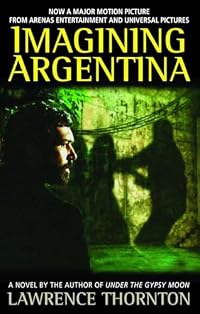
Imagining Argentina is set in the dark days of the late 1970's, when thousands of Argentineans disappeared without a trace into the general's prison cells and torture chambers. When Carlos Ruweda's wife is suddenly taken from him, he discovers a magical gift- In waking dreams, he had clear visions of the fates of "the disappeared." But he cannot "imagine" what has happened to his own wife. Driven to near madness, his mind cannot be taken away- imagination, stories, and the mystical secrets show more of the human spirit. show lessTags
Recommendations






































Member Reviews
In Argentina, during the brutal military rule known as The Dirty War, thousands of students, scholars and unionists simply "disappear" and the Mothers of the Plaza de Mayo begin their marches to bring attention to the regime's policies of terror, kidnapping, and murder. Carlos Rueda, a playwright for a children's theater in Buenos Aires, is married to Cecelia, an outspoken editor at a large newspaper. They have a teenage daughter. One day Cecelia is kidnapped from their home by the regime, and in his grief Carlos joins the Mothers in marching. Hearing their stories, he begins to have visions of the fates of their loved ones. Sometimes all he can report are details of pain and death; other times he is able to predict returns which come show more true, to the wonderment of the crowds that flock to his home each Thursday evening, hoping he can help. But Cecelia, the one "disappeared" he wants so badly to find, appears to him only in bits and pieces as the months stretch into years.
This is the third time I've read this book, and it is as magical, moving, and disturbing as when first published. Carlos' visions tell the story of Argentina's misery, of how young people and even children were kidnapped, mercilessly tortured and raped, and often killed. We see a previously-civilized country ruled by those who indulge themselves in the name of "order", and the fight put up by those willing to risk everything to imagine a different future for their country. In our current political climate, where thugs again proclaim the benefits of unfettered hate and violence against "others", the book is a vivid reminder of the trap waiting for any nation, even ours, when evil overcomes common sense and convinces the easily-lead that their worst tendencies can be justified. show less
This is the third time I've read this book, and it is as magical, moving, and disturbing as when first published. Carlos' visions tell the story of Argentina's misery, of how young people and even children were kidnapped, mercilessly tortured and raped, and often killed. We see a previously-civilized country ruled by those who indulge themselves in the name of "order", and the fight put up by those willing to risk everything to imagine a different future for their country. In our current political climate, where thugs again proclaim the benefits of unfettered hate and violence against "others", the book is a vivid reminder of the trap waiting for any nation, even ours, when evil overcomes common sense and convinces the easily-lead that their worst tendencies can be justified. show less
I've fallen behind writing reviews of the books I've been reading this year, so I thought I'd try to write some shorter reviews just to catch up.
So, Imagining Argentina is one of the books Goodreads has been recommending to me for yonks, because I've read a number of other novels set in South American dictatorships in the same period – Of Love and Shadows, Senselessness, The Story of the Night, and most of Carolina de Robertis' work – and those are all fantastic reads if you're considering picking up this. This book, obviously, deals with many of the same issues as those: political repression, disappearances, torture. But it also has a bit of a different feel about it. It certainly has some magical realism vibes, with the main show more character, Carlos Rueda, blessed with some clairvoyance enabling him to reveal the fates of many of Buenos Aires' disappeared. But it's also, if I can say it, a little less engaging than the other books I've mentioned. The many vignettes within are, I think, emotionally impactful in isolation… but they're all rather disconnected from each other, so the novel feels a bit disjointed and lacks a compulsive, “must read more!” quality.
I want to be clear that I did like this book, and it's as good a reminder of the regressive bloodlust of right-wing regimes as anything else. Parts of it have certainly stuck in my mind: there is a subplot where one of the fates Carlos Rueda reveals is that of a boy who “disappeared” in Nazi Germany, which has stuck in my mind, and some of the commentary on how the Argentine regime saw it as their duty to “purify” the country of all “subversive”, left-wing influences before they could leave the way clear for a restoration of democracy. Really, lots of parts. It just wasn't the kind of book that keeps you reading anxiously to the end. show less
So, Imagining Argentina is one of the books Goodreads has been recommending to me for yonks, because I've read a number of other novels set in South American dictatorships in the same period – Of Love and Shadows, Senselessness, The Story of the Night, and most of Carolina de Robertis' work – and those are all fantastic reads if you're considering picking up this. This book, obviously, deals with many of the same issues as those: political repression, disappearances, torture. But it also has a bit of a different feel about it. It certainly has some magical realism vibes, with the main show more character, Carlos Rueda, blessed with some clairvoyance enabling him to reveal the fates of many of Buenos Aires' disappeared. But it's also, if I can say it, a little less engaging than the other books I've mentioned. The many vignettes within are, I think, emotionally impactful in isolation… but they're all rather disconnected from each other, so the novel feels a bit disjointed and lacks a compulsive, “must read more!” quality.
I want to be clear that I did like this book, and it's as good a reminder of the regressive bloodlust of right-wing regimes as anything else. Parts of it have certainly stuck in my mind: there is a subplot where one of the fates Carlos Rueda reveals is that of a boy who “disappeared” in Nazi Germany, which has stuck in my mind, and some of the commentary on how the Argentine regime saw it as their duty to “purify” the country of all “subversive”, left-wing influences before they could leave the way clear for a restoration of democracy. Really, lots of parts. It just wasn't the kind of book that keeps you reading anxiously to the end. show less
This novel set during the 70s junta in Argentina (and its kidnappings, tortures, rapes and killings) is gritty, imaginative, dark and hopeful - all at the same time. What happens when citizens respond to a military junta with imagination and storytelling (which may even be prophetic and creating a new reality)? How does that impact the way that people choose to believe and to fight the terror they live with?
A fascinating look at imagination, memory, story. And birds. I started highlighting those themes as I read the book.
(recommeded by Matthew Rock)
A fascinating look at imagination, memory, story. And birds. I started highlighting those themes as I read the book.
(recommeded by Matthew Rock)
Imagining Argentina is indeed a book replete with beautiful and illuminating metaphors. It accurately describes many of the events that are still not common enough knowledge from the most recent military dictatorship in Argentina. I thought most accurate was the depiction of the inhumanity of the generals, whose greatest hope was not a peaceful, just society, but an authoritarian realm where fear dominated the populous, where all dissonant viewpoints were silenced into an artificial and dreadful homogeneity. The book moved me to tears, yes, and captured Buenos Aires, yes, and brought the pain of Argentine mothers of disappeared children to an American audience.
BUT
Much of the book details the fates of detainees who were able to escape show more from the detention centers, able to resume lives after the dictatorship ended. This feels to me like an American imposition on the Argentine tragedy. In the many detention centers we toured while in the land of grass fed beef and tango, not once did anyone mention people who had escaped. I do not know if anyone actually managed to sneak past guards; I doubt it was a common occurrence if it happened at all. This hopeful view--of reunions and babies returned from prison--obscures the darker tragedies and unfortunate successes the militares had in obliterating most of the country's progressive leadership. show less
BUT
Much of the book details the fates of detainees who were able to escape show more from the detention centers, able to resume lives after the dictatorship ended. This feels to me like an American imposition on the Argentine tragedy. In the many detention centers we toured while in the land of grass fed beef and tango, not once did anyone mention people who had escaped. I do not know if anyone actually managed to sneak past guards; I doubt it was a common occurrence if it happened at all. This hopeful view--of reunions and babies returned from prison--obscures the darker tragedies and unfortunate successes the militares had in obliterating most of the country's progressive leadership. show less
This novel set during the 70s junta in Argentina (and its kidnappings, tortures, rapes and killings) is gritty, imaginative, dark and hopeful - all at the same time. What happens when citizens respond to a military junta with imagination and storytelling (which may even be prophetic and creating a new reality)? How does that impact the way that people choose to believe and to fight the terror they live with?
A fascinating look at imagination, memory, story. And birds. I started highlighting those themes as I read the book.
(recommeded by Matthew Rock)
A fascinating look at imagination, memory, story. And birds. I started highlighting those themes as I read the book.
(recommeded by Matthew Rock)
this was a beautifully written and moving book about the power of words and imagination in the face of dire circumstances. i really enjoyed this one.
Here comes another "I read this so long ago, can I put together enough memories to really talk about it?" Senior year of high school during the spring we had an international literature class, and this was I guess our "South America" book. It's a magical realism story where someone imagines people who have been disappeared by the government coming back and kind of creates them. I liked it well enough, but my favorite magical realism piece was a play called "Marisol" that I went to with a friend when we visited San Francisco.
Members
- Recently Added By
Lists

Pen/Faulkner Winners and Finalists
178 works; 9 members

Swinging Seventies
255 works; 18 members
Author Information

10 Works 559 Members
Awards and Honors
Awards
Distinctions
Notable Lists
Work Relationships
Has the adaptation
Common Knowledge
- Original publication date
- 1987
- People/Characters
- Carlos Rueda; Cecilia Rueda; Martin Benn
- Important places
- Argentina; Latin America; South America
- Related movies
- Imagining Argentina (2003 | IMDb)
- Dedication
- for Toni
Classifications
Statistics
- Members
- 402
- Popularity
- 77,004
- Reviews
- 7
- Rating
- (3.80)
- Languages
- 7 — Dutch, English, Finnish, Italian, Norwegian (Bokmål), Norwegian, Spanish
- Media
- Paper, Audiobook
- ISBNs
- 13
- ASINs
- 4