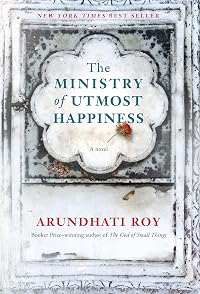
The Ministry of Utmost Happiness
by Arundhati Roy
On This Page
Description
New York Times Best SellerLonglisted for the Man Booker Prize
Named a Best Book of 2017 by NPR, Amazon, Kirkus, The Washington Post, Newsday, and the Hudson Group
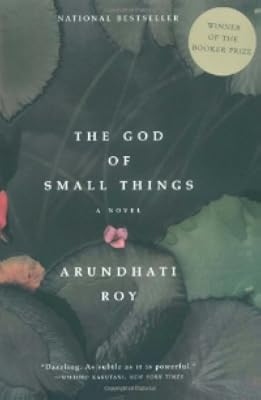
A dazzling, richly moving new novel by the internationally celebrated author of The God of Small Things
The Ministry of Utmost Happiness takes us on an intimate journey of many years across the Indian subcontinent—from the cramped neighborhoods of Old Delhi and the roads of the new city to the mountains and valleys of show more Kashmir and beyond, where war is peace and peace is war.
It is an aching love story and a decisive remonstration, a story told in a whisper, in a shout, through unsentimental tears and sometimes with a bitter laugh. Each of its characters is indelibly, tenderly rendered. Its heroes are people who have been broken by the world they live in and then rescued, patched together by acts of love—and by hope.
The tale begins with Anjum—who used to be Aftab—unrolling a threadbare Persian carpet in a city graveyard she calls home. We encounter the odd, unforgettable Tilo and the men who loved her—including Musa, sweetheart and ex-sweetheart, lover and ex-lover; their fates are as entwined as their arms used to be and always will be. We meet Tilo’s landlord, a former suitor, now an intelligence officer posted to Kabul. And then we meet the two Miss Jebeens: the first a child born in Srinagar and buried in its overcrowded Martyrs’ Graveyard; the second found at midnight, abandoned on a concrete sidewalk in the heart of New Delhi.
As this ravishing, deeply humane novel braids these lives together, it reinvents what a novel can do and can be. The Ministry of Utmost Happiness demonstrates on every page the miracle of Arundhati Roy’s storytelling gifts. show less
Tags
Recommendations






Member Reviews
When Aftab was born he was a hermaphrodite and on adulthood morphed into Anjum. After living with other Hijra, Anjum finally sets up home in a cemetery and builds a community of waifs and strays like her. Woven around this tale is the bigger story of pot-partition India and particularly the politics of Kashmir, that northern province and Islamic homeland disputed by India and Pakistan.
This is a huge novel which, in similar vein to Roy's debut 'The God of Small Things', manages to be both detailed in meticulous storytelling and vast in scope. This is book which demands time spending on it and I think I will also need to re-read it to take in everything. However Roy is a great writer and she is able to tell a magical tale yet get across show more those huge political statements that are so close to her heart and which have been her focus for the last twenty years. show less
This is a huge novel which, in similar vein to Roy's debut 'The God of Small Things', manages to be both detailed in meticulous storytelling and vast in scope. This is book which demands time spending on it and I think I will also need to re-read it to take in everything. However Roy is a great writer and she is able to tell a magical tale yet get across show more those huge political statements that are so close to her heart and which have been her focus for the last twenty years. show less
The Millstone of Unfair Expectations
I am, by nature, a punctual person. I was very late to one novelistic Roy party and relatively early to the next. But in this case, it was the one I was late for that I enjoyed.
In 2014, I finally read The God of Small Things, Roy’s award-winning and (then) only novel, published nearly 20 years earlier. I loved it: the lyrical mysticism, the layers of meaning and metaphor, the tangled plot, the complex characters, and the rich but unfamiliar setting. See my review HERE for why.
News that she’d finally written another novel (this) filled me with joy and excitement. I was conscious that it had a lot to live up to, but was eager to read it. Then I saw a trickle of very conflicting reviews from trusted show more GR friends. But I won a free copy in a GR giveaway. Fate?
The Misery of Most Unhappiness
It pains me that I gave up on this book a little over one third through. There are flickers of beautiful writing, and interesting characters that I cared about. I suspect the different threads of the story eventually weave a wondrous tapestry, and I would probably discover the significance of recurring saffron and parakeets (the vultures are more obvious).
But…
There are many buts.
Overall, it's a confusing, disjointed, inelegant muddle, with lengthy diversions into ideological and ecological rants and subplots, and with the narrative switching between novelistic, mystical, journalese, and political tract. The chapter where I abandoned it added letters, adverts, and a Kashmiri-English alphabet to the mix. All of those things can work. But here, for me, they don't. It was just too much.
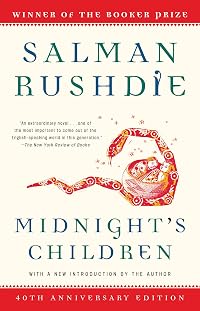
And the politics. This is what Roy has devoted herself to in the years between her two novels. I admire her devotion to advocacy for marginalised groups, but I was hampered by my relative ignorance of Indian issues. I felt this a bit with Rushdie’s Midnight’s Children (see my review HERE), with which this has more than a few similarities (including a child born at midnight), but Rushdie made it more digestible for ill-informed readers like me. And his storytelling was consistently magical.
This novel is dedicated “To The Unconsoled”. Is it heretical appropriation to consider myself a little unconsoled?
The Mirror of Most Transformation
This is about people reinventing themselves, as Roy certainly has. That is an inspiring and positive message and is what I will try to take away from my partial reading. The transformations include:
• A woman trapped in a man’s body.
• An adoptive mother who tries to “transfuse herself into [child’s] memory and consciousness… so that they could belong to each other completely” and to rewrite her life to please her child and make herself “a simpler, happier person”.
• “A revolutionary trapped in an accountant’s mind.”
• A man who adopts the name Saddam Hussein because he admires the courage to do what needed to be done and to face the fatal consequences with dignity “I want to be this kind of bastard”!
• An abandoned baby girl raised by a moderately wealthy woman.
• An irreverent, iconoclastic student who becomes an unemployable intellectual, and then a mainstream journalist.
The Mix of Uncertain Gender
“Holy Souls trapped in the wrong bodies”
One of the main characters is a Hijra: a term used in India for those who, in the UK, might identify as trans women. Her life is especially intriguing, and sensitively and insightfully portrayed.
The fact of their existence is apparently broadly accepted and unquestioned. The attitudes towards them are more mixed: they have a degree of protection because it’s thought unlucky to harm them. As long as they keep to the margins of society, with a few elevated to celebrity status, most get by, despite the perpetual risk of “harassment and humiliation (of being seen as well as of being unseen)”.
Some of the more negative attitudes seem to come from the Hijra themselves: “We’re jackals who feed off other people’s happiness”, who were created by God as “an experiment… a living creature that is incapable of happiness” because their war is internal, and thus they can’t escape it.
This leads to more existential analysis:
“She fell through a crack between the world she knew and worlds she did not know existed.”
“Was it possible to live outside language?” - when in Urdu, everything has a gender.
The Minimum of Utmost Quotes
• “She recognised loneliness… And she had learned… that Need was a warehouse that could accommodate a considerable amount of cruelty.”
• “The fan had human qualities - she was coy, moody and unpredictable.”
• “The Mouse [nickname of abandoned child] absorbs love like sand absorbs the sea.”
• “In the hissing blue light of the… lantern [his] face looked like a dried riverbed.”
• “Her steadfast commitment to an exaggerated, outrageous kind of femininity made the real, biological women… look cloudy and dispersed.”
• “To be present in history, even as nothing more than a chuckle, was a universe away from being absent from it.”
• “It was an unprepossessing graveyard.”
• “The smack addicts… shadows just a deeper shade of night… clots of homeless people sat around fires… stray dogs in better health than the humans.”
• “A ravaged, feral spectre, out-haunting every djinn and spirit” - the overwhelming effect of grief and undiagnosed PTSD.
• “She lay in a pool of light, under a column of neon-lit mosquitoes… She had already learned that tears, her tears at least, were futile.” (An abandoned baby who is then described as symbolic of the city in general and slum clearance in particular.)
• “[Journalists] asking urgent, empty questions; they asked the poor what it was like to be poor… The TV channels… never ran out of despair.”
• “He who believed he was always right. She who knew she was all wrong… augmented by her ambiguity.”
• “The fog is hunched up against the window panes.”
• “Candidly homosexual, although he never brought it up in conversation.”
• “Something about the stillness of this hastily abandoned space makes it look like a frozen frame in a moving picture. It seems to contain the geometry of motion… The absence of the person who lived here is so real, so palpable, that it is almost a presence” show less
I am, by nature, a punctual person. I was very late to one novelistic Roy party and relatively early to the next. But in this case, it was the one I was late for that I enjoyed.
In 2014, I finally read The God of Small Things, Roy’s award-winning and (then) only novel, published nearly 20 years earlier. I loved it: the lyrical mysticism, the layers of meaning and metaphor, the tangled plot, the complex characters, and the rich but unfamiliar setting. See my review HERE for why.
News that she’d finally written another novel (this) filled me with joy and excitement. I was conscious that it had a lot to live up to, but was eager to read it. Then I saw a trickle of very conflicting reviews from trusted show more GR friends. But I won a free copy in a GR giveaway. Fate?
The Misery of Most Unhappiness
It pains me that I gave up on this book a little over one third through. There are flickers of beautiful writing, and interesting characters that I cared about. I suspect the different threads of the story eventually weave a wondrous tapestry, and I would probably discover the significance of recurring saffron and parakeets (the vultures are more obvious).
But…
There are many buts.
Overall, it's a confusing, disjointed, inelegant muddle, with lengthy diversions into ideological and ecological rants and subplots, and with the narrative switching between novelistic, mystical, journalese, and political tract. The chapter where I abandoned it added letters, adverts, and a Kashmiri-English alphabet to the mix. All of those things can work. But here, for me, they don't. It was just too much.
And the politics. This is what Roy has devoted herself to in the years between her two novels. I admire her devotion to advocacy for marginalised groups, but I was hampered by my relative ignorance of Indian issues. I felt this a bit with Rushdie’s Midnight’s Children (see my review HERE), with which this has more than a few similarities (including a child born at midnight), but Rushdie made it more digestible for ill-informed readers like me. And his storytelling was consistently magical.
This novel is dedicated “To The Unconsoled”. Is it heretical appropriation to consider myself a little unconsoled?
The Mirror of Most Transformation
This is about people reinventing themselves, as Roy certainly has. That is an inspiring and positive message and is what I will try to take away from my partial reading. The transformations include:
• A woman trapped in a man’s body.
• An adoptive mother who tries to “transfuse herself into [child’s] memory and consciousness… so that they could belong to each other completely” and to rewrite her life to please her child and make herself “a simpler, happier person”.
• “A revolutionary trapped in an accountant’s mind.”
• A man who adopts the name Saddam Hussein because he admires the courage to do what needed to be done and to face the fatal consequences with dignity “I want to be this kind of bastard”!
• An abandoned baby girl raised by a moderately wealthy woman.
• An irreverent, iconoclastic student who becomes an unemployable intellectual, and then a mainstream journalist.
The Mix of Uncertain Gender
“Holy Souls trapped in the wrong bodies”
One of the main characters is a Hijra: a term used in India for those who, in the UK, might identify as trans women. Her life is especially intriguing, and sensitively and insightfully portrayed.
The fact of their existence is apparently broadly accepted and unquestioned. The attitudes towards them are more mixed: they have a degree of protection because it’s thought unlucky to harm them. As long as they keep to the margins of society, with a few elevated to celebrity status, most get by, despite the perpetual risk of “harassment and humiliation (of being seen as well as of being unseen)”.
Some of the more negative attitudes seem to come from the Hijra themselves: “We’re jackals who feed off other people’s happiness”, who were created by God as “an experiment… a living creature that is incapable of happiness” because their war is internal, and thus they can’t escape it.
This leads to more existential analysis:
“She fell through a crack between the world she knew and worlds she did not know existed.”
“Was it possible to live outside language?” - when in Urdu, everything has a gender.
The Minimum of Utmost Quotes
• “She recognised loneliness… And she had learned… that Need was a warehouse that could accommodate a considerable amount of cruelty.”
• “The fan had human qualities - she was coy, moody and unpredictable.”
• “The Mouse [nickname of abandoned child] absorbs love like sand absorbs the sea.”
• “In the hissing blue light of the… lantern [his] face looked like a dried riverbed.”
• “Her steadfast commitment to an exaggerated, outrageous kind of femininity made the real, biological women… look cloudy and dispersed.”
• “To be present in history, even as nothing more than a chuckle, was a universe away from being absent from it.”
• “It was an unprepossessing graveyard.”
• “The smack addicts… shadows just a deeper shade of night… clots of homeless people sat around fires… stray dogs in better health than the humans.”
• “A ravaged, feral spectre, out-haunting every djinn and spirit” - the overwhelming effect of grief and undiagnosed PTSD.
• “She lay in a pool of light, under a column of neon-lit mosquitoes… She had already learned that tears, her tears at least, were futile.” (An abandoned baby who is then described as symbolic of the city in general and slum clearance in particular.)
• “[Journalists] asking urgent, empty questions; they asked the poor what it was like to be poor… The TV channels… never ran out of despair.”
• “He who believed he was always right. She who knew she was all wrong… augmented by her ambiguity.”
• “The fog is hunched up against the window panes.”
• “Candidly homosexual, although he never brought it up in conversation.”
• “Something about the stillness of this hastily abandoned space makes it look like a frozen frame in a moving picture. It seems to contain the geometry of motion… The absence of the person who lived here is so real, so palpable, that it is almost a presence” show less
It is hard to boil this book down to a succinct summary. There are two primary storylines. The first is about Anjum, born Aftab, an intersexual individual, reared as male, but who inclines to female. She faces many challenges as a hiira. The second is told by Tilo, an architect with many relationship partners, one of whom is wanted for terrorism. This book hits on numerous social issues in India from partition to present. It is less a novel than the author’s examination these issues.
I enjoyed Anjum’s story. It is easy to empathize with her. If the entire book had been about her life, I would have probably loved it. The writing is solid in terms of the forms of expression, the breadth of language, and flow. This book has spurred me show more to read more non-fiction to learn more about India’s political situation and internal conflicts.
The structure of this book did not work for me. Tilo seems to come out of nowhere and derailed my interest in Anjum’s story. I could not discern an overarching plot. It comes across as scattered, even rambling at times. For example, there is literally an A to Z list of terms one would find in a Kashmiri to English dictionary. I normally like character-driven narratives, but in this case, many characters seem to exist to serve as illustrations of political points or historical atrocities the author is trying to highlight. I loved The God of Small Things but the best I can say about this book is that it is okay. show less
I enjoyed Anjum’s story. It is easy to empathize with her. If the entire book had been about her life, I would have probably loved it. The writing is solid in terms of the forms of expression, the breadth of language, and flow. This book has spurred me show more to read more non-fiction to learn more about India’s political situation and internal conflicts.
The structure of this book did not work for me. Tilo seems to come out of nowhere and derailed my interest in Anjum’s story. I could not discern an overarching plot. It comes across as scattered, even rambling at times. For example, there is literally an A to Z list of terms one would find in a Kashmiri to English dictionary. I normally like character-driven narratives, but in this case, many characters seem to exist to serve as illustrations of political points or historical atrocities the author is trying to highlight. I loved The God of Small Things but the best I can say about this book is that it is okay. show less
Explicitly political second novel of Arundhati after a twenty year fiction black-out. The plot is brilliant but probably difficult to follow for many, especially those who are unfamiliar with India, the rise of the BJP and Kashmir. Roy opts from the start to focus on a group of marginalised outcasts of Indian society, the flotsam of Hindu nationalist Progress, hermaphrodites, muslim cow buriers, transvestites, harijan protesters, and Kashmir freedom fighters. And yet she manages to cross the lines by including characters who work for India’s security and Police force. The core cast of characters seem to share their participation in a drama group that prepares a play under the flamboyant leadership of a gay Britisher. The play is never show more performed due to the outbreak of communal violence. I adored Roy’s sarcastic, tongue-in-cheek humour and devastating yet subtle critique of Hindu nationalism. Her plea for an India that is home to as diverse a cast of people as possible shines through in all its brilliance, scorching the nationalist platitudes of its recent rulers. This was worth waiting for, and yet … Arundhati give us more! show less
Such a tender rendering of characters whose individual struggles are interwoven into the dense and complex political fabric of their country. The scope of what she has included, the breadth but also the depth of it, is so staggering and utterly amazing. How did she fit it all? How did she talk about it all with so much tenderness, humanity, and love? At no point did she discount the amount of violence that we have to also think about. I thought that she captured the complexity very well too, especially if she were to talk about the politics without the characters. Some characters are quite obviously stock, in terms of the opinions they have (like the typical of 'liberal' or 'centrist' types, and one of course one of them is a show more journalist! lol) but I guess it is quite necessary especially for people who are not familiar with the politics, just so they can get some sort of approximation of what the different viewpoints are. (Also definitely, while she is nuanced she does have a firm stand which is why the book pisses off so many nationalists). Having watched/read enough Arundhati Roy interviews I could recognise that some parts were based on her own experience too.. I'm glad that her writing this was just so fully human, so full of the blood that made senseless violence feel a bit more human.
Sometimes it did feel like she forgot the novel a bit and she goes off to talk about the politics. The density of it meant that I was acutely aware that there's a lot I will not fully understand because I am not living in India or fully immersed in their politics, life there, nor experienced the decades that have unfolded. Despite some stock characters, she still manages to write about it all with the heartbreaking intimacy that I love about her writing... this quote:
"God's carotid burst open on the new border between India and Pakistan and a million people died of hatred. Neighbours turned on each other as though they'd never known each other, never been to each other's weddings, never sung each other's songs."
The way she wrote about what Kashmiris feel, go through, were parts where I felt most touched.. nobody really goes into that level of human understanding where you try to understand what violence can do to a community, how they regard each other, how it affects the way they might trust or view each other, their own history or survivability. How that level of violence and trauma affects the deepest level of human affection and relational experience.
Of course on the other side of it all is that it can be so chilling how she writes about the mechanical cruelty of the 'right', the way they clean up the street after a massacre-
“The post-massacre protocol was quick and efficient- perfected by practice. Within an hour the dead bodies had been removed to the morgue in the Police Control Room, and the wounded to hospital. The street was hosed down, the blood directed into the open drains. Shops reopened. Normalcy was declared. "
the way they systematically torture and kill. The way they practice their lies so easily. The way the deaths of people are rewritten in official reports. Think I'll never forget that part of the book where they made one Kashmiri man try to bring out another severely injured Kashmiri man they were chasing who had hidden in sewage. For one a half hours they had looked at each other until the suspect died there, in sewage, and then he was reported to be a terrorist/militia member the authorities had captured in a supposedly tense face-off. It was these kind of episodes that really revealed the cruelty and inhumanity so much, & it was parts like this where I the aforementioned heartbreaking exposition on Kashmiris really tore through me:
“Those eyes that stared at us for one and a half hours – they were forgiving eyes, understanding eyes. We Kashmiris do not need to speak to each other any more in order to understand each other. We do terrible things to each other, we wound and betray and kill each other, but we understand each other.” show less
Sometimes it did feel like she forgot the novel a bit and she goes off to talk about the politics. The density of it meant that I was acutely aware that there's a lot I will not fully understand because I am not living in India or fully immersed in their politics, life there, nor experienced the decades that have unfolded. Despite some stock characters, she still manages to write about it all with the heartbreaking intimacy that I love about her writing... this quote:
"God's carotid burst open on the new border between India and Pakistan and a million people died of hatred. Neighbours turned on each other as though they'd never known each other, never been to each other's weddings, never sung each other's songs."
The way she wrote about what Kashmiris feel, go through, were parts where I felt most touched.. nobody really goes into that level of human understanding where you try to understand what violence can do to a community, how they regard each other, how it affects the way they might trust or view each other, their own history or survivability. How that level of violence and trauma affects the deepest level of human affection and relational experience.
Of course on the other side of it all is that it can be so chilling how she writes about the mechanical cruelty of the 'right', the way they clean up the street after a massacre-
“The post-massacre protocol was quick and efficient- perfected by practice. Within an hour the dead bodies had been removed to the morgue in the Police Control Room, and the wounded to hospital. The street was hosed down, the blood directed into the open drains. Shops reopened. Normalcy was declared. "
the way they systematically torture and kill. The way they practice their lies so easily. The way the deaths of people are rewritten in official reports. Think I'll never forget that part of the book where they made one Kashmiri man try to bring out another severely injured Kashmiri man they were chasing who had hidden in sewage. For one a half hours they had looked at each other until the suspect died there, in sewage, and then he was reported to be a terrorist/militia member the authorities had captured in a supposedly tense face-off. It was these kind of episodes that really revealed the cruelty and inhumanity so much, & it was parts like this where I the aforementioned heartbreaking exposition on Kashmiris really tore through me:
“Those eyes that stared at us for one and a half hours – they were forgiving eyes, understanding eyes. We Kashmiris do not need to speak to each other any more in order to understand each other. We do terrible things to each other, we wound and betray and kill each other, but we understand each other.” show less
By standards of a conventional novel, this is a failure. It is one of the most interesting failures I've read. It's a sprawling, ambitious novel with no plot. Many of the elements of modern India--Dalit and hijra rights, the occupation of Kashmir, tribal land enclosures, Hindu fundamentalism, Maoist uprisings--are here. It's alive on every page.
This is bound to piss off far-right patriots and nationalists of every stripe. It will probably also piss off people who read solely for entertainment and need a beginning, middle, and an end.
There are some reservations I have about this and her politics. Maybe my quibble is that she doesn't go far enough. I could have done without the "one baby to unite them all" thread. I'm guessing that this show more is what Roy and her editors feel they have to give readers who demand some sense of "closure". So that's my biggest issue with the book: at heart it's about radical politics, but it acquiesces to conservative notions of art and what a novel should be, maybe? I'm not sure.
But if this is what failed fiction looks like--attentive to the dispossessed, the marginalised, and the oppressed; fractured, broken, and sprawling--then I'll take it over polite, well-mannered, perfectly-executed fiction any day. show less
This is bound to piss off far-right patriots and nationalists of every stripe. It will probably also piss off people who read solely for entertainment and need a beginning, middle, and an end.
There are some reservations I have about this and her politics. Maybe my quibble is that she doesn't go far enough. I could have done without the "one baby to unite them all" thread. I'm guessing that this show more is what Roy and her editors feel they have to give readers who demand some sense of "closure". So that's my biggest issue with the book: at heart it's about radical politics, but it acquiesces to conservative notions of art and what a novel should be, maybe? I'm not sure.
But if this is what failed fiction looks like--attentive to the dispossessed, the marginalised, and the oppressed; fractured, broken, and sprawling--then I'll take it over polite, well-mannered, perfectly-executed fiction any day. show less
What was Arundhati Roy doing here? This is a major work, ten years in writing and it made the Booker longlist. But it's a mess. It starts with one story, about Indian hijra's, Indian men from different religions who transition to woman and traditionally were often eunuchs. They have a long history of somewhat acceptance in India. Then the book runs in the Kashmir Hindu massacres of Muslims in the 1990's, like as in a collision. It just smashed in and comes to a stop. And then becomes a different book, with different characters, thinking in completely different ways. We switch economic and educational classes. We begin with Anjum, a hijra living as a tree in a graveyard, that is, passive, accepting and adapting to everything, but also in show more a graveyard. And we end...um, I'm not even sure where. Everything about India that Roy has issues with is in this book. Every dark element of her personal biography, criticized and revealed in her 2025 memoir, can be found here in this 2016 novel. It’s a kitchen sink of contemporary Indian catastrophes.
Eventually we spend a whole lot of time in the 1990's of Kashmir. It's dark and sad...and extensive. It's powerful, but isn't really helped as we, the reader, don't really know how we got here, or what we should be doing or thinking here. How it goes from one of the many horrors in Indian life, that include Bhopal, destructive corruption, government overreach, Indira Ghandi's assassination - pollution, environmental and cultural destruction, abuse, torture, murder, over and over again - to then focus on one of these terrible things, Kashmir, it's disorienting. And it's not like the book lets the other stuff go.
I listened on audio and I kind of let it all pass. Arundhati is reading and can kind of read anything and keep our attention. It's moving in the micro-level, or entertaining. I was oddly patient and tolerant, but also oddly not that involved. Maybe tragically not that involved. I don't know. But looking back, I'm just kind of overwhelmed at all the things that stuck together, each seemingly just kinda lumped onto the lump. I note that many readers don't finish. But I'm not sure how much better my experience was.
So, a passive curious experience for me.
2026
https://www.librarything.com/topic/384249#9220142 show less
Eventually we spend a whole lot of time in the 1990's of Kashmir. It's dark and sad...and extensive. It's powerful, but isn't really helped as we, the reader, don't really know how we got here, or what we should be doing or thinking here. How it goes from one of the many horrors in Indian life, that include Bhopal, destructive corruption, government overreach, Indira Ghandi's assassination - pollution, environmental and cultural destruction, abuse, torture, murder, over and over again - to then focus on one of these terrible things, Kashmir, it's disorienting. And it's not like the book lets the other stuff go.
I listened on audio and I kind of let it all pass. Arundhati is reading and can kind of read anything and keep our attention. It's moving in the micro-level, or entertaining. I was oddly patient and tolerant, but also oddly not that involved. Maybe tragically not that involved. I don't know. But looking back, I'm just kind of overwhelmed at all the things that stuck together, each seemingly just kinda lumped onto the lump. I note that many readers don't finish. But I'm not sure how much better my experience was.
So, a passive curious experience for me.
2026
https://www.librarything.com/topic/384249#9220142 show less
Members
- Recently Added By
Published Reviews
ThingScore 100
This review gives order and intelligence to the spectrum of bad reviews about this mysterious book. This book contains a secret code of mystical nature, and must be read several times. Attainment is as good as the trouble inflicted in the lifetime of the protagonist....Read on
added by MaliniChaudhri
Lists

2018 Women's Prize for Fiction Longlist
16 works; 11 members

Booker Prize
491 works; 62 members

Man Booker Prize Longlist 2017
13 works; 4 members

Top Five Books of 2017
757 works; 231 members

Kirkus Starred Fiction Reviews of Books Published in 2017
412 works; 7 members

Books Read in 2017
4,249 works; 130 members

History: Asia
103 works; 1 member

To Read
617 works; 7 members

Goodreads Choice Awards 2017
20 works; 2 members

Books Read in 2019
4,052 works; 108 members
Author Information

59+ Works 29,537 Members
Suzanna Arundhati Roy, 1961 - Suzanna Roy was born November 24, 1961. Her parents divorced and she lived with her mother Mary Roy, a social activist, in Aymanam. Her mother ran an informal school named Corpus Christi and it was there Roy developed her intellectual abilities, free from the rules of formal education. At the age of 16, she left home show more and lived on her own in a squatter's colony in Delhi. She went six years without seeing her mother. She attended Delhi School of Architecture where she met and married fellow student Gerard Da Cunha. Neither had a great interest in architecture so they quit school and went to Goa. They stayed there for seven months and returned broke. Their marriage lasted only four years. Roy had taken a job at the National Institute of Urban Affairs and, while cycling down a road; film director Pradeep Krishen offered her a small role as a tribal bimbo in Massey Saab. She then received a scholarship to study the restoration of monuments in Italy. During her eight months in Italy, she realized she was a writer. Now married to Krishen, they planned a 26-episode television epic called Banyan Tree. They didn't shoot enough footage for more than four episodes so the serial was scrapped. She wrote the screenplay for the film In Which Annie Gives It Those Ones and Electric Moon. Her next piece caused controversy. It was an article that criticized Shekar Kapur's film Bandit Queen, which was about Phoolan Devi. She accused Kapur of misrepresenting Devi and it eventually became a court case. Afterwards, finished with film, she concentrated on her writing, which became the novel "A God of Small Things." It is based on what it was like growing up in Kerala. The novel contains mild eroticism and again, controversy found Roy having a public interest petition filed to remove the last chapter because of the description of a sexual act. It took Roy five years to write "A God of Small Things" and was released April 4, 1997 in Delhi. It received the Booker prize in London in 1997 and has topped the best-seller lists around the world. Roy is the first non-expatriate Indian author and the first Indian woman to win the Booker prize. (Bowker Author Biography) show less
Awards and Honors
Work Relationships
Is contained in
Common Knowledge
- Canonical title
- The Ministry of Utmost Happiness
- Original title
- The Ministry of Utmost Happiness
- Original publication date
- 2017-06
- Important places
- Kashmir
- Important events
- Kashmir Conflict
- Epigraph
- I mean, it's all a matter of your heart...
Nâzim Hikmet
In what language does rain fall / over tormented cities?
Pablo Neruda
Death flies in, thin bureaucrat, from the plains--
--Agha Shahid Ali
Then, as she had already died four or five times, the apartment had remained available for a drama more serious than her own death.
--Jean Genet
And they would not believe me precisely because they would know that what I said was true.
--James Baldwin
then there was the changing of the seasons. "This is also a journey," M said, "and they can't take it away from us."
--Nadezhda Madelstam - Dedication
- To,
The Unconsoled - First words
- At magic hour, when the sun has gone but the light has not, armies of flying foxes unhinge themselves from the Banyan trees in the old graveyard and drift across the city like smoke.
I
WHERE DO OLD BIRDS GO TO DIE?
She lived in the graveyard like a tree. - Quotations
- The moment I saw her, a part of me walked out of my body and wrapped itself around her. And there is still remains. (Page 256)
- Last words*
- (Click to show. Warning: May contain spoilers.)Weil Miss Jebeen, Miss Udaya Jebeen gekommen ist.
- Original language
- English
*Some information comes from Common Knowledge in other languages. Click "Edit" for more information.
Classifications
Statistics
- Members
- 2,468
- Popularity
- 7,844
- Reviews
- 66
- Rating
- (3.57)
- Languages
- 16 — Catalan, Danish, Dutch, English, Estonian, Finnish, French, German, Italian, Polish, Portuguese, Slovenian, Spanish, Swedish, Turkish, Ukrainian
- Media
- Paper, Audiobook, Ebook
- ISBNs
- 61
- ASINs
- 11