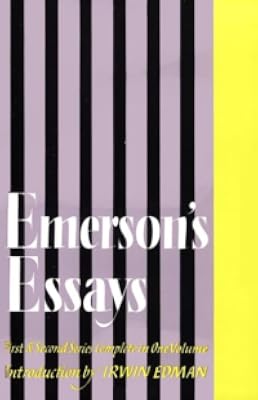
Essays: First Series and Second Series
by Ralph Waldo Emerson 
On This Page
Description
In 1834, Ralph Waldo Emerson, formerly a Unitarian minister, began a new career as a public lecturer. Many of those lectures formed the source material for his essays. Nature (1836), his first published work, contained the essence of his transcendental philosophy, which involved viewing the world of natural phenomena as a symbol of the inner life and emphasizing individual freedom and self-reliance. This collection contains eleven of his most celebrated and memorable essays from this period, show more and includes Self-Reliance, Nature, Circles, and Gifts. show lessTags
Recommendations






















Member Recommendations
Member Reviews
Audio: 1/1/2012; 14 hrs., 2 min.; Blackstone Publishing 9781483067704;
SUMMARY / EVALUATION:
I have long wanted to read Emerson, so finally downloaded this collection of his Essays from Overload. What reminded me that I'd wanted to get familiar with his essays was the book on Oliver Wendell Holmes. It had mentioned that Emerson was one of his father’s friends whom he’d met as a boy and came to admire especially while in college and forever after. I did enjoy listening to these essays, but I have to confess much of it called for more thinking than listening straight through allows for. The man liked to write poetically, in fact every essay begins with a poem. It seems to me he writes ambiguously and obscurely. Or maybe it just seems show more so to me because so much of the language, or the way it was used wasn’t familiar.
From the “Gifts” essay for example: "Flowers and fruits are always fit presents; flowers, because they are a proud assertion that a ray of beauty outvalues all the utilities of the world. These gay natures contrast with the somewhat stern countenance of ordinary nature: they are like music heard out of a work-house. Nature does not cocker us: we are children, not pets: she is not fond: everything is dealt to us without fear or favor, after severe universal laws. Yet these delicate flowers look like the frolic and interference of love and beauty."
I understand the passage now, but at first listen, I needed more time. The first line is clear enough, although I am not certain I agree. I know many a recipient of a gift of flowers who have deigned them impersonal, common, and slap-dash. The next line though, requires that I consider nature and search my mind for what might be meant by “ordinary nature” as opposed to flowers, and what about it presents a stern countenance. And, of course, I’m not familiar with work-houses, but presumably they were devoted to some sort of labor so a little thought makes it clear that music coming from one might seem cheerily incongruous and might brighten its mood a little. “Cocker” isn’t a word I commonly hear, but I assume it is the same as cockle, similar to coddle. But I don’t understand how nature treats us more childlike than pet-like—or what nature would have to do to cocker us, and if it did, would we then be pet-like? See what I mean about it taking more consideration than one has time for listening to it straight through? So, audio, for me, isn’t really the most appropriate format for this.
I did learn that Emerson had no interest in the occult arts—in one of the essays he states that to the selfish, astronomy becomes astrology, and then I think, anatomy becomes phrenology, and there is a third one.
And then, compassion doesn’t seem to be a valued trait, as in the “Self Reliance” essay, he says, “Do not tell me, as a good man did today, of my obligation to put all poor men in good situations. Are they my poor? I tell thee, thou foolish philanthropist, that I grudge the dollar, the dime, the cent, I give to such men as do not belong to me and to whom I do not belong.” I shouldn’t say I never feel this way myself, but its not something I admire in myself or others or would necessarily advise emulating.
I did enjoy listening to these essays though.
Ralph Waldo Emerson’s Essays are available at the Gutenberg Project, complete with a glossary for many of the terms. This would be the better mode to consume I believe.
AUTHOR:
Ralph Waldo Emerson (May 25, 1803 – April 27, 1882). According to Wikipedia, he went by his middle name, Waldo, and “was an American essayist, lecturer, philosopher, and poet who led the transcendentalist movement of the mid-19th century. He was seen as a champion of individualism and a prescient critic of the countervailing pressures of society, and he disseminated his thoughts through dozens of published essays and more than 1,500 public lectures across the United States.”
NARRATOR:
Jeff Riggenbach (January 12, 1947?) I’m not sure I found the right Jeff Riggenbach online, but if it’s the fellow with this birthday, he is an advocate of the Libertarian movement. It makes sense to me that such a fellow would enjoy narrating Emerson’s essays, so I’m thinking I found the right one. At any rate he has a good narrative voice for this.
GENRE: Philosophy
LOCATIONS: Boston, Massachusetts
SAMPLE QUOTATION:
From "Nature"
"It seems as if the day was not wholly profane, in which we have given heed to some natural object. The fall of snowflakes in a still air, preserving to each crystal its perfect form; the blowing of sleet over a wide sheet of water, and over plains; the waving rye-fields; the mimic waving of acres of houstonia, whose inumerable florets whiten and riplle before the eye; the reflections of trees and flowers in glassy lakes; the musical steaming odorous south wind, which converts all trees to wind-harps, the crackly and spurting of hemlocki in the flames; or of pine-logs, which yield glory to the walls and faces in the sitting-room,---these are the music and pictures of the most ancient religion"
RATING: I give this a three, but I suspect if I spent some time reading the print I would come to appreciate it more. show less
SUMMARY / EVALUATION:
I have long wanted to read Emerson, so finally downloaded this collection of his Essays from Overload. What reminded me that I'd wanted to get familiar with his essays was the book on Oliver Wendell Holmes. It had mentioned that Emerson was one of his father’s friends whom he’d met as a boy and came to admire especially while in college and forever after. I did enjoy listening to these essays, but I have to confess much of it called for more thinking than listening straight through allows for. The man liked to write poetically, in fact every essay begins with a poem. It seems to me he writes ambiguously and obscurely. Or maybe it just seems show more so to me because so much of the language, or the way it was used wasn’t familiar.
From the “Gifts” essay for example: "Flowers and fruits are always fit presents; flowers, because they are a proud assertion that a ray of beauty outvalues all the utilities of the world. These gay natures contrast with the somewhat stern countenance of ordinary nature: they are like music heard out of a work-house. Nature does not cocker us: we are children, not pets: she is not fond: everything is dealt to us without fear or favor, after severe universal laws. Yet these delicate flowers look like the frolic and interference of love and beauty."
I understand the passage now, but at first listen, I needed more time. The first line is clear enough, although I am not certain I agree. I know many a recipient of a gift of flowers who have deigned them impersonal, common, and slap-dash. The next line though, requires that I consider nature and search my mind for what might be meant by “ordinary nature” as opposed to flowers, and what about it presents a stern countenance. And, of course, I’m not familiar with work-houses, but presumably they were devoted to some sort of labor so a little thought makes it clear that music coming from one might seem cheerily incongruous and might brighten its mood a little. “Cocker” isn’t a word I commonly hear, but I assume it is the same as cockle, similar to coddle. But I don’t understand how nature treats us more childlike than pet-like—or what nature would have to do to cocker us, and if it did, would we then be pet-like? See what I mean about it taking more consideration than one has time for listening to it straight through? So, audio, for me, isn’t really the most appropriate format for this.
I did learn that Emerson had no interest in the occult arts—in one of the essays he states that to the selfish, astronomy becomes astrology, and then I think, anatomy becomes phrenology, and there is a third one.
And then, compassion doesn’t seem to be a valued trait, as in the “Self Reliance” essay, he says, “Do not tell me, as a good man did today, of my obligation to put all poor men in good situations. Are they my poor? I tell thee, thou foolish philanthropist, that I grudge the dollar, the dime, the cent, I give to such men as do not belong to me and to whom I do not belong.” I shouldn’t say I never feel this way myself, but its not something I admire in myself or others or would necessarily advise emulating.
I did enjoy listening to these essays though.
Ralph Waldo Emerson’s Essays are available at the Gutenberg Project, complete with a glossary for many of the terms. This would be the better mode to consume I believe.
AUTHOR:
Ralph Waldo Emerson (May 25, 1803 – April 27, 1882). According to Wikipedia, he went by his middle name, Waldo, and “was an American essayist, lecturer, philosopher, and poet who led the transcendentalist movement of the mid-19th century. He was seen as a champion of individualism and a prescient critic of the countervailing pressures of society, and he disseminated his thoughts through dozens of published essays and more than 1,500 public lectures across the United States.”
NARRATOR:
Jeff Riggenbach (January 12, 1947?) I’m not sure I found the right Jeff Riggenbach online, but if it’s the fellow with this birthday, he is an advocate of the Libertarian movement. It makes sense to me that such a fellow would enjoy narrating Emerson’s essays, so I’m thinking I found the right one. At any rate he has a good narrative voice for this.
GENRE: Philosophy
LOCATIONS: Boston, Massachusetts
SAMPLE QUOTATION:
From "Nature"
"It seems as if the day was not wholly profane, in which we have given heed to some natural object. The fall of snowflakes in a still air, preserving to each crystal its perfect form; the blowing of sleet over a wide sheet of water, and over plains; the waving rye-fields; the mimic waving of acres of houstonia, whose inumerable florets whiten and riplle before the eye; the reflections of trees and flowers in glassy lakes; the musical steaming odorous south wind, which converts all trees to wind-harps, the crackly and spurting of hemlocki in the flames; or of pine-logs, which yield glory to the walls and faces in the sitting-room,---these are the music and pictures of the most ancient religion"
RATING: I give this a three, but I suspect if I spent some time reading the print I would come to appreciate it more. show less
At this point I know two things.
Emerson is a genius.
And I'm not, because my head hurts.
Emerson is a genius.
And I'm not, because my head hurts.
IN RETROSPECT, I DON'T THINK THAT DAD REALLY CARED FOR THESE CONTEMPLATIVE THINGS. HhISTORY AND BIOGRAPHY, AND GEOGRAPHY AND OCCASIONALY CHURCH BOOKS WERE MORE TO HIS TASTE
Westvaco is the West Virginia Paper Co., makers of fine papers. For 47 years, they did a special Christmas book each year that they distributed to their customers, all featuring works from American history or literature. They all include a decorated slipcover, fine endpapers and many have embossed images on the book covers. Some feature gilt edges and silk ribbon bookmarks. Although they had a limited press run the number is not stated nor are they numbered or signed.
Politics
victorian
Publicada por primera vez en 1836, es considerada una obra cumbre del trascendentalismo americano
Jan 3, 2020Spanish
Members
- Recently Added By
Lists

Merrill's English Texts
59 works; 2 members

Existentialism
90 works; 11 members

Best Essay Collections
61 works; 24 members

W. S. Maugham's Reading Suggestions for Spiritual Enrichment: American
13 works; 4 members

Harold Bloom - The Western Canon: C. The Democratic Age
336 works; 15 members

Trinity College Booklist (1951): Class Ten, English Literature
358 works; 5 members

Publisher's Weekly Bestsellers Prior to 1895 in Chronological Order
95 works; 6 members

Greatest Books, allegedly
484 works; 9 members
Author Information

802+ Works 21,161 Members
Known primarily as the leader of the philosophical movement transcendentalism, which stresses the ties of humans to nature, Ralph Waldo Emerson, American poet and essayist, was born in Boston in 1803. From a long line of religious leaders, Emerson became the minister of the Second Church (Unitarian) in 1829. He left the church in 1832 because of show more profound differences in interpretation and doubts about church doctrine. He visited England and met with British writers and philosophers. It was during this first excursion abroad that Emerson formulated his ideas for Self-Reliance. He returned to the United States in 1833 and settled in Concord, Massachusetts. He began lecturing in Boston. His first book, Nature (1836), published anonymously, detailed his belief and has come to be regarded as his most significant original work on the essence of his philosophy of transcendentalism. The first volume of Essays (1841) contained some of Emerson's most popular works, including the renowned Self-Reliance. Emerson befriended and influenced a number of American authors including Henry David Thoreau. It was Emerson's practice of keeping a journal that inspired Thoreau to do the same and set the stage for Thoreau's experiences at Walden Pond. Emerson married twice (his first wife Ellen died in 1831 of tuberculosis) and had four children (two boys and two girls) with his second wife, Lydia. His first born, Waldo, died at age six. Emerson died in Concord on April 27, 1882 at the age of 78 due to pneumonia and is buried in Sleepy Hollow Cemetery in Concord, Massachusetts. (Bowker Author Biography) show less
Ralph Waldo Emerson has a Legacy Library. Legacy libraries are the personal libraries of famous readers, entered by LibraryThing members from the Legacy Libraries group.
Some Editions
Awards and Honors
Series
Belongs to Publisher Series
Work Relationships
Has as a commentary on the text
Has as a student's study guide
Common Knowledge
- Canonical title
- Essays: First Series and Second Series
- Original publication date
- 1841-1844
- People/Characters
- Ralph Waldo Emerson
- First words
- This series of books will include in complete editions those masterpieces of English Literature that are best adapted for the use of schools and colleges.
- Last words
- (Click to show. Warning: May contain spoilers.)For the like reason they ask the aid of wild passions, as in the gaming and war, ape in some manner these flames and generosities of the heart.
- Original language
- English
Classifications
Statistics
- Members
- 2,206
- Popularity
- 9,232
- Reviews
- 7
- Rating
- (4.16)
- Languages
- 7 — English, Finnish, German, Hungarian, Portuguese, Russian, Spanish
- Media
- Paper, Audiobook, Ebook
- ISBNs
- 118
- UPCs
- 1
- ASINs
- 160