On This Page
Description
What happens when your digital self overpowers your physical self? A life in Permutation City is unlike any life to which you're accustomed. You have Eternal Life, the power to live forever. Immortality is a real thing, just not the thing you'd expect. Life is just electronic code. You have been digitized, scanned, and downloaded into a virtual reality program. A Copy of a Copy. For Paul Durham, he keeps making Copies of himself, but the issue is that his Copies keep changing their minds and show more shutting themselves down. You also have Maria Deluca, who is nothing but an Autoverse addict. She spends every waking minute with the cellular automaton known as the Autoverse, a world that lives by the mathematical "laws of physics." Paul makes Maria an offer to design and drop a seed into the Autoverse that will allow her to indulge in her obsession. There is, however, one catch: you can no longer terminate, bail out, and remove yourself. You will never be your normal flesh-and-blood life again. The question then becomes: Is this what she really wants? Is this what we really want? From the brilliant mind of Greg Egan, Permutation City, first published in 1994, comes a world of wonder that makes you ask if you are you, or is the Copy of you the real you? show lessTags
Recommendations



Member Recommendations
jekier Heavily features mind uploading.

Member Reviews
What starts and ends as a basic search for immortality as data, as in uploading perfect copies of yourself to cheat death indefinitely, makes this 1994 novel a rather focused utopian novel. Not that things are all rosy, of course, but that it's the search for utopia, or heaven on earth, that drives the characters here.
Distinctions get very hazy between real and real. When the universe is math and math is the universe, a perfect copy as data will have no real difference with everything we have. Change some basic laws, add new elements, ramp up your perceptions or slow them way down. It doesn't really matter. Create a universe that is self-evolving, have it compete with itself and all the parts within it, run a simulation of Life, and show more turn Darwinism and Game Theory upon data elements.
It's smart. It's evolution in data. And when you can live thousands of years working out all the kinks in your programming in a few eyeblinks in that boring other reality, why not go all the way and live forever for real, speeding up and slowing down within the actual universe, give yourself robot waldos, meet new neighbors... or aliens... and generally play god?
We're already the running software platform in our own universe, after all. Matter doesn't really exist anyway. We're running on an encoded holographic universe. This novel just flips the concept in a mirror and spells out what we might need to do to survive.
Sure, we've seen this concept done many times now, but look at the date here. It's ALSO been done before, but few have gone as far or all out as Greg Egan. The denizens of Permutation City seem to be doing it right.
Yes, there's a good story and good characters, too, but in its heart, this is definitely a utopian novel. :)
I really miss those. show less
Distinctions get very hazy between real and real. When the universe is math and math is the universe, a perfect copy as data will have no real difference with everything we have. Change some basic laws, add new elements, ramp up your perceptions or slow them way down. It doesn't really matter. Create a universe that is self-evolving, have it compete with itself and all the parts within it, run a simulation of Life, and show more turn Darwinism and Game Theory upon data elements.
It's smart. It's evolution in data. And when you can live thousands of years working out all the kinks in your programming in a few eyeblinks in that boring other reality, why not go all the way and live forever for real, speeding up and slowing down within the actual universe, give yourself robot waldos, meet new neighbors... or aliens... and generally play god?
We're already the running software platform in our own universe, after all. Matter doesn't really exist anyway. We're running on an encoded holographic universe. This novel just flips the concept in a mirror and spells out what we might need to do to survive.
Sure, we've seen this concept done many times now, but look at the date here. It's ALSO been done before, but few have gone as far or all out as Greg Egan. The denizens of Permutation City seem to be doing it right.
Yes, there's a good story and good characters, too, but in its heart, this is definitely a utopian novel. :)
I really miss those. show less
A personal high water mark for hard SF. In Permutation City, the rich can afford to download their consciousness into a version of virtual reality. Having attained this form of immortality, they can edit their own soul to match their preferences for life. Copies run at a much slower tick rate than our reality, in part due to the limits of computing, which means that to properly communicate with a copy, people must essentially go into a coma so their brain speed matches with their copy. Unsurprisingly, there's a messy relationship between AI copies and their 'real world' counterparts that Egan explores both technological and philosophically. How much can we change ourselves before we become someone else entirely? What truly exists or show more counts as conscious life? Is anything real except the mind (Solipsism)?
Parallel to these advances, there's a version of reality called the Autoverse, where life is simulated as one-to-one as possible. One of the main characters, Maria, discovers that biota in the Autoverse can evolve similarly to the real world, which means that a whole separate universe could exist separately from our reality with the processes of a computer, though the computing power to run this universe would be beyond current computing limits. Despite that, Maria is contracted to build a theoretical model for this Autoverse universe by a man named Paul Durham, who is creating a private 'Garden of Eden' settlement in VR for the copies of his of corporate elite clients that will allegedly be immune to commodity market that processing power exists on. I know for a fact that I'm horribly butchering this summary, but that's partially due to just how ambitious Egan is in Permutation City. This work really has to be read to have a grasp on all that it tries to do.
I connected to this work intensely, even though a lot of the 'dust theory' went over my head. It's dense, ideas heavy, but with super digestible prose that reminds me of Egan's contemporary, Robert Charles Wilson, if he spent less time on characters and more time on quantum mechanics. Perhaps that's (at least partially) why I enjoyed it. I enjoy feeling challenged, like I'm only scratching the surface of what there is discover about a work. I will admit, though, that I debated whether the difficulty that I had with some of Egan's concepts derived from their inherent complexity, or if he simply poorly communicates them. I can see both sides of this argument, and wouldn't begrudge someone at all for disagreeing with me. Even though it's not a long novel, it feels as though it is; Egan's density takes time to contend with.
As much as this is a novel of ideas over characters, there's also some very gripping plot points that kept me engaged with the story too. There's a scene in a shower that's very reminiscent to a similar scene in Greg Bear's Blood Music, and shocked me nearly as much. I always appreciate when the scope of a novel continues to grow until its humble beginnings are barely recognizable to the concluding drama.
Coincidentally, I heard a news story just before reading Permutation City about the CEO of Zoom talking about how he's looking forward to the imminent use of AI to attend meetings in your stead while using a mask of your face and copy of your personality/knowledge base. This is of course a hyper specific example, and I don't personally put much stock into prescience when it comes to SF, but I couldn't help but shiver at Egan's perceptiveness when it came to most facets of AI. show less
Parallel to these advances, there's a version of reality called the Autoverse, where life is simulated as one-to-one as possible. One of the main characters, Maria, discovers that biota in the Autoverse can evolve similarly to the real world, which means that a whole separate universe could exist separately from our reality with the processes of a computer, though the computing power to run this universe would be beyond current computing limits. Despite that, Maria is contracted to build a theoretical model for this Autoverse universe by a man named Paul Durham, who is creating a private 'Garden of Eden' settlement in VR for the copies of his of corporate elite clients that will allegedly be immune to commodity market that processing power exists on. I know for a fact that I'm horribly butchering this summary, but that's partially due to just how ambitious Egan is in Permutation City. This work really has to be read to have a grasp on all that it tries to do.
I connected to this work intensely, even though a lot of the 'dust theory' went over my head. It's dense, ideas heavy, but with super digestible prose that reminds me of Egan's contemporary, Robert Charles Wilson, if he spent less time on characters and more time on quantum mechanics. Perhaps that's (at least partially) why I enjoyed it. I enjoy feeling challenged, like I'm only scratching the surface of what there is discover about a work. I will admit, though, that I debated whether the difficulty that I had with some of Egan's concepts derived from their inherent complexity, or if he simply poorly communicates them. I can see both sides of this argument, and wouldn't begrudge someone at all for disagreeing with me. Even though it's not a long novel, it feels as though it is; Egan's density takes time to contend with.
As much as this is a novel of ideas over characters, there's also some very gripping plot points that kept me engaged with the story too. There's a scene in a shower that's very reminiscent to a similar scene in Greg Bear's Blood Music, and shocked me nearly as much. I always appreciate when the scope of a novel continues to grow until its humble beginnings are barely recognizable to the concluding drama.
Coincidentally, I heard a news story just before reading Permutation City about the CEO of Zoom talking about how he's looking forward to the imminent use of AI to attend meetings in your stead while using a mask of your face and copy of your personality/knowledge base. This is of course a hyper specific example, and I don't personally put much stock into prescience when it comes to SF, but I couldn't help but shiver at Egan's perceptiveness when it came to most facets of AI. show less
Permutation City by Greg Egan
I don't read a lot of hard sf because my understanding of science is rudimentary at best, but I do tend to enjoy it when I read one that do not go too far over my head. I feel I only need to understand the basic plot and the characters' motivation, the whys if not the hows of it. If those conditions are met then my patchy understanding of the scientific details is not too much of an impediment and the bits that get through to me tend to be quite fascinating.
So it is with Permutation City which had me hooked from Chapter One which takes place inside a computer (no, not the plastic casing!) and is told from the point of view of a simulated personality, a software version of the protagonist. The opening scene show more where this simulated man "wakes up" and feel an unbearable disconnection from reality is like nothing I have ever read before. The story of this book is based on the author's "dust theory" which posits that:
"There is no difference, even in principle, between physics and mathematics, and that all mathematically possible structures exist, among them our physics and therefore our spacetime." (Wikipedia)
If I understand this theory correctly it means that there is no difference between a simulated person (called a "Copy" in this book) constructed from mathematics and the original flesh and blood person. To experiment on or delete such a person would be cruel and unethical, not to mention absolutely beastly. Virtual Reality as portrayed in this book is actually a layer of reality where actions tend to have consequences which are just as "real" to the people in this environment. Without going into the synopsis this book is essentially about what constitute reality, an examination of the nature of the consciousness, and the implication and psychological impact of digitization of personalities for the original people and the "Copies".
The sf trope of digitizing or simulating personalities utilized so well in Richard K. Morgan's [b:Altered Carbon|40445|Altered Carbon (Takeshi Kovacs, #1)|Richard K. Morgan|https://d.gr-assets.com/books/1387128955s/40445.jpg|2095852] is done even better here. For me the sticking point of this trope is that I do not believe that the digital version of myself would really be me regardless of the accuracy of the backup, if I am dead and gone the digital replacement would bring me back to life. There is no "right answer" to this question, it depends on your personal belief. However, the issue is very well explored here:
There are also many brilliant other concepts in this book. How time can be slowed down in the virtual world (the word "cyberspace" suddenly seems a bit quaint) so that the time in reality just whizzes by. There are "slow clubs" and slums for "Copies" of less well to do people who can not afford the expense of running their virtual counterparts in or near real time. Also the launching of an entirely new virtual universe.
What ultimately makes this book worthwhile for me though is that it is about people and the "effects of technology on the human condition". This may be the first sf book that seriously consider the philosophical implications of what the author calls "conscious software"*. I am always fascinated by the theme of how technology can change what it means to be human, and in order to explore this theme properly the characters need to be well developed and believable. If they were just flat devices to service the plot it would render the theme completely ineffective. Egan did a very good job with characterization here, few of the characters are actually likable but they have their own virtues and flaws.
As usual much of the science is beyond me and the book is completely devoid of humor (not a necessity but always a bonus in serious novels). but the book has given me plenty to ponder in the wee hours which is a great alternative to getting up to get ready for work. Definitely a worthwhile and fascinating read.
4.5 stars
* Related interview with author.
Excellent [a:Jo Walton|107170|Jo Walton|https://d.gr-assets.com/authors/1353809579p2/107170.jpg]'s review of this book. show less
I don't read a lot of hard sf because my understanding of science is rudimentary at best, but I do tend to enjoy it when I read one that do not go too far over my head. I feel I only need to understand the basic plot and the characters' motivation, the whys if not the hows of it. If those conditions are met then my patchy understanding of the scientific details is not too much of an impediment and the bits that get through to me tend to be quite fascinating.
So it is with Permutation City which had me hooked from Chapter One which takes place inside a computer (no, not the plastic casing!) and is told from the point of view of a simulated personality, a software version of the protagonist. The opening scene show more where this simulated man "wakes up" and feel an unbearable disconnection from reality is like nothing I have ever read before. The story of this book is based on the author's "dust theory" which posits that:
"There is no difference, even in principle, between physics and mathematics, and that all mathematically possible structures exist, among them our physics and therefore our spacetime." (Wikipedia)
If I understand this theory correctly it means that there is no difference between a simulated person (called a "Copy" in this book) constructed from mathematics and the original flesh and blood person. To experiment on or delete such a person would be cruel and unethical, not to mention absolutely beastly. Virtual Reality as portrayed in this book is actually a layer of reality where actions tend to have consequences which are just as "real" to the people in this environment. Without going into the synopsis this book is essentially about what constitute reality, an examination of the nature of the consciousness, and the implication and psychological impact of digitization of personalities for the original people and the "Copies".
The sf trope of digitizing or simulating personalities utilized so well in Richard K. Morgan's [b:Altered Carbon|40445|Altered Carbon (Takeshi Kovacs, #1)|Richard K. Morgan|https://d.gr-assets.com/books/1387128955s/40445.jpg|2095852] is done even better here. For me the sticking point of this trope is that I do not believe that the digital version of myself would really be me regardless of the accuracy of the backup, if I am dead and gone the digital replacement would bring me back to life. There is no "right answer" to this question, it depends on your personal belief. However, the issue is very well explored here:
"To me, spending hundreds of thousands of dollars for the chance to be imitated by a computer after my death is just … farcical. I’m not an eccentric millionaire, I don’t want to spend my money – or yours – building some kind of … talking monument to my ego. I still have a sense of proportion."
‘I do believe that Copies are intelligent. I just wouldn’t say that they are – or they aren’t – ‘‘the same person as’’ the person they were based on. There’s no right or wrong answer to that; it’s a question of semantics, not a question of truth. "
"Being scanned wouldn't make me feel any better about dying. Whatever a Copy of me might think, if one was ever run.’
... and much later on in book:
"Copies, like funerals, were for the benefit of the survivors"
There are also many brilliant other concepts in this book. How time can be slowed down in the virtual world (the word "cyberspace" suddenly seems a bit quaint) so that the time in reality just whizzes by. There are "slow clubs" and slums for "Copies" of less well to do people who can not afford the expense of running their virtual counterparts in or near real time. Also the launching of an entirely new virtual universe.
What ultimately makes this book worthwhile for me though is that it is about people and the "effects of technology on the human condition". This may be the first sf book that seriously consider the philosophical implications of what the author calls "conscious software"*. I am always fascinated by the theme of how technology can change what it means to be human, and in order to explore this theme properly the characters need to be well developed and believable. If they were just flat devices to service the plot it would render the theme completely ineffective. Egan did a very good job with characterization here, few of the characters are actually likable but they have their own virtues and flaws.
As usual much of the science is beyond me and the book is completely devoid of humor (not a necessity but always a bonus in serious novels). but the book has given me plenty to ponder in the wee hours which is a great alternative to getting up to get ready for work. Definitely a worthwhile and fascinating read.
4.5 stars
* Related interview with author.
Excellent [a:Jo Walton|107170|Jo Walton|https://d.gr-assets.com/authors/1353809579p2/107170.jpg]'s review of this book. show less
This is undoubtedly one of the best books I have ever read. One of the knockdown Christian arguments for the existence of god is that of the first mover; as it goes "effect requires cause / since the universe is in motion, it must have had a cause / therefore god." Of course, this argument merely passes the buck --- if the universe can't be started in motion, why can god? What was his mover? Permutation City is what happens when you bite the bullet and take that question _seriously._
This book follows a computer-simulated psychonaut in his quest to understand the nature of consciousness and reality. Egan really takes his time exploring the consequences of being able to make simulated copies of humans --- for example, what happens if you show more run their subjective experience backwards? Or if you remove a haunting memory? Are two indistinguishable copies the same person? Amazingly, every result here is both coherent and interesting, and I found myself pausing every few pages to think deeply about the consequences of some aspect of Permutation City's reality. Egan is a mathematician, and it shows.
Go read this book. If you appreciate hard science fiction and remarkably good world-building, you will love it. show less
This book follows a computer-simulated psychonaut in his quest to understand the nature of consciousness and reality. Egan really takes his time exploring the consequences of being able to make simulated copies of humans --- for example, what happens if you show more run their subjective experience backwards? Or if you remove a haunting memory? Are two indistinguishable copies the same person? Amazingly, every result here is both coherent and interesting, and I found myself pausing every few pages to think deeply about the consequences of some aspect of Permutation City's reality. Egan is a mathematician, and it shows.
Go read this book. If you appreciate hard science fiction and remarkably good world-building, you will love it. show less
This is my third Greg Egan book (previously read two of his short story collections). I can see why "Permutation City" is one of the most recommended Egan books. We have deep explorations of some of his favorite ideas: identity, memory, software and brain technology.
As the back of the book puts it:"By the year 2045, immortality is a reality. Well, more or less. The human mind can be scanned and downloaded into virtual environments."
That's just the starting point. The story goes in unexpected directions and "permutations" on the idea. I love how Egan asks and explores what-if questions about software and virtual reality (e.g., "If you lived in virtual reality and could do anything you could imagine, what would life be like?"). The book show more and technical details hold up VERY well even though the book was published in 1994.
It's a dense book and I probably didn't follow all of the technical details to the Nth degree, so it could be fun to re-read some day. Bravo! I recommend it to science fiction fans who are also excited about software (bonus points if you like discussions about physics and biology). There are also touching character moments throughout that explore the human implications of these changes. show less
As the back of the book puts it:"By the year 2045, immortality is a reality. Well, more or less. The human mind can be scanned and downloaded into virtual environments."
That's just the starting point. The story goes in unexpected directions and "permutations" on the idea. I love how Egan asks and explores what-if questions about software and virtual reality (e.g., "If you lived in virtual reality and could do anything you could imagine, what would life be like?"). The book show more and technical details hold up VERY well even though the book was published in 1994.
It's a dense book and I probably didn't follow all of the technical details to the Nth degree, so it could be fun to re-read some day. Bravo! I recommend it to science fiction fans who are also excited about software (bonus points if you like discussions about physics and biology). There are also touching character moments throughout that explore the human implications of these changes. show less
[This was also published at my website, the Chicago Center for Literature and Photography.]
There's a running joke throughout Greg Egan's 1994 Permutation City that neatly encapsulates both all the good things and all the bad things about the book in general. Namely, a TV show has recently been created in their day-after-tomorrow world that was specifically designed to sell the just-invented concept of virtual reality to the mouth-breathing masses, a show that's been deliberately dumbed down to make it more palpable to the slack-jawed yokels, in which crazy fantastical things are always happening within a virtual space that doesn't even begin to conform to reality, which for anyone familiar with this period in sci-fi history is very, show more very clearly Egan poking fun of the other cyberpunk novels of those early-'90s years that got a lot more famous than his, like William Gibson's Neuromancer and Neal Stephenson's Snow Crash. But in the actual virtual reality that all the smart, rich people in Egan's universe actually do inhabit, the ultimate goal is for the virtual world to match the boring real world as exactly as possible, and the most excited anyone ever gets is when their avatars count out loud from one to ten to check the lag between their time and our own. (Or to quote The Simpsons: "Perfectly level flying is the supreme challenge of the scale model pilot!")
That says everything you need to know about about Egan as an author, a "hard" science-fiction writer who is also a working mathematics doctorate holder in his day job, and who has built an award-winning and cultishly popular career writing speculative novels that stick as closely to real science as humanly possible. I think that's great, I want there to be no mistake, and I'm glad that these kinds of books exist for all those science-oriented readers who get frustrated by the "soft" sci-fi books that tend to be the big bestsellers of the genre and have much more of an impact on the general culture. (If you ever want to cause an aneurysm in a hard sci-fi fan, ask them for their opinion on Star Wars.) But that said, hard sci-fi is generally not really my cup of tea -- in fact, I doubt I would've ever read this unless it had been recommended by a new friend of mine in Chicago, fellow hard sci-fi author Jeremy John -- and as a result I found Permutation City to be only a bit above mediocre, with a central premise revolving around quantum mechanics and multidimensional consciousness that might as well have been freaking Hogwarts, as little as I could keep up with the high-level real science being bandied about.
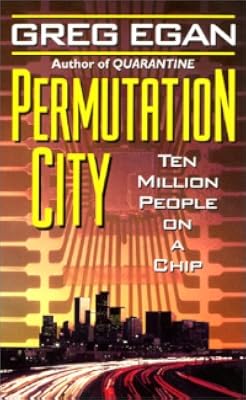
Unfortunately for hard sci-fi authors, most of us are never going to consider it a thrilling climax when a group of scientists flip a switch, stare at some dots on a computer screen, perform some calculations, then excitedly declare, "It worked! It worked!," which is why hard sci-fi is fated to always exist on the cultish outskirts of genre literature. And despite his publisher's best efforts to "sex up" this story, through the cyberpunk-looking cover art and a tagline that has absolutely nothing to do with the actual plot ("Ten Million People On A Chip!"), Permutation City falls squarely into hard sci-fi territory, making it easy to see why his "dumbed-down" '90s colleagues like Gibson and Stephenson are now well-loved mainstream figures while Egan is still barely known beyond his core fan base of Larry-Niven-loving convention veterans. It should all be kept in mind before picking up a copy yourself. show less
There's a running joke throughout Greg Egan's 1994 Permutation City that neatly encapsulates both all the good things and all the bad things about the book in general. Namely, a TV show has recently been created in their day-after-tomorrow world that was specifically designed to sell the just-invented concept of virtual reality to the mouth-breathing masses, a show that's been deliberately dumbed down to make it more palpable to the slack-jawed yokels, in which crazy fantastical things are always happening within a virtual space that doesn't even begin to conform to reality, which for anyone familiar with this period in sci-fi history is very, show more very clearly Egan poking fun of the other cyberpunk novels of those early-'90s years that got a lot more famous than his, like William Gibson's Neuromancer and Neal Stephenson's Snow Crash. But in the actual virtual reality that all the smart, rich people in Egan's universe actually do inhabit, the ultimate goal is for the virtual world to match the boring real world as exactly as possible, and the most excited anyone ever gets is when their avatars count out loud from one to ten to check the lag between their time and our own. (Or to quote The Simpsons: "Perfectly level flying is the supreme challenge of the scale model pilot!")
That says everything you need to know about about Egan as an author, a "hard" science-fiction writer who is also a working mathematics doctorate holder in his day job, and who has built an award-winning and cultishly popular career writing speculative novels that stick as closely to real science as humanly possible. I think that's great, I want there to be no mistake, and I'm glad that these kinds of books exist for all those science-oriented readers who get frustrated by the "soft" sci-fi books that tend to be the big bestsellers of the genre and have much more of an impact on the general culture. (If you ever want to cause an aneurysm in a hard sci-fi fan, ask them for their opinion on Star Wars.) But that said, hard sci-fi is generally not really my cup of tea -- in fact, I doubt I would've ever read this unless it had been recommended by a new friend of mine in Chicago, fellow hard sci-fi author Jeremy John -- and as a result I found Permutation City to be only a bit above mediocre, with a central premise revolving around quantum mechanics and multidimensional consciousness that might as well have been freaking Hogwarts, as little as I could keep up with the high-level real science being bandied about.
Unfortunately for hard sci-fi authors, most of us are never going to consider it a thrilling climax when a group of scientists flip a switch, stare at some dots on a computer screen, perform some calculations, then excitedly declare, "It worked! It worked!," which is why hard sci-fi is fated to always exist on the cultish outskirts of genre literature. And despite his publisher's best efforts to "sex up" this story, through the cyberpunk-looking cover art and a tagline that has absolutely nothing to do with the actual plot ("Ten Million People On A Chip!"), Permutation City falls squarely into hard sci-fi territory, making it easy to see why his "dumbed-down" '90s colleagues like Gibson and Stephenson are now well-loved mainstream figures while Egan is still barely known beyond his core fan base of Larry-Niven-loving convention veterans. It should all be kept in mind before picking up a copy yourself. show less
This book is a blast. Classic Egan: huge, complex, and ultimately--well, plausible, if plausible is when you can't really refute it.
It's almost completely irrelevant to the main plot of the book, but the extent to which Egan was able to guess at the general shape of the early-21st century internet & related economy is quietly awe-inspiring.
Like a few other of his books, I find myself having to squint sideways a bit and do some handwaving for a few of his ideas--observer-effect kind of quantum woo. In this case, it's the idea that internally self-consistent narratives are basically self-sustaining, "computing" themselves across any arrangement of matter, anywhere in space-time, that matches up.
Even setting that giant idea aside, there's show more tons going on here. Egan blows Conway's Game of Life up to a really interesting "artificial life" that is a constant counterpoint to merely "virtual" reality; and he starts delving into what post-humanity could really look like in a virtual world. That's even before he starts getting into a kind of epistemologically warring Platonic-forms plot played out on virtual Von Neumann/Turing machines.
Characters here are...odd, a bit disjointed, solipsistic, really. Of the four major point-of-view streams (Dunham, Maria, Peer, Riemann), only Dunham & Maria have any overlap. Riemann's self-imposed hell is an odd narrative choice in such a relatively short novel that's already trying to cram a lot in, and something to ponder. Peer's is the only timeline that feels like much of a genuine arc, as he genuinely embraces the possibilities of his situation.
The gutsy way that Egan spins really abstract concepts into concrete plot twists is a delight. Qua novel, this book is weak in a lot of ways, but it has stuck with me in a strangely affecting way. Recommended. show less
It's almost completely irrelevant to the main plot of the book, but the extent to which Egan was able to guess at the general shape of the early-21st century internet & related economy is quietly awe-inspiring.
Like a few other of his books, I find myself having to squint sideways a bit and do some handwaving for a few of his ideas--observer-effect kind of quantum woo. In this case, it's the idea that internally self-consistent narratives are basically self-sustaining, "computing" themselves across any arrangement of matter, anywhere in space-time, that matches up.
Even setting that giant idea aside, there's show more tons going on here. Egan blows Conway's Game of Life up to a really interesting "artificial life" that is a constant counterpoint to merely "virtual" reality; and he starts delving into what post-humanity could really look like in a virtual world. That's even before he starts getting into a kind of epistemologically warring Platonic-forms plot played out on virtual Von Neumann/Turing machines.
Characters here are...odd, a bit disjointed, solipsistic, really. Of the four major point-of-view streams (Dunham, Maria, Peer, Riemann), only Dunham & Maria have any overlap. Riemann's self-imposed hell is an odd narrative choice in such a relatively short novel that's already trying to cram a lot in, and something to ponder. Peer's is the only timeline that feels like much of a genuine arc, as he genuinely embraces the possibilities of his situation.
The gutsy way that Egan spins really abstract concepts into concrete plot twists is a delight. Qua novel, this book is weak in a lot of ways, but it has stuck with me in a strangely affecting way. Recommended. show less
Members
- Recently Added By
Lists

Best Science Fiction Novels
816 works; 426 members

What Makes This Book So Great
102 works; 16 members

Singularity
12 works; 1 member

Stories of Immortality and Reincarnation
17 works; 5 members

Finished in 2020
12 works; 2 members

Geek Books
27 works; 7 members

Simulated Reality in Fiction
124 works; 7 members

Broderick and Di Filippo's Science Fiction: The 101 Best Novels 1985-2010
103 works; 7 members

SFF Down Under
59 works; 3 members

Books We Couldn't Put Down
443 works; 197 members

Books We Want To Read Again For The First Time
384 works; 160 members
Favorite Science Fiction
456 works; 218 members

An evolving science fiction novel canon
50 works; 2 members

Best Cyberpunk
41 works; 7 members
Author Information

129+ Works 13,916 Members
Some Editions
Awards and Honors
Awards
Series

Belongs to Publisher Series
Bastei Science Fiction-Special (24200)
Work Relationships
Is an adaptation of
Common Knowledge
- Original publication date
- 1994
- People/Characters
- Paul Durham; Maria DeLuca
- Epigraph
- Into a mute crypt, I
Can't pity our time
Turn amity poetic
Ciao, tiny trumpet!
Manic piety tutor
Tame purity tonic
Up, meiotic tyrant!
I taint my top cure
To it, my true... (show all) panic
Put at my nice riot
To trace impunity
I tempt an outcry, I
Pin my taut erotic
Art to epic mutiny
Can't you permit it
To cite my apt ruin?
My true icon: tap it
Copy time, turn it; a
Rite to cut my pain
Atomic putty? Rien!
Found in the memory of a discarded notepad in the Common Room of the Psychiatric Ward, Blacktown Hospital, June 6, 2045. - Dedication
- "Thanks to Deborah Beale, Charon Wood, Peter Robinson, David Pringle, Lee Montgomerie, Gardner Dozois and Sheila Williams"
- First words
- Paul Durham opened his eyes, blinking at the room's unexpected brightness, then lazily reached out to place one hand in a patch of sunlight at the edge of the bed.
- Last words
- (Click to show. Warning: May contain spoilers.)Durham promised her "I will. In the next life."
Classifications
Statistics
- Members
- 2,212
- Popularity
- 9,127
- Reviews
- 48
- Rating
- (3.88)
- Languages
- 7 — Czech, English, French, German, Italian, Polish, Spanish
- Media
- Paper, Audiobook, Ebook
- ISBNs
- 24
- ASINs
- 8