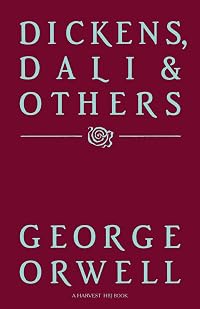
Dickens, Dali and Others
by George Orwell 
On This Page
Description
Ten celebrated essays by a man universally regarded as a master of the essay form. Included are such classics as "Charles Dickens," "The Art of Donald McGill," "Boys' Weeklies," "Raffles and Miss Blandish," and "Benefit of Clergy: Some Notes on Salvador Dali."Tags
Recommendations













Member Reviews
Whatever else one says about Orwell, he’s got a mature and reasoned viewpoint. It was a relief to read this after trying to read Chesterton, who just hammered and hammered on Christianity as reflected in the works of various authors.
At first, reading about Dickens, I thought, “Dang! Not again, except now it’s socialism” But that didn’t continue. Orwell is certainly focused on economic inequalities, but he doesn’t allow that to overwhelm everything else about an author.
Among the different chapters I found the sections on Dickens, Boys’ Weeklies, and P. G. Wodehouse to be the most rewarding, although the entire book is intelligent, worthwhile, and entertaining to read. The section on Dali is perhaps the weakest part of the show more book, but it was written in 1944, so allowances must be made.
I highly recommend this book to anyone interested in authors from the last century, in older viewpoints, or in Orwell himself. show less
At first, reading about Dickens, I thought, “Dang! Not again, except now it’s socialism” But that didn’t continue. Orwell is certainly focused on economic inequalities, but he doesn’t allow that to overwhelm everything else about an author.
Among the different chapters I found the sections on Dickens, Boys’ Weeklies, and P. G. Wodehouse to be the most rewarding, although the entire book is intelligent, worthwhile, and entertaining to read. The section on Dali is perhaps the weakest part of the show more book, but it was written in 1944, so allowances must be made.
I highly recommend this book to anyone interested in authors from the last century, in older viewpoints, or in Orwell himself. show less
Ratings
Members
- Recently Added By
Lists

Maybe This Year? Books to Look Forward To
409 works; 9 members
Author Information

388+ Works 221,144 Members
George Orwell was born Eric Arthur Blair on June 25, 1903 in Motihari in Bengal, India and later studied at Eton College for four years. He was an assistant superintendent with the Indian Imperial Police in Burma. He left that position after five years and moved to Paris, where he wrote his first two books: Burmese Days and Down and Out in Paris show more and London. He then moved to Spain to write but decided to join the United Workers Marxist Party Militia. After being decidedly opposed to communism, he served in the British Home Guard and with the Indian Service of the BBC during World War II. After the war, he wrote for the Observer and was literary editor for the Tribune. His best known works are Animal Farm and 1984. His other works include A Clergyman's Daughter, Keep the Aspidistra Flying, The Road to Wigan Pier, Homage to Catalonia, and Coming Up for Air. He died on January 21, 1950 at the age of 46. (Bowker Author Biography) show less
George Orwell has a Legacy Library. Legacy libraries are the personal libraries of famous readers, entered by LibraryThing members from the Legacy Libraries group.
Work Relationships
Contains
Is a commentary on the text of
Common Knowledge
- Quotations
- The energy that actually shapes the world springs from emotions--racial pride, leader-worship, religious belief, love of war--which liberal intellectuals mechanically write off as anachronisms, and which they have usually des... (show all)troyed so completely in themselves as to have lost all power of action.
...though Fascism does not offer any real return to the past, those who yearn for the past will accept Fascism sooner than its probable alternatives. - Blurbers
- Pritchett, V. S.
Classifications
- Genres
- Nonfiction, Literature Studies and Criticism
- DDC/MDS
- 828.912 — Literature & rhetoric English & Old English literatures English miscellaneous writings English miscellaneous writings 1900- English miscellaneous writings 1900-1999 English miscellaneous writings 1900-1945
- LCC
- PR6029 .R8 — Language and Literature English English Literature 1900-1960
- BISAC
Statistics
- Members
- 83
- Popularity
- 383,571
- Reviews
- 1
- Rating
- (3.45)
- Languages
- English
- Media
- Paper
- ISBNs
- 3
- ASINs
- 2