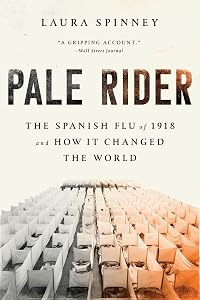
Pale Rider: The Spanish Flu of 1918 and How It Changed the World
by Laura Spinney
On This Page
Description
"The Spanish flu of 1918-1920 was one of the greatest human disasters of all time. It infected a third of the people on Earth--from the poorest immigrants of New York City to the king of Spain, Franz Kafka, Mahatma Gandhi and Woodrow Wilson. But despite a death toll of between 50 and 100 million people, it exists in our memory as an afterthought to World War I. In this gripping narrative history, Laura Spinney traces the overlooked pandemic to reveal how the virus traveled across the globe, show more exposing mankind's vulnerability and putting our ingenuity to the test. As socially significant as both world wars, the Spanish flu dramatically disrupted--and often permanently altered--global politics, race relations and family structures, while spurring innovation in medicine, religion and the arts. It was partly responsible, Spinney argues, for pushing India to independence, South Africa to apartheid and Switzerland to the brink of civil war. It also created the true "lost generation." Drawing on the latest research in history, virology, epidemiology, psychology and economics, Pale Rider masterfully recounts the little-known catastrophe that forever changed humanity"--Amazon. show lessTags
Recommendations






Member Reviews
I loved the world-wide view and the multiple frames of analysis the author took. There were huge historical impacts of the Spanish flu, but also impacts on art, culture, memory....
The author wove facts and figures with human interest "dives" into individual stories, which I also liked.
The parallels to today's COVID 19 reactions can't be missed: arguments that authorities are exaggerating the danger, that mandatory vaccines are a violation of human rights, about the use of lockdowns, quarantines, masking. And the author's assertion that "the demands of national security, a thriving economy and public health are rarely aligned."
This book shows why history matters. And leaves me somewhat frustrated that the world was not better prepared to show more deal with the current pandemic. I hope someone does a similar analysis of COVID 19 when sufficient time has passed. show less
The author wove facts and figures with human interest "dives" into individual stories, which I also liked.
The parallels to today's COVID 19 reactions can't be missed: arguments that authorities are exaggerating the danger, that mandatory vaccines are a violation of human rights, about the use of lockdowns, quarantines, masking. And the author's assertion that "the demands of national security, a thriving economy and public health are rarely aligned."
This book shows why history matters. And leaves me somewhat frustrated that the world was not better prepared to show more deal with the current pandemic. I hope someone does a similar analysis of COVID 19 when sufficient time has passed. show less
Published in 2017, I ordered this book at the end of 2019, before anyone had heard of the new pandemic or Covid-19. It arrived on my doorstep just days after the first cases became known at the beginning of 2020 but has been passed around and just arrived back with me last month. One good thing about reading it after the worst of our present pandemic has passed is that I can see the issues and similarities and understand them better. This is an excellent history book, well-written and well-researched.
"We find ourselves at an interesting point on the remembering / forgetting arc with respect to the twentieth century. The two world wars are still raw, we refer back to them obsessively and are firmly convinced that we will never forget show more them - though past experience suggests that they will gradually lose their lustre in our minds, or be obscured by other wars. Meanwhile the Spanish flu intrudes more and more into our historical consciousness, but it can't shake the prefix 'forgotten'.
Why does memory for a pandemic take time to develop? Perhaps one reason is that it's not so easy to count the dead. They don't wear uniforms, display exit wounds or fall down in a circumscribed arena. They die in large numbers in a short space of time, over a vast expanse of space, and many of them disappear into mass graves, not only before their disease has been diagnosed, but often before their lives have even been recorded. For most of the twentieth century, people thought the Spanish flu had killed around 20 million people, when the real number was two, three, possibly even five times that." show less
"We find ourselves at an interesting point on the remembering / forgetting arc with respect to the twentieth century. The two world wars are still raw, we refer back to them obsessively and are firmly convinced that we will never forget show more them - though past experience suggests that they will gradually lose their lustre in our minds, or be obscured by other wars. Meanwhile the Spanish flu intrudes more and more into our historical consciousness, but it can't shake the prefix 'forgotten'.
Why does memory for a pandemic take time to develop? Perhaps one reason is that it's not so easy to count the dead. They don't wear uniforms, display exit wounds or fall down in a circumscribed arena. They die in large numbers in a short space of time, over a vast expanse of space, and many of them disappear into mass graves, not only before their disease has been diagnosed, but often before their lives have even been recorded. For most of the twentieth century, people thought the Spanish flu had killed around 20 million people, when the real number was two, three, possibly even five times that." show less
This book provides a global perspective on the “Spanish” influenza of 1918 (which did not originate in Spain) that killed between 50 and 100 million people. Chapter One recounts the history of flu viruses, providing the context for the rest of the book. The middle chapters focus on the virus itself – where it originated (most likely Kansas, US), how it spread, and its impact throughout the world. The final chapter brings up the potential for future pandemics and what we can do to be prepared. It was released in 2017, so the “future” being described would include COVID-19.
It provides a logical, well-structured discussion of the science behind viruses, germ theory, genetics, disease transmission, and what was (and was not) show more known in 1918. It speaks of the three waves of the virus, and how they were staggered in the northern and southern hemispheres. It calls attention to the fact that viruses mutate – this is a normal progression and should not be considered surprising or alarming.
Content includes the importance of detection, tracking the spread, and compliance with safety measures (masks, limits on mass gatherings, social distancing, vaccinations). There is a decent discussion of how flu can originate in animals and be transmitted to humans (bird, horses, ferrets). The importance of attaining herd immunity is stressed.
I appreciate Spinney’s analysis, which is based upon a detailed review of historical and scientific documentation. It includes anecdotes from people around the world – Australia, Brazil, China, UK, US, Persia, Russia, Samoa, Spain, South Africa, Vanuatu, just to name a few. It outlines the groundwork being done in the scientific community to study these viruses and enable vaccines to be developed more quickly. This book is a great example of how we can learn from what has transpired in the past.
I have an interest in both science and history, so I found it engaging. It is remarkable that the fallout we have seen in terms of social, cultural, political, and information delivery can all be correlated to what happened in 1918, but on a different scale due to less scientific knowledge and technological development. I think it is a good idea to read about influenza and pandemics in order to gain an understanding of the facts. show less
It provides a logical, well-structured discussion of the science behind viruses, germ theory, genetics, disease transmission, and what was (and was not) show more known in 1918. It speaks of the three waves of the virus, and how they were staggered in the northern and southern hemispheres. It calls attention to the fact that viruses mutate – this is a normal progression and should not be considered surprising or alarming.
Content includes the importance of detection, tracking the spread, and compliance with safety measures (masks, limits on mass gatherings, social distancing, vaccinations). There is a decent discussion of how flu can originate in animals and be transmitted to humans (bird, horses, ferrets). The importance of attaining herd immunity is stressed.
I appreciate Spinney’s analysis, which is based upon a detailed review of historical and scientific documentation. It includes anecdotes from people around the world – Australia, Brazil, China, UK, US, Persia, Russia, Samoa, Spain, South Africa, Vanuatu, just to name a few. It outlines the groundwork being done in the scientific community to study these viruses and enable vaccines to be developed more quickly. This book is a great example of how we can learn from what has transpired in the past.
I have an interest in both science and history, so I found it engaging. It is remarkable that the fallout we have seen in terms of social, cultural, political, and information delivery can all be correlated to what happened in 1918, but on a different scale due to less scientific knowledge and technological development. I think it is a good idea to read about influenza and pandemics in order to gain an understanding of the facts. show less
Laura Spinney wrote Pale Rider: The Spanish Flu of 1918 and How It Changed the World in 2017, but she could have written it in 2020. The book deals with the effects of the 1918 pandemic, but it could be about the Covid-19 pandemic, which continues to dominate humankind as I write this. The impacts, effects, and results of the worldwide outbreak in 1918 and the public's reactions to it are all but indistinguishable from those being reported in the news in April of 2020. In 1918, viruses were as yet unseen and poorly understood; in 2020, not only doctors but also millions of lay viewers have seen images of the novel coronavirus thanks to today's electron microscopes. Yet, despite the technological developments of the intervening 100 show more years, human impacts and reactions remain remarkably unchanged.
I found Pale Rider an interesting read, a “page turner” more gripping than many fictional novels, yet it is manifestly factual in its presentation of the spread of the 1918 influenza virus around the world and of some of its residual effects. To call Spinney's work “entertaining” would be to belittle its contribution to our knowledge of the pandemic, so I shall say rather that it is a fascinating, well-written history from which the reader will assuredly gain some new knowledge. For example, from other sources, I had some inkling that the Spanish Flu was not well named since Spain was most likely not the actual country of origin. The actual origin is not and likely never will be known for certain, but I was surprised to learn that evidence exists for possible points of origin in France, in China and in Kansas! Applied to the Covid-19 pandemic of 2020, this bit of knowledge about the origin of the 1918 pandemic is a suitable argument for never referring to the 2020 outbreak as the “Chinese Flu.”
Given the many commonalities between the 1918 and 2020 incidents, plus Spinney's clear and easily understood explanation of how viruses mutate and spread, her book is not “just” a history but is also a valuable guide for understanding world events today, though they be a century after the events she describes. The 19th Century French writer Jean-Baptiste Alphonse Karr came up with the best linguistic expression to explain this applicability to two events separated by one hundred years: plus ça change, plus c'est la même chose, the more it changes, the more it stays the same. I cannot stress enough just how amazed I was at the similarity between the events in Spinney's book and the events on the daily news in the early Spring of 2020: the rapid spread of the virus, the inability of governments to deal with it, the incredible existence of conspiracy theorists, the frantic search for effective medicines, and on and on.
Hopefully, some of the palliatives attempted in 1918 are no longer being tried in 2020: Aspirin was prescribed in such overwhelming dosages that some deaths may have resulted from aspirin poisoning rather than effects of the virus. Quinine, arsenic preparations, camphor oil, digitalis, strychnine, Epsom salts, castor oil—even bloodletting—were tried. But this topic, too, finds a parallel in 2020: The drug chloroquine, a synthetic form of quinine, is bruited by some as a treatment although some news reports relating this drug to cardiotoxicity have surfaced. Plus ça change, plus c'est la même chose.
Pale Rider is many things. Without ever addressing Covid-19 (since it was written three years before Covid-19 appeared) it reassures us that the global disease outbreak of 2020 is only the latest example of outbreaks that have swept through humankind periodically since before commencement of the Common Era 2,000 years ago. It is equally disheartening that humankind seems as powerless to conquer Covid-19 in 2020 as it was to overcome the Spanish Flu in 1918. It is a history book. It is informative. It is quite well written and interesting to read. If one wishes to know how viruses interact with and influence human societies, Spinney's book is a good one with which to begin. show less
I found Pale Rider an interesting read, a “page turner” more gripping than many fictional novels, yet it is manifestly factual in its presentation of the spread of the 1918 influenza virus around the world and of some of its residual effects. To call Spinney's work “entertaining” would be to belittle its contribution to our knowledge of the pandemic, so I shall say rather that it is a fascinating, well-written history from which the reader will assuredly gain some new knowledge. For example, from other sources, I had some inkling that the Spanish Flu was not well named since Spain was most likely not the actual country of origin. The actual origin is not and likely never will be known for certain, but I was surprised to learn that evidence exists for possible points of origin in France, in China and in Kansas! Applied to the Covid-19 pandemic of 2020, this bit of knowledge about the origin of the 1918 pandemic is a suitable argument for never referring to the 2020 outbreak as the “Chinese Flu.”
Given the many commonalities between the 1918 and 2020 incidents, plus Spinney's clear and easily understood explanation of how viruses mutate and spread, her book is not “just” a history but is also a valuable guide for understanding world events today, though they be a century after the events she describes. The 19th Century French writer Jean-Baptiste Alphonse Karr came up with the best linguistic expression to explain this applicability to two events separated by one hundred years: plus ça change, plus c'est la même chose, the more it changes, the more it stays the same. I cannot stress enough just how amazed I was at the similarity between the events in Spinney's book and the events on the daily news in the early Spring of 2020: the rapid spread of the virus, the inability of governments to deal with it, the incredible existence of conspiracy theorists, the frantic search for effective medicines, and on and on.
Hopefully, some of the palliatives attempted in 1918 are no longer being tried in 2020: Aspirin was prescribed in such overwhelming dosages that some deaths may have resulted from aspirin poisoning rather than effects of the virus. Quinine, arsenic preparations, camphor oil, digitalis, strychnine, Epsom salts, castor oil—even bloodletting—were tried. But this topic, too, finds a parallel in 2020: The drug chloroquine, a synthetic form of quinine, is bruited by some as a treatment although some news reports relating this drug to cardiotoxicity have surfaced. Plus ça change, plus c'est la même chose.
Pale Rider is many things. Without ever addressing Covid-19 (since it was written three years before Covid-19 appeared) it reassures us that the global disease outbreak of 2020 is only the latest example of outbreaks that have swept through humankind periodically since before commencement of the Common Era 2,000 years ago. It is equally disheartening that humankind seems as powerless to conquer Covid-19 in 2020 as it was to overcome the Spanish Flu in 1918. It is a history book. It is informative. It is quite well written and interesting to read. If one wishes to know how viruses interact with and influence human societies, Spinney's book is a good one with which to begin. show less
Before Covid-19 I was drawn to pandemic stories but unlike others during this time I've avoided such books. However, this was recommended by a friend and I'm glad I took her recommendation.
Pale Rider is an interesting mix of the science, history, and sociology of the 1918 flu pandemic. It was published in 2017, so though references the 2014 Ebola outbreak Covid-19 wasn't on the general public's radar. Although this discusses flu viruses and future flu pandemics, there's so much we should have but didn't learn from the way various countries handled 1918 flu pandemic. Almost everything we did right back then we're doing now. Nearly everything we did wrong back then we're doing now. It seems to be human nature not to learn from history but show more if we only looked back, we could have handled this pandemic differently. There are so many Aha! moments in this book that it's worth reading, at least in order to understand ourselves. It was interestingly told and worth the read. show less
Pale Rider is an interesting mix of the science, history, and sociology of the 1918 flu pandemic. It was published in 2017, so though references the 2014 Ebola outbreak Covid-19 wasn't on the general public's radar. Although this discusses flu viruses and future flu pandemics, there's so much we should have but didn't learn from the way various countries handled 1918 flu pandemic. Almost everything we did right back then we're doing now. Nearly everything we did wrong back then we're doing now. It seems to be human nature not to learn from history but show more if we only looked back, we could have handled this pandemic differently. There are so many Aha! moments in this book that it's worth reading, at least in order to understand ourselves. It was interestingly told and worth the read. show less
I found this a fascinating read and, though I am far from an expert on the scientific side, I was struck by the sociological look at how people responded (and are responding) not only to the virus, but to the measures taken to control the virus. If you believe that "no one saw anything like this coming," well...think again. What the Spanish flu taught us, in essence, is that another flu pandemic is inevitable, but whether it kills 10 million or 100 million will be determined by the world into which it emerges.
Bonus quotation re: the impact on economically vulnerable and marginalized communities: The flu may have been democratic, as one French historian pointed out, but the society it struck was not.(/i>
Bonus quotation re: the impact on economically vulnerable and marginalized communities: The flu may have been democratic, as one French historian pointed out, but the society it struck was not.(/i>
Pale Rider is the second book I've read about the 1918 pandemic. Since I'm currently living through one, I want to find out as much as possible about the subject. The previous one I read, by John M. Barry, was written in 2005 and covered the topic thoroughly. It documented the status of the medical community (or lack thereof) at the time, and the scientific nature of viruses—how they are born, how they mutate, and how they kill humans. Pale Rider delves more into the human crisis of dying and surviving the pandemic worldwide. The book is well written and documents many historical events across the globe while the Spanish flu flourished and massacred millions. Since it was written in 2017, it also cites the most recent statistics show more uncovered since Mr. Barry's book. I was surprised to learn that recently scientists have recreated the 1918 virus and are currently studying it in a secure biological facility. Let's hope it never gets loose. Laura Spinney's insights into the tremendous impact the pandemic had—and continues to have—on our society is spot-on, and her speculation on why this extraordinary loss-of-life event has mostly been forgotten is interesting. In her Afterword: On Memory, she notes: 'That perhaps one reason is that it's not so easy to count the dead. They don't wear uniforms, display exit wounds, or fall down in a circumscribed arena. They die in large numbers in a short space of time, over a vast expanse of space, and many of them disappear into mass graves, not only before their disease has been diagnosed, but often before their lives have even been recorded.' Maybe this is why our current population is having so much trouble acknowledging that we have another killer virus stalking us and are resisting simple guidelines that have been well documented to save lives. Everything we've learned from past pandemics is being ignored by our POTUS, who continues not to take it seriously while making light of our fallen brothers. It's shameful, and I'm sad that I'm an unwilling participant in today's pandemic. show less
Members
- Recently Added By
Published Reviews
"Een vaccin gaat onze problemen niet oplossen .. Nu komt het aan op medewerking van het publiek. Het is daarbij essentieel dat de overheid eerlijk blijft tegen haar burgers
added by nagel175
Lists

Best History Books about Epidemics
27 works; 24 members

Non-Fiction Worth Reading
1,016 works; 262 members

Books Mentioned in the A+ Autostraddle Pop Up Discords Nov 2022 & Dec 2022
223 works; 3 members
Author Information

8+ Works 1,306 Members
Some Editions
Awards and Honors
Distinctions
Notable Lists
Common Knowledge
- Canonical title*
- 1918. L'influenza spagnola. La pandemia che cambiò il mondo
- Original title
- Pale Rider: The Spanish Flu of 1918 and How It Changed the World
- Alternate titles*
- 1918. L'influenza spagnola. L'epidemia che cambiò il mondo
- Original publication date
- 2017
- People/Characters
- Richard Pfeiffer; Guillaume Apollinaire; Pedro Nava; Percy Watson; Bishop Antonio Alvaro y Ballano; Royal S. Copeland (show all 19); Joseph Stella; Ahmad Qavam al-Saltaneh; Rolla E. Hoffman; Yakov Bardakh; Linus Hiram French; Valentine McGillycuddy; Wu Lien-teh; Ilya Mechnikov; Jonas Salk; Dujarric de la Riviere; Nontetha Nkwenkwe; Mohandas Gandhi; Lu Xun
- Important places
- Camp Funston, Fort Riley, Kansas, USA; Tianjin, China; Freetown, Western Area, Sierra Leone; Rio de Janeiro, Rio de Janeiro, Brasil; Shansi, China; Rand Gold Mine, Germiston, Gauteng, South Africa (show all 13); Kimberley Diamond Mine, Northern Cape, South Africa; Mashhad, Razavi Khorasan, Iran; Zamora, Zamora Spain; Odesa, Ukraine; Bristol Bay, Alaska, USA; Étaples, Pas-de-Calais, France; New York, New York, USA
- Important events
- World War I (1914 | 1918); Russian Flu (1889 | 1890); Influenza Pandemic (1918 | 1920); Vaccine Revolt (1904); Great Sickness (1900); Great Kantō Earthquake (1923) (show all 7); Black October (1918)
- Dedication
- For RSJF and the lost generations
- First words
- Introduction
Kaiser Wilhelm of Germany abdicated on 9 November 1918 and in the streets of Paris there was jubilation.
Sometime around the winter solstice of 412 BC, a cough wracked the people of Perinthus, a port city on the Sea of Marmara in what was then northern Greece. - Quotations
- ...the demands of national security, a thriving economy and public health are rarely aligned, and elected representatives defending the first two undermine the third...
Victorian science would have left the world hard and clean and care, like a landscape in the moon, but this science is in truth but a little light in the darkness, and outside that limited circle of definite knowledge we see ... (show all)the loom and shadow of gigantic and fantastic possibilities around us, throwing themselves continually across our consciousness in such ways that it is difficult to ignore them. - Sir Arthur Conan Doyle - Last words
- (Click to show. Warning: May contain spoilers.)Over the centuries, humans came to perceive flu as an increasingly intimate dance with the Devil, and even as they added to their knowledge, man and microbe continue to shape one another.
(Click to show. Warning: May contain spoilers.)Afterword
Those threads will reinforce it in our consciousness, and help pull it free. - Original language
- English
*Some information comes from Common Knowledge in other languages. Click "Edit" for more information.
Classifications
- Genres
- History, General Nonfiction, Nonfiction, Science & Nature
- DDC/MDS
- 614.5 — Applied science & technology Medicine & health Epidemics, Poisons, Alternative Medicine Incidence of and public measures to prevent specific diseases and kinds of diseases
- LCC
- RC150.4 .S665 — Medicine Internal medicine Internal medicine Infectious and parasitic diseases
- BISAC
Statistics
- Members
- 836
- Popularity
- 32,885
- Reviews
- 43
- Rating
- (3.94)
- Languages
- 6 — Dutch, English, French, German, Italian, Spanish
- Media
- Paper, Audiobook, Ebook
- ISBNs
- 29
- ASINs
- 9