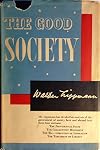
The Good Society
by Walter Lippmann
On This Page
Description
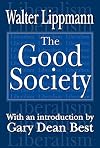
The Good Society is a critical text in the history of liberalism. Initially a series of articles published in a variety of Lippmann's favorite magazines, as the whole evolved, it became a frontal assault against totalitarian tendencies within American society. Lippmann took to task those who sought to improve the lot of mankind by undoing the work of their predecessors and by undermining movements in which men struggle to be free. This book is a strong indictment of programs of reform that show more are at odds with the liberal tradition, and it is critical of those who ask people to choose between security and liberty.The Good Society falls naturally into two segments. In the first, Lippmann shows the errors and common fallacies of faith in government as the solution to all problems. He says, "from left to right, from communist to conservative. They all believe the same fundamental doctrine. All the philosophies go into battle singing the same tune with slightly different words." In the second part of the book, Lippmann offers reasons why liberalism lost sight of its purpose and suggests the first principles on which it can flourish again.Lippmann argues that liberalism's revival is inevitable because no other system of government can work, given the kind of economic world mankind seeks. He did not write The Good Society to please adherents of any political ideology. Lippmann challenges all philosophies of government, and yet manages to present a positive program. Bewildered liberals and conservatives alike will find this work a successful effort to synthesize a theory of liberalism with the practice of a strong democracy. Gary Dean Best has provided the twenty-first century reader a clear-eyed context for interpreting Lippmann's defense of classical liberalism.The Good Society is the eleventh in a series of books written by Walter Lippmann reissued by Transaction with new introductions and in a paperback format. As show lessTags
Recommendations



























Member Recommendations
Member Reviews
Members
- Recently Added By
Author Information

28+ Works 2,061 Members
Walter Lippmann, an American political journalist, dominated political journalism in the United States from World War I almost until his death. In his last year as a student at Harvard University, he was an assistant to the philosopher George Santayana. He read extensively in Freud and was in every sense an "intellectual" journalist. "His Public show more Opinion" (1922) became the intellectual anchor for the study of public opinion, and it is widely read today. He came close in this book to questioning whether citizens can possibly make rational, democratic decisions. The source of the difficulty is not our irrationality but the inherent nature of the modern system of mass communication; information must be condensed into brief slogans. These slogans become stereotypes, a concept that Lippmann brilliantly analyzed prior to its acceptance by psychologists. As a political columnist, he wrote on many topics, particularly on foreign relations, and he held a position of prestige in Washington's press corps that has never been matched. Alastair Buchan wrote in 1974 that Walter Lippman was "the name that opened every door." (Bowker Author Biography) show less
Awards and Honors
Notable Lists
Common Knowledge
- Original title
- An Inquiry into the Principles of the Good Society
- Original publication date
- 1937
- People/Characters
- Franklin Delano Roosevelt; Karl Marx; Friedrich Engels; Vladimir Lenin; Benito Mussolini; Adolf Hitler (show all 16); Joseph Stalin; Leon Trotsky; Woodrow Wilson; Louis XIV, 1638-1715; Jean Baptiste Colbert; Edward Coke; Jeremy Bentham; John Stuart Mill; Adam Smith; John Maynard Keynes
- Important events
- World War I; Socialism; Gradual collectivism
- Dedication
- To Walter Wilmerding
- First words
- In the violent conflicts which now trouble the earth the active contenders believe that since the struggle is so deadly it must be that the issues which divide them are deep.
- Last words
- (Click to show. Warning: May contain spoilers.)For the will to be free is perpetually renewed in every individual who uses his faculties and affirms his manhood.
- Original language
- English US
Classifications
- Genres
- Politics and Government, Nonfiction, General Nonfiction, Philosophy, History
- DDC/MDS
- 320.51 — Social sciences Political science Political science (Politics and government) Political ideologies Liberalism
- LCC
- JC251 .L5 — Political Science Political theory Political theory. The state. Theories of the state Modern state
- BISAC
Statistics
- Members
- 99
- Popularity
- 324,407
- Rating
- (3.25)
- Languages
- English, French
- Media
- Paper, Ebook
- ISBNs
- 10
- ASINs
- 4