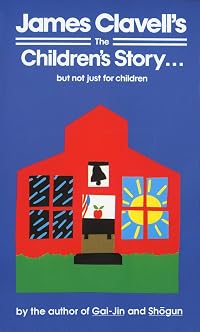
The Children's Story
by James Clavell
On This Page
Description
"What does 'allegiance' mean?" the New Teacher asked, hand over her heart.In this classic and chilling tale about an elementary school classroom in post-war occupied America, James Clavell brings to light the vulnerability of children and the power educators have to shape and change young minds. Originally written in the Cold War era, Clavell's extraordinary and enduringly relevant allegory on the impressionability of the human mind is still read in schools around the globe today, and is a show more call to every person to keep questioning and keep learning.
. Historical Fiction. Literature. Fiction. show less
Tags
Recommendations

















Member Recommendations
Member Reviews
In this very slight short story, packaged in book form as a novella with many blank pages, Clavell focuses on an elementary school classroom immediately after a war, when the victors have made control of the educational institutions in an unnamed western country—evidently the US—a priority. Dressed in olive drab, a young, pretty, fresh-smelling nineteen-year-old enters the classroom. She is “New Teacher”. In her light, entirely unaccented, perfect English, she directs the children’s frightened teacher, an old-school elderly spinster, to the principal’s office, and then proceeds with an expert deconstruction of the American pledge of allegiance. In a few short minutes, the flag is dismantled—its cloth is cut, a piece is show more distributed to each student, and the flag pole is tossed out the window. God is shown not to exist, and prayer is, of course proved to be utterly ineffectual. No one, other than another human, will give you anything, New Teacher says. “Praying to God or anything or anyone is a waste of time.” In sweet tones, she also undermines parents and their old-fashioned ideas. The grown-ups with “bad thoughts” are being sent back to school to unlearn them. In fact, the father of Johnny, the only resistant student in the class, is one of them. Ultimately, though, even he submits to the teacher’s charm and gentle reprogramming. Candy is enough to gain power over his classmates, but New Teacher has to expertly employ a different strategy with him. She acknowledges—strokes—his intelligence and need for power by appointing him class monitor.
The last few pages of this little book present a reproduction of Clavell’s scrawling handwritten explanation of the genesis of the story. According to this account, years ago one of Clavell’s children asked for a dime as a reward for quickly, accurately, and fluently reciting the pledge of allegiance—without comprehending a single word of what she was saying. This apparently concerned him greatly. Not understanding what you’re signing on to, obediently and unquestioningly doing what you’re told, and being rewarded for easy compliance, as the story illustrates, sets you up to be indoctrinated, controlled, and exploited by others (including pretty, olive-drab-clad young women who are cogs in Dear Leader’s communist, atheistic oppressive system).
This is a facile, underwhelming little story, dressed up as a cautionary tale. It’s not quite clear whether the author thinks the pledge is a bad thing in itself (though I detected a slight whiff of horror at the possibility of a nation’s religion and belief in God being erased). What Clavell seems to be concerned about is citizens, even the youngest, not being encouraged to think about what they’ are taught. When an educational system values and fosters obedience and compliance in children, it consequently plays a major role in creating a society whose citizenry is vulnerable to manipulation and control—by its own government and others.
Who can argue with that? show less
The last few pages of this little book present a reproduction of Clavell’s scrawling handwritten explanation of the genesis of the story. According to this account, years ago one of Clavell’s children asked for a dime as a reward for quickly, accurately, and fluently reciting the pledge of allegiance—without comprehending a single word of what she was saying. This apparently concerned him greatly. Not understanding what you’re signing on to, obediently and unquestioningly doing what you’re told, and being rewarded for easy compliance, as the story illustrates, sets you up to be indoctrinated, controlled, and exploited by others (including pretty, olive-drab-clad young women who are cogs in Dear Leader’s communist, atheistic oppressive system).
This is a facile, underwhelming little story, dressed up as a cautionary tale. It’s not quite clear whether the author thinks the pledge is a bad thing in itself (though I detected a slight whiff of horror at the possibility of a nation’s religion and belief in God being erased). What Clavell seems to be concerned about is citizens, even the youngest, not being encouraged to think about what they’ are taught. When an educational system values and fosters obedience and compliance in children, it consequently plays a major role in creating a society whose citizenry is vulnerable to manipulation and control—by its own government and others.
Who can argue with that? show less
This story takes place in a classroom somewhere in the U.S., with the feeling that a war has been lost. A new teacher is brought in to educate the youngsters while the old teacher is sent to the principal’s office, never to be seen again. This new teacher is young, enthusiastic, and friendly – exactly the type of person that sends warning signals to an adult, but easily wins over children with her alleged logic about loyalty and symbols, religion, and patriotism.
When one boy argues they always begin the day with the Pledge of Allegiance, she acquiesces then challenges the children to explain what it means. She kindly questions everything they have to say, gently leading them toward what we know to be the new party line.
An excellent show more short story that will make you angry and horrified. It warns how easily children can be manipulated by adults. A quick read at only 96 pages, it will, nonetheless, stay with you for a long time. show less
When one boy argues they always begin the day with the Pledge of Allegiance, she acquiesces then challenges the children to explain what it means. She kindly questions everything they have to say, gently leading them toward what we know to be the new party line.
An excellent show more short story that will make you angry and horrified. It warns how easily children can be manipulated by adults. A quick read at only 96 pages, it will, nonetheless, stay with you for a long time. show less
When this story was first published during the Cold War, America felt threatened by the USSR. Today the threat is infinitely more chilling, not just because it’s already happening, but because it comes from within our own country.
This book was a gift of my BC friend. Knowing I like James Clavell, she thought I might like this book by him too.
And she was right. I think it is not really a book for children, I think it is more for teens. Children do not have very much insight in how 'people work', how people can manipulate and be manipulated.
For grown ups it can be an eye opener, makes very clear how easy it is to maniputale children, let them believe what you want. Even the ones that are skeptical can be turned into the direction you want to. For parents of young children it is a warning that you should try to know what is going on in your child's life e.g. at school like in this little book.
I liked it a lot!!
And she was right. I think it is not really a book for children, I think it is more for teens. Children do not have very much insight in how 'people work', how people can manipulate and be manipulated.
For grown ups it can be an eye opener, makes very clear how easy it is to maniputale children, let them believe what you want. Even the ones that are skeptical can be turned into the direction you want to. For parents of young children it is a warning that you should try to know what is going on in your child's life e.g. at school like in this little book.
I liked it a lot!!
Impressionable young children w/ Teacher
It was a simple incident in the life of James Clavell—a talk with his young daughter just home from school—that inspired this chilling tale of what could happen in twenty-five quietly devastating minutes. He writes, "The Children's Story came into being that day. It was then that I really realized how vulnerable my child's mind was —any mind, for that matter—under controlled circumstances. Normally I write and rewrite and re-rewrite, but this story came quickly—almost by itself. Barely three words were changed. It pleases me greatly because I kept asking the questions…
Questions like, What's the use of 'I pledge allegiance' without understanding? Like Why is it so easy to divert show more thoughts? Like What is freedom? and Why is so hard to explain?
The Children's Story keeps asking me all sorts of questions I cannot answer. Perhaps you can—then your child will...." show less
It was a simple incident in the life of James Clavell—a talk with his young daughter just home from school—that inspired this chilling tale of what could happen in twenty-five quietly devastating minutes. He writes, "The Children's Story came into being that day. It was then that I really realized how vulnerable my child's mind was —any mind, for that matter—under controlled circumstances. Normally I write and rewrite and re-rewrite, but this story came quickly—almost by itself. Barely three words were changed. It pleases me greatly because I kept asking the questions…
Questions like, What's the use of 'I pledge allegiance' without understanding? Like Why is it so easy to divert show more thoughts? Like What is freedom? and Why is so hard to explain?
The Children's Story keeps asking me all sorts of questions I cannot answer. Perhaps you can—then your child will...." show less
twist on cult mentality
Every American should read this book. Especially elementary school personal who are daily involved in having students recite the pledge!
Members
- Recently Added By
Author Information

132+ Works 29,295 Members
Screenwriter, director, producer, and novelist, James Clavell, was born on October 10, 1924, in Sydney, Australia. Clavell's full name was Charles Edmund DuMaresq de Clavelle. Though he wrote screenplays for such highly-acclaimed films as The Fly, The Great Escape, and To Sir With Love, Clavell is best known for his best-selling, grand novels. The show more novels, which are set in the Far East, include King Rat, Tai-pan, Shogun, Noble House, and Gai-Jin. Remarkable for their scrupulous attention to cultural detail and their innovative plots, Clavell's work has been compared to that of Charles Dickens. Clavell died on September 7, 1994, at the age of 69. (Bowker Author Biography) show less
Awards and Honors
Notable Lists
Work Relationships
Has the adaptation
Common Knowledge
- Original publication date
- 1963
Classifications
Statistics
- Members
- 421
- Popularity
- 73,331
- Reviews
- 10
- Rating
- (3.84)
- Languages
- English
- Media
- Paper, Audiobook, Ebook
- ISBNs
- 14
- ASINs
- 13