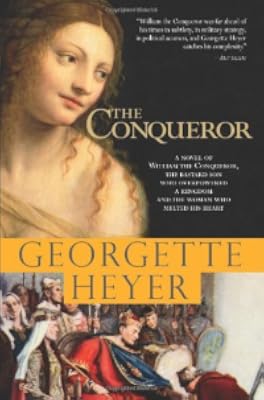
The Conqueror (Historical Romances Book 7)
by Georgette Heyer
On This Page
Description
The true story of William the Bastard, base-born son of the Duke of Normandy, who made himself king of England and the woman who melted his heart.Tags
Recommendations














Member Reviews
I finished this while waiting for the turkey to cook, and it's a good thing the last few chapters weren't longer, or we'd have had a burnt bird!
This tells the life story of William the Conqueror from his birth, through his struggles to hold the Duchy of Normandy to his invasion of England and being crowned King of England (I think I'm safe and that should not be a surprise to anyone). It is helped along by William's having a dedicated knight Raoul of Harcourt, who chooses to follow William and becomes as much a friend as a loyal knight. At first, Raoul admires William, but gradually he comes to realise that they have very different ambition, and that Williams ambitions could cause a lot of pain and hurt to Raoul and those he has come show more to call his friends. This is complicated further by one of his friends being Edgar,a Saxom thegn sent to William's court as a hostage. It gets complicated, in a way that books referencing battles rarely are. Things are not always black and white and there are divided loyalties that get in the way. The description of the battle of Hastings is every bit a vicious as a battle can be. It's not what you expect from a writer of romances, but it just shows her range. The ending is both sad and full of hope, there will be a future, both for Raoul and England, although they will not be a smooth ride, they will endure.
Re-read.
I suppose as you already know the end, a second read isn't spoiled by having finished it once. I think that by using Raoul (I don't know if he is real or invented) as a stand in for us, it allows us to relate to William as a man, rather than just as an exalted personage. He could be too distant to be able to relate to, in this we relate to Raoul, who links us to William. And we feel for Raoul and Edgar and the situation they find themselves in, the resolution forever out of their hands. It did it again, tears at the end, even though I knew it was coming from the moment it is prophesied. It stands up well to a second reading and the ferocity of the battle looses nothing on a second pass. show less
This tells the life story of William the Conqueror from his birth, through his struggles to hold the Duchy of Normandy to his invasion of England and being crowned King of England (I think I'm safe and that should not be a surprise to anyone). It is helped along by William's having a dedicated knight Raoul of Harcourt, who chooses to follow William and becomes as much a friend as a loyal knight. At first, Raoul admires William, but gradually he comes to realise that they have very different ambition, and that Williams ambitions could cause a lot of pain and hurt to Raoul and those he has come show more to call his friends. This is complicated further by one of his friends being Edgar,a Saxom thegn sent to William's court as a hostage. It gets complicated, in a way that books referencing battles rarely are. Things are not always black and white and there are divided loyalties that get in the way. The description of the battle of Hastings is every bit a vicious as a battle can be. It's not what you expect from a writer of romances, but it just shows her range. The ending is both sad and full of hope, there will be a future, both for Raoul and England, although they will not be a smooth ride, they will endure.
Re-read.
I suppose as you already know the end, a second read isn't spoiled by having finished it once. I think that by using Raoul (I don't know if he is real or invented) as a stand in for us, it allows us to relate to William as a man, rather than just as an exalted personage. He could be too distant to be able to relate to, in this we relate to Raoul, who links us to William. And we feel for Raoul and Edgar and the situation they find themselves in, the resolution forever out of their hands. It did it again, tears at the end, even though I knew it was coming from the moment it is prophesied. It stands up well to a second reading and the ferocity of the battle looses nothing on a second pass. show less
If this had been my first Heyer, it would also have been my last. This novel was written in 1927, and reissued in 1966 when the 900th anniversary of the Norman Conquest was celebrated.
They shoulda left it on the shelf. It's boring.
I leave all issues of historical accuracy to the anal-compulsive yammerers who think fiction should obey the laws of fact, contenting myself only with the observation that there are a scant number of primary sources from 900-plus years ago, so just unpucker and leave it alone.
The book starts with imagining the life of William's mother, Herleva, in the tannery town of Falaise. This is usually a bad sign that we're going to pretend we were there, but tell our story in third person omniscient PoV. The auguries show more were correct. Bleeearrgh! Nobosy knows if William's mother was named Herleva for a fact; nobody knows when he was born; nobody knows much about Falaise and its townspeople; so QUIT PRETENDING WE DO! This narrative voice gives the book a spurious air of knowledge imparted instead of speculation and storytelling indulged in; far better to use limited or even first person narration.
And then there are the generational complaints...the silly formality of language (how should we represent the voices of people from the past? It's a good question, but one I think the bygone writers always answered wrong, giving the men and women who came before us the silly faux gravitas of Formal Speech) which makes Every Utterance A Statement, instead of giving a character a voice we can accept and believe in.
Oh well. It was a nice idea to read one of Mrs. Heyer's historicals. I won't do it again. Regencies or nothing at all. NOT recommended. show less
They shoulda left it on the shelf. It's boring.
I leave all issues of historical accuracy to the anal-compulsive yammerers who think fiction should obey the laws of fact, contenting myself only with the observation that there are a scant number of primary sources from 900-plus years ago, so just unpucker and leave it alone.
The book starts with imagining the life of William's mother, Herleva, in the tannery town of Falaise. This is usually a bad sign that we're going to pretend we were there, but tell our story in third person omniscient PoV. The auguries show more were correct. Bleeearrgh! Nobosy knows if William's mother was named Herleva for a fact; nobody knows when he was born; nobody knows much about Falaise and its townspeople; so QUIT PRETENDING WE DO! This narrative voice gives the book a spurious air of knowledge imparted instead of speculation and storytelling indulged in; far better to use limited or even first person narration.
And then there are the generational complaints...the silly formality of language (how should we represent the voices of people from the past? It's a good question, but one I think the bygone writers always answered wrong, giving the men and women who came before us the silly faux gravitas of Formal Speech) which makes Every Utterance A Statement, instead of giving a character a voice we can accept and believe in.
Oh well. It was a nice idea to read one of Mrs. Heyer's historicals. I won't do it again. Regencies or nothing at all. NOT recommended. show less
Subtitled: "A Novel of William the Conqueror, the Bastard Son Who Overpowered a Kingdom and the Woman Who Melted His Heart". This the famous "William the Conqueror" from English historical fame, when England fought to rule territories in France. I read a brief overview of the historical background to be able to follow Heyer's story (thank you Wikipedia). The novel was well done and I found it very engaging. A Georgian romance of the lusty, gritty style and not in the softer Regency style.
The Conqueror is one of six historical novels written by Georgette Heyer, who is best known for her Regency Romances, and if this is an indication of the other five - then sign me up!
Heyer brings us back to 11th Century Normandy and introduces us to William, Duke of Normandy, (a.k.a. William the Bastard) through the eyes of Raoul de Harcourt - a knight in Duke William's retinue.
Raoul began his service to the Duke as a young knight and he quickly rose to be one of William's most trusted friends. Loyalty is a running theme throughout the novel - loyalty from a knight to his lord. Raoul may not have agreed with a lot of the tactics used by William, but he trusted and respected his lord enough to comply. Don't get me wrong, Raoul was no show more pushover - he voiced his opinions when it was warranted, but in the end he knew his role and played the part.
Duke William was a very intriguing man - ambitious would be putting it lightly. He valued brain over braun and cunning over might. Once he saw something he wanted, he got it. Doesn't matter how, but he got it. Which leads me into a great scene with William and his future wife, Mathilda....but I'll leave that for you to read! Let's just say it's not a good idea to call William a bastard!
One aspect of why I love historical fiction is the educational factor. I know I'm a total dork, but it's true - I've learned so much history through all the historical fiction novels I have read. I take some of it with a grain of salt cause it's historical fiction after all, but for the most part I know a lot more than I did a few years ago. While reading The Conqueror I learned a great deal more about the difference between an Englishman (or Saxon) and a Norman and the Battle of Hastings scene was not put-down-able!
I enthusiastically recommend this novel! Heyer's writing is impeccable and her research is without a doubt one of the best. Character development is awesome and dialogue excellent. The Conqueror keeps you enthralled during and wanting more when you're done...which is how every good book should be!
Amy says: 5 / 5
Soundtrack: Conquest by Whitestripes show less
Heyer brings us back to 11th Century Normandy and introduces us to William, Duke of Normandy, (a.k.a. William the Bastard) through the eyes of Raoul de Harcourt - a knight in Duke William's retinue.
Raoul began his service to the Duke as a young knight and he quickly rose to be one of William's most trusted friends. Loyalty is a running theme throughout the novel - loyalty from a knight to his lord. Raoul may not have agreed with a lot of the tactics used by William, but he trusted and respected his lord enough to comply. Don't get me wrong, Raoul was no show more pushover - he voiced his opinions when it was warranted, but in the end he knew his role and played the part.
Duke William was a very intriguing man - ambitious would be putting it lightly. He valued brain over braun and cunning over might. Once he saw something he wanted, he got it. Doesn't matter how, but he got it. Which leads me into a great scene with William and his future wife, Mathilda....but I'll leave that for you to read! Let's just say it's not a good idea to call William a bastard!
One aspect of why I love historical fiction is the educational factor. I know I'm a total dork, but it's true - I've learned so much history through all the historical fiction novels I have read. I take some of it with a grain of salt cause it's historical fiction after all, but for the most part I know a lot more than I did a few years ago. While reading The Conqueror I learned a great deal more about the difference between an Englishman (or Saxon) and a Norman and the Battle of Hastings scene was not put-down-able!
I enthusiastically recommend this novel! Heyer's writing is impeccable and her research is without a doubt one of the best. Character development is awesome and dialogue excellent. The Conqueror keeps you enthralled during and wanting more when you're done...which is how every good book should be!
Amy says: 5 / 5
Soundtrack: Conquest by Whitestripes show less
Georgette Heyer’s classic 1931 novel tells the story of William the Conqueror, Duke of Normandy, and his rise to power alongside his wife Matilda. The story begins in 1028 with William's birth and continues to his coronation Christmas Day 1066, though most of the book is taken up with the battles for and around Normandy.
The Conqueror also tells the story of fictional Raoul de Harcourt, an idealistic young nobleman who believes William will bring stability and social justice to Normandy. As Raoul faithfully accompanies William in a series of adventures that leads ever-closer to a climactic account of the Battle of Hastings, we observe ambition, deliberate cruelty, and political blackmail. Alongside the myth, however, Heyer presents a show more William who owes much of his success to practical military innovations, including quick troop mobilization and trained archers.
If you hear the name, Georgette Heyer, you may think romance but there's actually very little here about the relationship between William and Matilda. The author does a great job with the historic detail of the battles, the clothes and the politics of the time. The portrayal of the events leading up to the Norman conquest of England is evenhanded and factual. The attention to detail is amazing and the sense of place and time is very atmospheric. On the downside, the old fashioned language makes it difficult for me to say there's any sort of flowing narrative. Nevertheless, The Conqueror delivers an enjoyable read and I recommend it to anyone interested in know more about the Conquest. show less
The Conqueror also tells the story of fictional Raoul de Harcourt, an idealistic young nobleman who believes William will bring stability and social justice to Normandy. As Raoul faithfully accompanies William in a series of adventures that leads ever-closer to a climactic account of the Battle of Hastings, we observe ambition, deliberate cruelty, and political blackmail. Alongside the myth, however, Heyer presents a show more William who owes much of his success to practical military innovations, including quick troop mobilization and trained archers.
If you hear the name, Georgette Heyer, you may think romance but there's actually very little here about the relationship between William and Matilda. The author does a great job with the historic detail of the battles, the clothes and the politics of the time. The portrayal of the events leading up to the Norman conquest of England is evenhanded and factual. The attention to detail is amazing and the sense of place and time is very atmospheric. On the downside, the old fashioned language makes it difficult for me to say there's any sort of flowing narrative. Nevertheless, The Conqueror delivers an enjoyable read and I recommend it to anyone interested in know more about the Conquest. show less
The Conqueror is one of my favourite books by a favourite author - Georgette Heyer.
Known for her Regency novels, Heyer sometimes broke the mould, and wrote novels (usually historical), set in another period of English history.
The Conqueror is based on the life and times of William Duke of Normandy, later King of England with the Norman conquest in 1066.
Born the bastard son of Robert the Magnificent, Duke of Normandy, the story begins in William's 17th year. He has been Duke of Normandy from childhood and has survived several assassination attempts.
The story continues to show how he puts down rebellions and ousts rivals one by one, slowly but surely strengthening his hold on his Duchy.
The story is seen through the eyes of Raoul de show more Harcourt, William's boon companion. There are many twists of fortune and none so lucky as the one that landed Harold Godwineson on the shores of Ponthieu and from thence to Normandy.
Heyer slowly but surely sets the scene for Hastings. The plot is superb and she writes with a sure, light touch and even the heaviest of subjects are dealt with deftly. Her research is meticulous and she sticks to historical facts most of the time.
Character development is sure - you can see how William and Raoul progress from teenagers to experienced men. The story also follows the tale of Raoul and Elfrida the Saxon - sister to his dearest friend Edgar the Saxon.
Does their friendship and love survive the bloodbath of Hastings? While it's a historical novel, in Miss Heyer's hands, it becomes a thing of beauty and a joy to read.
I've lost count of the number of times I've re-read it and enjoyed it as much. She is one author most of whose books I own and reread often. show less
Known for her Regency novels, Heyer sometimes broke the mould, and wrote novels (usually historical), set in another period of English history.
The Conqueror is based on the life and times of William Duke of Normandy, later King of England with the Norman conquest in 1066.
Born the bastard son of Robert the Magnificent, Duke of Normandy, the story begins in William's 17th year. He has been Duke of Normandy from childhood and has survived several assassination attempts.
The story continues to show how he puts down rebellions and ousts rivals one by one, slowly but surely strengthening his hold on his Duchy.
The story is seen through the eyes of Raoul de show more Harcourt, William's boon companion. There are many twists of fortune and none so lucky as the one that landed Harold Godwineson on the shores of Ponthieu and from thence to Normandy.
Heyer slowly but surely sets the scene for Hastings. The plot is superb and she writes with a sure, light touch and even the heaviest of subjects are dealt with deftly. Her research is meticulous and she sticks to historical facts most of the time.
Character development is sure - you can see how William and Raoul progress from teenagers to experienced men. The story also follows the tale of Raoul and Elfrida the Saxon - sister to his dearest friend Edgar the Saxon.
Does their friendship and love survive the bloodbath of Hastings? While it's a historical novel, in Miss Heyer's hands, it becomes a thing of beauty and a joy to read.
I've lost count of the number of times I've re-read it and enjoyed it as much. She is one author most of whose books I own and reread often. show less
Georgette Heyer’s “The Conqueror” is a lengthy work of fiction based on the real life of England’s William I, following his rise to fame in Normandy, through to his victory at the Battle of Hastings in 1066, culminating in his being crowned.
This novel is divided into five parts with a short prologue and an epilogue. Overall it proved a little too exhaustive for my tastes.
The first three parts have the occasional interesting or even entertaining moment, but mostly I felt bored by the mundane tone, or by sections that were over-detailed with little happening.
Come Part Four, however, the narrative picks up a gear with the Saxon Harold’s arrival in Normandy. Ms Heyer does a fine job of depicting this great warrior who became King show more Harold II of England. It’s hard to visualise or get to know most of the characters, though, as there are so many, making it difficult to remember who was who and such like.
Part Five is also of better quality, featuring the Battle of Hastings itself, which is well described. I feel that if the first three parts been heavily edited, while including more dialogue to help make the mainly lacklustre characters come to life, then this would’ve been a much more engaging piece of work.
By the end I was glad I resisted the temptation to give up reading, as it turned out better than I thought following the halfway stage, but I was equally glad to finish the book.
I rate this 3 stars – but only just! show less
This novel is divided into five parts with a short prologue and an epilogue. Overall it proved a little too exhaustive for my tastes.
The first three parts have the occasional interesting or even entertaining moment, but mostly I felt bored by the mundane tone, or by sections that were over-detailed with little happening.
Come Part Four, however, the narrative picks up a gear with the Saxon Harold’s arrival in Normandy. Ms Heyer does a fine job of depicting this great warrior who became King show more Harold II of England. It’s hard to visualise or get to know most of the characters, though, as there are so many, making it difficult to remember who was who and such like.
Part Five is also of better quality, featuring the Battle of Hastings itself, which is well described. I feel that if the first three parts been heavily edited, while including more dialogue to help make the mainly lacklustre characters come to life, then this would’ve been a much more engaging piece of work.
By the end I was glad I resisted the temptation to give up reading, as it turned out better than I thought following the halfway stage, but I was equally glad to finish the book.
I rate this 3 stars – but only just! show less
Members
- Recently Added By
Lists

Favorite Georgette Heyer Novels, Ranked
49 works; 29 members

Books I've Read More Than Once
602 works; 49 members

Best Historical Fiction authors
41 works; 9 members
Author Information

125+ Works 78,054 Members
Georgette Heyer was born on August 16, 1902 at Wimbledon, London. She wrote The Black Moth as a story for her brother Boris. Her father, impressed with his daughter's imagination, suggested that she prepare it to be published, which it was by Constable in 1921. Having scored an instant success with The Black Moth at the age of nineteen under her show more own name, Georgette Heyer, she experimented with a pseudonym, Stella Martin, for her third book, published by Mills & Boon. She continued writing and in 1925 she married Ronald Rougier, a mining engineer. After reasonable but not spectacular sales from her first few books the instant success of These Old Shades in 1926 brought her a solid source of income which was very necessary at the time since the family relied to a large extent on the income from Georgette Heyer's writing. She wrote over fifty books during her lifetime and created the Regency England genre of romance novels. She died on July 4, 1974 at the age of 71. (Bowker Author Biography) show less
Some Editions
Series
Belongs to Publisher Series
dtv (12278)
Work Relationships
Common Knowledge
- Canonical title
- The Conqueror (Historical Romances Book 7) (Historical Romances Book 7)
- Original title
- The Conqueror
- Original publication date
- 1931
- People/Characters
- William the Conqueror; Matilda of Flanders; Matilda of Flanders, Queen Consort of England
- Important places
- England, UK; Hastings, East Sussex, England, UK; East Sussex, England, UK; Normandy, France
- Important events
- Battle of Hastings (1066)
- First words
- There was so much noise in the market-place, such a hubbub of shouting and chaffering, that Herleva dragged herself to the window of her chamber and stood peeping doswn through the wollow-slats that made a lattice over the op... (show all)ening.
- Original language
- English
Classifications
Statistics
- Members
- 682
- Popularity
- 42,004
- Reviews
- 23
- Rating
- (3.34)
- Languages
- English, German
- Media
- Paper, Audiobook, Ebook
- ISBNs
- 19
- UPCs
- 1
- ASINs
- 36