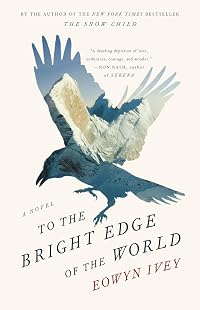
To the Bright Edge of the World
by Eowyn Ivey
On This Page
Description
An atmospheric, transporting tale of adventure, love, and survival from the bestselling author of The Snow Child, finalist for the Pulitzer Prize. One of the Best Books of 2016--Amazon A Washington Post Notable Book of 2016 A Goodreads Choice Award Nominee A Library Journal Top 10 Book of 2016 A BookPage Best Book of 2016 In the winter of 1885, decorated war hero Colonel Allen Forrester leads a small band of men on an expedition that has been deemed impossible: to venture up the Wolverine show more River and pierce the vast, untamed Alaska Territory. Leaving behind Sophie, his newly pregnant wife, Colonel Forrester records his extraordinary experiences in hopes that his journal will reach her if he doesn't return--once he passes beyond the edge of the known world, there's no telling what awaits him. The Wolverine River Valley is not only breathtaking and forbidding but also terrifying in ways that the colonel and his men never could have imagined. As they map the territory and gather information on the native tribes, whose understanding of the natural world is unlike anything they have ever encountered, Forrester and his men discover the blurred lines between human and wild animal, the living and the dead. And while the men knew they would face starvation and danger, they cannot escape the sense that some greater, mysterious force threatens their lives. Meanwhile, on her own at Vancouver Barracks, Sophie chafes under the social restrictions and yearns to travel alongside her husband. She does not know that the winter will require as much of her as it does her husband, that both her courage and faith will be tested to the breaking point. Can her exploration of nature through the new art of photography help her to rediscover her sense of beauty and wonder? The truths that Allen and Sophie discover over the course of that fateful year change both of their lives--and the lives of those who hear their stories long after they're gone--forever. show lessTags
Recommendations













Member Recommendations
pamelahuffman By the same author. Also set in Alaska. Also has some magical realism which is presented as more real than magic. Thoroughly enjoyed both.
30
pamelahuffman Narrative is split between male and female protagonists in both stories. Males are out in the world while women struggle on the home front. Loved both.
30
pamelahuffman In both books there are people in the present trying to make sense of journals and artifacts from the past. Loved both books.
30
Member Reviews
Alaska, 1885, and Lt Colonel Allen Forrester has left his new wife Sophie behind in Vancouver as he leads an expedition deep into the heart of uncharted territory. His small team and both aided and hindered by the native people they meet and have to fight against nature in the form of ice and snow, rocks and water. Meanwhile Sophie copes with loss by deepening her interest in nature and learning photography.
In itself this would be a wonderful book, the story of two people separated by circumstance and trying to get back together but it is so much more. An elegy to the wide and bleak expanses of Alaska, a study of lost peoples and their culture and brought into relief by the communication between a relative of Forrester and a museum show more curator contrasting their modern lives with those of the past. What I so disliked about Ivey’s first novel ‘The Snow Child’, the magical dreamy element is still present here but it is played so subtly that it feels integral to the story. This book works on so many levels and is a joy to read – a pity I devoured it so quickly because I was left wanting more. show less
In itself this would be a wonderful book, the story of two people separated by circumstance and trying to get back together but it is so much more. An elegy to the wide and bleak expanses of Alaska, a study of lost peoples and their culture and brought into relief by the communication between a relative of Forrester and a museum show more curator contrasting their modern lives with those of the past. What I so disliked about Ivey’s first novel ‘The Snow Child’, the magical dreamy element is still present here but it is played so subtly that it feels integral to the story. This book works on so many levels and is a joy to read – a pity I devoured it so quickly because I was left wanting more. show less
In an expedition loosely based on one undertaken by Lieutenant Henry T. Allen in 1885, the fictitious Lieutenant Colonel Allen Forrester and two subordinates intend to travel up the Wolverine River to find a Northwest passage in Alaska. The river route has been attempted before, but failed due to either impassable terrain or hostile natives. As if these challenges were not enough, Forrester is confronted with fantastical events his logical mind refuses to accept, and Lieutenant Pruitt is haunted by his role in the Elk Creek massacre. Meanwhile, back at the Vancouver Barracks in Washington Territory, Allen's wife Sophie is dealing with challenges of her own.
Their stories are told through their diaries, a few letters between them, and show more some official correspondence regarding the expedition. This epistolary style works well, allowing both Allen and Sophie to relate their experiences in the first person. This timeline is encapsulated by correspondence between Walter, an elderly descendant of Sophie's, and Josh, a young Alaskan museum curator to whom Walter wants to entrust the diaries. Although it may sound complicated, it reads smoothly and the layers of narratives allows for interpretation and perspective. For example, Josh and Walter are able to discuss the differences between Allen's diaries and his official reports, the impact the expedition had on the native peoples, and cultural loss.
Allen's story is one of adventure interspersed with Athabaskan myths. Although I was familiar with some of the stories, such as those of Old Man Raven, others were new, and I went online to learn more about the Fog Woman and The Spruce Tree Man. Sophie's story was no less compelling, and she may have been the more developed character, with a better-developed back story and more introspective writing. She is a naturalist and photographer in an age where both are seen as male occupations, and her intelligence and desire for self-determination make her interactions with the other officers′ wives and the post doctor complicated.
I loved Eowyn Ivey′s first novel, [The Snow Child], and was not disappointed with her second, although Snow Child is still my favorite. I was immediately drawn into this story, but felt things bog down a bit, before I was swept back into it. I think Ivey′s strengths are her characters and her ability to integrate myth and fairy tales into her plots. Her deft handling of the epistolary style in this book reminds me of [Daniel Stein, Interpreter: A Novel in Documents] by Ludmila Ulitskaya. After only two novels, Ivey feels like not only an accomplished writer, but also one with a distinctive style, and I look forward to her next work. show less
Their stories are told through their diaries, a few letters between them, and show more some official correspondence regarding the expedition. This epistolary style works well, allowing both Allen and Sophie to relate their experiences in the first person. This timeline is encapsulated by correspondence between Walter, an elderly descendant of Sophie's, and Josh, a young Alaskan museum curator to whom Walter wants to entrust the diaries. Although it may sound complicated, it reads smoothly and the layers of narratives allows for interpretation and perspective. For example, Josh and Walter are able to discuss the differences between Allen's diaries and his official reports, the impact the expedition had on the native peoples, and cultural loss.
Allen's story is one of adventure interspersed with Athabaskan myths. Although I was familiar with some of the stories, such as those of Old Man Raven, others were new, and I went online to learn more about the Fog Woman and The Spruce Tree Man. Sophie's story was no less compelling, and she may have been the more developed character, with a better-developed back story and more introspective writing. She is a naturalist and photographer in an age where both are seen as male occupations, and her intelligence and desire for self-determination make her interactions with the other officers′ wives and the post doctor complicated.
I loved Eowyn Ivey′s first novel, [The Snow Child], and was not disappointed with her second, although Snow Child is still my favorite. I was immediately drawn into this story, but felt things bog down a bit, before I was swept back into it. I think Ivey′s strengths are her characters and her ability to integrate myth and fairy tales into her plots. Her deft handling of the epistolary style in this book reminds me of [Daniel Stein, Interpreter: A Novel in Documents] by Ludmila Ulitskaya. After only two novels, Ivey feels like not only an accomplished writer, but also one with a distinctive style, and I look forward to her next work. show less
The truth is, I was aware of this book even before it came out because I adored Ivey's first book so much. But because the premise of this one didn't sound particularly appealing--I'm super-picky about historical fiction and don't read it all that often--I just didn't pick it up. But then I read Ivey's most recent book, and decided I had to try this one.
I'm so, so glad I did. This may be my favorite of Ivey's works now, though I've loved all of them.
To the Bright Edge of the World uses the epistolary form to the absolute pinnacle of its potential, focusing on the diaries and letters kept by husband and wife as he explores Alaska and she waits at home for him and attempts to learn photography while also dealing with personal matters and show more the sexism of the mid to late 1800s. Meanwhile, though, Ivey also brings in news clippings (perhaps expectedly) and, more importantly, some few letters from others, which I won't say more about for fear of ruining the surprise--but they add to the story wonderfully. Meanwhile, though, Ivey's gorgeous writing allows us to get to know the characters through their letters and diaries, and the form makes for fast reading which is all the more powerful as a result.
I absolutely adored this book. show less
I'm so, so glad I did. This may be my favorite of Ivey's works now, though I've loved all of them.
To the Bright Edge of the World uses the epistolary form to the absolute pinnacle of its potential, focusing on the diaries and letters kept by husband and wife as he explores Alaska and she waits at home for him and attempts to learn photography while also dealing with personal matters and show more the sexism of the mid to late 1800s. Meanwhile, though, Ivey also brings in news clippings (perhaps expectedly) and, more importantly, some few letters from others, which I won't say more about for fear of ruining the surprise--but they add to the story wonderfully. Meanwhile, though, Ivey's gorgeous writing allows us to get to know the characters through their letters and diaries, and the form makes for fast reading which is all the more powerful as a result.
I absolutely adored this book. show less
Each time I turn these brittle pages, and imagine the Colonel camped right outside my window, writing by campfire, meeting the first people of this land, it feels like time has collapsed and the past is happening now. This is what made me fall in love with history.
For my part, this is what made me fall in love with this story. Ivey has such a knack for time travel that not only did I feel the story rolling out before me, like watching it on a movie screen, but simultaneously felt myself part of the story she told. I was in the 19th Century Alaska wilderness, encountering strange new creatures, of this world, and the one beyond the veil; I was part of the blood, sweat and terror that it took to be brave enough to strap a pack on your show more back, and set out to explore the unknown, in a time when all you had to rely on for safety and protection, were your wits, the goodwill of your companions, and the benevolence of those in hitherto-unknown cultures.
As much as I was firmly in place, reading the thoughts of Lt. Col. Allen Forrester, and walking beside him, I was also in Sophie Forrester's heart and mind:
It is past dark now, and I shiver beneath the covers and long for sleep. A gale whips the fir trees around the cabin and sleet pecks at the window; I think the dreary weather must account for some of my restlessness. This bed was never so cold and empty when Allen was here. Even with Charlotte tucked in across the hall, I feel wholly alone. The house creaks and groans, and I hear some board or branch outside that knocks in the wind. I do not usually possess a fearful imagination, but I could almost expect a "rapping at my chamber door."
Ivey paints a world so vividly, I hear the echoes of Shakespeare's Tempest, reaching out through time:
O wonder!
How many goodly creatures are there here!
How beauteous mankind is! O brave new world
That has such people in't!
I hear it in a way that I've never quite heard before. The wilderness talks to me in a voice refulgent with magic and alchemy; with divination and superstition; with sorcery and mysticism, and I believe every word.
And poetry. Such lovely and luminous thoughts depicted with the dexterous hand of Blake:
Have you ever seen the nest of a humming bird? She would march to Kingdom Come in search of one, the Colonel says. He is bemused & clumsy in his affection. He cannot comprehend how she should find so much in that small hold. He is neither blessed nor cursed with a poet's heart.
He does not see. In the palm of the hand, such a nest might become Mr. Blake's wildflower. Infinity, all of Eternity, collapsed like damp foetal feathers inside a thimble egg.
Auguries. Heaven. Or Hell. Joy. Or Woe. Victory. Birth. Death. Defeat. All told in a raven's cry, a vulture's flight. Can I recall those signs of Innocence? The babe that weeps. A skylark wounded in the wing. All Heaven in a rage. ... the lines escape me.
One reading is barely enough for this work. It should be read again and again, in order to fully appreciate all that is here. The beauty of it is, one can dip into it, in parts, given its diary form, and take out gold nuggets to ponder at random, without losing anything of the whole.
Ivey must have travelled back in time, on a raven's wing, to portray such convincing and authentic voices. She never offers easy resolutions and never whitewashes the truth into political correctness.
While it is a very easy read, it is not an easy book: all warning goes out that if you think you've understood it all first time around, -- you are a poet, and a wise soul, in your own right, beyond compare. show less
For my part, this is what made me fall in love with this story. Ivey has such a knack for time travel that not only did I feel the story rolling out before me, like watching it on a movie screen, but simultaneously felt myself part of the story she told. I was in the 19th Century Alaska wilderness, encountering strange new creatures, of this world, and the one beyond the veil; I was part of the blood, sweat and terror that it took to be brave enough to strap a pack on your show more back, and set out to explore the unknown, in a time when all you had to rely on for safety and protection, were your wits, the goodwill of your companions, and the benevolence of those in hitherto-unknown cultures.
As much as I was firmly in place, reading the thoughts of Lt. Col. Allen Forrester, and walking beside him, I was also in Sophie Forrester's heart and mind:
It is past dark now, and I shiver beneath the covers and long for sleep. A gale whips the fir trees around the cabin and sleet pecks at the window; I think the dreary weather must account for some of my restlessness. This bed was never so cold and empty when Allen was here. Even with Charlotte tucked in across the hall, I feel wholly alone. The house creaks and groans, and I hear some board or branch outside that knocks in the wind. I do not usually possess a fearful imagination, but I could almost expect a "rapping at my chamber door."
Ivey paints a world so vividly, I hear the echoes of Shakespeare's Tempest, reaching out through time:
O wonder!
How many goodly creatures are there here!
How beauteous mankind is! O brave new world
That has such people in't!
I hear it in a way that I've never quite heard before. The wilderness talks to me in a voice refulgent with magic and alchemy; with divination and superstition; with sorcery and mysticism, and I believe every word.
And poetry. Such lovely and luminous thoughts depicted with the dexterous hand of Blake:
Have you ever seen the nest of a humming bird? She would march to Kingdom Come in search of one, the Colonel says. He is bemused & clumsy in his affection. He cannot comprehend how she should find so much in that small hold. He is neither blessed nor cursed with a poet's heart.
He does not see. In the palm of the hand, such a nest might become Mr. Blake's wildflower. Infinity, all of Eternity, collapsed like damp foetal feathers inside a thimble egg.
Auguries. Heaven. Or Hell. Joy. Or Woe. Victory. Birth. Death. Defeat. All told in a raven's cry, a vulture's flight. Can I recall those signs of Innocence? The babe that weeps. A skylark wounded in the wing. All Heaven in a rage. ... the lines escape me.
One reading is barely enough for this work. It should be read again and again, in order to fully appreciate all that is here. The beauty of it is, one can dip into it, in parts, given its diary form, and take out gold nuggets to ponder at random, without losing anything of the whole.
Ivey must have travelled back in time, on a raven's wing, to portray such convincing and authentic voices. She never offers easy resolutions and never whitewashes the truth into political correctness.
While it is a very easy read, it is not an easy book: all warning goes out that if you think you've understood it all first time around, -- you are a poet, and a wise soul, in your own right, beyond compare. show less
To The Bright Edge of the World has over a 4-star rating on Goodreads, so I am in the minority here, but I didn't end up liking the story nearly as much as I hoped.
While The Snow Child by Eowyn Ivey is still on my shelf unread, I feel like a know enough about how that particular story translated to some of my friends, and I am quite drawn to what promises to be a suspenseful story full of mysticism. To The Bright Edge of the Future sounded like it promised the same level of promise, so I took a chance, like I so often do.
I loved the writing. The story is compiled to include journal entries from Colonel Allen Forrester as he navigates a government commissioned expedition through unmapped portions of Alaska, diary entries from his wife show more Sophia, pictures, illustrations, letters, and clips from various other documents. Eowyn Ivey has a talent for writing such documents to create a vivid picture, and creates a beautiful story in some aspects, but it wasn't enough for me.
The difficulty that I had was that the story is based heavily on real life events of an Alaska expedition that took place in 1885, led by Henry T. Allen. The author did her research, but I don't at all care for the way in which she used the information. This book could have been more mystical, or it could have been written as a straight up nonfiction, but instead it is a fence sitter.
My recommendation is that if you are looking for a thought provoking story filled with interesting lore, look elsewhere. If you are interesting in the early exploration of Alaska, go read nonfiction. A good possibility might by Exploration of Alaska 1865- 1900 by Morgan Sherwood. show less
While The Snow Child by Eowyn Ivey is still on my shelf unread, I feel like a know enough about how that particular story translated to some of my friends, and I am quite drawn to what promises to be a suspenseful story full of mysticism. To The Bright Edge of the Future sounded like it promised the same level of promise, so I took a chance, like I so often do.
I loved the writing. The story is compiled to include journal entries from Colonel Allen Forrester as he navigates a government commissioned expedition through unmapped portions of Alaska, diary entries from his wife show more Sophia, pictures, illustrations, letters, and clips from various other documents. Eowyn Ivey has a talent for writing such documents to create a vivid picture, and creates a beautiful story in some aspects, but it wasn't enough for me.
The difficulty that I had was that the story is based heavily on real life events of an Alaska expedition that took place in 1885, led by Henry T. Allen. The author did her research, but I don't at all care for the way in which she used the information. This book could have been more mystical, or it could have been written as a straight up nonfiction, but instead it is a fence sitter.
My recommendation is that if you are looking for a thought provoking story filled with interesting lore, look elsewhere. If you are interesting in the early exploration of Alaska, go read nonfiction. A good possibility might by Exploration of Alaska 1865- 1900 by Morgan Sherwood. show less
Eowyn Ivey's second novel, To the Bright Edge of the World, in an impressive feat. This epistolary novel shows considerable research and passion for the subjects. Personally, I'm not a big fan of correspondence-based novels. Often, I find it is poorly done—authors too often rely on giving information that they wouldn't share or need to share with the recipient, all for the sake of advancing the plot. I roll my eyes every time. I guess you could say it's a pet peeve.
Had I known To the Bright Edge of the World was an epistolary novel before I picked it up, I might have delayed my read. I liked Ivey's previous work, The Snow Child, immensely, but not enough to suffer through four hundred pages of fictitious documents. But Ivey does it show more flawlessly. She truly gets into the minds of her characters and writes as they would have. She trusts her readers to discover what was left unsaid and to piece it all together to make a plot. The different periods and perspectives all come together to create a rather engaging read.
That said, I'm still not a fan of the epistolary novel. To the Bright Edge of the World is such a fantastic example of how it can be done well, but I didn't fall in love. For me, stories with an overly present narrator force me to take a step back from the tale, and that's exactly what happened here. I enjoyed the characters and scenery (Oh, the setting of this one!) from a distance, but never felt fully committed. show less
Had I known To the Bright Edge of the World was an epistolary novel before I picked it up, I might have delayed my read. I liked Ivey's previous work, The Snow Child, immensely, but not enough to suffer through four hundred pages of fictitious documents. But Ivey does it show more flawlessly. She truly gets into the minds of her characters and writes as they would have. She trusts her readers to discover what was left unsaid and to piece it all together to make a plot. The different periods and perspectives all come together to create a rather engaging read.
That said, I'm still not a fan of the epistolary novel. To the Bright Edge of the World is such a fantastic example of how it can be done well, but I didn't fall in love. For me, stories with an overly present narrator force me to take a step back from the tale, and that's exactly what happened here. I enjoyed the characters and scenery (Oh, the setting of this one!) from a distance, but never felt fully committed. show less
Although they share the same setting of Alaska, To The Bright Edge of the World by Eowyn Ivey is very different from her first book, The Snow Child. This second book tells the story of a husband and wife, separated by circumstances yet both describing their new experiences in the form of journal entries. The story is further enhanced by other letters, newspaper articles and photographs that gives this tale a cohesiveness and brings the reader a true sense of learning more about the history of Alaska.
The author has replaced the charm and lightness of The Snow Child with a more adventurous story of discovery and survival, as Col. Allen Forrester leads a small expedition up the unexplored Wolverine River into the heart of Alaska. He show more leaves behind his pregnant wife, Sophie, who chafes under the restrictions of being female when she also longs to out in the frontier. She takes up the new art of photography which opens up a whole new world of nature for her to explore. Ivey hasn’t totally abandoned the magical qualities that she sprinkles throughout her writing bit in this book she uses Indian folklore and mythical legends to bring that unexpected wonder to the story.
To The Bright Edge of the World is a great adventure story with a compelling plot and a fantastic setting that the author delivers with exceptional writing skill. This is an epic story that captures the big picture with it’s sweeping vistas yet also hones in on the small details that makes this book also a touching love story. show less
The author has replaced the charm and lightness of The Snow Child with a more adventurous story of discovery and survival, as Col. Allen Forrester leads a small expedition up the unexplored Wolverine River into the heart of Alaska. He show more leaves behind his pregnant wife, Sophie, who chafes under the restrictions of being female when she also longs to out in the frontier. She takes up the new art of photography which opens up a whole new world of nature for her to explore. Ivey hasn’t totally abandoned the magical qualities that she sprinkles throughout her writing bit in this book she uses Indian folklore and mythical legends to bring that unexpected wonder to the story.
To The Bright Edge of the World is a great adventure story with a compelling plot and a fantastic setting that the author delivers with exceptional writing skill. This is an epic story that captures the big picture with it’s sweeping vistas yet also hones in on the small details that makes this book also a touching love story. show less
Members
- Recently Added By
Lists

ALA The Reading List
490 works; 28 members

Best Books About Journeys and Quests
117 works; 30 members

Top Five Books of 2017
757 works; 230 members

2017 Notable Books for Adults
26 works; 5 members

Willoyd's Tour of the USA
25 works; 1 member

Books Read in 2016
4,666 works; 197 members

Books Read in 2023
5,547 works; 145 members
Kirkus Starred Fiction Reviews of Books Published in 2016
63 works; 3 members

Netgalley Reads
460 works; 3 members

Books Read in 2022
5,168 works; 111 members

Books Read in 2018
4,360 works; 110 members

Recommended Nature Writing
346 works; 180 members

Books about/set in Alaska
51 works; 12 members

Favorite Epistolary Fiction
143 works; 144 members

Literary Travelogue of the United States Challenge
133 works; 6 members

Books We Couldn't Put Down
443 works; 197 members

Top Five Books of 2023
767 works; 317 members

Books Read 2026
21 works; 1 member
Author Information

7+ Works 7,289 Members
Some Editions
Awards and Honors
Awards
Common Knowledge
- Canonical title
- To the Bright Edge of the World
- Original title
- To the Bright Edge of the World
- Original publication date
- 2016-08-02
- People/Characters
- Lieutenant Colonel Allen Forrester; Sophie Forrester; Lieutenant Andrew Pruitt; Sergeant Bradley Tillman; Wesley Jenson; William Samuelson (show all 22); The Old Man; Nat'aaggi; General Haywood; Mrs Haywood; Evelyn Haywood; Mrs Connor; Sarah Whithers; Charlotte MacCarthy; Dr Randall; Joe MacGillivray; Henry Redington; Ceeth Hwya; Mrs Lowe; Walter Forrester; Joshua Sloan; Moses Picea
- Important places
- Vancouver Barracks, Washington Territory, USA; Perkins Island, Alaska, USA; Wolverine River Valley, Alaska, USA; Wolverine Mountain, Alaska, USA
- Epigraph
- I looked directly into its eyes and knew that I understood nothing.
Richard K. Nelson on seeing an Alaska wolverine, Make Prayers to the Raven - First words
- Mr. Sloan, I warned you I am a stubborn old man.
- Quotations
- All that matters is how a man lives in this world.
You have an eye for the extraordinary, Sophie. It makes me wish all the more that you could have seen Alaska, only without our hardships, for I believe you would have spied something beyond what my poor senses could fathom. I... (show all) found myself inadequate in the face of it. Only now, as I leave these shores behind, do I begin to try to comprehend: gray rivers that roar down from the glaciers, mountains & spruce valleys as far as the eye can see. It is a grand, inscrutable wildness. Never are the people here allowed to forget that each of us is alive only by a small thread. - Last words
- (Click to show. Warning: May contain spoilers.)Now through June 1, more than 100 of Mrs. Forrester's photographs will be on display at the Anderson Museum of Art.
- Publisher's editor
- Arthur, Reagan; Harrington, Mary-Anne
- Original language
- English
- Canonical DDC/MDS
- 813.6
- Canonical LCC
- PS3609.V54
Classifications
Statistics
- Members
- 1,323
- Popularity
- 18,214
- Reviews
- 89
- Rating
- (4.10)
- Languages
- 6 — Dutch, English, Finnish, French, German, Swedish
- Media
- Paper, Audiobook, Ebook
- ISBNs
- 29
- ASINs
- 7