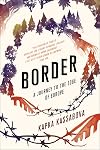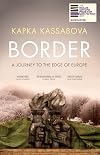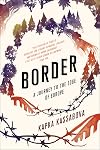
Border: A Journey to the Edge of Europe
by Kapka Kassabova
On This Page
Description
"In this extraordinary work of narrative reportage, Kapka Kassabova returns to Bulgaria, from where she emigrated as a girl twenty-five years previously, to explore the border it shares with Turkey and Greece. When she was a child, the border zone was rumored to be an easier crossing point into the West than the Berlin Wall, and it swarmed with soldiers and spies. On holidays in the "Red Riviera" on the Black Sea, she remembers playing on the beach only miles from a bristling electrified show more fence whose barbs pointed inward toward the enemy: the citizens of the totalitarian regime. Kassabova discovers a place that has been shaped by successive forces of history: the Soviet and Ottoman empires, and, older still, myth and legend. Her exquisite portraits of fire walkers, smugglers, treasure hunters, botanists, and border guards populate the book. There are also the ragged men and women who have walked across Turkey from Syria and Iraq. But there seem to be nonhuman forces at work here too: This densely forested landscape is rich with curative springs and Thracian tombs, and the tug of the ancient world, of circular time and animism, is never far off."--Amazon.com. show lessTags
Recommendations









Member Reviews
During Kapka Kassabova's childhood, Bulgaria's southern border was part of the Iron Curtain, a mysterious and deadly zone, out of bounds to everyone except border guards and a few specially vetted and supervised shepherds and foresters, a place where desperate East Germans would make futile attempts to escape to the West under the pretext of beach holidays by the Black Sea. Now it's the southern frontier of the European Union, the point where desperate people from countries like Syria are trying to get in.
Kassabova returns to the region to explore this border, from both sides, visiting the Strandja mountains on the Black Sea coast, the Rhodope mountains in the west, and the Thracian plain around Edirne (Adrianople) in between the two. show more This isn't the kind of travel book that has a lot of actual travel in it, though: she is more interested in people and their stories than in scenery or buildings, so she takes the time to stay where she is, sit in cafés, and let the locals come and talk to her. She finds out about local practices and beliefs that seem to go back a long way before Christianity and Islam (firewalking, divination, sacred springs, etc.), about smugglers, treasure-hunters and former border guards, about the region's many minority groups, and about the uncountable individual human tragedies that go with the "bigger historical picture", from the pre-WWI Balkan Wars and the Treaty of Lausanne right through to Bulgaria's forced de-islamisation programme of the late eighties and the Syrian refugee crisis that was at its height while she was researching this book.
Fascinating, and very engaging writing. The tone and emphasis are quite different, but there was a lot of overlap of interest and sympathies that made me think of Paddy Leigh Fermor's Roumeli. show less
Kassabova returns to the region to explore this border, from both sides, visiting the Strandja mountains on the Black Sea coast, the Rhodope mountains in the west, and the Thracian plain around Edirne (Adrianople) in between the two. show more This isn't the kind of travel book that has a lot of actual travel in it, though: she is more interested in people and their stories than in scenery or buildings, so she takes the time to stay where she is, sit in cafés, and let the locals come and talk to her. She finds out about local practices and beliefs that seem to go back a long way before Christianity and Islam (firewalking, divination, sacred springs, etc.), about smugglers, treasure-hunters and former border guards, about the region's many minority groups, and about the uncountable individual human tragedies that go with the "bigger historical picture", from the pre-WWI Balkan Wars and the Treaty of Lausanne right through to Bulgaria's forced de-islamisation programme of the late eighties and the Syrian refugee crisis that was at its height while she was researching this book.
Fascinating, and very engaging writing. The tone and emphasis are quite different, but there was a lot of overlap of interest and sympathies that made me think of Paddy Leigh Fermor's Roumeli. show less
Kapka Kassabova now lives in Scotland and before that resided in New Zealand, but she was not born in these places. Twenty-five years ago she left Bulgaria as a teenager and in this book she returns to her home country. In her childhood, the border between Bulgaria, Turkey and Greece was part of the Iron Curtain. A few miles from where she played on the beach was the physical barrier, an electric fence whose sharpest barbs were directed at the real enemy; its own people. It had the reputation of being an easier point to cross over to the West than further North and therefore the woods and valleys crawled with soldiers and spies after those people seeking freedom.
The recent past is just a small part of the long history of this region. show more Kassabova travels around the region talking to border guards, fire walkers and treasure hunters as well as meeting the disposed and displaced who have made their way from Iraq and Syria. These refugees have walked away from the horrors of war with only the clothes on their back in search of freedom and a new life. There is much more to this landscape that the modern borders sit uncomfortably on top of. Peeling back the layers of past in the dense forests, she travels to springs that have deep pagan roots and are still considered to have healing qualities and visits tombs that add an ancient dimension to the land.
'It is not for everyone', Nevzat agreed, but I could see that he loved these villages. He and Mr Karadeniz resonated with the ruinous beauty of this landscape. Because they were its children.
This book is primarily about people of the region as well as the places they inhabit. Kassabova meets and speaks to the people in villages who are seeing their populations plummet and the buildings crumble around them. However, this is not just about those that live in the region; but she is prepared to share a coffee or a meal with those that are waiting before passing through to other places, shining a light on the current refugee crisis that is prompting the rise of nationalism in Europe. Most impressive though is Kassabova’s writing; it is elegant and lyrical with a beautiful haunting melancholy about it, immersing you, the reader, in the landscape. Just, quite a wonderful book really. 4.5 stars show less
The recent past is just a small part of the long history of this region. show more Kassabova travels around the region talking to border guards, fire walkers and treasure hunters as well as meeting the disposed and displaced who have made their way from Iraq and Syria. These refugees have walked away from the horrors of war with only the clothes on their back in search of freedom and a new life. There is much more to this landscape that the modern borders sit uncomfortably on top of. Peeling back the layers of past in the dense forests, she travels to springs that have deep pagan roots and are still considered to have healing qualities and visits tombs that add an ancient dimension to the land.
'It is not for everyone', Nevzat agreed, but I could see that he loved these villages. He and Mr Karadeniz resonated with the ruinous beauty of this landscape. Because they were its children.
This book is primarily about people of the region as well as the places they inhabit. Kassabova meets and speaks to the people in villages who are seeing their populations plummet and the buildings crumble around them. However, this is not just about those that live in the region; but she is prepared to share a coffee or a meal with those that are waiting before passing through to other places, shining a light on the current refugee crisis that is prompting the rise of nationalism in Europe. Most impressive though is Kassabova’s writing; it is elegant and lyrical with a beautiful haunting melancholy about it, immersing you, the reader, in the landscape. Just, quite a wonderful book really. 4.5 stars show less
I thought this was exquisite. Then again I am most interested in borders and liminal spaces, regular people, and consequences over time. I would never class this as a travelogue, just a narrative that happens to take place during a journey. Highly recommended if you know your own tastes and how much they overlap with mine.
Part travel memoir, part mediation on borders, Kassabova's book is an exploration of the people, geography, and history of the borders between Turkey, Greece, and Bulgaria. This is well written and the material is well presented, but I never quite settled into it. While Kassabova does explore history further back than the Cold War and does discuss the geography of the place, I was hoping for something that was more evenly balanced. This felt Cold War, Cold War, Cold War, to me, and that is not a criticism as such but rather just the reason *I* got impatient with it. It was also far more unsettling than I was in a place to sit with right now. I probably would have enjoyed the book more at a different time.
I read this with my book club, show more and the other members all liked it much more than I did, some very much. So YMMV considerably. show less
I read this with my book club, show more and the other members all liked it much more than I did, some very much. So YMMV considerably. show less
Joy's Review: Kassaboya spends at least a year exploring the borders between Bulgaria, Turkey, and Greece. She tells of her experiences, history, myths, and personal stories of those she meets with incredibly descriptive, beautiful language. A part of the world that I know little about, Kassavoba describes a deep and varied history from empires to nations and hardships upon hardships. What a wonderful book! I plan to read it again.
Let me start out by saying that I absolutely loved this book. Ms. Kassabova is a staggeringly talented narrative storyteller, and her account of the history and happenings in the Bulgarian/Greek/Turkish area are informative and interesting. Her cast of locals with whom she travels and gets to know add much to the texture and depth of her book, which is well worth your time and attention. I'm pretty sure that I blew through it in three days of solid reading, as once I jumped in, I just made coffee and kept reading.
A fabulous book with exquisite writing and fresh language. No surprise that she was a poet first.
A few minor examples:
“The land was pale and exhausted with winter.”
“… a sleepy Greek border town. From its outskirts you could see [the town of] Edirne, spread out like a concubine in the haze.”
“… the people-darkened streets led to the market like arteries to a beating heart.”
And English is not even her native language.
The author grew up in Soviet-aligned Bulgaria and moved with her family to New Zealand in the early 90s after the collapse of the Soviet Union. In the mid-2010s, she traveled to towns on both sides of the border, met many locals with stories to tell, and explored the history of the region.
Especially disturbing show more were the escape attempts from the Iron Curtain, from Bulgaria and East Germany, across the mountainous border into Greece and Turkey. Many who fled were caught before crossing and executed.
She is a master writer. And now I want to read more of her work.
Highly recommended!
P.S. The book includes an excellent hand-drawn map that usually sufficed without going to Google Maps. show less
A few minor examples:
“The land was pale and exhausted with winter.”
“… a sleepy Greek border town. From its outskirts you could see [the town of] Edirne, spread out like a concubine in the haze.”
“… the people-darkened streets led to the market like arteries to a beating heart.”
And English is not even her native language.
The author grew up in Soviet-aligned Bulgaria and moved with her family to New Zealand in the early 90s after the collapse of the Soviet Union. In the mid-2010s, she traveled to towns on both sides of the border, met many locals with stories to tell, and explored the history of the region.
Especially disturbing show more were the escape attempts from the Iron Curtain, from Bulgaria and East Germany, across the mountainous border into Greece and Turkey. Many who fled were caught before crossing and executed.
She is a master writer. And now I want to read more of her work.
Highly recommended!
P.S. The book includes an excellent hand-drawn map that usually sufficed without going to Google Maps. show less
Members
- Recently Added By
Lists

Top Five Books of 2018
802 works; 265 members

Best Travel Writing - Non-Fiction
110 works; 6 members

Review 2
36 works; 1 member

Books Read in 2018
4,360 works; 110 members
Not the NYT list of top 100 21st century books
100 works; 6 members
Author Information

19+ Works 888 Members
Kapka Kassabova is the author of three poetry collections, the novel Villa Pacifica, and the acclaimed memoirs Street Without a Name: Childhood and Other Misadventures in Bulgaria, and Twelve Minutes of Love: A Tango Story. She lives in Scotland.
Awards and Honors
Awards
Distinctions
The Guardian Book of the Day (2017-02-08)
The Guardian Book of the Day (2017-02-05)
Common Knowledge
- Canonical title
- Border: A Journey to the Edge of Europe
- Original publication date
- 2017
- Important places
- Bulgaria; Balkans; Strandja; Greece; Turkey; Edirne, Turkey (show all 8); Svilengrad, Bulgaria; Harmanli, Bulgaria
- Original language
- English UK
Classifications
- Genres
- Travel, Nonfiction, General Nonfiction, Biography & Memoir
- DDC/MDS
- 949.903 — History & geography History of Europe Greece, Albania, Yugoslavia, Serbia, Romania, Bulgaria Bulgaria (formerly Aegean islands)
- LCC
- DR50.8 .K37 — History of Europe, Asia, Africa and Oceania Balkan Peninsula History of Balkan Peninsula Thrace
- BISAC
Statistics
- Members
- 386
- Popularity
- 81,093
- Reviews
- 16
- Rating
- (4.05)
- Languages
- English, German, Italian, Spanish
- Media
- Paper, Audiobook, Ebook
- ISBNs
- 13
- ASINs
- 5