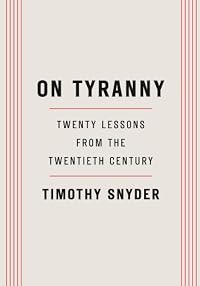
On Tyranny: Twenty Lessons from the Twentieth Century
by Timothy Snyder
On This Page
Description
#1 NEW YORK TIMES BESTSELLER • A “bracing” (Vox) guide for surviving and resisting America’s turn towards authoritarianism, from “a rising public intellectual unafraid to make bold connections between past and present” (The New York Times)“Timothy Snyder reasons with unparalleled clarity, throwing the past and future into sharp relief. He has written the rare kind of book that can be read in one sitting but will keep you coming back to help regain your bearings.”—Masha show more Gessen
The Founding Fathers tried to protect us from the threat they knew, the tyranny that overcame ancient democracy. Today, our political order faces new threats, not unlike the totalitarianism of the twentieth century. We are no wiser than the Europeans who saw democracy yield to fascism, Nazism, or communism. Our one advantage is that we might learn from their experience.
On Tyranny is a call to arms and a guide to resistance, with invaluable ideas for how we can preserve our freedoms in the uncertain years to come. show less
Tags
Recommendations




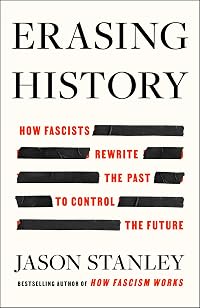
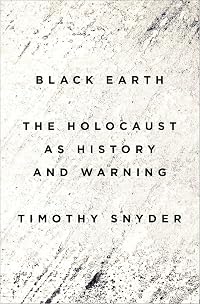
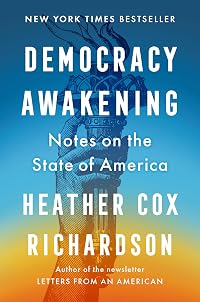
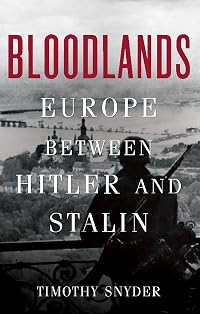





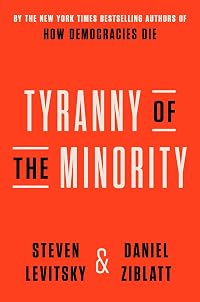


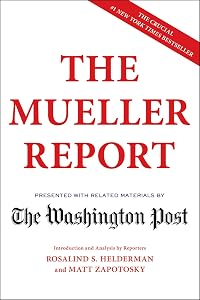
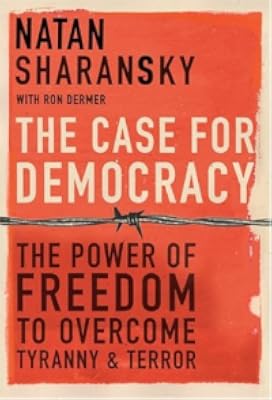
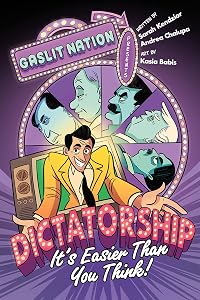
Member Recommendations
Sandwich76 A fantasy novel about the slippery slope into tyranny.
2wonderY On Tyranny is a short synopsis of the much more extensive and scholarly conclusions recorded in Black Earth.
Member Reviews
Rating: 5* of five
Not for its perfection of style but for its perfection of wisdom and its amazing timeliness. As I write this today, 24 March 2018, I saw the face of our future president in Emma Gonzalez as she stood silent, focused, determined, at a march made by young people to demand their lives be protected from ammosexual assholes. She spoke for six minutes and twenty seconds in total, the same amount of time that it took one piece of shit human being to slaughter seventeen of her classmates.
I believe that her speech...the few words, the long silence...will be the spark of the youth revolution our country so very badly needs. I am hopeful that Emma Gonzalez will be, by her very adamantine sense of self and her charismatic show more gravitas, the voice that alerts her compatriots to Author Snyder's clarion call to clarity:
The most unbelievably high stakes are at risk in the November 2018 elections. Buy this book not for yourself but for your hopes of a reasonably happy future for the United States of America, buy it in quantity and give it to everyone you know and/or can find who is under 25, and talk to them about why you're giving them this short, clear, concise, and urgently necessary book.
Your life, my life, the life of a truly great nation, depends on them showing up at the ballot box on 6 November 2018. This is neither hyperbole nor alarmism. It is simply the truth. Looking away from the horrors of the current kakistocracy's rise to any position of power higher than hall monitor at the local middle school will only ensure the brutal and vicious agenda of these lowlife scumbags and their horrifying cadres of disgustingly venal and/or stupid supporters will succeed. show less
Not for its perfection of style but for its perfection of wisdom and its amazing timeliness. As I write this today, 24 March 2018, I saw the face of our future president in Emma Gonzalez as she stood silent, focused, determined, at a march made by young people to demand their lives be protected from ammosexual assholes. She spoke for six minutes and twenty seconds in total, the same amount of time that it took one piece of shit human being to slaughter seventeen of her classmates.
I believe that her speech...the few words, the long silence...will be the spark of the youth revolution our country so very badly needs. I am hopeful that Emma Gonzalez will be, by her very adamantine sense of self and her charismatic show more gravitas, the voice that alerts her compatriots to Author Snyder's clarion call to clarity:
The politics of inevitability is a self-induced intellectual coma.
The most unbelievably high stakes are at risk in the November 2018 elections. Buy this book not for yourself but for your hopes of a reasonably happy future for the United States of America, buy it in quantity and give it to everyone you know and/or can find who is under 25, and talk to them about why you're giving them this short, clear, concise, and urgently necessary book.
Your life, my life, the life of a truly great nation, depends on them showing up at the ballot box on 6 November 2018. This is neither hyperbole nor alarmism. It is simply the truth. Looking away from the horrors of the current kakistocracy's rise to any position of power higher than hall monitor at the local middle school will only ensure the brutal and vicious agenda of these lowlife scumbags and their horrifying cadres of disgustingly venal and/or stupid supporters will succeed. show less
“You should read this.”
Those simple words ran across my mind as I finished page 126 of this wonderful book. I am no political scientist though I follow current events tightly. This book, written in 2017 in the aftermath of the election of Donald Trump, reminds us how fragile history can be. By looking at the challenges of the present, it looks at how democracy was subverted by tyranny in the twentieth century.
Snyder provides twenty lessons to readers based upon global failures of the 1900s – for example, the rise of Nazi Germany, the rise of Stalinist Russia, and the rise of Putin’s Russia. Make no mistake, this book, despite its title evoking the twentieth century, is thoroughly grounded in twenty-first-century events. It uses show more those current events as a prism to recall prior history.
This book is readable and accessible to the masses. Much as The Federalist Papers did for the US Constitution, this book attempts to do for 2016-2020. It seeks to remind us of the choices we face in the voting booth and in our lives and encourages us to make those choices with confidence. Snyder, by trade a professor of history at Yale, seeks to imprint upon us the fragility of history. As with the twentieth century, only a few wrong decisions can get us far off course.
Snyder concludes by discussing the “politics of inevitability” that seemed to envelop American discourse in the early twenty-first century. “Democracy will inevitably triumph,” these false words told us. The rise of authoritarianism in America laid bare this false creed. To remind us of our duty, the author – in a sort of jeremiad – calls us to return to the study of history in an attempt to make more history. Citing Shakespeare’s Hamlet, Snyder calls the now-informed reader to embrace the challenges of the present. Will we listen? show less
Those simple words ran across my mind as I finished page 126 of this wonderful book. I am no political scientist though I follow current events tightly. This book, written in 2017 in the aftermath of the election of Donald Trump, reminds us how fragile history can be. By looking at the challenges of the present, it looks at how democracy was subverted by tyranny in the twentieth century.
Snyder provides twenty lessons to readers based upon global failures of the 1900s – for example, the rise of Nazi Germany, the rise of Stalinist Russia, and the rise of Putin’s Russia. Make no mistake, this book, despite its title evoking the twentieth century, is thoroughly grounded in twenty-first-century events. It uses show more those current events as a prism to recall prior history.
This book is readable and accessible to the masses. Much as The Federalist Papers did for the US Constitution, this book attempts to do for 2016-2020. It seeks to remind us of the choices we face in the voting booth and in our lives and encourages us to make those choices with confidence. Snyder, by trade a professor of history at Yale, seeks to imprint upon us the fragility of history. As with the twentieth century, only a few wrong decisions can get us far off course.
Snyder concludes by discussing the “politics of inevitability” that seemed to envelop American discourse in the early twenty-first century. “Democracy will inevitably triumph,” these false words told us. The rise of authoritarianism in America laid bare this false creed. To remind us of our duty, the author – in a sort of jeremiad – calls us to return to the study of history in an attempt to make more history. Citing Shakespeare’s Hamlet, Snyder calls the now-informed reader to embrace the challenges of the present. Will we listen? show less
"When exactly was the 'again' in the slogan, 'Make America great again'? It is, sadly, the same 'again' that we find in 'Never again.'"
Timothy Snyder, a leading historian of Central and Eastern Europe, the Soviet Union, and the Holocaust, has surveyed our current political landscape and offers 20 lessons and warnings about the precipice upon which we find ourselves. Some of the parallels he draws between where we are now and where countries in Europe found themselves in the early 1930s with the rise of Fascism and the late 1940s with the spread of Communism (as well as what happened with the collapse of the USSR and the later rise of Putin) are chilling. But his overarching point is that we have the benefit of learning from history, if show more only we pay attention. To that end, I encourage everyone to read this, if you have not already. It's very short and a quick read, but one I know I will be referring to often in the years ahead.
4 stars
"When we repeat the same words and phrases that appear in the daily media, we accept the absence of a larger framework. To have such a framework requires more concepts, and having more concepts requires reading. So get the screens out of your room and surround yourself with books. The characters in Orwell's and Bradbury's books could not do this - but we still can." show less
Timothy Snyder, a leading historian of Central and Eastern Europe, the Soviet Union, and the Holocaust, has surveyed our current political landscape and offers 20 lessons and warnings about the precipice upon which we find ourselves. Some of the parallels he draws between where we are now and where countries in Europe found themselves in the early 1930s with the rise of Fascism and the late 1940s with the spread of Communism (as well as what happened with the collapse of the USSR and the later rise of Putin) are chilling. But his overarching point is that we have the benefit of learning from history, if show more only we pay attention. To that end, I encourage everyone to read this, if you have not already. It's very short and a quick read, but one I know I will be referring to often in the years ahead.
4 stars
"When we repeat the same words and phrases that appear in the daily media, we accept the absence of a larger framework. To have such a framework requires more concepts, and having more concepts requires reading. So get the screens out of your room and surround yourself with books. The characters in Orwell's and Bradbury's books could not do this - but we still can." show less
Clear, concise, intelligent, and powerful.
Coming of age in America during the Trump presidency has been an odd thing. I feel as though my generation has been flung into the political sphere because we’re surrounded by constant crisis. We have school shooter drills, we see our peers massacred on the news every month, we read about the burning earth and the sea life all choked up with plastics and we’re aware of this massive screaming chaos around us, and it seems like politics in the United States is no longer a discussion between two parties trying to incorporate plans in different ways (if ever it was), but is now a naïve moderate establishment versus a fascist death cult.
We weren’t old enough to be terribly aware of the way show more past presidencies proceeded, but we know it was nothing like this. The first national election in which we’ll be eligible to vote has an incumbent who is a literal criminal. The news tells us it wasn’t always this way, and we can remember some semblance of normalcy, times when you could talk about politics without condemning yourself to a debate about which groups of citizens should be sacrificed on the altar of corporate greed. But for the majority of our adolescence and political consciousness, Trump has been our president. We hardly remember a time when each week didn’t come with an escalation of scandal or another crime on the president’s rap sheet. We are aware that we live in a turbulent time but we feel increasingly that we’ve been told to drive across the country in a car on fire without being given the tools to put the fire out.
Books like On Tyranny are exceptionally important because they contextualise moments like this one. This is as much a guide book to standing up against authoritarianism as it is a historical explanation for why doing so is critically important. It praises humanity and connection and courage in the face of crushing apathy and terror. It feels vital now in 2020, on the brink of a crucial election that has the power to change our course or solidify a new normal. I, like many of my peers after these last long four years, am nervous, I am furious, I am disillusioned, I am ashamed, I am disgusted, I am ready for change.
And I am registered to vote. show less
Coming of age in America during the Trump presidency has been an odd thing. I feel as though my generation has been flung into the political sphere because we’re surrounded by constant crisis. We have school shooter drills, we see our peers massacred on the news every month, we read about the burning earth and the sea life all choked up with plastics and we’re aware of this massive screaming chaos around us, and it seems like politics in the United States is no longer a discussion between two parties trying to incorporate plans in different ways (if ever it was), but is now a naïve moderate establishment versus a fascist death cult.
We weren’t old enough to be terribly aware of the way show more past presidencies proceeded, but we know it was nothing like this. The first national election in which we’ll be eligible to vote has an incumbent who is a literal criminal. The news tells us it wasn’t always this way, and we can remember some semblance of normalcy, times when you could talk about politics without condemning yourself to a debate about which groups of citizens should be sacrificed on the altar of corporate greed. But for the majority of our adolescence and political consciousness, Trump has been our president. We hardly remember a time when each week didn’t come with an escalation of scandal or another crime on the president’s rap sheet. We are aware that we live in a turbulent time but we feel increasingly that we’ve been told to drive across the country in a car on fire without being given the tools to put the fire out.
Books like On Tyranny are exceptionally important because they contextualise moments like this one. This is as much a guide book to standing up against authoritarianism as it is a historical explanation for why doing so is critically important. It praises humanity and connection and courage in the face of crushing apathy and terror. It feels vital now in 2020, on the brink of a crucial election that has the power to change our course or solidify a new normal. I, like many of my peers after these last long four years, am nervous, I am furious, I am disillusioned, I am ashamed, I am disgusted, I am ready for change.
And I am registered to vote. show less
One of the most overlooked aspects of this book is simply its size. It is a small format book, designed to replicate those pocket US Constitutions that some people love to whip out and wave in your face, typically when they are trying to defend their right to open carry a rocket launcher. But that format similarity is also to say that this is the book that every US student should be made to study along with the Constitution, because it details how appallingly vulnerable the US system is to an authoritarian takeover. That should not be news at this point in time, but large parts of the US population, including many liberals, still don't get it. If I started pulling out my favorite quotes form his book I would never stop, so I won't. show more Instead, just buy it, read it, learn from it, and put it into practice. Most importantly, learn lesson 1 (I'm looking at you Washington Post and LA Times): don't obey in advance. show less
I would say this book ought to be required reading for anyone in the post-trump era, to remind us not only of what is REAL but of the lessons of history. Without directly citing my favourite Santayana quote ("Those who do not learn from history are doomed to repeat it"), Snyder spells out in Twenty Lessons, exactly why this is so.
This is a book to check back with from time to time. It's a book that should be the text book and manual for students, to prepare them for the future (both high school and university students). And, if you ask me, it's a book that ought to be read with care and caution by every politician, to (hopefully) help keep them accountable for their actions. Of course, if more citizens knew more history and heeded the show more signs all around them, the *text* might not be so necessary.
And the cynic in me heaves a big sigh and says that, sadly, I think those who most need to read this, probably won't....
I thought I would include a few quotes from the book but in truth, I can't decide which, as I marked so many. So, just read it. There is good advice and good common sense and worthy values on almost every page. show less
This is a book to check back with from time to time. It's a book that should be the text book and manual for students, to prepare them for the future (both high school and university students). And, if you ask me, it's a book that ought to be read with care and caution by every politician, to (hopefully) help keep them accountable for their actions. Of course, if more citizens knew more history and heeded the show more signs all around them, the *text* might not be so necessary.
And the cynic in me heaves a big sigh and says that, sadly, I think those who most need to read this, probably won't....
I thought I would include a few quotes from the book but in truth, I can't decide which, as I marked so many. So, just read it. There is good advice and good common sense and worthy values on almost every page. show less
4/3/2018 - This is a most amazing book, so small and yet so powerful. As the American government seems to be drifting toward tyranny, Yale professor Timothy Snyder has provided a manual for how individuals might choose to proceed in an anxious time. He takes lessons from history to show that democracy is neither guaranteed nor necessarily permanent, even in the United States in the twenty-first century.
The book scared the hell out of me as well as gave me some idea of why we are at such a crossroads at this time. More important, it gave me some ideas for how to proceed. I found that I had to stop periodically to copy down many quotes. Everything the professor wrote seemed so important and true. The book left me with the feeling of how show more fragile democracy might be. show less
The book scared the hell out of me as well as gave me some idea of why we are at such a crossroads at this time. More important, it gave me some ideas for how to proceed. I found that I had to stop periodically to copy down many quotes. Everything the professor wrote seemed so important and true. The book left me with the feeling of how show more fragile democracy might be. show less
Members
- Recently Added By
Published Reviews
ThingScore 50
As social and political winds change, librarians can find themselves in a precarious position depending on the nature of this change. Professional librarians adhere, at least in theory, to the ALA Code of Ethics—a document that outlines our general philosophies on access and censorship with regard to library users. While these guidelines are general, they provide a reasonable framework for show more handling challenges we are likely to face in the normal service of our jobs. At politically fraught times, however, these guidelines serve as a critical backbone for the ethical practice of our profession. As an example, the passing of the wide-sweeping Patriot Act following the September 11 terrorist attacks created direct practical and ethical dilemmas for librarians across the county by requiring compliance with investigators’ requests for protected documents such as patron borrowing records [Full text of review available through C&RL] show less
added by jordsly
Snyder knows this subject cold...
For such a small book, Snyder invests “On Tyranny” with considerable heft...
Of course, just as I was pondering whether “On Tyranny” exaggerates, Trump tweeted that the press is the enemy of the American people. That sounds awfully pre-fascist to me. So approach this short book the same way you would a medical pamphlet warning about an infectious show more disease. Read it carefully and be on the lookout for symptoms. show less
For such a small book, Snyder invests “On Tyranny” with considerable heft...
Of course, just as I was pondering whether “On Tyranny” exaggerates, Trump tweeted that the press is the enemy of the American people. That sounds awfully pre-fascist to me. So approach this short book the same way you would a medical pamphlet warning about an infectious show more disease. Read it carefully and be on the lookout for symptoms. show less
added by 2wonderY
Snyder also tells us, somewhat unnecessarily, that we can survive tyranny by establishing a private life and staying calm when the unthinkable arrives. The creeping destruction of democracy can be stopped or reversed; it's not inevitable, as his injunction to "be as courageous as you can" implies. In this book, as in his others, Snyder provokes us to think again about major issues of our time, show more as well as significant elements of the past, but he seems to have rushed it out rather too quickly. It could do with far greater depth of historical illustration, not to mention recourse to the many thinkers whose wisdom we might profit from in dealing with the issue of tyranny and how to combat it. Democracy dies in many different ways, and to help us in defending our rights we need a more thoughtful book than this. show less
added by Cynfelyn
Lists

Guttabois
27 works; 1 member

Phi Beta Kappa reading list
260 works; 8 members

2020
21 works; 1 member

Powell's 50 Books for 50 Years
50 works; 4 members

Books Read in 2018
4,360 works; 110 members

2024-2025 Ezra Klein Guest Recommendations
213 works; 6 members

Non-Fiction
68 works; 1 member

Top Five Books of 2025
954 works; 303 members

Totalitarianism and Democratic Erosion: Essential Readings
45 works; 1 member

Political Theory
23 works; 1 member

Résister au fascisme
35 works; 2 members
Talk Discussions
Past Discussions
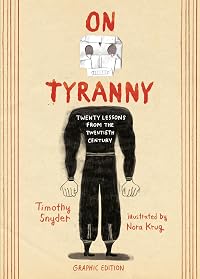
On Tyranny graphic edition in Combiners! (January 2022)
Author Information

34+ Works 12,224 Members
Some Editions
Awards and Honors
Awards
Work Relationships
Common Knowledge
- Canonical title
- On Tyranny: Twenty Lessons from the Twentieth Century
- Original title
- On Tyranny. Twenty Lessons from the Twentieth Century
- Original publication date
- 2017-02-28
- People/Characters
- Adolf Eichmann; Stanley Milgram; Wendell Phillips; Teresa Prekerowa; Hannah Arendt; Victor Klemperer (show all 17); Carl Schmitt; Vladimir Putin; Adolf Hitler; Thomas Jefferson; Joseph Stalin; Vaclav Havel; Hans Frank; Donald Trump; Winston Churchill; Eugène Ionesco; Leszek Kolakowski
- Important places
- United States of America; Germany; Nazi Germany; Soviet Union; Russia; Austria (show all 10); London, England, UK; Warsaw, Poland; Gdansk, Poland; Ukraine
- Epigraph
- In politics, being deceived is no excuse.
—Leszek Kołakowski - First words
- History does not repeat, but it does instruct.
- Quotations
- A party emboldened by a favorable election result or motivated by ideology, or both, might change the system from within.
We need paper ballots, because they cannot be tampered with remotely and can always be recounted.
For us, the lesson is that or natural fear and grief must not enable the destruction of our institutions. Courage does not mean not fearing, or not grieving. It does mean recognizing and resisting terror management right away... (show all), from the moment of the attack, precisely when it seems most difficult to do so.
Make sure you and your family have passports.
A nationalist will say that "it can't happen here," which is the first step toward a disaster. A patriot says that it could happen here, but that we will stop it.
One thing is certain: If young people do not begin to make history, politicians of eternity and inevitability will destroy it. And to make history, young Americans will have to know some. This is not the end, but a beginning.
For resistance to succeed [...] boundaries must be crossed... [P]eople must find themselves in places that are not their homes, and among groups who were not previously their friends. Protest can be organized through social m... (show all)edia, but nothing is real that does not end on the streets. If tyrants feel no consequences for their actions in the three-dimensional world, nothing will change.
On February 2, 1933, for example, a leading newspaper for German Jews published an editorial expressing this mislaid trust: We do not subscribe to the view that Mr. Hitler and his friends, now finally in possession of the pow... (show all)er they have so long desired, will implement the proposals circulating in [Nazi newspapers]; they will not suddenly deprive German Jews of their constitutional rights, nor enclose them in ghettos, nor subject them to the jealous and murderous impulses of the mob. They cannot do this because a number of crucial factors hold powers in check…and they clearly do not want to go down that road. When one acts as a European power, the whole atmosphere tends towards ethical reflection upon one’s better self and away from revisiting one’s earlier oppositional posture.
American democracy must be defended from Americans who would exploit its freedoms to bring about its end.
We believe that we have checks and balances, but have rarely faced a situation like the present: when the less popular of the two parties controls every lever of power at the federal level, as well as the majority of statehou... (show all)ses. The party that exercises such control proposes few policies that are popular with the society at large, and several that are generally unpopular—and thus must either fear democracy or weaken it.
It is impossible to carry out democratic elections, try cases at court, design and enforce laws, or indeed manage any of the other quiet business of government when agencies beyond the state also have access to violence. For ... (show all)just this reason, people and parties who wish to undermine democracy and the rule of law create and fund violent organizations that involve themselves in politics. Such groups can take the form of a paramilitary wing of a political party, the personal bodyguard of a particular politician—or apparently spontaneous citizens’ initiatives, which usually turn out to have been organized by a party or its leader.
For violence to transform not just the atmosphere but also the system, the emotions of rallies and the ideology of exclusion have to be incorporated into the training of armed guards. These first challenge the police and mili... (show all)tary, then penetrate the police and military, and finally transform the police and military.
Each story on televised news is “breaking” until it is displaced by the next one. So we are hit by wave upon wave but never see the ocean.
Some of the political and historical texts that inform the arguments made here are “Politics and the English Language” by George Orwell (1946); The Language of the Third Reich by Victor Klemperer (1947); The Origins of To... (show all)talitarianism by Hannah Arendt (1951); The Rebel by Albert Camus (1951); The Captive Mind by Czesław Miłosz (1953); “The Power of the Powerless” by Václav Havel (1978); “How to Be a Conservative-Liberal-Socialist” by Leszek Kołakowski (1978); The Uses of Adversity by Timothy Garton Ash (1989); The Burden of Responsibility by Tony Judt (1998); Ordinary Men by Christopher Browning (1992); and Nothing Is True and Everything Is Possible by Peter Pomerantsev (2014). Christians might return to the foundational book, which as ever is very timely. Jesus preached that it “is easier for a camel to go through the eye of a needle than for a rich man to enter into the kingdom of God.” We should be modest, for “whosoever shall exalt himself shall be abased; and he that shall humble himself shall be exalted.” And of course we must be concerned with what is true and what is false: “And ye shall know the truth, and the truth shall make you free.”
And now, as then, many people confused faith in a hugely flawed leader with the truth about the world we all share. Post-truth is pre-fascism.
A Nazi leader outmaneuvers his opponents by manufacturing a general conviction that the present moment is exceptional, and then transforming that state of exception into a permanent emergency. Citizens then trade real freedom... (show all) for fake safety.
For tyrants, the lesson of the Reichstag fire is that one moment of shock enables an eternity of submission. For us, the lesson is that our natural fear and grief must not enable the destruction of our institutions.
A nationalist will say that “it can’t happen here,” which is the first step toward disaster. A patriot says that it could happen here, but that we will stop it.
In the politics of eternity, the seduction by a mythicized past prevents us from thinking about possible futures. The habit of dwelling on victimhood dulls the impulse of self-correction. Since the nation is defined by its in... (show all)herent virtue rather than by its future potential, politics becomes a discussion of good and evil rather than a discussion of possible solutions to real problems. - Last words
- (Click to show. Warning: May contain spoilers.)Yet he concludes: "Nay, come, let's go together."
- Blurbers
- Applebaum, Anne; Beevor, Antony; Abrams, J.J.; Burns, Ken; Fairey, Shepard; Powell, Nate
- Original language
- English US
- Canonical DDC/MDS
- 321.9
- Canonical LCC
- JC495
- Disambiguation notice
- This work is the original, text edition of Timothy Snyder's On Tyranny (2017). Please do not combine either with the modified text Graphic Edition with Nora Krug illustrations and formatting (2021), or with the Expande... (show all)d Audiobook Edition (2022; “ Updated with Twenty New Lessons from Russia's War on Ukraine”); each of those editions have different content from this original.
Classifications
- Genres
- Politics and Government, General Nonfiction, Nonfiction, History, Philosophy
- DDC/MDS
- 321.9 — Society, government, & culture Political science Systems of governments and states Authoritarian government: Despotism, dictatorship, totalitarianism [formerly : Anarchism as political system]
- LCC
- JC495 — Political Science Political theory Political theory. The state. Theories of the state Forms of the state
- BISAC
Statistics
- Members
- 4,971
- Popularity
- 2,814
- Reviews
- 170
- Rating
- (4.18)
- Languages
- 19 — Catalan, Czech, Danish, Dutch, English, Finnish, French, German, Greek, Italian, Norwegian (Bokmål), Polish, Portuguese, Romanian, Russian, Spanish, Swedish, Turkish, Chinese, traditional
- Media
- Paper, Audiobook, Ebook
- ISBNs
- 51
- ASINs
- 12