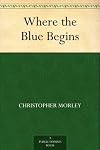
Where the Blue Begins
by Christopher Morley
On This Page
Description
Pook Press celebrates the great Golden Age of Illustration in children's literature. Many of the earliest children's books, particularly those dating back to the 1850s and before, are now extremely scarce and increasingly expensive. Pook Press are working to republish these classic works in affordable, high quality, colour editions, using the original text and artwork so these works can delight another generation of children.Tags
Recommendations















Member Reviews
Mr. Gissing, newly burdened with three foundlings, sets off to the city (New York) to make some more money. But it is also an excuse to pursue his quest to find the blue horizon that has always been out of reach, no matter how far he has walked across the meadows and hills to find it. He takes a job at a department store in the city, later joins the church as a "lay reader" where he drastically exceeds his authority, and finally finds himself a sea captain! All along the way, he excels at small things but still fails to find the spiritual fulfillment he is seeking.
Oh - and one thing I forgot to tell you - Mr. Gissing and all the other characters in the book, save perhaps one, are dogs. Why, I can't say. Other than a few references to show more paws and finding it hard to reach things, they behave just like humans. They smoke pipes, they go shopping, they drive cars, they go to church. The only hint of why Mr. Gissing must be a dog perhaps comes in his musings on the nature of god, whom he thinks, may not be a dog....
Despite its strangeness (or perhaps because of it), this is a well-written, engaging story. Mr. Gissing's success in the department store is a pretty good lesson for anyone in a service industry. After that, the story becomes pleasingly insane. There is a hilarious escape in a steamroller, and Mr. Gissing's actions after he finds himself in charge of a seagoing passenger vessel are certainly memorable. The ending of the story--until the final lines--is a little abstract and makes the reader wonder about what has happened before, but the final moral is a good one. Morley is trying to say something important here; why he chose such a strange vehicle calls for more research! show less
Oh - and one thing I forgot to tell you - Mr. Gissing and all the other characters in the book, save perhaps one, are dogs. Why, I can't say. Other than a few references to show more paws and finding it hard to reach things, they behave just like humans. They smoke pipes, they go shopping, they drive cars, they go to church. The only hint of why Mr. Gissing must be a dog perhaps comes in his musings on the nature of god, whom he thinks, may not be a dog....
Despite its strangeness (or perhaps because of it), this is a well-written, engaging story. Mr. Gissing's success in the department store is a pretty good lesson for anyone in a service industry. After that, the story becomes pleasingly insane. There is a hilarious escape in a steamroller, and Mr. Gissing's actions after he finds himself in charge of a seagoing passenger vessel are certainly memorable. The ending of the story--until the final lines--is a little abstract and makes the reader wonder about what has happened before, but the final moral is a good one. Morley is trying to say something important here; why he chose such a strange vehicle calls for more research! show less
first line: "Gissing lived alone (except for his Japanese butler) in a little house in the country, in that woodland suburb region called the Canine Estates."
I really didn't enjoy this as much as the other Morley books I've read (Parnassus on Wheels and The Haunted Bookshop). The surrealism (dogs -- one, by the name of Gissing, in particular -- who dress in clothes, work jobs, attend church, and otherwise carry on very much as men) didn't work as well for me as well as it has in G.K. Chesterton's novels (to which I kept finding myself compare this).
Still, there are some good moments...particularly a chase scene involving Gissing, a steam roller, and a posse-pack led by the outraged Bishop Borzoi.
I really didn't enjoy this as much as the other Morley books I've read (Parnassus on Wheels and The Haunted Bookshop). The surrealism (dogs -- one, by the name of Gissing, in particular -- who dress in clothes, work jobs, attend church, and otherwise carry on very much as men) didn't work as well for me as well as it has in G.K. Chesterton's novels (to which I kept finding myself compare this).
Still, there are some good moments...particularly a chase scene involving Gissing, a steam roller, and a posse-pack led by the outraged Bishop Borzoi.
engaging book, all dogs, peculiar ending
Anthropomorphic dogs. Not my favorite.
Ratings
Members
- Recently Added By
Lists

For Further Reading: A List of 160 Novels from 15 Literatures
160 works; 4 members
Author Information

622+ Works 7,513 Members
Some Editions
Series
Belongs to Publisher Series
Work Relationships
Is contained in
Common Knowledge
- Canonical title
- Where the Blue Begins
- Original publication date
- 1922
- First words
- Gissing lived alone (except for his Japanese butler) in a little house in the country, in that woodland suburb region called the Canine Estates.
Classifications
- Genres
- Fiction and Literature, General Fiction
- DDC/MDS
- 813.49 — Literature & rhetoric American literature in English American fiction in English Later 19th Century 1861-1900 Minor novelists
- LCC
- PS3525 .O71 — Language and Literature American literature American literature Individual authors 1900-1960
- BISAC
Statistics
- Members
- 175
- Popularity
- 186,433
- Reviews
- 4
- Rating
- (3.41)
- Languages
- English
- Media
- Paper, Ebook
- ISBNs
- 32
- ASINs
- 17