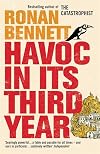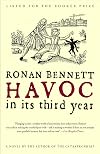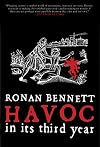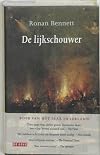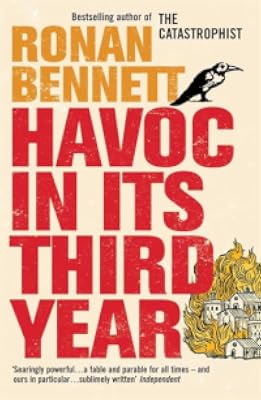
Havoc, in Its Third Year
by Ronan Bennett
On This Page
Description
John Brigge is a governer, a man who has kept away from intrigues to work on his farm and be with his wife, now expecting their first child. He is also - secretly - a Catholic. When he is called to settle the murder of a new-born child, Brigge finds himself drawn into matters he wants to avoid. Katherine Shay, an Irishwoman, is accused of killing her baby. Brigge wants to wait for more evidence. The ascendant Puritan faction, however, demand her immediate hanging. Brigge suspects their haste show more has little to do with their talk of justice. What are they hiding? And does he really want to know? In the background, a rebellion is brewing. Only Brigge - and his investigation - can change the tide. Torn between home and the world, haunted by the mystery of Katharine Shay, he must finally make a stand. show lessTags
Recommendations














Member Reviews
This was disappointing. Historical fiction can be a heavy lift, especially when it is set in a time of such twisted and unfamiliar mindset as Puritanism. This succumbed to caricature, and did not really grapple with the Puritan outlook, other than blame-and-shame. It basically took a modern-minded protagonist, thrust him into the uncongenial setting, and he didn't much like it. We likely wouldn't either, but if you are expecting insight or understanding as to the trends of those times, you will not find it here.
This is a mystery and a morality play and a historical novel all rolled into one.
In 1630, John Brigge is the coroner and one of the Governors in an unnamed Northern England town. When he is called into town from his family and farm on the other side of the desolate moor, he finds not only a woman accused of murdering her newborn son, but political upheaval as law-and-order extremists use fiery oratory and public torture to consolidate their power.
There are times when the implicit comparison to modern times is a little heavy handed, but, in general, the author avoids preaching by focusing on human ambiguity rather than human hypocrisy. Whether the final ending is heard-heartedly cynical or comfortingly realistic is up for debate.
In 1630, John Brigge is the coroner and one of the Governors in an unnamed Northern England town. When he is called into town from his family and farm on the other side of the desolate moor, he finds not only a woman accused of murdering her newborn son, but political upheaval as law-and-order extremists use fiery oratory and public torture to consolidate their power.
There are times when the implicit comparison to modern times is a little heavy handed, but, in general, the author avoids preaching by focusing on human ambiguity rather than human hypocrisy. Whether the final ending is heard-heartedly cynical or comfortingly realistic is up for debate.
In 'Havoc in its third year' the author has chosen an historical setting to address a range of moral issues. Set in England, in an un-named town and county, but I suspect it is somewhere like Yorkshire. The year is 1630, Charles I is ruling without Parliament and sectarian discontent is building towards the Civil War. John Brigge,the central character, is a recusant, living in a fanatically protestant society. He is a landowning farmer who also holds the role of local coroner. A young itinerant woman is accused of infanticide, the locals are sure she is guilty, but his investigation of the case uncovers the growing tensions within the local community and their leaders.
Bennett has written an extraordinary allegory for our times, fear of show more crime, fear of immigrants and those practicing other faiths,fear of the breakdown of society are all used by the governors of the community as reason for ever more harsh legislation and punitive punishments for supposed transgressors. The rising paranoia has allowed old rights and entitlements to be leached away thereby placing more and more power in the hands of the governors. The leader of the governors in the book, who holds the title of Master, is a man who, came as a young idealistic lawyer to challenge and remove the previous corrupt regime (adherents wear a blue ribbon in their hats!). As time has passed he has become more and more draconian in his attitudes until there is little difference between his governance and that of the regime he ousted, and anyone who even questions him on any decision is considered an enemy and in the wrong.
Set against this sombre canvas is the detail of Brigge's personal life, and his attempts as a decent man to hold true to his beliefs.
It is no easy task for an author who has chosen to write of such a period in history to find the right style. Modern English would seem too lax but to write it in imagined historic speech can seem arch and I loathe it when a book is written in a style I call "forsoothly". Bennett has managed to find a spareness of language that fits the time perfectly. The book has echoes of
Millar's play "The Crucible" with Brigge as John Proctor trying to find a path through the treacherous quicksands of fanaticsm. I think this is an outstanding novel, and even the most politically disinterested reader cannot fail to grasp the illusions Bennett has drawn between those times and Britain today. show less
Bennett has written an extraordinary allegory for our times, fear of show more crime, fear of immigrants and those practicing other faiths,fear of the breakdown of society are all used by the governors of the community as reason for ever more harsh legislation and punitive punishments for supposed transgressors. The rising paranoia has allowed old rights and entitlements to be leached away thereby placing more and more power in the hands of the governors. The leader of the governors in the book, who holds the title of Master, is a man who, came as a young idealistic lawyer to challenge and remove the previous corrupt regime (adherents wear a blue ribbon in their hats!). As time has passed he has become more and more draconian in his attitudes until there is little difference between his governance and that of the regime he ousted, and anyone who even questions him on any decision is considered an enemy and in the wrong.
Set against this sombre canvas is the detail of Brigge's personal life, and his attempts as a decent man to hold true to his beliefs.
It is no easy task for an author who has chosen to write of such a period in history to find the right style. Modern English would seem too lax but to write it in imagined historic speech can seem arch and I loathe it when a book is written in a style I call "forsoothly". Bennett has managed to find a spareness of language that fits the time perfectly. The book has echoes of
Millar's play "The Crucible" with Brigge as John Proctor trying to find a path through the treacherous quicksands of fanaticsm. I think this is an outstanding novel, and even the most politically disinterested reader cannot fail to grasp the illusions Bennett has drawn between those times and Britain today. show less
Set in England in the early 1630s, but with lots of resonance for the present, as a small town's leaders seek to impose order in the face of perceptions of increasing disorder & immorality by increasingly harsh & far-reaching punishment. Our hero haltingly pleads for tolerance, reason, & mercy but is torn between the need to make such pleas in public, the risks of doing so, & the desire to simply retreat into the pleasures & small comforts of his family (his wife & son). The hero is a compelling, truly good (though flawed) character (as are some of those around him), the story is a real page-turner, there are some very touching scenes & keen insights into the human capacity for both mercy & terrible cruelty (no naive message of show more tolerance here), all combine to make this brief novel immensely rewarding. show less
Set in Northern England, in a town that at times almost seems as if it must be London, in what the author claims is the 1630s, HAVOC in its third year gives a grim picture of a disintegrating society. This is not history seen from the top, as we often have with political histories, but seen from the bottom, looking at events from the point of view of the ordinary person. The tension between those trying to keep the peace and those trying to feed their families is very real.
John Brigge is the coroner but lives outside the town, He is also a member of the board of governors, a friend of the Master. Fanaticism is growing. Suspicion that Irish immigrants, secret papists, and an impending invasion are responsible for failed crops, rising show more prices, disease, and poverty, give power hungry members of the board of governors the opportunity they need to increase their powers and to implement drastic punitive measures. Other members of the board, including John Brigge, become their victims.
As coroner John Brigge works with an ad hoc jury of common citizens to decide the cause of death of all corpses. The jury vote according to their eyes and often reflect the opinions of the townspeople rather based on any expert knowledge. Too often there is no rationale explanation of the cause of death and the reason assigned is "act of god". The starting point of the unravelling of John Brigge's life is his dissatisfaction with the commonly held view that an Irishwoman Katherine Shay has killed her baby. His suspicions are aroused when the serving wench at the inn where the murder supposedly happened, who is cited as a witness to the murder, is mysteriously unavailable.
HAVOC is rich in detail and presents a description of the dystopian society in early Stuart England that will eventually spawn a civil war, the execution of a king, and the rise of Cromwell. Fascinating reading. show less
John Brigge is the coroner but lives outside the town, He is also a member of the board of governors, a friend of the Master. Fanaticism is growing. Suspicion that Irish immigrants, secret papists, and an impending invasion are responsible for failed crops, rising show more prices, disease, and poverty, give power hungry members of the board of governors the opportunity they need to increase their powers and to implement drastic punitive measures. Other members of the board, including John Brigge, become their victims.
As coroner John Brigge works with an ad hoc jury of common citizens to decide the cause of death of all corpses. The jury vote according to their eyes and often reflect the opinions of the townspeople rather based on any expert knowledge. Too often there is no rationale explanation of the cause of death and the reason assigned is "act of god". The starting point of the unravelling of John Brigge's life is his dissatisfaction with the commonly held view that an Irishwoman Katherine Shay has killed her baby. His suspicions are aroused when the serving wench at the inn where the murder supposedly happened, who is cited as a witness to the murder, is mysteriously unavailable.
HAVOC is rich in detail and presents a description of the dystopian society in early Stuart England that will eventually spawn a civil war, the execution of a king, and the rise of Cromwell. Fascinating reading. show less
John Brigge is the coroner and a governer of a small city in northern England in 1630. On a cold winter day he is called to investigate the death of a newborn baby and to establish the guilt of it's mother, a charismatic Irishwoman. Although the governers of the city and its population are baying for blood Brigge is not satisfied and sets out to find a vital witness.
This book is about religious hatred, intolerance and superstitious fear of the unknown. The powerful Puritan governers torture and murder to establish their authority all in the name of God.
This book was long listed for the Booker Prize in 2004. It is an exciting read but not a very comfortable one with the vivid scenes of human suffering and death.
This book is about religious hatred, intolerance and superstitious fear of the unknown. The powerful Puritan governers torture and murder to establish their authority all in the name of God.
This book was long listed for the Booker Prize in 2004. It is an exciting read but not a very comfortable one with the vivid scenes of human suffering and death.
Bennett did a great job of setting a tone and mood in Havoc and the story started out in a direction that kept my interest. However, he kind of went off the deep end when the main character started his wanderings--- I just didn't feel it was in keeping with the first half of the book in terms of tone or plot. The very obvious in-your-face Jesus analogies were a bit off-putting as well. I would rate it lower but the writing itself was quite nice and for some reason I can't seem to bring myself to get rid of this book, which says something, though I'm not sure what....
Members
- Recently Added By
Lists

International IMPAC Dublin Literary Award
179 works; 6 members

Man Booker Prize Longlist 2004
22 works; 2 members

Authors from Ireland
17 works; 1 member
Author Information

13 Works 1,529 Members
Awards and Honors
Awards
Notable Lists
Common Knowledge
- Canonical title
- Havoc, in Its Third Year
- Original publication date
- 2004
- People/Characters
- John Brigge; Dorcas; Elizabeth Brigge; Adam; Katherine Shay; Nathaniel Challoner (show all 8); Scaife; Deborah
- Important places
- England, UK; Yorkshire, England, UK
- Dedication
- To Finn-Tomas
- First words
- When the woman found milk in her breasts, and other secret feminine tokens, Scaife, the constable's man, an archdolt, was dispatched across the windswept moors and icy mountains to fetch Mr. John Brigge, coroner in the wapent... (show all)akes of Agbrigg and Morley.
- Last words
- (Click to show. Warning: May contain spoilers.)Then Elizabeth came to him. She took his hand and put it to her breast and whispered to him that here there was mercy and all men who sought it should have it.
Classifications
Statistics
- Members
- 373
- Popularity
- 84,508
- Reviews
- 10
- Rating
- (3.69)
- Languages
- Dutch, English
- Media
- Paper, Audiobook, Ebook
- ISBNs
- 13
- ASINs
- 2