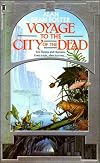
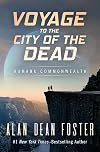
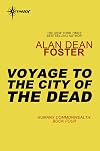
Voyage to the City of the Dead
by Alan Dean Foster
Humanx Commonwealth, other books: publishing order (4), Humanx Commonwealth: timeline (106 AA), Humanx Commonwealth Universe (Humanx Commonwealth — 2.4)
On This Page
Description
From a #1 New York Times-bestselling author, a research expedition to an alien planet takes a treacherous turn for married scientists in this sci-fi fantasy. As the first humans granted permission to explore Tslamaina, Etienne and Lyra Redowl should have been ecstatic. The planet's massive river valley is like no other in the known universe, with three intelligent species living along its waters-a dream expedition for the geologist-anthropologist duo. But the intolerable climate makes their show more research arduous, as does the growing tension between them. Fortunately, the husband-and-wife team are well prepared for their adventure, with a state-of-the-art hydrofoil and the assistance of the native inhabitants. But nothing could have prepared them for the dangers they encounter as they make their way to the river's source. "One of the most consistently inventive and fertile writers of science fiction and fantasy." -The Times (London.) show lessTags
Recommendations




















Member Reviews
Spoilers, obviously.
This is apparently part of a... not exactly a series, but a set of linked books. I haven't read any others, but I don't think it's affected my enjoyment of the book.
Generally speaking, I enjoyed this book. I read it pretty much in a single sitting over an afternoon, which says a lot. ADF did a good job of worldbuilding; the planet is novel and interesting, and though it's probably scientifically impossible, I didn't have any trouble suspending my disbelief. He sketches out the culture fairly quickly, giving enough information to read the story smoothly, but leaving things vague. This vagueness avoids leaving much open to scepticism, and given how little the humans know about the world in question, is also entirely show more appropriate. I quite liked the alien races as well, though the Na were a bit cardboard for my taste.
This book has some really nice ideas and concepts in it. The monetary basis of the Mai culture was quite fun, and I loved the vertical division of cultures and the Topapasirut. He also defied my expectations by turning round the Tsla when they seemed bound for tired old stereotype territory. Slightly on the other hand, all of the alien characters confirm rigidly to their cultural norms. Now ADF doesn't go very deeply into their cultures, and the humans don't have enough knowledge to pick out subtle differences, so I can't hold it too strongly against him, but really the supporting cast don't get much in the way of characterisation.
Just in passing, I liked that the humans are not automatically white Anglo-Saxon types, which is casually mentioned at the start without making it too pointed; calling them Lyra and Etienne seems slightly odd if ADF was going for something different, but it's fine.
I also enjoyed the way the journey let the relationship between Lyra and Etienne develop. I thought it did a decent job of portraying a couple whose relationship is strained after years of field research and planet-hopping, and the ways that might manifest. Both the manifestations and the characters were a little gender-stereotyped: a logical male geologist who gets frustrated, is foolishly jealous, comes up with plans and does the last-minute rescuing; an empathic female anthropologist who is passive-aggressive, is unreasonable in arguments, and loses her objectivity to fall in love with the native culture. It is from the 1980s, so it's not all that surprising, and Lyra does get her turn at problem-solving too. ADF does a reasonable job of convincing me they're genuinely fond of each other, though, and I was interested in how things would turn out at the end; their journey up the river is both an exploration of the planet and a chance to explore the status of their relationship, and I expected a decent emotional payoff.
And that - the end - is really where things fell down for me. Perhaps I was naive, but I'd been reading this book as something genuinely different, a sci-fi novel about exploration and relationships, with something in common with Gerald Durrell or Attenborough novels about real-life travels and the incidents and friendships that they bring. Although the prelude to the novel is a Mai-based vignette about a mythical El Dorado-type treasure trove they expect the humans to find for them, it's largely ignored for the rest of the book; in fact, the ambush section doesn't make much sense in the light of the prelude, as it would completely frustrate the Mai's own plans. So what I vaguely expected was for the human voyage to bring them to the City of the Dead as the novel proclaims, which... well, they sort of do, but it's a bit odd, as the City doesn't seem to actually be a city or anything like one. Then the interesting story about exploration and relationships goes away and something entirely less interesting takes its place. The remaining aliens are killed off, which is basically unnecessary; as they were largely indistinguishable except by species, the deaths doesn't get much of a reaction, so it mostly comes across as a way to create some cheap tension and isolate the humans for the Message. The betrayal did get to me, but mostly because I was disappointed Homat was pushed into a cheap dramatic ending so easily. Now in some ways, it was more appropriate for him to stick with authentic Mai behaviour than to be a token Friendly Native, so I do appreciate that. However, there was no indication anywhere that it would happen, and it doesn't entirely make sense if he's supposed to be clever. You can argue that the riches on offer sent him a bit mad, I suppose, but taking unnecessary risks is highlighted early on as being quite un-Mai.
Mostly, though, it was the revelation that annoyed me. Suddenly, the book I was enjoying turned into another book. Yulour is revealed to be not a Tsla, but another type of alien entirely, which is known only by rumour across the galaxy and is the mystic caretaker race of a previous galaxy-spanning higher civilisation that has mysteriously vanished! Now, let me be clear. I'm not especially interested in that story, which has been done plenty of times, but that's not what bothered me. What bothered me was ADF dropping that on me in the last chapter of a book without a single suggestion that such aliens existed; that such a prior civilisation existed; or that this was going to be a book about revealing mystic truths to worthy humans in a secret cave. Right until this point, I had been lulled into believing that this was a fascinating and original travelogue, gently exploring ADF's world and the heads of the human protagonists. Suddenly, the ending I had expected - no, earned, by reading the rest of the book - was denied me in favour of this tired old mystic twaddle, which threw out the satisfying climax in favour of something much LESS interesting.
This unwanted twist also reminded me of the actual premise of the book, which suddenly made less sense. The City of the Dead turns out to be neither a City nor full of anything Dead, and as the machines are described as still functional, I can't see how the Mai trader in the prelude has apparently looted one for a vast bar of sunit (nor indeed how he brought it back on his own...). It also turns out that, although the humans were given permission to explore the river in the hopes of them finding the City for the Mai, the Mai don't seem to have ever had a clever plan to actually benefit from that discovery; they're clearly stated as being too wary to risk the journey themselves, so how do they expect to get any sunit back? The devious plan they do have in place turns out to be ambushing the boat on its way up the river, which... doesn't get them any sunit, so why bother with the whole City of the Dead thing in the first place? Similarly, Homat ends up undermining his own perfectly functional plans for huge self-betterment.
Basically, this is a mostly solid and pleasant read, with novel and interesting settings and ideas, which ends up undermining itself by suddenly trying to be a completely different book (in a different subgenre) in the last chapter, bringing its own plotlines into question and denying the reader satisfying resolutions to the issues the rest of the book has dealt with. We get a quick 'happy ending' for the relationship plotline, rather than anything substantial; the scientific elements are largely ignored; the alien characters are all dead in a fairly unsatisfying way; and there's no indication of what the successful journey means for (or says about) the interrelation of the three native sentient species. Instead, ADF gives me a sudden infodump of exposition that I never wanted to explain the world whose nature I hadn't been nudged to question, a bit of "powerful beings are looking after things" and more exposition about the nature of these new aliens he's suddenly introduced, and some random portentiousness.
I'm still glad I've read it, and I enjoyed it on the whole, but it's frustrating to think how much better it would have been - both more enjoyable and simply better and more interesting as a book - if ADF had simply made good on the premise and promise of the bulk of the book. My experience here will make me wary of getting invested in any of his other works, for fear of being cheated in the same way. show less
This is apparently part of a... not exactly a series, but a set of linked books. I haven't read any others, but I don't think it's affected my enjoyment of the book.
Generally speaking, I enjoyed this book. I read it pretty much in a single sitting over an afternoon, which says a lot. ADF did a good job of worldbuilding; the planet is novel and interesting, and though it's probably scientifically impossible, I didn't have any trouble suspending my disbelief. He sketches out the culture fairly quickly, giving enough information to read the story smoothly, but leaving things vague. This vagueness avoids leaving much open to scepticism, and given how little the humans know about the world in question, is also entirely show more appropriate. I quite liked the alien races as well, though the Na were a bit cardboard for my taste.
This book has some really nice ideas and concepts in it. The monetary basis of the Mai culture was quite fun, and I loved the vertical division of cultures and the Topapasirut. He also defied my expectations by turning round the Tsla when they seemed bound for tired old stereotype territory. Slightly on the other hand, all of the alien characters confirm rigidly to their cultural norms. Now ADF doesn't go very deeply into their cultures, and the humans don't have enough knowledge to pick out subtle differences, so I can't hold it too strongly against him, but really the supporting cast don't get much in the way of characterisation.
Just in passing, I liked that the humans are not automatically white Anglo-Saxon types, which is casually mentioned at the start without making it too pointed; calling them Lyra and Etienne seems slightly odd if ADF was going for something different, but it's fine.
I also enjoyed the way the journey let the relationship between Lyra and Etienne develop. I thought it did a decent job of portraying a couple whose relationship is strained after years of field research and planet-hopping, and the ways that might manifest. Both the manifestations and the characters were a little gender-stereotyped: a logical male geologist who gets frustrated, is foolishly jealous, comes up with plans and does the last-minute rescuing; an empathic female anthropologist who is passive-aggressive, is unreasonable in arguments, and loses her objectivity to fall in love with the native culture. It is from the 1980s, so it's not all that surprising, and Lyra does get her turn at problem-solving too. ADF does a reasonable job of convincing me they're genuinely fond of each other, though, and I was interested in how things would turn out at the end; their journey up the river is both an exploration of the planet and a chance to explore the status of their relationship, and I expected a decent emotional payoff.
And that - the end - is really where things fell down for me. Perhaps I was naive, but I'd been reading this book as something genuinely different, a sci-fi novel about exploration and relationships, with something in common with Gerald Durrell or Attenborough novels about real-life travels and the incidents and friendships that they bring. Although the prelude to the novel is a Mai-based vignette about a mythical El Dorado-type treasure trove they expect the humans to find for them, it's largely ignored for the rest of the book; in fact, the ambush section doesn't make much sense in the light of the prelude, as it would completely frustrate the Mai's own plans. So what I vaguely expected was for the human voyage to bring them to the City of the Dead as the novel proclaims, which... well, they sort of do, but it's a bit odd, as the City doesn't seem to actually be a city or anything like one. Then the interesting story about exploration and relationships goes away and something entirely less interesting takes its place. The remaining aliens are killed off, which is basically unnecessary; as they were largely indistinguishable except by species, the deaths doesn't get much of a reaction, so it mostly comes across as a way to create some cheap tension and isolate the humans for the Message. The betrayal did get to me, but mostly because I was disappointed Homat was pushed into a cheap dramatic ending so easily. Now in some ways, it was more appropriate for him to stick with authentic Mai behaviour than to be a token Friendly Native, so I do appreciate that. However, there was no indication anywhere that it would happen, and it doesn't entirely make sense if he's supposed to be clever. You can argue that the riches on offer sent him a bit mad, I suppose, but taking unnecessary risks is highlighted early on as being quite un-Mai.
Mostly, though, it was the revelation that annoyed me. Suddenly, the book I was enjoying turned into another book. Yulour is revealed to be not a Tsla, but another type of alien entirely, which is known only by rumour across the galaxy and is the mystic caretaker race of a previous galaxy-spanning higher civilisation that has mysteriously vanished! Now, let me be clear. I'm not especially interested in that story, which has been done plenty of times, but that's not what bothered me. What bothered me was ADF dropping that on me in the last chapter of a book without a single suggestion that such aliens existed; that such a prior civilisation existed; or that this was going to be a book about revealing mystic truths to worthy humans in a secret cave. Right until this point, I had been lulled into believing that this was a fascinating and original travelogue, gently exploring ADF's world and the heads of the human protagonists. Suddenly, the ending I had expected - no, earned, by reading the rest of the book - was denied me in favour of this tired old mystic twaddle, which threw out the satisfying climax in favour of something much LESS interesting.
This unwanted twist also reminded me of the actual premise of the book, which suddenly made less sense. The City of the Dead turns out to be neither a City nor full of anything Dead, and as the machines are described as still functional, I can't see how the Mai trader in the prelude has apparently looted one for a vast bar of sunit (nor indeed how he brought it back on his own...). It also turns out that, although the humans were given permission to explore the river in the hopes of them finding the City for the Mai, the Mai don't seem to have ever had a clever plan to actually benefit from that discovery; they're clearly stated as being too wary to risk the journey themselves, so how do they expect to get any sunit back? The devious plan they do have in place turns out to be ambushing the boat on its way up the river, which... doesn't get them any sunit, so why bother with the whole City of the Dead thing in the first place? Similarly, Homat ends up undermining his own perfectly functional plans for huge self-betterment.
Basically, this is a mostly solid and pleasant read, with novel and interesting settings and ideas, which ends up undermining itself by suddenly trying to be a completely different book (in a different subgenre) in the last chapter, bringing its own plotlines into question and denying the reader satisfying resolutions to the issues the rest of the book has dealt with. We get a quick 'happy ending' for the relationship plotline, rather than anything substantial; the scientific elements are largely ignored; the alien characters are all dead in a fairly unsatisfying way; and there's no indication of what the successful journey means for (or says about) the interrelation of the three native sentient species. Instead, ADF gives me a sudden infodump of exposition that I never wanted to explain the world whose nature I hadn't been nudged to question, a bit of "powerful beings are looking after things" and more exposition about the nature of these new aliens he's suddenly introduced, and some random portentiousness.
I'm still glad I've read it, and I enjoyed it on the whole, but it's frustrating to think how much better it would have been - both more enjoyable and simply better and more interesting as a book - if ADF had simply made good on the premise and promise of the bulk of the book. My experience here will make me wary of getting invested in any of his other works, for fear of being cheated in the same way. show less
Etienne and Lyra Redowl map the planet Horseye's dangerous, 12,000-kilometer River Skar. They navigate treacherous, uncharted waters to uncover the secrets of the river's mysterious source.
Married research team Etienne and Lyra Redowl, experts in alien cultures, explore the planet Horseye, a world known for its massive, dangerous river chasm. They document the three distinct sentient species living along the river, including the traders, the Mai, who assist the researchers while pursuing their own agenda.
They face significant natural hazards and environmental hazards while traveling upriver. The explorers reach the mysterious City of the Dead at the river's source, only to discover the rumored treasure is actually an ancient artifact show more and a massive device used for monitoring deep space. show less
Married research team Etienne and Lyra Redowl, experts in alien cultures, explore the planet Horseye, a world known for its massive, dangerous river chasm. They document the three distinct sentient species living along the river, including the traders, the Mai, who assist the researchers while pursuing their own agenda.
They face significant natural hazards and environmental hazards while traveling upriver. The explorers reach the mysterious City of the Dead at the river's source, only to discover the rumored treasure is actually an ancient artifact show more and a massive device used for monitoring deep space. show less
Romanzo di viaggio ed esplorazione, su un'altro pianeta, una bella avventura magistralmente sviluppata, ricca ed avvincente. Lettura consigliata.
Dec 9, 2013Italian
Ratings
Members
- Recently Added By
Lists

Books Read in 2014
2,343 works; 89 members
Author Information

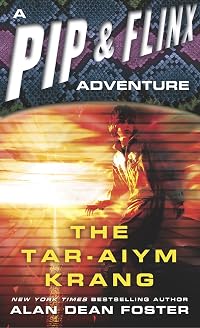
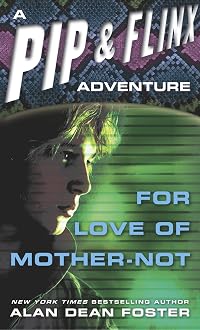
Bestselling science fiction writer Alan Dean Foster was born in New York City in 1946, but raised mainly in California. He received a B.A. in Political Science from UCLA in 1968, and a M.F.A. in 1969. Foster enjoys traveling because it gives him opportunities to meet new people and explore new places and cultures. This interest is carried over to show more his writing, but with a twist: the new places encountered in his books are likely to be on another planet, and the people may belong to an alien race. Foster began his career as an author when a letter he sent to Arkham Collection was purchased by the editor and published in the magazine in 1968. His first novel, The Tar-Aiym Krang, introduced the Humanx Commonwealth, a galactic alliance between humans and an insectlike race called Thranx. Several other novels, including the Icerigger trilogy, are also set in the world of the Commonwealth. The Tar-Aiym Krang also marked the first appearance of Flinx, a young man with paranormal abilities, who reappears in other books, including Orphan Star, For Love of Mother-Not, and Flinx in Flux. Foster has also written The Damned series and the Spellsinger series, which includes The Hour of the Gate, The Moment of the Magician, The Paths of the Perambulator, and Son of Spellsinger, among others. Other books include novelizations of science fiction movies and television shows such as Star Trek, The Black Hole, Starman, Star Wars, and the Alien movies. Splinter of the Mind's Eye, a bestselling novel based on the Star Wars movies, received the Galaxy Award in 1979. The book Cyber Way won the Southwest Book Award for Fiction in 1990. His novel Our Lady of the Machine won him the UPC Award (Spain) in 1993. He also won the Ignotus Award (Spain) in 1994 and the Stannik Award (Russia) in 2000. He is the recipient of the Faust, the IAMTW Lifetime achievement award. Alan Dean Foster's Star Wars: The Force Awakens, was a 2015 New York Times bestseller. (Bowker Author Biography) show less
Some Editions
Series

Humanx Commonwealth, other books: publishing order
8 works (4)

Humanx Commonwealth: timeline
29 works (106 AA)

Humanx Commonwealth Universe
1 works (Humanx Commonwealth — 2.4)
Belongs to Publisher Series
Work Relationships
Common Knowledge
- Canonical title
- Voyage to the City of the Dead
- Original publication date
- 1984-08
- People/Characters
- Etienne Redowl; Lyra Redowl
- Important places
- Horseye, Humanx Commonwealth (Tslamaina)
- Dedication
- For Daniel, with love, for when he gets older and starts traveling...
- First words
- They didn't call the Guard because the intruder was already half dead.
- Last words
- (Click to show. Warning: May contain spoilers.)For a more specific explanation of what it meant in this instance the Xunca would have to be consulted.
Wherever they were.
Classifications
Statistics
- Members
- 594
- Popularity
- 49,236
- Reviews
- 4
- Rating
- (3.30)
- Languages
- English, German, Hungarian, Italian
- Media
- Paper, Ebook
- ISBNs
- 9
- ASINs
- 6