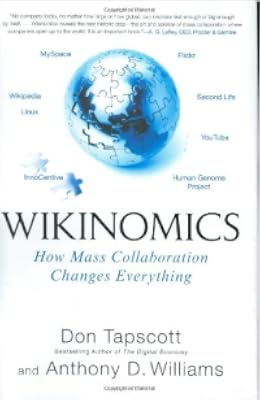
Wikinomics: How Mass Collaboration Changes Everything
by Don Tapscott, Anthony D. Williams
On This Page
Description
Today, encyclopedias, jetliners, operating systems, mutual funds, and many other items are being created by teams numbering in the thousands or even millions. While some leaders fear the heaving growth of these massive online communities, Wikinomics proves this fear is folly. Smart firms can harness collective capability and genius to spur innovation, growth, and success. A brilliant guide to one of the most profound changes of our time, Wikinomics challenges our most deeply rooted show more assumptions about business and will prove indispensable to anyone who wants to understand competitiveness in the twenty-first century. show lessTags
Recommendations





























Member Recommendations


Member Reviews
“The monolithic, self-contained, inwardly focused corporation is dying" -- is the gist of this enjoyable book. However, it's not just all about the old-guard's eschaton; /Wikinomics/ is primarily about the new type of corporation taking over the world. To wit:
"Regardless of the industry you compete in, or whether your firm is large or small, internal capabilities and a handful of pre-web partnerships are not sufficient to meet the market’s expectations for growth and innovation. Winning companies today have open and porous boundaries, and compete by reaching outside their walls to harness external knowledge, resources and capabilities. They’re like a hub for innovation, and a magnet for uniquely qualified minds. They focus their show more internal staff on value integration and orchestration, and treat the world as their R&D department. All of this adds up to a new kind of collaborative enterprise. An ecosystem of peers that is constantly shaping and re-shaping clusters of knowledge and capability to compete on an international basis.”
Forget about the Age of Aquarius; this is the new Age of Mass Collaboration.
“The new age of mass collaboration will no doubt seem complex and uncertain. And it’s true that collaboration and openness are more art than science. Leaders must prepare their collaborative minds and companies will need unique capabilities to work in collaborative environments. Capabilities to develop new kinds of relationships, sense important developments, add value, and turn nascent network knowledge into compelling value, are becoming the bread and butter of wealth creation and success.”
Second Life, Google, Amazon, Gold Corp: all are companies that follow this new, exciting business model. If you want to read something stimulating and visionary, read /Wikinomics/. show less
"Regardless of the industry you compete in, or whether your firm is large or small, internal capabilities and a handful of pre-web partnerships are not sufficient to meet the market’s expectations for growth and innovation. Winning companies today have open and porous boundaries, and compete by reaching outside their walls to harness external knowledge, resources and capabilities. They’re like a hub for innovation, and a magnet for uniquely qualified minds. They focus their show more internal staff on value integration and orchestration, and treat the world as their R&D department. All of this adds up to a new kind of collaborative enterprise. An ecosystem of peers that is constantly shaping and re-shaping clusters of knowledge and capability to compete on an international basis.”
Forget about the Age of Aquarius; this is the new Age of Mass Collaboration.
“The new age of mass collaboration will no doubt seem complex and uncertain. And it’s true that collaboration and openness are more art than science. Leaders must prepare their collaborative minds and companies will need unique capabilities to work in collaborative environments. Capabilities to develop new kinds of relationships, sense important developments, add value, and turn nascent network knowledge into compelling value, are becoming the bread and butter of wealth creation and success.”
Second Life, Google, Amazon, Gold Corp: all are companies that follow this new, exciting business model. If you want to read something stimulating and visionary, read /Wikinomics/. show less
Link to my 'Mostly NF' blog review to read and comment OR read the text right here:
Collaboration used to be an activity between willing partners. In business today it is almost a sink or swim requirement.
I recently finished Wikinomics: How Mass Collaboration Changes Everything by Don Tapscott and Anthony Williams. It's a new book addressing the global collaboration marketplace and its impact on micro- and macroeconomics. The authors slide you into the topic with examples from popular culture -- particularly social networking websites like MySpace, flickr, YouTube, and Wikipedia -- where millions of people like you and I connect online based upon our common interests and experiences. Each social web participant joins for his/her own show more reasons and motivations, but every person's small contribution collectively creates an amazingly complex whole. No single person or organization builds a social network. The collaborative effort of the entire community does. [Please see my previous blog review of The Wisdom of Crowds.]
The same phenomenon is hitting the corporate world. Competition from traditional rivals and former third world nations is fierce. Large companies find it increasingly difficult to do everything they once did. They don't exist in a vacuum any more. There's always someone somewhere who can do something better. Business leaders shed the least productive parts of their empires in order to focus on the remaining activities they do best.
In many cases, they team with former rivals, vendors, and suppliers as equals. Large corporations like Boeing and Merck used to dictate the terms of their business transactions to suppliers. Now they collaborate. Open source strategies connect countries, companies, and district offices. Managers, employees, consultants, and customers are more responsive to each other when they trust and freely interact. Using collaborative business models, products can be designed, tested, produced, marketed, and shipped faster and more efficiently than traditional, proprietary, top-down planning.
This is not a perfect situation, of course. Critics believe collective efforts lead to mediocrity; popular but vanilla. And real people are lost in the shuffle when companies go off shore or when uncompensated contributions cause a brain drain. The media have extensively covered such stories in the news. The authors argue, however, that NOT adopting some of these strategies could be worse. A company that shuns global collaboration in hopes of everything staying put or kept under its control will be slower, less efficient, less responsive, and more expensive. That could eventually doom the entire company. Customers, after all, can always find faster, less expensive suppliers. It wouldn't be difficult. They're online, too.
Wikinomics is a business book at its core, with numerous case studies of business collaboration in action. I enjoyed these passages the most -- particularly the background stories involving groups with which I'm familiar: Wikipedia, linux, and the quirky innovators at the Geek Squad. The authors discuss the natural hesitation to share intellectual property and copyrights, but they also argue that opening R & D to outsiders ironically pays dividends in surprising ways.
The authors overstate some things. One company's niche success does not mean its strategies will work for someone else. Overall, however, the authors' arguments appear sound. They're certainly not new. Wikinomics is basic capitalism. The new angle of wikinomics, however, is showing how the capitalism engine runs on a rich new fuel blend: easily exchanged ideas from a global collective of self-motivated experts. Mass collaboration is already changing everything. show less
Collaboration used to be an activity between willing partners. In business today it is almost a sink or swim requirement.
I recently finished Wikinomics: How Mass Collaboration Changes Everything by Don Tapscott and Anthony Williams. It's a new book addressing the global collaboration marketplace and its impact on micro- and macroeconomics. The authors slide you into the topic with examples from popular culture -- particularly social networking websites like MySpace, flickr, YouTube, and Wikipedia -- where millions of people like you and I connect online based upon our common interests and experiences. Each social web participant joins for his/her own show more reasons and motivations, but every person's small contribution collectively creates an amazingly complex whole. No single person or organization builds a social network. The collaborative effort of the entire community does. [Please see my previous blog review of The Wisdom of Crowds.]
The same phenomenon is hitting the corporate world. Competition from traditional rivals and former third world nations is fierce. Large companies find it increasingly difficult to do everything they once did. They don't exist in a vacuum any more. There's always someone somewhere who can do something better. Business leaders shed the least productive parts of their empires in order to focus on the remaining activities they do best.
In many cases, they team with former rivals, vendors, and suppliers as equals. Large corporations like Boeing and Merck used to dictate the terms of their business transactions to suppliers. Now they collaborate. Open source strategies connect countries, companies, and district offices. Managers, employees, consultants, and customers are more responsive to each other when they trust and freely interact. Using collaborative business models, products can be designed, tested, produced, marketed, and shipped faster and more efficiently than traditional, proprietary, top-down planning.
This is not a perfect situation, of course. Critics believe collective efforts lead to mediocrity; popular but vanilla. And real people are lost in the shuffle when companies go off shore or when uncompensated contributions cause a brain drain. The media have extensively covered such stories in the news. The authors argue, however, that NOT adopting some of these strategies could be worse. A company that shuns global collaboration in hopes of everything staying put or kept under its control will be slower, less efficient, less responsive, and more expensive. That could eventually doom the entire company. Customers, after all, can always find faster, less expensive suppliers. It wouldn't be difficult. They're online, too.
Wikinomics is a business book at its core, with numerous case studies of business collaboration in action. I enjoyed these passages the most -- particularly the background stories involving groups with which I'm familiar: Wikipedia, linux, and the quirky innovators at the Geek Squad. The authors discuss the natural hesitation to share intellectual property and copyrights, but they also argue that opening R & D to outsiders ironically pays dividends in surprising ways.
The authors overstate some things. One company's niche success does not mean its strategies will work for someone else. Overall, however, the authors' arguments appear sound. They're certainly not new. Wikinomics is basic capitalism. The new angle of wikinomics, however, is showing how the capitalism engine runs on a rich new fuel blend: easily exchanged ideas from a global collective of self-motivated experts. Mass collaboration is already changing everything. show less
This is a great book. Everyone knows what Wikipedia, Flickr, YouTube and MySpace are; the authors explain how and why they work, and why they matter to business. They identify four critical components to mass collaboration: openness, peering, sharing, and acting globally.
I thought the "acting globally" was interesting. They repeated stated that acting globally is not the same as multinational. Having "branches" in different countries isn't enough. Companies need to integrate the capabilities inside and outside their walls to bring products to market. And they need to do it while respecting community and cultural norms.
I guess the one itch I have with the authors is the idea of "value creation." I put it the buzzword bingo category: show more everybody uses the phrase but nobody knows what it means. I don't think they did a good job defining it, either. And this is a vital economic concept as we move into the next century. If much of the IP is truly shared and if the barriers to entry are truly dropping in many areas, how does a company make money? Never mind the "returning value to investors," how do they make money to make payroll and keep the lights on? And how does the employee in a company deal with the fact that, for every talented individual I employ, there are 200 who are as good or better on the Internet?
But how can you not like a book that says, "As it leverages its ecosystem to gobble up more surface area on the Web, [Amazon] is poised to become the dominant retail force on the planet, period. If we were running Wal-Mart, we would be very scared indeed."
As an economic model, the idea of "mass collaboration" seems half-baked. That aside, the book is well written and documented, and is engaging reading. show less
I thought the "acting globally" was interesting. They repeated stated that acting globally is not the same as multinational. Having "branches" in different countries isn't enough. Companies need to integrate the capabilities inside and outside their walls to bring products to market. And they need to do it while respecting community and cultural norms.
I guess the one itch I have with the authors is the idea of "value creation." I put it the buzzword bingo category: show more everybody uses the phrase but nobody knows what it means. I don't think they did a good job defining it, either. And this is a vital economic concept as we move into the next century. If much of the IP is truly shared and if the barriers to entry are truly dropping in many areas, how does a company make money? Never mind the "returning value to investors," how do they make money to make payroll and keep the lights on? And how does the employee in a company deal with the fact that, for every talented individual I employ, there are 200 who are as good or better on the Internet?
But how can you not like a book that says, "As it leverages its ecosystem to gobble up more surface area on the Web, [Amazon] is poised to become the dominant retail force on the planet, period. If we were running Wal-Mart, we would be very scared indeed."
As an economic model, the idea of "mass collaboration" seems half-baked. That aside, the book is well written and documented, and is engaging reading. show less
Full of useless, meaningless symbolic language like "harness the harvest". Time after time, the reader is told that "smart companies will be able to tap into" this and that opportunity. So if you don't succeed, apparently you're not a smart company. It's the emperor's new clothes all over. These authors are naked.
Wikinomics is all about taking the business model of Wikipedia and expanding it to marketable products, service lines, and companies. Published in 2008, it's surprising how dated some of the examples seem today (My Space? Friendster? Delicious?) It does go to show how fickle the public can be, today's billion dollar baby is the butt of tomorrow's joke. Examples aside, Wikinomics - How Mass Collaboration Changes Everything is all about the benefits of open source; putting ideas into the public domain; and receiving highly qualified input from contributors throughout the world. Tapscott lauds corporations that embrace this new paradigm; and vilifies those who cling too tightly to the seemingly out-dated concepts of intellectual property. show more A few mega-corps are targets of his scorn: Apple and Sony among them. And a few are heralded as leaders in this new world, among them IBM.
The book is rife with examples on how some existing companies or product lines leverage the phenomenon of community development. For business folk looking a new, possibly profitable, direct, it can provide food for thought. However, it can just as easily spell doom for currently lucrative industries should their cash cow be served at the soup kitchen. Tapscott does not balance his book by suggesting this approach could spell doom for particular industries or product lines.
Tapscott also revisits the same examples over and over. This rather undermines the "all the cool kids are doing it" vibe he's trying to convey n the book. I think I would have enjoyed a shorter, tighter book that visits these corporate examples but once. After the second or third time, these examples feel recycled and whatever point Tapscott is trying to make is lost. Still, while I was already familiar with open-source software development (Linux was his model) and, of course, Wikipedia; it was kind of neat seeing how something not in the tech/IP realm: a gold mining company, leverages this model to find new veins to exploit. show less
The book is rife with examples on how some existing companies or product lines leverage the phenomenon of community development. For business folk looking a new, possibly profitable, direct, it can provide food for thought. However, it can just as easily spell doom for currently lucrative industries should their cash cow be served at the soup kitchen. Tapscott does not balance his book by suggesting this approach could spell doom for particular industries or product lines.
Tapscott also revisits the same examples over and over. This rather undermines the "all the cool kids are doing it" vibe he's trying to convey n the book. I think I would have enjoyed a shorter, tighter book that visits these corporate examples but once. After the second or third time, these examples feel recycled and whatever point Tapscott is trying to make is lost. Still, while I was already familiar with open-source software development (Linux was his model) and, of course, Wikipedia; it was kind of neat seeing how something not in the tech/IP realm: a gold mining company, leverages this model to find new veins to exploit. show less
good intentions, probably best for those just discovering what everyone else has been doing for years (ie, editing wikis, 'collaborating', etc.) I think it is a great study of how business is finally coming around to seeing the value of what we have already been doing for a while.
Note: this book has an optimistic tone to it that borders on boosterism.
Note: this book has an optimistic tone to it that borders on boosterism.
tedious and repetitive BUT ideas that are put forward in this book are valid and inspiring. If only the authors could write it in a more condensed way...
Members
- Recently Added By
Published Reviews
ThingScore 25
"Strip out the waffle and there's potential for a good article in Wired or the Economist, but nowhere near enough to justify a 300+ page book. ... 3/10"
added by legallypuzzled
Lists

Ryan Holiday's Books To Base Your Life On
97 works; 2 members
Author Information

25+ Works 4,846 Members
Don Tapscott is Chairman of the Alliance for Converging Technologies (www.actnet.com), an international research and consulting group that advises corporations and governments worldwide on strategy in the digital economy.

5 Works 2,742 Members
Some Editions
Awards and Honors
Series
Belongs to Publisher Series
Business bibliotheek (2008)
Common Knowledge
- Original publication date
- 2006
- Dedication
- We dedicate this book to our children, Alex and Niki Tapscott and Immanuel Williams. We hope that it helps our generation open up the economy to yours.
- First words
- Throughout history corporations have organized themselves according to strict hierarchical lines of authority.
- Last words
- (Click to show. Warning: May contain spoilers.)Is your mind wired for wikinomics?
Classifications
Statistics
- Members
- 2,732
- Popularity
- 6,794
- Reviews
- 41
- Rating
- (3.54)
- Languages
- 14 — Chinese, Czech, Dutch, English, French, German, Hungarian, Italian, Japanese, Korean, Polish, Portuguese, Romanian, Spanish
- Media
- Paper, Audiobook, Ebook
- ISBNs
- 42
- ASINs
- 15