On This Page
Description
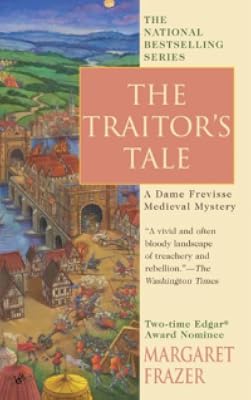
The 16th mystery in the Edgar]-nominated series finds Dame Frevisse assisting her cousin Alice in burying her husband, the hated Duke of Suffolk. The Traitors Tale features a guest appearance by Simon Joliffe, now featured in his own spinoff series.Tags
Recommendations





Member Reviews
I’m so pleased that I’ve discovered a whole new bunch of mysteries, the "Sister Frevisse" series by Margaret Frazer that features a nun in the 15th century as the main character. One might ask, “Where have you been all this time??” considering that the first of these books, "The Novice’s Tale," was published in 1993. But at least I’ve noticed the series now, so I finally got there.
In fact, this is one of the history-based books I picked up on a whim at the library last week, inspired by Carrie at the Books and Movies book review blog when she talked about her favourite historical novels. So it’s her fault that I now have 21 more books to read.
What I loved about this story was the political intrigue, and Frazer’s coherent show more and elaborate interpretation of several events leading up to the Wars of the Roses in England. Events, incidentally, that have never been satisfactorily explained, yet which seem to dovetail very nicely with Ms. Frazer’s possible scenario. I gather from other reviews, though, that this novel was something of a departure from her other stories, which usually focus more on local murders or mysteries and don’t get into the wider intrigues. But since I love those wider, nation-threatening plots (I am an avid Dorothy Dunnett fan after all), this was meat and drink for me, and it remains to be seen how well I like the other tales with a narrower focus.
The main character, Sister Frevisse, is very clever and sensible, and strongly reminds me of a great friend of mine, which may be why I like her so much. I didn’t find Frevisse entirely convincing, though, whenever she claimed that she’d rather be cloistered in the St. Frideswide nunnery than out in the world dealing with wider affairs. She simply seemed too engaged, and I couldn’t imagine that she would ever be content denying herself — and the world — the use of that mind to help solve the world’s problems. So that just never rang quite true for me.
I was also a bit uncomfortable with the way Frevisse and Joliffe — the other main character in this story, the travelling player-minstrel-spy who has his own growing Margaret Frazer series — kept having to recount all their information and theories to each other. To me, this smacked a little bit of a need to bring the reader up to speed on information that might have been conveyed some other way, instead of with all this exposition.
But on the whole, I quite enjoyed the story. Frazer clearly portrays the life of people in 15th century England, from nuns in the cloister to townsfolk at the local tavern to high lords in their chambers. The combination of the political intrigue, the historical information, and the interesting characters made this book a pleasure to read. And whetted my appetite for the rest of the series. All 21 of them. show less
In fact, this is one of the history-based books I picked up on a whim at the library last week, inspired by Carrie at the Books and Movies book review blog when she talked about her favourite historical novels. So it’s her fault that I now have 21 more books to read.
What I loved about this story was the political intrigue, and Frazer’s coherent show more and elaborate interpretation of several events leading up to the Wars of the Roses in England. Events, incidentally, that have never been satisfactorily explained, yet which seem to dovetail very nicely with Ms. Frazer’s possible scenario. I gather from other reviews, though, that this novel was something of a departure from her other stories, which usually focus more on local murders or mysteries and don’t get into the wider intrigues. But since I love those wider, nation-threatening plots (I am an avid Dorothy Dunnett fan after all), this was meat and drink for me, and it remains to be seen how well I like the other tales with a narrower focus.
The main character, Sister Frevisse, is very clever and sensible, and strongly reminds me of a great friend of mine, which may be why I like her so much. I didn’t find Frevisse entirely convincing, though, whenever she claimed that she’d rather be cloistered in the St. Frideswide nunnery than out in the world dealing with wider affairs. She simply seemed too engaged, and I couldn’t imagine that she would ever be content denying herself — and the world — the use of that mind to help solve the world’s problems. So that just never rang quite true for me.
I was also a bit uncomfortable with the way Frevisse and Joliffe — the other main character in this story, the travelling player-minstrel-spy who has his own growing Margaret Frazer series — kept having to recount all their information and theories to each other. To me, this smacked a little bit of a need to bring the reader up to speed on information that might have been conveyed some other way, instead of with all this exposition.
But on the whole, I quite enjoyed the story. Frazer clearly portrays the life of people in 15th century England, from nuns in the cloister to townsfolk at the local tavern to high lords in their chambers. The combination of the political intrigue, the historical information, and the interesting characters made this book a pleasure to read. And whetted my appetite for the rest of the series. All 21 of them. show less
Set at the start of the Wars of the Roses, this is a detective story featuring a Nun connected to an aristocratic family and a travelling player who is now in the household of a great noble - and acts as his spy. Sister Frevise is, in my mind, a more mature lady and has gathered experience of the world and its people in her lifetime, but has found her place in the Nunnery. Jolliffe is not necessarily so fortunate, he is, to not mince words, a spy in the service of the Duke of York - which probably isn't the safest service to be in at this moment in time, when plots are afoot to have his Lord charged with treason...
This is clearly not the first in the series, and the main players have some history that is part explained and does have a show more bearing on events in this book, but I didn't feel that I was missing great chunks of plot not having read the books in sequence.
The basis of the story (the probably murder of the Duke of Suffolk and the plan to charge the Duke of York with treason) has a basis in fact, which makes the whole thing hang together very coherently. That the murder of the Duke's servants has followed in a particularly cunning manner just adds to the speculation as to what is going on and how high does it go? There are a number of uneasy relationships in this book, and some alliances are formed on the basis that mine enemy's enemy is my friend. They're not necessarily natural friends. The detail and the characters all work, even those that are lesser players in the narrative. I listened to this and there did seem to be a great deal of dialogue used in order to progress the story. Not one I will be rushing back to, but not one I'd avoid either. show less
This is clearly not the first in the series, and the main players have some history that is part explained and does have a show more bearing on events in this book, but I didn't feel that I was missing great chunks of plot not having read the books in sequence.
The basis of the story (the probably murder of the Duke of Suffolk and the plan to charge the Duke of York with treason) has a basis in fact, which makes the whole thing hang together very coherently. That the murder of the Duke's servants has followed in a particularly cunning manner just adds to the speculation as to what is going on and how high does it go? There are a number of uneasy relationships in this book, and some alliances are formed on the basis that mine enemy's enemy is my friend. They're not necessarily natural friends. The detail and the characters all work, even those that are lesser players in the narrative. I listened to this and there did seem to be a great deal of dialogue used in order to progress the story. Not one I will be rushing back to, but not one I'd avoid either. show less
I was glad to have read up on this era and the history around English kings; Henrys and Richards. It helped flesh out the story, and made it interesting in a different way. The plot, murder, mystery, characters, time and place descriptions as always, are what really held my interest. Love having Dame Frevisse and Joliffe working together.
Not as good as most of the series; too much politics of the time.
Not as good as most of the series; too much politics of the time.
Ratings
Members
- Recently Added By
Author Information

41+ Works 6,609 Members
Series

Common Knowledge
- Canonical title
- The Traitor's Tale
- Original publication date
- 2007-01-02
- People/Characters
- Dame Claire; Domina Elisabeth (prioress of St. Frideswide's); Dame Frevisse Barrett; Sister Johane; Dame Juliana; Sister Margrett (show all 25); Sister Thomasine; Lady Margaret Beaufort (Meg); Edward Burgate (Suffolk's secretary); Alice de la Pole (Dowager Duchess of Suffolk); John de la Pole (Duke of Suffolk); Ela (head of the guesthall servants); Matthew Gough; Henry VI, King of England; Robert James; Margaret of Anjou (Henry VI's queen); Roger Naylor (St. Frideswide's steward); Joliffe Noreys; Sir William Oldhall; Sir Thomas Stanley; Master Thorpe; Master Tresham; Mistress Tresham; Nicholas Vaughn; Richard Plantagenet, 3rd Duke of York
- Important places
- London, England, UK; Oxfordshire, England, UK; St. Frideswide's, Oxfordshire, England, UK; Suffolk, England, UK; Wingfield, Suffolk, England, UK
- Important events
- Hundred Years' War (1337 | 1453); Jack Cade's Rebellion (1450)
Classifications
Statistics
- Members
- 211
- Popularity
- 154,491
- Reviews
- 5
- Rating
- (3.75)
- Languages
- English
- Media
- Paper, Audiobook
- ISBNs
- 8
- ASINs
- 1