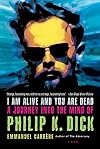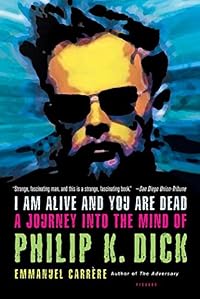
I Am Alive and You Are Dead: A Journey into the Mind of Philip K. Dick
by Emmanuel Carrère
On This Page
Description
For his many devoted readers, Philip K. Dick is not only one of the "one of the most valiant psychological explorers of the 20th century" (The New York Times) but a source of divine revelation. In the riveting style that won accolades for The Adversary, Emmanuel Carre?re's I Am Alive and You Are Dead, follows Dick's strange odyssey from his traumatic beginnings in 1928, when his twin sister died in infancy, to his lonely end in 1982, beset by mystical visions of swirling pink light, show more three-eyed invaders, and messages from the Roman Empire. Drawing on interviews as well as unpublished sources, he vividly conjures the spirit of this restless observer of American postwar malaise who subverted the materials of science fiction--parallel universes, intricate time loops, collective delusions--to create classic works of contemporary anxiety. show lessTags
Recommendations





















Member Recommendations

Member Reviews
It is hard to know what to make of this fictionalized biography of Philip K. Dick. The New York Times said it gives us a “bubble gum” treatment of Dick’s fiction, and that’s about right, but it reads a bit like a Dick story, and suggests that Scanner Darkly may be about as autobiographical as anything Dick ever wrote. There are no notes and no sources, so who knows what you can believe. Which seems to have been Dick’s attitude about reality, so there you go. 3.5.
This is in no sense a scholarly work—no footnotes, no bibliography, not even a "further reading" list. Emmaneul Carrère is an unabashed fan of Philip K. Dick who, having read everything there was to read, still wanted to know more about how Dick's mind worked. He pursued this quest through much of Dick's unpublished material and apparently interviews with those who knew him. (I say "apparently" because the lack of footnotes, while adding to readability, does detract from complete clarity about sources and research methods.) Nevertheless, Carrère has produced a fascinating book, and he and his translator, Timothy Brent, have made it a very readable one, too.
Carrère gives a reasonably full account of Dick's life, while assuming that show more his readers are those who have already read most or all of Dick's major works, and the earlier biographies. (Cautionary note: this means that, if you haven't read Dick's major works, you should beware of spoilers.) His goal is working out an understanding of his subject's mind from this wealth of material. To what extent did the traumas of Dick's childhood (the death of his twin sister when they were a few weeks old, his parents' divorce, his mother's own obsessions) contribute to his own instability and emotional problems, and to what extent were they merely the background against which his own personality oddities played out? How did his problems and his drug use affect his fiction? How much was the drug use the cause of his later problems, and how much was it an unguided attempt at self-medication? Carrère seems both clear-eyed and sympathetic in his descriptions of not only Philip Dick, but also his parents, wives, and friends. This is a highly readable and interesting book about a fascinating writer.
Recommended. show less
Carrère gives a reasonably full account of Dick's life, while assuming that show more his readers are those who have already read most or all of Dick's major works, and the earlier biographies. (Cautionary note: this means that, if you haven't read Dick's major works, you should beware of spoilers.) His goal is working out an understanding of his subject's mind from this wealth of material. To what extent did the traumas of Dick's childhood (the death of his twin sister when they were a few weeks old, his parents' divorce, his mother's own obsessions) contribute to his own instability and emotional problems, and to what extent were they merely the background against which his own personality oddities played out? How did his problems and his drug use affect his fiction? How much was the drug use the cause of his later problems, and how much was it an unguided attempt at self-medication? Carrère seems both clear-eyed and sympathetic in his descriptions of not only Philip Dick, but also his parents, wives, and friends. This is a highly readable and interesting book about a fascinating writer.
Recommended. show less
This one should be taken with a large pile of salt, but it's a really enjoyable biography for fans of PKD who have read all of his major works. (If you haven't read those books, then this one will be full of spoilers.) The narrator attempts to get inside Phil's mind and makes the creative process behind the novels part the story. In other words, it makes things up. That makes this "biography" essentially a work of historical fiction. But it does deliver a smooth, satisfying narrative, so I'd say it's well worth a read despite its factual shortcomings.
I had a serious phildickian moment while reading this concurrently with High Weirdness: I briefly became unstuck in time and had no idea who i was reading: Carrere, Erik Davis, PKD or myself.
Quarter of a century after his death, Philip K. Dick’s reputation and status is beginning to transcend mere founding fatherhood of modern science fiction and drift towards a more general greatness within the broader pastures of modern American literature.
Dick was exasperated about the perceived limitations of his genre while he was alive but before his untimely death in 1982 he had received industry acclaim for "The Man in the High Castle" in the sixties, but otherwise had garnered only cult following. Broader recognition beckoned - Ridley Scott’s "Blade Runner", based on Dick’s altogether more complex "Do Androids Dream of Electric Sheep?" was in post-production. Fame and fortune beckoned, but by this stage, as Emmanuel Carrere show more makes plain, even if he had not suffered massive stroke, Philip K Dick was in no state, mental or physical, to enjoy or capitalise on it.
That Dick was a troubled soul is relatively well known, but Carrere’s biography explores and extrapolates Dick’s unstable mental state into his literature and life choices, which became increasingly bizarre as the Seventies wore on. Carrere sources Dick’s discord in the death in infancy of his twin sister Jane, and was compounded by Dick’s hypochondria – and has produced an effervescent and fascinating portrait. Carrere, perhaps by taking some licence, gives us a close and personal view into his subject’s unusually complex psyche which is rare in a contemporary biography (the only other comparable example I can recall is the Gilmans’ excellent "Alias David Bowie"). Because of Carrere’s aproach, Philip K. Dick is made very real on the page.
Some will complain that Carerre’s approach crosses a sacred line into fictionalising, but philosophically I don’t have a problem with that (I’m not sure there even is such a line in fact): particularly since Philip K Dick is long dead, outside the content of his oeuvre we don't have any “facts” against which Carrere’s story can be measured – which will give pause in some quarters – but it doesn’t feel to me that Carrere has breached the poetic licence he undoubtedly as as a biographer. That the complaints, such as they are, have mostly been “in principle” and not on substance seems to confirm that. These are fair fictionalisations, that is, and they paint a vibrant and fascinating picture of the man and an excellent introduction to his major works which are analysed and contextualised in a good amount of detail.
The implication, never actually made, is that Dick’s hypochondria transcended simple pharmaceutical dependence and evolved into paranoia and ultimately genuine psychiatric illness. One might wonder what effect the cinematic success of Blade Runner and the many subsequent Dick dramatisations might have had on his mental state and subsequent writing career, but not for long: on Carrere’s account he was a burnt-out husk by the end so, most likely, none.
Carrere is a novelist himself, and he writes well – as, it should be said, does his translator. This didn’t feel at all like a translated book.
Well recommended. show less
Dick was exasperated about the perceived limitations of his genre while he was alive but before his untimely death in 1982 he had received industry acclaim for "The Man in the High Castle" in the sixties, but otherwise had garnered only cult following. Broader recognition beckoned - Ridley Scott’s "Blade Runner", based on Dick’s altogether more complex "Do Androids Dream of Electric Sheep?" was in post-production. Fame and fortune beckoned, but by this stage, as Emmanuel Carrere show more makes plain, even if he had not suffered massive stroke, Philip K Dick was in no state, mental or physical, to enjoy or capitalise on it.
That Dick was a troubled soul is relatively well known, but Carrere’s biography explores and extrapolates Dick’s unstable mental state into his literature and life choices, which became increasingly bizarre as the Seventies wore on. Carrere sources Dick’s discord in the death in infancy of his twin sister Jane, and was compounded by Dick’s hypochondria – and has produced an effervescent and fascinating portrait. Carrere, perhaps by taking some licence, gives us a close and personal view into his subject’s unusually complex psyche which is rare in a contemporary biography (the only other comparable example I can recall is the Gilmans’ excellent "Alias David Bowie"). Because of Carrere’s aproach, Philip K. Dick is made very real on the page.
Some will complain that Carerre’s approach crosses a sacred line into fictionalising, but philosophically I don’t have a problem with that (I’m not sure there even is such a line in fact): particularly since Philip K Dick is long dead, outside the content of his oeuvre we don't have any “facts” against which Carrere’s story can be measured – which will give pause in some quarters – but it doesn’t feel to me that Carrere has breached the poetic licence he undoubtedly as as a biographer. That the complaints, such as they are, have mostly been “in principle” and not on substance seems to confirm that. These are fair fictionalisations, that is, and they paint a vibrant and fascinating picture of the man and an excellent introduction to his major works which are analysed and contextualised in a good amount of detail.
The implication, never actually made, is that Dick’s hypochondria transcended simple pharmaceutical dependence and evolved into paranoia and ultimately genuine psychiatric illness. One might wonder what effect the cinematic success of Blade Runner and the many subsequent Dick dramatisations might have had on his mental state and subsequent writing career, but not for long: on Carrere’s account he was a burnt-out husk by the end so, most likely, none.
Carrere is a novelist himself, and he writes well – as, it should be said, does his translator. This didn’t feel at all like a translated book.
Well recommended. show less
25 years after his untimely death, Philip K. Dick is increasingly recognized as one of the major writers of the late 20th century, a figure who fearlessly confronted the political, cultural and spiritual dilemmas that have been central to modernity from the dawn of the nuclear age to the present day. His prodigious output over a 30-year career covers such themes as the nightmare of war, fascism, the nature of reality, the strange interpenetrations of technology and humanity that reshape the meaning and status of each, the search for spiritual grounding in a society that seems increasingly alien, the connections between past, present and future, and how the ways we understand sickness and health often reveal disturbing social show more tendencies.
Dick's use of science fiction as a medium was singularly well-suited for the intense and wide-ranging scope of his ideas while also being perhaps the most appropriate literary genre for his time and ours. Although science fiction was still regarded as a lowbrow genre at the time Dick began writing for publication and he made some attempts at producing "serious" literature at various points in his career, Dick was perceptive enough to understand the value of science fiction to accommodate his challenging ideas while making them palatable to a reasonably large audience. Dick's short fiction and novels have since proven to be a remarkably potent source of material for film adaptations, giving at least some of those ideas new life on the screen to challenge another generation, but - as anyone who has had the exhilarating experience of reading Dick's work can attest - there is really no substitute for his distinctive style.
Emmanuel Carrere's "I Am Alive and You Are Dead: A Journey into the Mind of Philip K. Dick" is an unusual biography. Although Carrere's text suggests that he carried out a significant amount of research, he has chosen not to document it by providing notes or sources. He also ventures far beyond the limits of what conventional biography would allow in terms of his speculations on the inner workings of Dick's mind. This imaginative approach, despite its hazards, may nevertheless be one of the better ways to view Dick's career in coherent terms, as sticking to the known facts of his life may be less useful. Carrere makes clear that Dick spent much of his time as a homebody, rarely venturing outside his living quarters when he became sufficiently settled down with one of his five wives. Domestic tranquility tended to be short-lived, and during periods when he was between relationships Dick would explore a somewhat wider social circle. Carrere describes Dick's brief sojourn in Berkeley (1964), his depressing span of time in the early 1970s in a commune-like California bachelor pad with several room-mates in various states of drug-induced stupor (much of this experience informing the setting of his novel A Scanner Darkly), and the final phase of his life in Fullerton among a sympathetic circle of friends and associates.
Carrere's portrait of Dick is often unflattering. Despite his gifts as a generous raconteur and debator who could stimulate and fascinate those around him as he wrestled with numerous themes, Dick was also a difficult person to be around for extended periods of time. He was emotionally needy and often behaved in immature ways, treated his wives and other women shabbily, was given to frequent bouts of paranoia and depression, and suffered from financial instability for much of his life. Dick tended to work in concentrated bursts of energy, writing several of his novels and stories in a series of late-night marathons. In the last years of his life he devoted much of his writing energy to a lengthy, unpublished "Exegesis" in which he took up a variety of philosophical and religious issues that obsessed him.
Carrere's explorations of Dick's inner life consist of extended meditations on themes central to his fiction at various stages of his career. Although these are mostly pure speculation on Carrere's part and should be recognized as such, they do provide a basis for fascinating questions about Dick's motivations and his sense of the culture in which he lived. Despite the often dark and terrifying themes in much of Dick's writing, there is nevertheless a sustained optimism, compassion, and hard-earned sense of the possible that can be found from beginning to end. Dick took alternate worlds seriously, and if Carrere's book sends you back to read, re-read, or discover new aspects of Dick's writing, it will have rewarded you with the gift of vision, something sorely needed in the grim present of 2007. show less
Dick's use of science fiction as a medium was singularly well-suited for the intense and wide-ranging scope of his ideas while also being perhaps the most appropriate literary genre for his time and ours. Although science fiction was still regarded as a lowbrow genre at the time Dick began writing for publication and he made some attempts at producing "serious" literature at various points in his career, Dick was perceptive enough to understand the value of science fiction to accommodate his challenging ideas while making them palatable to a reasonably large audience. Dick's short fiction and novels have since proven to be a remarkably potent source of material for film adaptations, giving at least some of those ideas new life on the screen to challenge another generation, but - as anyone who has had the exhilarating experience of reading Dick's work can attest - there is really no substitute for his distinctive style.
Emmanuel Carrere's "I Am Alive and You Are Dead: A Journey into the Mind of Philip K. Dick" is an unusual biography. Although Carrere's text suggests that he carried out a significant amount of research, he has chosen not to document it by providing notes or sources. He also ventures far beyond the limits of what conventional biography would allow in terms of his speculations on the inner workings of Dick's mind. This imaginative approach, despite its hazards, may nevertheless be one of the better ways to view Dick's career in coherent terms, as sticking to the known facts of his life may be less useful. Carrere makes clear that Dick spent much of his time as a homebody, rarely venturing outside his living quarters when he became sufficiently settled down with one of his five wives. Domestic tranquility tended to be short-lived, and during periods when he was between relationships Dick would explore a somewhat wider social circle. Carrere describes Dick's brief sojourn in Berkeley (1964), his depressing span of time in the early 1970s in a commune-like California bachelor pad with several room-mates in various states of drug-induced stupor (much of this experience informing the setting of his novel A Scanner Darkly), and the final phase of his life in Fullerton among a sympathetic circle of friends and associates.
Carrere's portrait of Dick is often unflattering. Despite his gifts as a generous raconteur and debator who could stimulate and fascinate those around him as he wrestled with numerous themes, Dick was also a difficult person to be around for extended periods of time. He was emotionally needy and often behaved in immature ways, treated his wives and other women shabbily, was given to frequent bouts of paranoia and depression, and suffered from financial instability for much of his life. Dick tended to work in concentrated bursts of energy, writing several of his novels and stories in a series of late-night marathons. In the last years of his life he devoted much of his writing energy to a lengthy, unpublished "Exegesis" in which he took up a variety of philosophical and religious issues that obsessed him.
Carrere's explorations of Dick's inner life consist of extended meditations on themes central to his fiction at various stages of his career. Although these are mostly pure speculation on Carrere's part and should be recognized as such, they do provide a basis for fascinating questions about Dick's motivations and his sense of the culture in which he lived. Despite the often dark and terrifying themes in much of Dick's writing, there is nevertheless a sustained optimism, compassion, and hard-earned sense of the possible that can be found from beginning to end. Dick took alternate worlds seriously, and if Carrere's book sends you back to read, re-read, or discover new aspects of Dick's writing, it will have rewarded you with the gift of vision, something sorely needed in the grim present of 2007. show less
This book will alter your perception of Philip K Dick.
Writing a biography is one thing, getting inside Philip K Dick's mind quite another. In this novelisation of the science fiction writer's life the biographical facts are incidental, and reconstructing the amphetamine fuelled thoughts that drove him to write, divorce (four times?), attempt suicide (twice), and invent and inhabit his own fantastic and fear-filled worlds is M. Carrere's objective.
He succeeds brilliantly. It's astounding that in his paranoid delusional state Dick achieved so much, although paradoxically that's what drove him. It's a testament to M. Carrere's skill that his portrait is so lucid. His book could so easily have fallen apart, as Dick did.
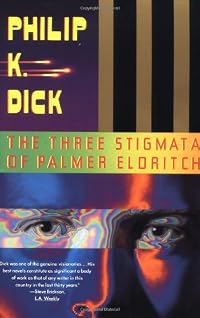
If you've seen some show more of the films (Blade Runner, Minority Report, A Scanner Darkly) or read some of the books (The Man in a High Castle, The Three Stigmata of Palmer Eldritch, Ubiq) reading this book will enhance your appreciation of them. You'll suddenly realise what Dick was getting at, where before you'd enjoyed the ride.
It left me wanting a 'proper' biography (which exists, it's by Lawrence Sutin). That's not a criticism, Dick's universe had little room for reality. He discards the bit players in his life when they cease to be relevant. Now I'd like to know about Dick, as they saw him. The 'real' Dick, perhaps. show less
Writing a biography is one thing, getting inside Philip K Dick's mind quite another. In this novelisation of the science fiction writer's life the biographical facts are incidental, and reconstructing the amphetamine fuelled thoughts that drove him to write, divorce (four times?), attempt suicide (twice), and invent and inhabit his own fantastic and fear-filled worlds is M. Carrere's objective.
He succeeds brilliantly. It's astounding that in his paranoid delusional state Dick achieved so much, although paradoxically that's what drove him. It's a testament to M. Carrere's skill that his portrait is so lucid. His book could so easily have fallen apart, as Dick did.
If you've seen some show more of the films (Blade Runner, Minority Report, A Scanner Darkly) or read some of the books (The Man in a High Castle, The Three Stigmata of Palmer Eldritch, Ubiq) reading this book will enhance your appreciation of them. You'll suddenly realise what Dick was getting at, where before you'd enjoyed the ride.
It left me wanting a 'proper' biography (which exists, it's by Lawrence Sutin). That's not a criticism, Dick's universe had little room for reality. He discards the bit players in his life when they cease to be relevant. Now I'd like to know about Dick, as they saw him. The 'real' Dick, perhaps. show less
Members
- Recently Added By
Published Reviews
ThingScore 75
Emmanuel Carrère thinks the posthumously published social novels Dick produced were done to please snobbish friends and lovers. However, Dick was continually looking for the form which would best suit his ideas. No great stylist, his problem was that he had a hard time putting a story together without the conventions of genre fiction. His best work uses the methods developed in the pages of show more Galaxy by a group of writers including Pohl, Kornbluth, Bester, Sheckley and Harlan Ellison. What we today recognise as the "PKD future" is actually a collaboration between these socially conscious writers responding to Eisenhower's and J Edgar Hoover's America and specifically to McCarthyism. Unlike the conservative techno-SF writers, they actually predicted the world we know today. show less
added by SnootyBaronet
Lists

Non-Fiction Worth Reading
1,015 works; 261 members
Author Information

49+ Works 6,810 Members
Emmanuel Carrere is one of France's most critically acclaimed writers, author of screenplays, a biography of Philip K. Dick, and two novels, including CLASS TRIP, which won the prestigious Prix Femina. A major bestseller in France, THE ADVERSARY is being published in eighteen countries. Carrere lives in Paris (Bowker Author Biography)
Some Editions
Common Knowledge
- Canonical title*
- Je suis vivant et vous êtes morts
- Original title
- I Am Alive and You Are Dead: A Journey into the Mind of Philip K. Dick
- Original publication date
- 1994 (English Translation) (English Translation); 1993
- People/Characters
- Philip K. Dick
- Epigraph
- I am sure, as you hear me say this, you do not truly believe me, or even believe that I believe it myself. But nevertheless it is true. . . . You are free to believe me or free to disbelieve, but please take my word on it th... (show all)at I am not joking; this is very serious, a matter of importance. I am sure that at the very least you will agree that for me even to claim this is in itself amazing. Often people claim to remember past lives; I claim to remember a different, very different, present life. I know of no one who has ever made that claim before, but I rather suspect that my experience is not unique; what perhaps is unique is the fact that I am willing to talk about it. -- FROM A SPEECH GIVEN BY PHILIP K. DICK IN FRANCE, SEPTEMBER 24, 1977
- Dedication
- For Anne
- First words
- The book you hold in your hands is a very peculiar book.
- Quotations
- He had never had imagination; he had only written reports.
- Last words
- (Click to show. Warning: May contain spoilers.)When Phil was laid next to Jane, the old man, who until then had shown no emotion, saw the tiny coffin and burst into sobs.
- Original language
- French
*Some information comes from Common Knowledge in other languages. Click "Edit" for more information.
Classifications
Statistics
- Members
- 734
- Popularity
- 38,315
- Reviews
- 18
- Rating
- (3.90)
- Languages
- 6 — English, French, German, Italian, Portuguese, Spanish
- Media
- Paper, Ebook
- ISBNs
- 26
- ASINs
- 7