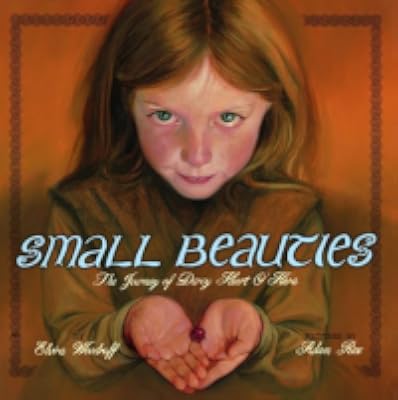
Small Beauties: The Journey of Darcy Heart O'Hara
by Elvira Woodruff (Author), Adam Rex (Illustrator)
On This Page
Description
Darcy Heart O'Hara, a young Irish girl who neglects her chores to observe the beauties of nature and everyday life, shares "family memories" with her homesick parents and siblings after the O'Haras are forced to emigrate to America in the 1840s.Tags
Recommendations





Member Reviews
Darcy Heart O'Hara - so named because of her Granny's prophecy that she would one day hold her family's heart in the palm of her hands - wasn't like the other children in her small Irish village of Pobble O'Keefe. She was a "noticer," someone with an eye for the small beauties around her, and although her family were sometimes impatient with her dreamy inattention to practical matters - gathering the eggs, milking the cow - it was a quality that would stand her (and them) in good stead, when the terrible events of the Great Famine overtook them. The failure of multiple potato crops, the resultant hunger that the O'Haras and all their neighbors experienced, the violent forced eviction from their home, and the long journey to America, show more were ugly, heart-breaking realities. Could Darcy's "small beauties" - the many little objects she has sewn into the hem of her dress, over the years - remind them of the beauty of their abandoned homeland?
An Gorta Mór (the "great hunger"), or the Great Famine, as it is known in English, was one of the defining events of modern Irish history, killing more than a million people outright, and sending more than a million more into exile, all in the course of seven years. More than simply the tragic and inevitable result of the potato blight which had struck all of Europe, it was a catastrophe that was caused by deliberate British policy (hence Tony Blair's apology to the Irish people, a few years back), and lingers on in the folk memory of the Irish, both at home and in the diaspora. Elvira Woodruff's Small Beauties: The Journey of Darcy Heart O'Hara is a moving introduction to this difficult topic, one ideally suited for younger readers. While it doesn't completely gloss over some of the more horrific aspects of this tragedy - the O'Hara's home is set alight by those evicting them, while they are still inside - it also doesn't concentrate on the atrocities. Instead, the narrative focuses on the love shared by the O'Hara family - the storytelling sessions with Granddad, the tearful goodbyes when the O'Hara grandparents decide they are too old to make the journey to America - as they struggle to survive a terrible time. The accompanying illustrations by Adam Rex, whose work is usually more in the comic vein, are simply beautiful, capturing the emotional register of each scene flawlessly.
I had tears in my eyes, as I finished this book, and I heartily recommend it to anyone looking for children's stories that address the Great Famine in Ireland, the experiences of the Irish in the diaspora, or the immigrant experience in general. show less
An Gorta Mór (the "great hunger"), or the Great Famine, as it is known in English, was one of the defining events of modern Irish history, killing more than a million people outright, and sending more than a million more into exile, all in the course of seven years. More than simply the tragic and inevitable result of the potato blight which had struck all of Europe, it was a catastrophe that was caused by deliberate British policy (hence Tony Blair's apology to the Irish people, a few years back), and lingers on in the folk memory of the Irish, both at home and in the diaspora. Elvira Woodruff's Small Beauties: The Journey of Darcy Heart O'Hara is a moving introduction to this difficult topic, one ideally suited for younger readers. While it doesn't completely gloss over some of the more horrific aspects of this tragedy - the O'Hara's home is set alight by those evicting them, while they are still inside - it also doesn't concentrate on the atrocities. Instead, the narrative focuses on the love shared by the O'Hara family - the storytelling sessions with Granddad, the tearful goodbyes when the O'Hara grandparents decide they are too old to make the journey to America - as they struggle to survive a terrible time. The accompanying illustrations by Adam Rex, whose work is usually more in the comic vein, are simply beautiful, capturing the emotional register of each scene flawlessly.
I had tears in my eyes, as I finished this book, and I heartily recommend it to anyone looking for children's stories that address the Great Famine in Ireland, the experiences of the Irish in the diaspora, or the immigrant experience in general. show less
I purchased this at Auntie’s Books in Spokane back in November of 2007, attracted by the lovely pictures and Irish theme. Set during the potato famine, it tells the story of the intrepid Darcy Heart O’Hara, who refuses to be downtrodden by the negatives in her life. Instead she finds “small beauties” – a butterfly wing, a pebble, a flower – amidst poverty and blight, carrying her treasures in the hem of her skirt. When her family is forced to emigrate to America after their cottage is set ablaze by the Crown's agent, Darcy brings her remembrances to call up memories of home and give courage to her family. My favorite picture is of Grandad telling stories at the hearth, all the family, the cats and dogs and pigs, gathered show more round. His hands and body language describe horses and fairies in the air. In an author’s note, Woodruff explains that the story is based on a family she’d read about who left County Cork in 1847. One of the children was Henry Ford.
I love that Darcy finds solace and hope in the smallest things and shares them with others. All the more reason for us to hold tight to our connections with the natural world, for they help keep us sane and alive. show less
I love that Darcy finds solace and hope in the smallest things and shares them with others. All the more reason for us to hold tight to our connections with the natural world, for they help keep us sane and alive. show less
Small Beauties is about a family in Ireland that lived on a potato farm. There was a baby born and they named her Darcy Heart because her grandmother saw into the future that she held the heart of the family. Darcy is very different from her family members. The rest of the family is so worried about the farm and Darcy gets distracted by the little things like flowers, pebbles, and even the clouds. To her, these were the finer things in life and she really appreciated them in ways that others didn't.
The time frame that this story took place in was 1845, during the Great Famine or the Great Hunger, which was the Potato famine. This was when all the potato crop went bad and everyone was starving and had no money. The O'Hara family was show more forced to emigrate to the United States. Once they were there, Darcy pulls out all the things that she saved in the hem of her dress, and it brought back all the great memories of Ireland.
I really enjoyed the plot of this story. It shows that even the smaller and non important things can somehow have a greater meaning. This teaches that you don't need the most extravagant things to have it all. Family is enough. show less
The time frame that this story took place in was 1845, during the Great Famine or the Great Hunger, which was the Potato famine. This was when all the potato crop went bad and everyone was starving and had no money. The O'Hara family was show more forced to emigrate to the United States. Once they were there, Darcy pulls out all the things that she saved in the hem of her dress, and it brought back all the great memories of Ireland.
I really enjoyed the plot of this story. It shows that even the smaller and non important things can somehow have a greater meaning. This teaches that you don't need the most extravagant things to have it all. Family is enough. show less
I personally loved this story and was very interested in the plot of the story. Although I have Irish heritage, I am unaware of many of the Irish traditions and lifestyles. I love history and so this book was great because it focused on the time period of the Great Potato Famine of Ireland in the late 1840’s. Although the story provided a lot of information on the famine and the hardships and struggles they went through, I liked how the story was told in a realistic way through the eyes of a young child. I loved how the child was very positive and was able to see the beauty in everything, even in the midst of destruction and loss: “But as poor as she was, Darcy often felt rich with the many beauties she noticed.” The story was show more great because it showed how a positive perspective can change your outlook on even the worst situations. show less
From the moment Darcy Heart O'Hara was born her family knew she had a gift, a "second sight" as her grandma immediately deemed. She noticed the beauty in all things around her, the birds, flowers, the clouds, and even the pebbles. As her family is stricken with hardship and their potato crop rots, Darcy still finds beauty in her surroundings. Sadly, the family must leave their beloved Ireland and migrate to a land of new beginnings, the United States. As her family mourns the loss of their land and home, Darcy fills the room with all of her small beauties she has kept, from a feather, to flowers, a bead from her grandma's rosary and finally a piece of hearthstone from their previous homeland.
The small bits from the previous home brings show more joyful memories to all of the family and Darcy realizes the importance of her gift that so many took forgranted. show less
The small bits from the previous home brings show more joyful memories to all of the family and Darcy realizes the importance of her gift that so many took forgranted. show less
Darcy lived with her family in Ireland, but she was much different from them. She loved the small beauties in the world that most people overlooked, and she would stop constantly to appreciate them and take notice. When a famine strikes and the family soon loses everything, they are forced to move to America. While they leave all, they have and are forced to make and find a new home, Darcy has a keepsake that will help them feel at home and see the beauty in the situation they are in.
The famine that struck Ireland devastated and destroyed the lives of many people living there during the time. While the O’Hara family in the story is fictional, the story is very realistic and was most likely like a lot of other family’s stories show more there. Darcy’s passion for finding the good in all the bad is something that we can all do, even today, when faced or experiencing things that we feel we can never come back from. The story gives background and knowledge to how hard the famine struck the people of Ireland, but also teaches a lesson that can be carried over in the reader’s ever day lives. I think it is a story that everyone can find a way to relate to in some aspect. show less
The famine that struck Ireland devastated and destroyed the lives of many people living there during the time. While the O’Hara family in the story is fictional, the story is very realistic and was most likely like a lot of other family’s stories show more there. Darcy’s passion for finding the good in all the bad is something that we can all do, even today, when faced or experiencing things that we feel we can never come back from. The story gives background and knowledge to how hard the famine struck the people of Ireland, but also teaches a lesson that can be carried over in the reader’s ever day lives. I think it is a story that everyone can find a way to relate to in some aspect. show less
I really liked this book! The first reason I liked this book was for the front and back flyleaf designs. After reading the title and predicting it was going to be about a journey a young girl’s goes on, the flyleaves depicted a colored pencil-drawn map of the Atlantic ocean with a nautical line drawn from Ireland to the United States. The flyleaves were also tainted a little brown to make the hand-drawn map look older. These flyleaves immediately caught my attention because I love the look of nautical maps and it gave me more insight as to where the young girl was going to be traveling. I have always wanted to go to Ireland so I was very interested to see if the young girl traveled to the United States or to Ireland from the United show more States. Another reason I enjoyed this book was for the unique placement of some of the illustrations throughout the story. Whenever the book enumerated items that were found in the hem of Darcy’s dress, the items were strung along within the text. For example, when Darcy lived in Ireland and found something she noticed was beautiful, she would loosen a few stiches in the hem of her dress and “tuck in a flower, a pebble, or a found butterfly’s wing.” After each item in the list, a picture of that item would be placed right next to it, allowing the reader to look at it as they read from left to right across the page. I loved this aspect of the book because it made reading the text more interesting to read by placing pictures where I would normally never see pictures in a text. I felt as if I was reading the pictures! Overall, the big idea of this book was to detail about the struggle of moving from one country to another when your entire family has lived in that country for as long as they can remember. The loss that comes with saying your final goodbyes to the country and the people who live there is a hard concept to grasp and deal with and this book wanted to highlight this event, especially because so many people when through this during the time immigrants were flooding to America. show less
Members
- Recently Added By
Author Information


Adam Rex received a BFA from the University of Arizona. His first picture book, The Dirty Cowboy by Amy Timberlake, was published in 2003. His works include Frankenstein Makes a Sandwich, The True Meaning of Smekday, and Fat Vampire. (Bowker Author Biography)
Awards and Honors
Awards
Notable Lists
Common Knowledge
- Original publication date
- 2006
- Important places
- Ireland
- Important events
- Irish potato famine
- Dedication
- For my mother, Franny Pirozzi, who always noticed the wildflowers growing along the road.
And for three Irish beauties I know:
Pat M. Brisson, who was born with poetry in her soul,
Caroline Ryon, who shes her heart... (show all) upon her page,
& her grandmother, Joan Donegan, whose poetry is in her smile.
-- E.W.
For Emma Leever and her family -- thanks. -- A.R. - First words
- On the night Darcy O'Hara was born, her father danced a jig in the firelight of their small cottage.
- Last words
- (Click to show. Warning: May contain spoilers.)And Darcy Heart O'Hara went right on noticing.
- Original language
- English
Classifications
Statistics
- Members
- 82
- Popularity
- 388,914
- Reviews
- 17
- Rating
- (4.23)
- Languages
- English
- Media
- Paper, Ebook
- ISBNs
- 3
- ASINs
- 1