
On This Page
Description
Faster than light travel is impossible--until the discovery of The Flow, an extradimensional field available at certain points in space-time, which can take us to other planets around other stars. Riding The Flow, humanity spreads to innumerable other worlds. Earth is forgotten. A new empire arises, the Interdependency, based on the doctrine that no one human outpost can survive without the others. It's a hedge against interstellar war--and, for the empire's rulers, a system of control. But show more when it's discovered that the entire Flow is moving, possibly separating all human worlds from one another forever, a scientist, a starship captain, and the emperox of the Interdependency must race to find out what can be salvaged from an empire on the brink of collapse. -- show lessTags
Recommendations

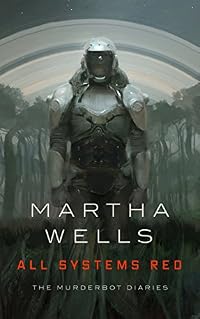
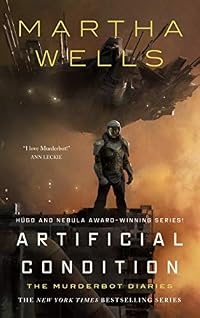
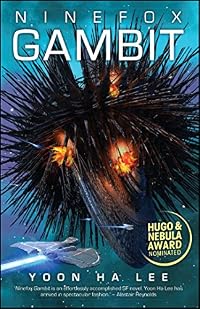
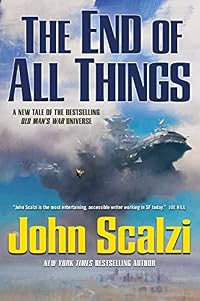


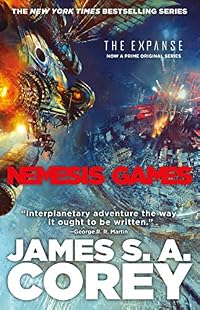
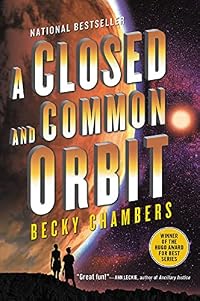

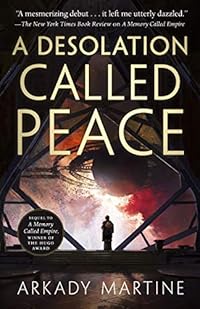
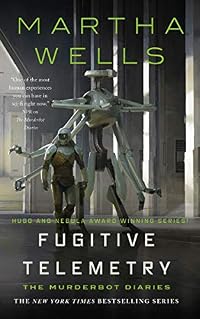


Member Recommendations
reading_fox Both feature unexpected Empresses in a hard SF universe.
Member Reviews
Definitely one of the best series I read this year. (Review is of the whole series because I read them so quickly I can't remember what parts happened in which volume)
In the far future, humanity is set up on a series of planets and systems that are connected by some pretty neat worm holes. They don't really know where they came from or how they work, which is a problem because it appears that they're closing. The new Emperox is concerned with trying to hold civilization together and rescue folks from worlds that aren't sustainable without the Interdependency because she's a benevolent ruler, but the power- and money-hungry factions of her quasi-government don't really care about that and so they're engaged in all kinds of machinations show more to thwart her in the pursuit of the aforementioned power and money.
Another main character is Lady Kiva Lagos who is probably the most delightfully profane person I've ever come across and I love her deeply. She will (and frequently does) sleep with anybody and doesn't give a F*** about anything but her family and getting laid, until she's in the middle of this whole cluster and seems to just enjoy f-ing up the lives of people who are a-holes.
Lastly, we have Marce Claremont, who grew up on the farthest planet out because his father was exiled there to try to figure out the whole tunnel disappearance thing (one had disappeared a some years prior), and his dad wants him to get back to inform the Emperox what he found out. He's a sweet, nerdy dude with a big brain and an even bigger heart. I love him, too.
In fact, I loved all these characters and also hated everyone trying to get in their way, and if you're a reader of Science Fiction, you know that usually they're more about ideas and plot (or blasting up space aliens) than characters. The great thing about Scalzi is that he writes amazing characters *in addition* to great plots and his stories engage both your mind and your heart. Well done. Highly recommend. show less
In the far future, humanity is set up on a series of planets and systems that are connected by some pretty neat worm holes. They don't really know where they came from or how they work, which is a problem because it appears that they're closing. The new Emperox is concerned with trying to hold civilization together and rescue folks from worlds that aren't sustainable without the Interdependency because she's a benevolent ruler, but the power- and money-hungry factions of her quasi-government don't really care about that and so they're engaged in all kinds of machinations show more to thwart her in the pursuit of the aforementioned power and money.
Another main character is Lady Kiva Lagos who is probably the most delightfully profane person I've ever come across and I love her deeply. She will (and frequently does) sleep with anybody and doesn't give a F*** about anything but her family and getting laid, until she's in the middle of this whole cluster and seems to just enjoy f-ing up the lives of people who are a-holes.
Lastly, we have Marce Claremont, who grew up on the farthest planet out because his father was exiled there to try to figure out the whole tunnel disappearance thing (one had disappeared a some years prior), and his dad wants him to get back to inform the Emperox what he found out. He's a sweet, nerdy dude with a big brain and an even bigger heart. I love him, too.
In fact, I loved all these characters and also hated everyone trying to get in their way, and if you're a reader of Science Fiction, you know that usually they're more about ideas and plot (or blasting up space aliens) than characters. The great thing about Scalzi is that he writes amazing characters *in addition* to great plots and his stories engage both your mind and your heart. Well done. Highly recommend. show less
I really needed something fun to read. This was it.
All I wanted was entertainment, and I got even a little bit more. The plot is just complicated enough to engage but not so much that you can’t remember who is who and what is what. Absorbing, fun, and just provocative enough for a kick.
The setting, in great space opera style, is a broad empire stretching across star systems. The empire’s elements are connected by the Flow, a faster-than-light natural interstellar freeway system.
Each of the empire’s systems is designed in interdependency, hence the empire’s name, the Interdependency. No system is capable of sustaining itself on its own. In fact, their very existence, since all but one is an artificially constructed and maintained show more habitat buried under an uninhabitable planet’s surface or floating above it, requires mutual trade and services.
As an interdependent system, it is stable. But it also depends on the Flow. Without the Flow, no ships could reach from system to system, providing the mutual support they all need.
And that’s the problem. Only a few know it, but the Flow is breaking down.
That’s the problem the new “emperox”, Greyland II (informerly Cardenia Wu), is facing as she succeeds her father to a job she never really wanted.
The story is a political one. Control of the Interdependency lies in a hierarchical guild structure, with Greyland’s guild house at the top but in constant competition with the others. Political scheming provides the historical background, exacerbates the coming crisis, and circumscribes the possibilities looking forward.
When I think of the elements I want in a big space opera, I think of:
A big idea — the Flow, tied with the political idea of interdependence
A massive, existential threat — the collapse of the Flow streams
Conflict — the guilds’ political scheming
Hope — Greyland’s honesty and naïveté
Central characters that bridge the small and the big scale stories — check (Cardenia Wu, Marce Claremont, and Kiva Lagos lead the way)
Aliens — optional (and absent here — remember, the Foundation also lacked aliens)
And the style, Scalzi’s style, is breezy and irreverent. Pages fly by, and you want more.
I’m a little bummed I finished the book, but there are two more. show less
All I wanted was entertainment, and I got even a little bit more. The plot is just complicated enough to engage but not so much that you can’t remember who is who and what is what. Absorbing, fun, and just provocative enough for a kick.
The setting, in great space opera style, is a broad empire stretching across star systems. The empire’s elements are connected by the Flow, a faster-than-light natural interstellar freeway system.
Each of the empire’s systems is designed in interdependency, hence the empire’s name, the Interdependency. No system is capable of sustaining itself on its own. In fact, their very existence, since all but one is an artificially constructed and maintained show more habitat buried under an uninhabitable planet’s surface or floating above it, requires mutual trade and services.
As an interdependent system, it is stable. But it also depends on the Flow. Without the Flow, no ships could reach from system to system, providing the mutual support they all need.
And that’s the problem. Only a few know it, but the Flow is breaking down.
That’s the problem the new “emperox”, Greyland II (informerly Cardenia Wu), is facing as she succeeds her father to a job she never really wanted.
The story is a political one. Control of the Interdependency lies in a hierarchical guild structure, with Greyland’s guild house at the top but in constant competition with the others. Political scheming provides the historical background, exacerbates the coming crisis, and circumscribes the possibilities looking forward.
When I think of the elements I want in a big space opera, I think of:
A big idea — the Flow, tied with the political idea of interdependence
A massive, existential threat — the collapse of the Flow streams
Conflict — the guilds’ political scheming
Hope — Greyland’s honesty and naïveté
Central characters that bridge the small and the big scale stories — check (Cardenia Wu, Marce Claremont, and Kiva Lagos lead the way)
Aliens — optional (and absent here — remember, the Foundation also lacked aliens)
And the style, Scalzi’s style, is breezy and irreverent. Pages fly by, and you want more.
I’m a little bummed I finished the book, but there are two more. show less
Everyone knows you can’t travel faster than the speed of light. But, the Flow provides a convenient workaround. The Flow connects the 47 habitable star systems remaining after Earth was lost. The Flow led to the philosophy of Interdependency. No one colony can survive on its own. Interdependency has shaped politics and religion to an equal extent as they have shaped economics. But can the Interdependency survive the coming instability of The Flow?
Fans of complex, through provoking space-opera rich in world-building (à la Frank Herbert’s Dune series) will rejoice.
When the trilogy is over, I hope for a companion The Collected Wisdom of Kiva Lagos. Her mastery of inventive cursing is matched only by her Machiavellian streak. I have show more so much to learn from her!
Wil Wheaton again shows why he is one of my favorite narrators! show less
Fans of complex, through provoking space-opera rich in world-building (à la Frank Herbert’s Dune series) will rejoice.
When the trilogy is over, I hope for a companion The Collected Wisdom of Kiva Lagos. Her mastery of inventive cursing is matched only by her Machiavellian streak. I have show more so much to learn from her!
Wil Wheaton again shows why he is one of my favorite narrators! show less
This is the second John Scalzi novel I've read after Redshirts, and if anything, it's somehow even worse. The main problem with The Collapsing Empire is that the main characters are all the same: relentless quippers. It's like reading the script for a Joss Whedon show, except even Joss Whedon knows you have to have real human emotion sometime to balance it out. I read a review of the book that claimed, "Scalzi’s characters have always been great—funny, dynamic, and easy to identify with—but over the years he’s improved in the way he frames and builds each individual personality. Cardenia, Marce, and Kiva all come from drastically different origins, and their reactions to the future are specific to their own perspective." show more Admittedly this review was on the blog of the publisher so of course it's a little slanted, but I found it inexplicable because all of these characters sounded exactly the same. They all quip and banter their way through every situation. The complete lack of earnest emotional response grew wearying, exacerbated by the fact that even the narrator gets in on the quipping! Like, if the narrator can't react like these things matter, why should I?
It also doesn't help that there seems to be a direct correlation between quippiness and moral worth. All the good characters are great at quipping; all the evil characters are humorless planks. It's way too obvious and too simple, like the Interdependency is not actually a monarchy or a theocracy, but a quiptocracy, where the most sarcastic person is placed in charge. And one of the characters in particular irritated me, Cardenia, whose sexual antics I found squicky in that her pressuring other people, including subordinates, into sex is presented in a ha-ha-she's-so-empowered-isn't-it-funny light.
Outside of the characters, there's just not much to this novel. The political set-up feels derivative of Dune and not particularly interestingly so: an interstellar empire where "guilds" and "houses" play significant roles. (I know Dune didn't originate this, but Collapsing Empire doesn't do anything unique with it except in superficial ways.) The main plot of the series is contrived. The "Flow" is the alternate dimension ships can move into to travel faster-than-light, a lot like the depiction of hyperspace in things like Babylon 5, but it's collapsing, meaning the end of the Interdependency. But somehow in a vast interstellar empire predicated on the existence of the Flow, there are literally two scientists who study it? And it seems kind of silly that the one who's predicted it's going to collapse figures this out about a week before it begins to happen. Like, what's the point? (Scalzi also seems to think that peer review is another person checking your sums.) The book does have the occasional surprising moment, but on the whole it moves in pretty predictable directions. show less
It also doesn't help that there seems to be a direct correlation between quippiness and moral worth. All the good characters are great at quipping; all the evil characters are humorless planks. It's way too obvious and too simple, like the Interdependency is not actually a monarchy or a theocracy, but a quiptocracy, where the most sarcastic person is placed in charge. And one of the characters in particular irritated me, Cardenia, whose sexual antics I found squicky in that her pressuring other people, including subordinates, into sex is presented in a ha-ha-she's-so-empowered-isn't-it-funny light.
Outside of the characters, there's just not much to this novel. The political set-up feels derivative of Dune and not particularly interestingly so: an interstellar empire where "guilds" and "houses" play significant roles. (I know Dune didn't originate this, but Collapsing Empire doesn't do anything unique with it except in superficial ways.) The main plot of the series is contrived. The "Flow" is the alternate dimension ships can move into to travel faster-than-light, a lot like the depiction of hyperspace in things like Babylon 5, but it's collapsing, meaning the end of the Interdependency. But somehow in a vast interstellar empire predicated on the existence of the Flow, there are literally two scientists who study it? And it seems kind of silly that the one who's predicted it's going to collapse figures this out about a week before it begins to happen. Like, what's the point? (Scalzi also seems to think that peer review is another person checking your sums.) The book does have the occasional surprising moment, but on the whole it moves in pretty predictable directions. show less
I was a huge fan of the entire Old Man’s War series, but hungry for more Scalzi after that I turned to Red Shirts and was pretty let down by the second half (in which it became entirely too meta/self-aware and stopped being fun). So I went into this skeptical, but hopeful, as I suspected crunchier sci-fi/space opera is where Scalzi really shines. What I got was better than I feared, but still somewhat less than I hoped for.
We’re introduced to a new universe that in some ways resembles the socially liberal future of Old Man’s War (which is good). We get some strong female and male leads, distinct personalities (though not necessarily dynamic ones), believable social mores, and its clear reasonable early on that characters can and show more will be sacrificed for the sake of plot. All of that is good. However, while the book was fun and rapid to digest, I found myself somewhat unsatisfied. I have seen other readers suggest that it felt a bit like information and developments might be being held back as this was intended as the first book in a fairly long series from the outset, and perhaps that’s part of the problem...but story felt almost rushed to me. For all this is meant as a galaxy spanning empire with complex political and social systems and scheming (perhaps a send up to Dune as others have said), it feels curiously light on details concerning what are undoubtedly intricate plots and socio-political and business connections, even where they would be directly relevant to the plot. We get some straight up exposition about it from the adorably vulgar Kiva Largos and the eminently hateable Nohamapetans, as well as from the memory room, but I feel like other major houses are largely ignored, as is the role of the Church. Why have such a rich and varied socio-political system if we aren’t going to explore its intricacies a bit?
And maybe it’s just because I loved Old Man’s War so much, but the storytelling as a whole seems rushed...at least until the end of the book which seems to stop too abruptly in media res.
However, at least I found myself interested in and curious about what was going to happen, something I couldn’t say for Redshirts. So i’ll Likely read the next book when it comes out and see if taken together the series seems to be more promising. I’ll definitely want an improvement over this to go beyond book two though. show less
We’re introduced to a new universe that in some ways resembles the socially liberal future of Old Man’s War (which is good). We get some strong female and male leads, distinct personalities (though not necessarily dynamic ones), believable social mores, and its clear reasonable early on that characters can and show more will be sacrificed for the sake of plot. All of that is good. However, while the book was fun and rapid to digest, I found myself somewhat unsatisfied. I have seen other readers suggest that it felt a bit like information and developments might be being held back as this was intended as the first book in a fairly long series from the outset, and perhaps that’s part of the problem...but story felt almost rushed to me. For all this is meant as a galaxy spanning empire with complex political and social systems and scheming (perhaps a send up to Dune as others have said), it feels curiously light on details concerning what are undoubtedly intricate plots and socio-political and business connections, even where they would be directly relevant to the plot. We get some straight up exposition about it from the adorably vulgar Kiva Largos and the eminently hateable Nohamapetans, as well as from the memory room, but I feel like other major houses are largely ignored, as is the role of the Church. Why have such a rich and varied socio-political system if we aren’t going to explore its intricacies a bit?
And maybe it’s just because I loved Old Man’s War so much, but the storytelling as a whole seems rushed...at least until the end of the book which seems to stop too abruptly in media res.
However, at least I found myself interested in and curious about what was going to happen, something I couldn’t say for Redshirts. So i’ll Likely read the next book when it comes out and see if taken together the series seems to be more promising. I’ll definitely want an improvement over this to go beyond book two though. show less
The first thing you have to accept is that this is part one of three (#3's due out fall 2020), so this is a third of the story. Okay? Okay. I've seen several low-star reviews harping on this. It's right there in the title, ahem.
Second; it really is space opera, but thankfully minus the goofiness many authors attempt under that subgenre title. It's playful, but not goofy.
Third; if you're like me and tire quickly under overloaded court intrigue, rest assured it is not overly complex and indeed there's also no language difference that would happen over distance & time in real life. Again, common in space opera.
Given all that, each point of view character remained interesting to me, which is no mean feat in a multi-POV story. And Scalzi show more kept the plot interesting, such that I kinda raced through the last few chapters - only to grin at the end.
Book 2's available from my library. Guess what tab I'm opening next. :) show less
Second; it really is space opera, but thankfully minus the goofiness many authors attempt under that subgenre title. It's playful, but not goofy.
Third; if you're like me and tire quickly under overloaded court intrigue, rest assured it is not overly complex and indeed there's also no language difference that would happen over distance & time in real life. Again, common in space opera.
Given all that, each point of view character remained interesting to me, which is no mean feat in a multi-POV story. And Scalzi show more kept the plot interesting, such that I kinda raced through the last few chapters - only to grin at the end.
Book 2's available from my library. Guess what tab I'm opening next. :) show less
This is one of Scalzi's better stories…on par with "Old Man's War". What makes this book so exciting is that the fights and battles and dangers all center around verbal/cerebral conflict, more than physical conflict. Yes, there is physical danger, but there's no lead-up to the physical dangers: they happen so quickly and are over so quickly that they merely provide a quick adrenalin rush between the verbal sparring and jabbing and cutting. This is a story that can be read twice--just for the sheer enjoyment of "hearing" noble(?) opponents fling words at each other, taking and giving emotional hits and cuts. Oh to be in the position of strength where you can say "this is not a negotiation!" (a catch-phrase that occurs several times) show more and force your opponent to back down and concede defeat. After the disappointment of "Redshirts" this is a winner and I look forward to the sequel. show less
Members
- Recently Added By
Published Reviews
ThingScore 75
Scalzi continues to be almost insufferably good at his brand of fun but think-y sci-fi adventure.
added by jimroberts
Lists

2018 Hugo Eligible Novels
170 works; 16 members

2017 Locus recommended reading list SciFi
28 works; 2 members

NPR Summer 2021: 50 Favorite Sci-Fi And Fantasy Books Of The Past Decade
50 works; 8 members

Locus Award for Best Novel/SF Novel
53 works; 6 members

2017 Science Fiction and Fantasy I'm Looking Forward To
46 works; 6 members

Read-alike - Murderbot Diaries, Martha Wells
22 works; 1 member

LGBTQ+ Speculative Fiction
817 works; 50 members

Books Read in 2017
4,248 works; 130 members

ALA The Reading List
490 works; 28 members
Books Read in 2018
4,360 works; 110 members

Books Read in 2019
4,052 works; 108 members

Books Read in 2020
4,379 works; 124 members

Female Protagonist
1,056 works; 56 members

Book Worlds We'd Like To Visit
322 works; 158 members
Author Information

135+ Works 67,324 Members
John Michael Scalzi was born May 10, 1969 in California. He attended the University of Chicago. During his 1989 -1990 school year he was the editor-in-chief of The Chicago Maroon. After graduating in 1991, Scalzi took a job as the film critic for the Fresno Bee newspaper, eventually also becoming a humor columnist. In 1996 he was hired as the show more in-house writer and editor at America Online. When he was laid off in 1998, he decided to become a full-time freelance writer and author. His first published novel was Old Man's War. His other works include Agent to the Stars, The Ghosts Brigades, The Androids Team, The Sagan Diary, The Last Colony, and Redshirts: A Novel with Three Codas. In 2014 his title, Locked In, made The New York Times Best Seller List. (Bowker Author Biography) show less
Some Editions
Awards and Honors
Awards
Distinctions
Series

Belongs to Publisher Series
Work Relationships
Common Knowledge
- Canonical title
- The Collapsing Empire
- Original title
- The Collapsing Empire
- Original publication date
- 2017-03-23
- People/Characters
- Lady Kiva Lagos; Cardenia Wu-Patrick (Emperox Grayland II); Lord Marce Claremont
- Important places
- End; Hub
- Dedication
- To Tom Doherty, specifically, and everyone at Tor generally. Thanks for believing in me. Here's to the next decade. (At least.)
- First words
- The mutineers would have gotten away with it, too, if it weren't for the collapse of the Flow.
- Last words
- (Click to show. Warning: May contain spoilers.)"I think it needs to end with another one," she said.
- Blurbers
- Hill, Joe
- Original language
- English
Classifications
Statistics
- Members
- 3,026
- Popularity
- 5,812
- Reviews
- 149
- Rating
- (3.91)
- Languages
- 7 — English, French, German, Italian, Polish, Spanish, Turkish
- Media
- Paper, Audiobook, Ebook
- ISBNs
- 23
- ASINs
- 10