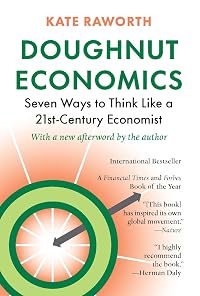
Doughnut Economics: Seven Ways to Think Like a 21st-Century Economist
by Kate Raworth
On This Page
Description
A Financial Times "Best Book of 2017: Economics" 800-CEO-Read "Best Business Book of 2017: Current Events & Public Affairs" Economics is the mother tongue of public policy. It dominates our decision-making for the future, guides multi-billion-dollar investments, and shapes our responses to climate change, inequality, and other environmental and social challenges that define our times. Pity then, or more like disaster, that its fundamental ideas are centuries out of date yet are still taught show more in college courses worldwide and still used to address critical issues in government and business alike. That's why it is time, says renegade economist Kate Raworth, to revise our economic thinking for the 21 st century. In Doughnut Economics, she sets out seven key ways to fundamentally reframe our understanding of what economics is and does. Along the way, she points out how we can break our addiction to growth; redesign money, finance, and business to be in service to people; and create economies that are regenerative and distributive by design. Named after the now-iconic "doughnut" image that Raworth first drew to depict a sweet spot of human prosperity (an image that appealed to the Occupy Movement, the United Nations, eco-activists, and business leaders alike), Doughnut Economics offers a radically new compass for guiding global development, government policy, and corporate strategy, and sets new standards for what economic success looks like. Raworth handpicks the best emergent ideas-from ecological, behavioral, feminist, and institutional economics to complexity thinking and Earth-systems science-to address this question: How can we turn economies that need to grow, whether or not they make us thrive, into economies that make us thrive, whether or not they grow? Simple, playful, and eloquent, Doughnut Economics offers game-changing analysis and inspiration for a new generation of economic thinkers. show lessTags
Recommendations


Member Reviews
Ok, I've read a lot of intro to econ books, and they never made sense to me. This book immediately makes it clear why. It's because classical economics is still based on entrenched thought patterns, and that any of the current reformatory ideas are just nibbling around the edges. Raworth proposes we turn things upside down, and now there's hope for the future. If only her proposal gains enough momentum, we can indeed have a more sane and healthy world.
(That is to say, please read this, or whatever TED talk or Executive Summary text or whatever you can find related to it, and think about who you do business with, how you choose what to consume, who you vote for, where you hold your investments, etc.)
(And btw, if you're skeptical, do show more know that I noticed that she does give credit to a *lot* of other people and movements and proposals; here she attempts to collate them all under an umbrella and alert readers of popular non-fiction to many of the best ideas and strategies. Also note that she, too, is skeptical, and is always looking at the counter-arguments to the pieces of her proposal.)
For example, think about the classic econ. icon 'rational man.' Did you ever recognize yourself in that abstraction? I sure didn't.
Robert Frank explains why "... our beliefs about human nature help shape human nature itself." ... " economics students were more likely than other students to be corruptible--willing to give a biased answer--if it led to a personal payout." ... " economics majors were more approving of their own and others' self-serving behavior, while economics professors gave significantly less money to charity than their worse-paid colleagues in many other disciplines." ... "By Encouraging us to expect the worst in others, it [self-serving theory or rational man] brings out the worst in us."
More: "... one Wikipedia page lists over 160 cognitive biases, like a jumbo-size game of spot the-difference between rational economic man and his fallible human equivalent." Later, "... we are motivated by far more than cost and price."
On another concept: I really want to find the original rules to the original version of Monopoly, as invented by Elizabeth Magie, called the Prosperity rules. I don't like 'rich get richer' in games or life, after all--everyone should have a fair shot.
Or consider Donella Meadows comment that "... the universe is messy.... It is dynamic. It self-organises and evolves. It creates diversity, not uniformity. That's what makes the world interesting, that's what makes it beautiful, and that's what makes it work."
Lord Griffith, vice-chairman of Goldman Sachs, said about a decade ago: "We have to tolerate the inequality as a way to achieve greater prosperity and opportunity for all."
On the other hand, C-ROADS is a role-playing exercise that has made powerful imagery of the effects of climate change available to powerful policy-makers: check it out.
Also check out the complementary currency scheme in Switzerland, Zeitvorsoge. It's one thing to participate in Freecycle and to donate to charity shops, but to get usable credit for one's good deeds, now that's worth exploring.
Also worth exploring is Oberlin, Ohio's, efforts, with its university, to go deep green.
To choose which businesses to buy from or invest in, I want to look at the websites for the Economy for the Common Good, B Corp's Impact Reports, and the MultiCapital Scorecard.
"So many of the transformative ideas are originating in other fields of thought such as psychology, ecology, physics, history, Earth-system science, geography, architecture, sociology and complexity science.... It is time for economics to step back from soloing in the lime light... less Lord of the Dance and more maypole dance; more actively interweaving its theories with insights arising in other disciplines."
Most importantly, the author reminds us that defining 'growth' as important is just plain nonsense. I've long wondered why the magazine "The Economist" bemoans the falling birthrate in Europe and Japan, on the grounds that their economy won't grow and that it's bad. Bull! Overpopulation is a 'clear and present danger' and if people are having fewer children that's terrific! (And if particular countries need more people, they can welcome refugees and other migrants. And if the particular danger is that there are too many frail seniors with expensive needs, let those of us who wish to pass do so!)
So anyway, yeah, down with the growth mindset and up with the goal of strategies to take care of everyone on the planet, including the critters and plants. show less
(That is to say, please read this, or whatever TED talk or Executive Summary text or whatever you can find related to it, and think about who you do business with, how you choose what to consume, who you vote for, where you hold your investments, etc.)
(And btw, if you're skeptical, do show more know that I noticed that she does give credit to a *lot* of other people and movements and proposals; here she attempts to collate them all under an umbrella and alert readers of popular non-fiction to many of the best ideas and strategies. Also note that she, too, is skeptical, and is always looking at the counter-arguments to the pieces of her proposal.)
For example, think about the classic econ. icon 'rational man.' Did you ever recognize yourself in that abstraction? I sure didn't.
Robert Frank explains why "... our beliefs about human nature help shape human nature itself." ... " economics students were more likely than other students to be corruptible--willing to give a biased answer--if it led to a personal payout." ... " economics majors were more approving of their own and others' self-serving behavior, while economics professors gave significantly less money to charity than their worse-paid colleagues in many other disciplines." ... "By Encouraging us to expect the worst in others, it [self-serving theory or rational man] brings out the worst in us."
More: "... one Wikipedia page lists over 160 cognitive biases, like a jumbo-size game of spot the-difference between rational economic man and his fallible human equivalent." Later, "... we are motivated by far more than cost and price."
On another concept: I really want to find the original rules to the original version of Monopoly, as invented by Elizabeth Magie, called the Prosperity rules. I don't like 'rich get richer' in games or life, after all--everyone should have a fair shot.
Or consider Donella Meadows comment that "... the universe is messy.... It is dynamic. It self-organises and evolves. It creates diversity, not uniformity. That's what makes the world interesting, that's what makes it beautiful, and that's what makes it work."
Lord Griffith, vice-chairman of Goldman Sachs, said about a decade ago: "We have to tolerate the inequality as a way to achieve greater prosperity and opportunity for all."
On the other hand, C-ROADS is a role-playing exercise that has made powerful imagery of the effects of climate change available to powerful policy-makers: check it out.
Also check out the complementary currency scheme in Switzerland, Zeitvorsoge. It's one thing to participate in Freecycle and to donate to charity shops, but to get usable credit for one's good deeds, now that's worth exploring.
Also worth exploring is Oberlin, Ohio's, efforts, with its university, to go deep green.
To choose which businesses to buy from or invest in, I want to look at the websites for the Economy for the Common Good, B Corp's Impact Reports, and the MultiCapital Scorecard.
"So many of the transformative ideas are originating in other fields of thought such as psychology, ecology, physics, history, Earth-system science, geography, architecture, sociology and complexity science.... It is time for economics to step back from soloing in the lime light... less Lord of the Dance and more maypole dance; more actively interweaving its theories with insights arising in other disciplines."
Most importantly, the author reminds us that defining 'growth' as important is just plain nonsense. I've long wondered why the magazine "The Economist" bemoans the falling birthrate in Europe and Japan, on the grounds that their economy won't grow and that it's bad. Bull! Overpopulation is a 'clear and present danger' and if people are having fewer children that's terrific! (And if particular countries need more people, they can welcome refugees and other migrants. And if the particular danger is that there are too many frail seniors with expensive needs, let those of us who wish to pass do so!)
So anyway, yeah, down with the growth mindset and up with the goal of strategies to take care of everyone on the planet, including the critters and plants. show less
A very interesting look at that, at times, somewhat dry topic of economics and in particular whether the traditional approach is fit for purpose in the 21st century, particularly in the context of climate change, dwindling resources etc.
Raworth thinks that the traditional approach is outdated, particularly in its seemingly single minded focus on a desire never-ending increase in GDP/GNP as the answer to all ills, such as poverty. At the same time, Raworth notes that the traditional approach under appreciates (if not ignores) the (adverse) impact of the past hundred or so years on the environment and the increasing need for more and more (scarce) resources (minerals, hydrocarbons, fertile land, water amongst others).
Raworth explores the show more history or economic theory, and concludes that modern economics has become too far removed from reality, having made many assumptions (the rational economic man; perfect market knowledge etc) in order to make various economic models 'workable', and provide almost science like predictions.
Indeed, reliance on some economic models or thinking influences how people think and act. Raworth cites 2 studies (pp100-101):
- third year economics university students rated altruistic values (eg helpfulness, honesty and loyalty) as being far less important in life than their 1st year equivalents;
- having published what became known as the Black- Scholes model (for predicting the likely price of options (derivatives) on the Chicago Board Options Exchange (which at the time was one of the most important derivatives exchanges in the world), the predictions initially made by the model deviated widely (by 30-40%) from the actual market prices. But after a few years, the model (without there being any changes to it) began to produce predictions which deviated by a mere 2% from actual market prices. A study by economic sociologists interviewing traders in the market demonstrated that the improvement came about because the traders had started to behave as if the theory/ model was true and were using the model's predictions as a benchmark for setting their own bids and bidding patterns. A variant of a self fulfilling prophecy.
Leaving behind traditional economics, Raworth asks that if we are not to act and run our economies in accord with traditional economic theory, how might we go about answering economic questions. And this is where the doughnut comes in.
In Raworth's words:
'The essence of the Doughnut: a social foundation of well-being that no one should fall below [in order that no person or peoples suffer critical human deprivation], and an ecological ceiling of planetary pressure that we should not go beyond [in order to avoid critical planetary degradation]. Between the two lies a safe and just space for all.' (p 11...words in [ ] added from the diagram on that page)
Raworth does not suggest that this is a prescription that is easy to implement, nor one as to which there are obvious answers when it comes to real life decisions, but spends the balance of the book making suggestions as to how we might change our ways of thinking in order to implement the Doughnut. Examples include:
- moving towards regenerative design ie approaching every decision as to design (eg as to physical artefacts) from the perspective of making every element of that artefact most adaptable to re-use, re-purposing, amenable to resource recovery and ultimately regeneration
- moving from being addicted to (GDP/GNP) growth to being agnostic about growth. That is not chasing growth, but being comfortable if growth does (or does not) come from time to time.
I have read that, at a personal level, Raworth who is based at Oxford and consults widely in Europe does not use air travel, but rather uses rail. An exception was apparently a trip to Australia with her family to visit her (Australian) husband's family. It is an example of asking, at every opportunity "do I need to consume this [given the resources that will be used/ the environmental impact of the consumption]?
In these few comments I have not done Raworth's thesis its proper due. But the book is very readable and does not require any particular economics background in order to understand.
I have not come across much discussion as to Raworth's thesis, in particular those critical, apart from one academic who posited that there was little prospect of implementing the Doughnut as (in my words) people's natures were so entrenched as being selfish that no one would ever give up anything for the common good.
That is a sad indictment if true.
Big Ship
1 July 2023 show less
Raworth thinks that the traditional approach is outdated, particularly in its seemingly single minded focus on a desire never-ending increase in GDP/GNP as the answer to all ills, such as poverty. At the same time, Raworth notes that the traditional approach under appreciates (if not ignores) the (adverse) impact of the past hundred or so years on the environment and the increasing need for more and more (scarce) resources (minerals, hydrocarbons, fertile land, water amongst others).
Raworth explores the show more history or economic theory, and concludes that modern economics has become too far removed from reality, having made many assumptions (the rational economic man; perfect market knowledge etc) in order to make various economic models 'workable', and provide almost science like predictions.
Indeed, reliance on some economic models or thinking influences how people think and act. Raworth cites 2 studies (pp100-101):
- third year economics university students rated altruistic values (eg helpfulness, honesty and loyalty) as being far less important in life than their 1st year equivalents;
- having published what became known as the Black- Scholes model (for predicting the likely price of options (derivatives) on the Chicago Board Options Exchange (which at the time was one of the most important derivatives exchanges in the world), the predictions initially made by the model deviated widely (by 30-40%) from the actual market prices. But after a few years, the model (without there being any changes to it) began to produce predictions which deviated by a mere 2% from actual market prices. A study by economic sociologists interviewing traders in the market demonstrated that the improvement came about because the traders had started to behave as if the theory/ model was true and were using the model's predictions as a benchmark for setting their own bids and bidding patterns. A variant of a self fulfilling prophecy.
Leaving behind traditional economics, Raworth asks that if we are not to act and run our economies in accord with traditional economic theory, how might we go about answering economic questions. And this is where the doughnut comes in.
In Raworth's words:
'The essence of the Doughnut: a social foundation of well-being that no one should fall below [in order that no person or peoples suffer critical human deprivation], and an ecological ceiling of planetary pressure that we should not go beyond [in order to avoid critical planetary degradation]. Between the two lies a safe and just space for all.' (p 11...words in [ ] added from the diagram on that page)
Raworth does not suggest that this is a prescription that is easy to implement, nor one as to which there are obvious answers when it comes to real life decisions, but spends the balance of the book making suggestions as to how we might change our ways of thinking in order to implement the Doughnut. Examples include:
- moving towards regenerative design ie approaching every decision as to design (eg as to physical artefacts) from the perspective of making every element of that artefact most adaptable to re-use, re-purposing, amenable to resource recovery and ultimately regeneration
- moving from being addicted to (GDP/GNP) growth to being agnostic about growth. That is not chasing growth, but being comfortable if growth does (or does not) come from time to time.
I have read that, at a personal level, Raworth who is based at Oxford and consults widely in Europe does not use air travel, but rather uses rail. An exception was apparently a trip to Australia with her family to visit her (Australian) husband's family. It is an example of asking, at every opportunity "do I need to consume this [given the resources that will be used/ the environmental impact of the consumption]?
In these few comments I have not done Raworth's thesis its proper due. But the book is very readable and does not require any particular economics background in order to understand.
I have not come across much discussion as to Raworth's thesis, in particular those critical, apart from one academic who posited that there was little prospect of implementing the Doughnut as (in my words) people's natures were so entrenched as being selfish that no one would ever give up anything for the common good.
That is a sad indictment if true.
Big Ship
1 July 2023 show less
The following review is written from the perspective of my startup:
Regen Network as a 21st-Century Economy
In 2017, economist Kate Raworth published Doughnut Economics: Seven Ways to Think Like a 21st-Century Economist. The core concept of the book—the doughnut—has quickly gained prominence—from UN circles to alternative economic communities—as a way to summarize the tensions surrounding what might have formerly been called “sustainable development.”
On the interior of the doughnut is a social foundation. This is composed of human rights and human needs, such as access to clean water, healthy food, political voice, gender equality, etc. On the exterior of the doughnut is the ecological ceiling—the carrying capacity of the show more earth and her biological systems to sustain civilization. This is composed of ecological limits, such as ocean acidification, climate change, and chemical pollution.
As you can see from all the red in the above illustration, we currently live in a very fat doughnut, which fails to meet the social floor and extends far beyond the ecological ceiling.
So how can we transition into that nice green ring? Raworth explores seven avenues in her book.
Regen Network just so happens to have been oriented around establishing stronger ecological limits since our founding (as our tagline “balance sheet for earth” might suggest). In reviewing Raworth’s septad I will also highlight the ways in which Regen Network works in these arenas.
I. Change the Goal: from GDP to the Doughnut
Regen Network has the aim of planetary regeneration, and the goal of building the livelihoods of farmers by compensating them for ecological land stewardship.
II. See the Big Picture: from self-contained market to embedded economy
All of the human sphere, including our markets and our economic, are nested within earth systems. By working to bring ecological health into economic calculus, Regen Network helps to bring about a shift to the embedded economy where there are no such thing as externalities.
III. Nurture Human Nature: from rational economic man to social adaptable humans
As a blockchain enterprise, Regen Network is founded on the ethic of decentralization. Decentralization puts faith in the agency and ingenuity of individuals and communities to self-organize, rather than thinking of people as cogs in a massive economic machine.
IV. Get Savvy with Systems: from mechanical equilibrium to dynamic complexity
Our name, Regen Network, was inspired by the concept of regeneration. The definition of regeneration has been formalized by the work of Carol Sanford in the school she calls living systems. Categorically, living systems are about dynamic complexity and are the antonym of mechanical equilibrium.
V. Design to Distribute: from “growth will even it up again” to distributive by design
Farming is both the most common and least paid vocation on earth. By focusing on farmer wellbeing, Regen Network aims to focus on the class that growth economics have left behind.
VI. Create to Regenerate: from “growth will clean it up again” to regenerative by design
To cite Sanford’s work again, regeneration emerges out of seven first principles (with definitions given in Regen’s context):
Whole: Regen Network works through the lens of bioregions and earth-as-superorganism.
Potential: what do ecosystems look like when fully thriving? What does it look like when communities and landscapes become an integrated whole?
Reciprocity: how do we cycle energy through biotic systems economic systems rather than working with linear models of accumulations/depletion?
Essence: what is at the core of a particular place, and how do we uplift and organize around it?
Nestedness: properties nest within bioregions and watersheds nest within continents and the planet.
Nodal: where are the epicenters of systems change? What attention in our economic systems, agricultural systems, and scientific systems will ripple out through entire domains?
Development: how can we build the capacity of land stewards to be more deeply in relationship with their land?
VII. Be Agnostic about Growth: from growth addicted to growth agnostic
To be frank, this is one area that the crypto space could take some more time to reflect. Standard crypto-economic models necessitate growth; Ethereum, Bitcoin, Cosmos, and Regen Network all currently have increasing supplies where network security hinges upon currency deflation driven by market cap expansion (the crypto-economic premises of this subject are beyond the scope of this post). That said, if the crypto space is good at anything, it is experimentation and iteration, and I anticipate some radically different token economic models coming online in coming years that work with demurrage and post-growth economics.
A Few Words on the Ecological Ceiling
In my view, the primary shortcoming of Raworth’s model is that it uses an anthropocentric ecological ceiling. The ecological ceiling is the threshold at which livings systems collapse. The problem with setting this as our limit is that it is deaf to the cries of countless others in the more-than-human sphere that are crushed on our path to that limit. Lots of species can go extinct, waterways polluted, and soils eroded before arriving at systems-collapse.
In other words, the ecological ceiling is utilitarian and instrumentalist; what utility does nature provide us with, and how can we maximize that utility up to the breaking point? This is a fundamentally violent approach divorced from a land ethic. Tree frogs, mosquitoes, and mangroves (even boulders) have their own lives and experiences which have inherent value.
The economy is a human-created sphere that operates within the human realm. How can we imbue the economy with consideration for the more-than-human world for its own sake? Do economic systems have the capacity to interact coherently with the sacred and numinous? These are some of the questions we’re exploring at Regen Network. show less
Regen Network as a 21st-Century Economy
In 2017, economist Kate Raworth published Doughnut Economics: Seven Ways to Think Like a 21st-Century Economist. The core concept of the book—the doughnut—has quickly gained prominence—from UN circles to alternative economic communities—as a way to summarize the tensions surrounding what might have formerly been called “sustainable development.”
On the interior of the doughnut is a social foundation. This is composed of human rights and human needs, such as access to clean water, healthy food, political voice, gender equality, etc. On the exterior of the doughnut is the ecological ceiling—the carrying capacity of the show more earth and her biological systems to sustain civilization. This is composed of ecological limits, such as ocean acidification, climate change, and chemical pollution.
As you can see from all the red in the above illustration, we currently live in a very fat doughnut, which fails to meet the social floor and extends far beyond the ecological ceiling.
So how can we transition into that nice green ring? Raworth explores seven avenues in her book.
Regen Network just so happens to have been oriented around establishing stronger ecological limits since our founding (as our tagline “balance sheet for earth” might suggest). In reviewing Raworth’s septad I will also highlight the ways in which Regen Network works in these arenas.
I. Change the Goal: from GDP to the Doughnut
Regen Network has the aim of planetary regeneration, and the goal of building the livelihoods of farmers by compensating them for ecological land stewardship.
II. See the Big Picture: from self-contained market to embedded economy
All of the human sphere, including our markets and our economic, are nested within earth systems. By working to bring ecological health into economic calculus, Regen Network helps to bring about a shift to the embedded economy where there are no such thing as externalities.
III. Nurture Human Nature: from rational economic man to social adaptable humans
As a blockchain enterprise, Regen Network is founded on the ethic of decentralization. Decentralization puts faith in the agency and ingenuity of individuals and communities to self-organize, rather than thinking of people as cogs in a massive economic machine.
IV. Get Savvy with Systems: from mechanical equilibrium to dynamic complexity
Our name, Regen Network, was inspired by the concept of regeneration. The definition of regeneration has been formalized by the work of Carol Sanford in the school she calls living systems. Categorically, living systems are about dynamic complexity and are the antonym of mechanical equilibrium.
V. Design to Distribute: from “growth will even it up again” to distributive by design
Farming is both the most common and least paid vocation on earth. By focusing on farmer wellbeing, Regen Network aims to focus on the class that growth economics have left behind.
VI. Create to Regenerate: from “growth will clean it up again” to regenerative by design
To cite Sanford’s work again, regeneration emerges out of seven first principles (with definitions given in Regen’s context):
Whole: Regen Network works through the lens of bioregions and earth-as-superorganism.
Potential: what do ecosystems look like when fully thriving? What does it look like when communities and landscapes become an integrated whole?
Reciprocity: how do we cycle energy through biotic systems economic systems rather than working with linear models of accumulations/depletion?
Essence: what is at the core of a particular place, and how do we uplift and organize around it?
Nestedness: properties nest within bioregions and watersheds nest within continents and the planet.
Nodal: where are the epicenters of systems change? What attention in our economic systems, agricultural systems, and scientific systems will ripple out through entire domains?
Development: how can we build the capacity of land stewards to be more deeply in relationship with their land?
VII. Be Agnostic about Growth: from growth addicted to growth agnostic
To be frank, this is one area that the crypto space could take some more time to reflect. Standard crypto-economic models necessitate growth; Ethereum, Bitcoin, Cosmos, and Regen Network all currently have increasing supplies where network security hinges upon currency deflation driven by market cap expansion (the crypto-economic premises of this subject are beyond the scope of this post). That said, if the crypto space is good at anything, it is experimentation and iteration, and I anticipate some radically different token economic models coming online in coming years that work with demurrage and post-growth economics.
A Few Words on the Ecological Ceiling
In my view, the primary shortcoming of Raworth’s model is that it uses an anthropocentric ecological ceiling. The ecological ceiling is the threshold at which livings systems collapse. The problem with setting this as our limit is that it is deaf to the cries of countless others in the more-than-human sphere that are crushed on our path to that limit. Lots of species can go extinct, waterways polluted, and soils eroded before arriving at systems-collapse.
In other words, the ecological ceiling is utilitarian and instrumentalist; what utility does nature provide us with, and how can we maximize that utility up to the breaking point? This is a fundamentally violent approach divorced from a land ethic. Tree frogs, mosquitoes, and mangroves (even boulders) have their own lives and experiences which have inherent value.
The economy is a human-created sphere that operates within the human realm. How can we imbue the economy with consideration for the more-than-human world for its own sake? Do economic systems have the capacity to interact coherently with the sacred and numinous? These are some of the questions we’re exploring at Regen Network. show less
It is genius to make a model that includes both human deprivation and planetary boundaries and with the aim to get every human into the “safe and just space” between those two. The place where every human has a decent living and we don’t destroy the planet seems like a pretty good idea and needs all the easy-to-grasp models it can get. The book felt more like a catalogue of ideas than a manual, but it put forth a clear and desirable goal, and the vocabulary and facts to talk about it.
This book is a great read and, although I have no knowledge of economics, the ideas within this book seem to be anideal way forward for the World.
There are seven steps; change the goal, see the big picture, nurture human nature, get savvy with systems, design to distribute, create to regenerate and be agnostic about growth. I find no reason to gainsay a single one so, why do I remain unconvinced?
It is clearly impossible for any system on earth to continue to produce 3% growth year on year, for ever but, that is a far different statement to, "money men will voluntarily reduce their push for profit. It should happen: it needs to happen but, it wont.
This work is part of the solution; it is an ideal for which to aim but, it provides show more precious little idea as to how to get from here to there. I, for one, hope that some clever mind can take this on... show less
There are seven steps; change the goal, see the big picture, nurture human nature, get savvy with systems, design to distribute, create to regenerate and be agnostic about growth. I find no reason to gainsay a single one so, why do I remain unconvinced?
It is clearly impossible for any system on earth to continue to produce 3% growth year on year, for ever but, that is a far different statement to, "money men will voluntarily reduce their push for profit. It should happen: it needs to happen but, it wont.
This work is part of the solution; it is an ideal for which to aim but, it provides show more precious little idea as to how to get from here to there. I, for one, hope that some clever mind can take this on... show less
The book does a nice job of laying out the problems with tackling modern crises (primarily climate change and income inequality) with traditional neoliberal economic policy. I think if you were an actual economist with more experience than one or two introductory courses then the discussion would seem very oversimplified, but as a layman like myself I think it's perfectly suitable introduction to the changing nature of the field. The claims are all well sourced and the book has a coherent structure upon which it builds upon the idea of a new kind of regenerative economy.
Where I think the text falls a bit short is that it's a bit too ambitious and broad to get into the nitty gritty details of most of the proposed solutions. Many of the show more ideas discussed could have been their own books of this length (see complementary currencies for a great example). So I think that again while the book serves as a nice introduction to the kind of thinking that economics needs to start to embrace, a lot of the solutions presented feel like they fall flat without a precise plan. But again, it's unclear if that's the purpose of the book so I think as an introduction it's fine. show less
Where I think the text falls a bit short is that it's a bit too ambitious and broad to get into the nitty gritty details of most of the proposed solutions. Many of the show more ideas discussed could have been their own books of this length (see complementary currencies for a great example). So I think that again while the book serves as a nice introduction to the kind of thinking that economics needs to start to embrace, a lot of the solutions presented feel like they fall flat without a precise plan. But again, it's unclear if that's the purpose of the book so I think as an introduction it's fine. show less
The dismal science has a propensity to be tedious and uninteresting to anyone outside its narrow sphere. But its influence is wide and pervasive, the neo-liberal agenda has given us a society where there is now a vast chasm between the super-rich elite and the poor underclass and where the single-minded pursuit of profit is degrading the world that we live in and are totally dependent on. This system that favours a small political and financial elite who make decisions based on a narrow range of interests and desires and I think that you could argue that economic theory has remained just a theory. The economists at the London School of Economics were quite embarrassed when the Queen asked how they managed to totally miss the 2008 show more financial crash. This is a common occurrence, time and time again these events have not been predicted, let alone prevented and they have caused serious harm to economies large and small.
Is there a way of fixing it though?
Kate Raworth thinks that there is. In this radical new economic theory that she sets out in Doughnut Economics, she identifies seven elements where the present systems have failed and her proposals to overhaul the current thinking. Addressing the fundamental issues such as growth, GDP, rational economic man and distribution of wealth her new economic plan takes us away from the folly of equilibrium and the boom and bust that always follows.
The principle of the doughnut above is that the outer ring is the limits of our resources; we, after all, are just on one planet and haven't got another to use when we have ruined and used this one. The inner ring is what we all need to be able to survive as human beings, from the essentials of food, water and shelter to the elements that make us civilised like energy, education and justice. The band between these two lines is the space where we all can live comfortably. It is a simple and elegant model and the places where parts of this have been implemented, the benefits are there for all to see.
When the short-term interests of a small elite diverge from the from the long-term interests of society as a whole, it is as Jared Diamond says, a blueprint for trouble. Raworth has developed an excellent and sustainable model of economics that we really need to start moving towards to, to make the economic systems work once again for the good of humanity and the planet. It is well thought through, with clear reasons as to why the current system is failing for most of the world at the moment and a soundly robust new system. For me though, the only thing it was lacking is the how we are going to change to something like this, that is urgently needed. Budging those vested and deeply ingrained interests is going to involve a lot of pain. Overall a really good book with a positive message and maybe a chance to turn a work that thrives for all. show less
Is there a way of fixing it though?
Kate Raworth thinks that there is. In this radical new economic theory that she sets out in Doughnut Economics, she identifies seven elements where the present systems have failed and her proposals to overhaul the current thinking. Addressing the fundamental issues such as growth, GDP, rational economic man and distribution of wealth her new economic plan takes us away from the folly of equilibrium and the boom and bust that always follows.
The principle of the doughnut above is that the outer ring is the limits of our resources; we, after all, are just on one planet and haven't got another to use when we have ruined and used this one. The inner ring is what we all need to be able to survive as human beings, from the essentials of food, water and shelter to the elements that make us civilised like energy, education and justice. The band between these two lines is the space where we all can live comfortably. It is a simple and elegant model and the places where parts of this have been implemented, the benefits are there for all to see.
When the short-term interests of a small elite diverge from the from the long-term interests of society as a whole, it is as Jared Diamond says, a blueprint for trouble. Raworth has developed an excellent and sustainable model of economics that we really need to start moving towards to, to make the economic systems work once again for the good of humanity and the planet. It is well thought through, with clear reasons as to why the current system is failing for most of the world at the moment and a soundly robust new system. For me though, the only thing it was lacking is the how we are going to change to something like this, that is urgently needed. Budging those vested and deeply ingrained interests is going to involve a lot of pain. Overall a really good book with a positive message and maybe a chance to turn a work that thrives for all. show less
Members
- Recently Added By
Published Reviews
One day economic historians might examine Doughnut Economics as an artifact of thinking that emerged as a result of the 2008 financial crisis, deriving its credibility from the fact that economics failed to predict it.
....
In her attempt to bring economics more up-to-date, as the subtitle of the book suggests, Raworth depicts humanity’s goals as a doughnut.
....
Overall, Doughnut Economics is show more excellent at describing economic concepts in accessible terms, and could be read as an add-on to an introductory economics textbook. Raworth’s in-depth summary of climate change is very well argued and would be useful for challenging climate change denial: in this sense, the book is more about sustainable development than economics.
Raworth criticises economists and politicians for debating ‘economic efficiency, productivity, and growth […] while hesitating to speak of justice, fairness, and rights’, without providing tangible policy recommendations. show less
....
In her attempt to bring economics more up-to-date, as the subtitle of the book suggests, Raworth depicts humanity’s goals as a doughnut.
....
Overall, Doughnut Economics is show more excellent at describing economic concepts in accessible terms, and could be read as an add-on to an introductory economics textbook. Raworth’s in-depth summary of climate change is very well argued and would be useful for challenging climate change denial: in this sense, the book is more about sustainable development than economics.
Raworth criticises economists and politicians for debating ‘economic efficiency, productivity, and growth […] while hesitating to speak of justice, fairness, and rights’, without providing tangible policy recommendations. show less
added by BraveKelso
Lists

2022
17 works; 1 member

BBA Potential: Young Adult
22 works; 2 members

My List
302 works; 1 member

Club Read's Recommended Nonfiction Written by Women
618 works; 30 members
Author Information

3+ Works 989 Members
Awards and Honors
Work Relationships
Common Knowledge
- Canonical title*
- Donitsitaloustiede: Seitsemän tapaa ajatella kuin 2000-luvun taloustieteilijä
- Original publication date
- 2017
*Some information comes from Common Knowledge in other languages. Click "Edit" for more information.
Classifications
Statistics
- Members
- 981
- Popularity
- 26,977
- Reviews
- 21
- Rating
- (4.13)
- Languages
- 12 — Danish, Dutch, English, Finnish, French, German, Italian, Polish, Portuguese, Spanish, Swedish, Turkish
- Media
- Paper, Audiobook, Ebook
- ISBNs
- 33
- ASINs
- 8