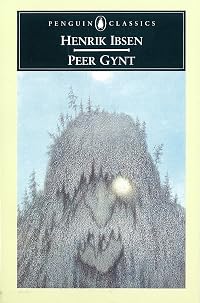
Peer Gynt
by Henrik Ibsen
On This Page
Description
Among the masterpieces of world literature, this great verse drama by Norway's famed playwright humorously yet profoundly explores the virtues, vices, and follies common to all humanity as it follows the roguish life of a charming but arrogant young man. A literary delight since it was first published in 1875.Tags
Recommendations














Member Reviews
I write this review with more than a little trepidation as one of my best friends is on his way to being, if he isn't already, an Ibsen scholar. So while writing this I imagine him here with me, just waiting to unleash his Olympian store of knowledge against my piddling review. But, you know, I'm nothing if not a challenge seeker, so here we are.
I read a collection of Ibsen's about two years ago, specifically The Wild Duck, Ghosts, Doll's House, and an Enemy of the People. I enjoyed them all immensely and very much appreciated the near complete lack of whimsy in his plays. Having theatrical experience only with the likes of Shakespeare and a taste of Marlowe (with an occasional sampling of Arthur Miller in high school) I was unprepared show more for just how unsympathetic a playwright could depict his world. Shakespeare and Marlowe were so grandiose, it didn't matter if it was romance, tragedy, comedy, everything was built to the skies. All of the characters felt important, like gods in a pantheon, putting on a divine show for barely comprehending mortals.
But Ibsen is strikingly different. His characters feel much more human, almost approachable. Society is flawed (and how) in the eyes of Ibsen and is that way because of the people who comprise it. No where is this more evident than in Ibsen's most well known (often called THE Norwegian Play) work, Peer Gynt.
Based on the fairy tale Per Gynt, Ibsen gives us the titular character who, very unlike any protagonist of a Shakespeare play, is just, well, low. He seems like the kind of character that, maybe, gets one possibly funny line in a Shakespeare play before being mocked, jeered or just killed before the main character can continue on his epic way. Gynt is, at times, base, shiftless, a vagrant, and, one would think, completely unworthy of an entire work based around his story. But two factors work to his favor. One, ninety-nine percent of the people, no, the world around him, are just as bad as he, worse because at least Gynt seems perfectly cognizant of his shortcomings and the lies he attempts to make his life consist of. Curiously in fact as there's more than enough evidence to justify the reading that every character is as full of con, as my father would say, as Gynt. The only difference being that, like so many of Ibsen's other works, that the many of society have judged the one individual as the target of their scorn, the altar where they lay their shortcomings, their sin, to burn and be forgotten. Peer Gynt the scapegoat without the title.
And the other reason as to why Gynt is worthy of his story, there are echoes of Goethe's Faust. Now, that alone doesn't make him worthy. It's the contradiction inherent there that makes the story. Goethe's Faust was about as elite a character as one can find. A brilliant doctor dabbling the black arts for the simple fact that the rest of the world bores him. Gynt is a character who pathologically avoids the rest of the world, only culling what he can whilst avoiding the real issues dogging his soul. Gynt isn't Faust, he's the anti-Faust. And that's the grandness of it as, to me, Gynt and Faust occupy the exact same world.
That having been said there were more than a few moments where I honestly believed Gynt on his way to redemption would encounter Faust on his way to damnation, both, the former stumbling and running the latter marching and proud, wending their way through a world where the divine (better:supernatural) is just below the surface of the world waiting to bless or condemn a man, often one then the other. The equal but opposite of the society that Ibsen routinely lambasted. The cynic in me says Ibsen was painting something like a Sartre 'No Exit' scenario, that there is no hope, or anything like it.
But the final scene, with the button moulder, with Gynt in the arms of Solveig, gives us something akin to hope, but not quite. I imagined the sun rising as the birds chirped their songs, Solveig herself at peace while Gynt, near his end whatever that will entail, driven to exhaustion, to death, with the agent of this fate, the button moulder just there, just waiting. Simply gorgeous. So not hope but, it seems, Ibsen doesn't answer the question of Gynt's fate with that, but with an ellipses trailing off. Namely, what we're left with is not a refuge in hope, but a refuge in ambiguity. Gynt could be judged to oblivion or given salvation, and the madness of it is that Ibsen leaves us right at the precipice where we either grow wings and fly or fall to something nice and Tarturus adjacent below.
It's brilliant, unwieldy, and something awesome, truly. Read it. show less
I read a collection of Ibsen's about two years ago, specifically The Wild Duck, Ghosts, Doll's House, and an Enemy of the People. I enjoyed them all immensely and very much appreciated the near complete lack of whimsy in his plays. Having theatrical experience only with the likes of Shakespeare and a taste of Marlowe (with an occasional sampling of Arthur Miller in high school) I was unprepared show more for just how unsympathetic a playwright could depict his world. Shakespeare and Marlowe were so grandiose, it didn't matter if it was romance, tragedy, comedy, everything was built to the skies. All of the characters felt important, like gods in a pantheon, putting on a divine show for barely comprehending mortals.
But Ibsen is strikingly different. His characters feel much more human, almost approachable. Society is flawed (and how) in the eyes of Ibsen and is that way because of the people who comprise it. No where is this more evident than in Ibsen's most well known (often called THE Norwegian Play) work, Peer Gynt.
Based on the fairy tale Per Gynt, Ibsen gives us the titular character who, very unlike any protagonist of a Shakespeare play, is just, well, low. He seems like the kind of character that, maybe, gets one possibly funny line in a Shakespeare play before being mocked, jeered or just killed before the main character can continue on his epic way. Gynt is, at times, base, shiftless, a vagrant, and, one would think, completely unworthy of an entire work based around his story. But two factors work to his favor. One, ninety-nine percent of the people, no, the world around him, are just as bad as he, worse because at least Gynt seems perfectly cognizant of his shortcomings and the lies he attempts to make his life consist of. Curiously in fact as there's more than enough evidence to justify the reading that every character is as full of con, as my father would say, as Gynt. The only difference being that, like so many of Ibsen's other works, that the many of society have judged the one individual as the target of their scorn, the altar where they lay their shortcomings, their sin, to burn and be forgotten. Peer Gynt the scapegoat without the title.
And the other reason as to why Gynt is worthy of his story, there are echoes of Goethe's Faust. Now, that alone doesn't make him worthy. It's the contradiction inherent there that makes the story. Goethe's Faust was about as elite a character as one can find. A brilliant doctor dabbling the black arts for the simple fact that the rest of the world bores him. Gynt is a character who pathologically avoids the rest of the world, only culling what he can whilst avoiding the real issues dogging his soul. Gynt isn't Faust, he's the anti-Faust. And that's the grandness of it as, to me, Gynt and Faust occupy the exact same world.
That having been said there were more than a few moments where I honestly believed Gynt on his way to redemption would encounter Faust on his way to damnation, both, the former stumbling and running the latter marching and proud, wending their way through a world where the divine (better:supernatural) is just below the surface of the world waiting to bless or condemn a man, often one then the other. The equal but opposite of the society that Ibsen routinely lambasted. The cynic in me says Ibsen was painting something like a Sartre 'No Exit' scenario, that there is no hope, or anything like it.
But the final scene, with the button moulder, with Gynt in the arms of Solveig, gives us something akin to hope, but not quite. I imagined the sun rising as the birds chirped their songs, Solveig herself at peace while Gynt, near his end whatever that will entail, driven to exhaustion, to death, with the agent of this fate, the button moulder just there, just waiting. Simply gorgeous. So not hope but, it seems, Ibsen doesn't answer the question of Gynt's fate with that, but with an ellipses trailing off. Namely, what we're left with is not a refuge in hope, but a refuge in ambiguity. Gynt could be judged to oblivion or given salvation, and the madness of it is that Ibsen leaves us right at the precipice where we either grow wings and fly or fall to something nice and Tarturus adjacent below.
It's brilliant, unwieldy, and something awesome, truly. Read it. show less
'Peer Gynt' (1867) will mean a great deal to Norwegians especially as a verse tragedy (its original form). It was also highly innovative in its 'cinematic' quality which outdoes Shakespeare in the rapdity of scene changes. However, I have always been more interested in content than form.
In this respect, 'Peer Gynt' is less impressive - a quasi-social satire with sometimes Pythonesque qualities that tries to do what 'Brand' had done more seriously, that is, to present us with a theatre of ideas. Like 'Brand', the issue at stake is 'redemption' and justification by faith.
To work outside its culture and country of origin, putting to one side the impressive music Grieg wrote for it, requires exceptional theatrical imagination, production show more and direction which would probably have to 'adapt' it rather than reproduce it 'authentically'.
Peer Gynt is quite simply a different sort of narcissist to Brand (who had appeared triumphally the year before) and a narcissist (in my view) is going to reappear in 'The Doll's House'. Where Brand was 'heroic' to a degree, Gynt is, to be a blunt, a human weasel.
The unlikeability of Gynt (amusing though he may be to contemporaries as the trickster-type) mostly just leaves a bad taste in the mouth. The ambiguous 'redemptive' ending (as unclear as that in 'Brand') reeks of 'mauvaise foi'. The creature is, to all intents and purposes, a sociopath.
I suppose, in the Lutheran world of stuffy Oslo, it may be that Gynt allowed its audience to think that a bit of faith at the end of a life of sin might just get a man through the eye of a needle at the end of his life (or not - the ambiguity is there). A comforting thought perhaps (or not).
As drama though, regardless of the 'ideology', it is interesting and innovative but it no longer has the impact it once had, not only because this sort of circus like approach to tale-telling has become normalised to the point of theatrical cliche but the issues are mostly no longer relevant today.
Unlike 'Brand' where, even if God is dead, you can comprehend the torment of the misguided heroic idealist and universalise the dangerous power of absurd belief in abstract absolutes, there is nothing of interest in Gynt. He is a shit to the end. Solveig, a masochist, certainly deserved better!
It is said that (as with Brand) Ibsen is playing with an image of himself - in the previous case as an 'all or nothing' absolutist and, perhaps, in the second as self-centred egoist. Neither, of course, is the man because neither type could present their own negative facets in this way.
If so, there is a degree of psychoanalytic courage in both plays but, in both plays, Ibsen is looking at these facets in a peculiarly distanced and clinical way as if he was in the process of shedding parts of himself and enabling himself to move on to the realist and social observations of his later plays.
I have concentrated here on content rather than form, fully recognising the importance of Ibsen's experimental modernism and unable to comment on the use of Dano-Norwegian verse forms which are a matter for academics.
I can certainly conceive of a modern production that 'adapts' Peer Gynt 'cinematically' for our time. This would not be Ibsen as he was but could be true to the spirit of Ibsen as he might have expressed his 'facet' in today's world. I await that production with interest. show less
In this respect, 'Peer Gynt' is less impressive - a quasi-social satire with sometimes Pythonesque qualities that tries to do what 'Brand' had done more seriously, that is, to present us with a theatre of ideas. Like 'Brand', the issue at stake is 'redemption' and justification by faith.
To work outside its culture and country of origin, putting to one side the impressive music Grieg wrote for it, requires exceptional theatrical imagination, production show more and direction which would probably have to 'adapt' it rather than reproduce it 'authentically'.
Peer Gynt is quite simply a different sort of narcissist to Brand (who had appeared triumphally the year before) and a narcissist (in my view) is going to reappear in 'The Doll's House'. Where Brand was 'heroic' to a degree, Gynt is, to be a blunt, a human weasel.
The unlikeability of Gynt (amusing though he may be to contemporaries as the trickster-type) mostly just leaves a bad taste in the mouth. The ambiguous 'redemptive' ending (as unclear as that in 'Brand') reeks of 'mauvaise foi'. The creature is, to all intents and purposes, a sociopath.
I suppose, in the Lutheran world of stuffy Oslo, it may be that Gynt allowed its audience to think that a bit of faith at the end of a life of sin might just get a man through the eye of a needle at the end of his life (or not - the ambiguity is there). A comforting thought perhaps (or not).
As drama though, regardless of the 'ideology', it is interesting and innovative but it no longer has the impact it once had, not only because this sort of circus like approach to tale-telling has become normalised to the point of theatrical cliche but the issues are mostly no longer relevant today.
Unlike 'Brand' where, even if God is dead, you can comprehend the torment of the misguided heroic idealist and universalise the dangerous power of absurd belief in abstract absolutes, there is nothing of interest in Gynt. He is a shit to the end. Solveig, a masochist, certainly deserved better!
It is said that (as with Brand) Ibsen is playing with an image of himself - in the previous case as an 'all or nothing' absolutist and, perhaps, in the second as self-centred egoist. Neither, of course, is the man because neither type could present their own negative facets in this way.
If so, there is a degree of psychoanalytic courage in both plays but, in both plays, Ibsen is looking at these facets in a peculiarly distanced and clinical way as if he was in the process of shedding parts of himself and enabling himself to move on to the realist and social observations of his later plays.
I have concentrated here on content rather than form, fully recognising the importance of Ibsen's experimental modernism and unable to comment on the use of Dano-Norwegian verse forms which are a matter for academics.
I can certainly conceive of a modern production that 'adapts' Peer Gynt 'cinematically' for our time. This would not be Ibsen as he was but could be true to the spirit of Ibsen as he might have expressed his 'facet' in today's world. I await that production with interest. show less
I was already aware that Ibsen was kind of an odd duck from reading/watching Hedda Gabler many years ago, and this play only confirmed my suspicions. The story this time in decidedly fantasy-based (which allows for many unbelievable situations and events), but it is the odd character of Peer Gynt which sets Ibsen apart. Throughout the play Peer veers back and forth between being a sympathetic character (who is trying to make it through the randomness of life) and an unsympathetic character (who knows that he's making foolhardy decisions. By the final scenes of the play, where he is attempting to avoid the middle-afterlife of the button mould (odd, seriously odd), we are asked to judge him alongside his life and even then thingns are not show more clear. Ibsen seems to be saying that no one truely goes to hell, but is the re-casting really a better thing? show less
یکی از عجیبترین کارهای ایبسن بود که شباهتی به هیچکدوم از کارهای دیگهش نداشت! تنها چیزی که ذهن من رو خیلی مشغول کرده بود، اینه که مثل نمایشنامهی «پرندهی آبی»، این نمایشنامه چطور روی صحنه اجرا خواهد شد! صحنههای پرشمار، دکورهای متنوع و عناصر فانتزی دخیل، مثل صحبت کردن برگ و شبنم و... یا نقش داشتن یک گربه! برخی نمایشنامهها برای خواندن نوشته میشن و میشه عدم توانایی اجراشون رو درک کرد، اما این نمایشنامه show more برای اجرای صحنهای نوشته شده و بارها نیز اجرا داشته!
در کنار همهی اینها، از ترجمهی استاد بهزاد قادری هم نباید گذشت... من نسخهی سابق پرگنت رو خوندم که انتشارات قطره چاپ کرده بود، و نه نسخهی جدیدتری که با همین ترجمه انتشارات بیدگل چاپ کرده، اما شاید اگر تحقیقات و کنجکاوی آقای قادری نبود، فهم این نمایشنامه برای یه خوانندهی ایرانی ناممکن میشد. show less
در کنار همهی اینها، از ترجمهی استاد بهزاد قادری هم نباید گذشت... من نسخهی سابق پرگنت رو خوندم که انتشارات قطره چاپ کرده بود، و نه نسخهی جدیدتری که با همین ترجمه انتشارات بیدگل چاپ کرده، اما شاید اگر تحقیقات و کنجکاوی آقای قادری نبود، فهم این نمایشنامه برای یه خوانندهی ایرانی ناممکن میشد. show less
A play about a habitual liar who runs away from home has an amazing selfish life and does a last minute deathbed confession to make up for it. Is the moral of this story that there's no justice in this world or the next?
This is a fun one as everyone knows someone like Gynt who tells outrageous lies and for some reason these people are always popular.
This is a fun one as everyone knows someone like Gynt who tells outrageous lies and for some reason these people are always popular.
Music made me read this play. Have you ever heard these songs?
* In the Hall of the Mountain King
* Morning Mood
They were written by Grieg, along with many other songs as the incidental music for Ibsen’s play. It’s a great experience to read the words that inspired those famous melodies.
Aside from the music, the play is brilliant on its own. It’s the story of a wholly self-centered anti-hero who is not good enough for heaven, nor bad enough for hell. (Ironically, Peer’s flaw—for all his selfishness—is not being himself!) Aside from the underlying Pelagianism, the scenes at the end with the Button-Molder are incredibly poignant. Listen to the Button-Molder:
But, my friend, that precisely is your offense.
You aren’t a sinner show more in the larger sense;
That’s why you’re let off the fiery griddle
And go, like the rest, in the casting ladle.
I scanned in my own copy of the book cover, the Signet Classic edition from 1964, because I love the painting. The Amazon link points to an in-stock version of the same translation. show less
* In the Hall of the Mountain King
* Morning Mood
They were written by Grieg, along with many other songs as the incidental music for Ibsen’s play. It’s a great experience to read the words that inspired those famous melodies.
Aside from the music, the play is brilliant on its own. It’s the story of a wholly self-centered anti-hero who is not good enough for heaven, nor bad enough for hell. (Ironically, Peer’s flaw—for all his selfishness—is not being himself!) Aside from the underlying Pelagianism, the scenes at the end with the Button-Molder are incredibly poignant. Listen to the Button-Molder:
But, my friend, that precisely is your offense.
You aren’t a sinner show more in the larger sense;
That’s why you’re let off the fiery griddle
And go, like the rest, in the casting ladle.
I scanned in my own copy of the book cover, the Signet Classic edition from 1964, because I love the painting. The Amazon link points to an in-stock version of the same translation. show less
Peer Gynt is very different from any other Ibsen I have read, and it feels like it was not written by the Father of Modern Theatre being a.) in verse, b.) a fairytale-like fantasy, and c.) absurd (in the theatrical sense).
Members
- Recently Added By
Lists

Plays I Like
230 works; 31 members

The Road to Freedom (Will Durant's 100 Best Books for an Education)
100 works; 8 members

Books Read in 2025
4,128 works; 98 members

Next Plays / 2025
352 works; 1 member

Recommended Reading : 600 Classics Reviewed, Editors of Salem Press, 2015
634 works; 6 members

New Lifetime Reading Plan by Fadiman and Major
225 works; 5 members

AP Lit
363 works; 6 members

Greatest Books, allegedly
484 works; 9 members

Authors from Norway
4 works; 1 member

Classics you know you should have read but probably haven't
421 works; 409 members

Harold Bloom - The Western Canon: C. The Democratic Age
336 works; 15 members

Books I've read
87 works; 2 members
Blue Pyramid 1,276 Best Books of All Time
1,248 works; 32 members

Philip Ward's Lifetime Reading Plan
592 works; 22 members

Books I Own But Haven't Read
144 works; 2 members
Favorite Literary Love Stories
182 works; 101 members

Fiction with Men's Given Names in the Title
302 works; 11 members
Author Information

716+ Works 27,541 Members
Henrik Ibsen, poet and playwright was born in Skein, Norway, in 1828. His creative work spanned 50 years, from 1849-1899, and included 25 plays and numerous poems. During his middle, romantic period (1840-1875), Ibsen wrote two important dramatic poems, Brand and Peer Gynt, while the period from 1875-1899 saw the creation of 11 realistic plays show more with contemporary settings, the most famous of which are A Doll's House, Ghosts, Hedda Gabler, and The Wild Duck. Henrik Ibsen died in Christiania (now Oslo), Norway in 1906. (Bowker Author Biography) show less
Some Editions
Awards and Honors
Notable Lists
Series
Belongs to Publisher Series
Work Relationships
Is contained in
The Master Builder / The Wild Duck / Peer Gynt / Hedda Gabler / Pillars of Society / A Doll's House / The League of Youth / Ghosts / Rosmersholm / John Gabriel Borkman / An Enemy of the People by Henrik Ibsen
Werke 3 : Peer Gynt, Die Frau vom Meer, Rosmersholm, Die Wildente, Nordische Heerfahrt by Henrik Ibsen
Nine Famous Plays, Including: Peer Gynt, A Doll's House, Ghosts, Hedda Gabler, An Enemy of the People by Henrik Ibsen
Hedda Gabler / Ghosts / An Enemy of the People / A Doll's House / The League of Youth / The Wild Duck / Peer Gynt by Henrik Ibsen
Ibsen's Selected Plays: Peer Gynt; A Doll's House; The Wild Duck; Hedda Gabler; The Master Builder [Norton Critical Edition] by Henrik Ibsen
Peer Gynt | Pillars of Society | A Doll's House | Ghosts | An Enemy of the People | The Wild Duck | Hedda Gabler | John Gabriel Borkman by Henrik Ibsen
Erster Band : Brand; Peer Gynt; Stützen der Gesellschaft; Ein Puppenheim; Gespenster by Henrik Ibsen
Komödie der Liebe. Die Kronprätendenten. Brand. Peer Gynt (= Sämtliche Werke Band II) by Henrik Ibsen
Die Höhepunkte seines Schaffens. DAS KLASSISCHE WERK -PeerGynt; Die Stützen der Gesellschaft; Nora oder ein Puppenheim; Gespenster, Ein Volksfeind, Die Wildente, Hedda Gabler, Das Fest auf Solhaug by Henrik Ibsen
Peer Gynt / A Doll's House / Ghosts / An Enemy of the People / The Wild Duck / John Gabriel Borkman by Henrik Ibsen
Una cassa di bambola - Spettri - L'anitra selvatica - Peer Gynt - La fattoria Rosmer - La do nna del mare - Hedda Gabler - Quando noi morti ci destiamo by Henrik Ibsen
Has the adaptation
Inspired
Has as a student's study guide
Common Knowledge
Classifications
- Genres
- Fiction and Literature, Poetry
- DDC/MDS
- 839.8226 — Literature & rhetoric German & related literatures Other Germanic literatures Danish and Norwegian literatures Norwegian literature Norwegian drama 1800–1899
- LCC
- PT8876 .A32 — Language and Literature German, Dutch and Scandinavian literatures Norwegian literature Individual authors or works 19th century Ibsen, Henrik
- BISAC
Statistics
- Members
- 1,818
- Popularity
- 12,026
- Reviews
- 25
- Rating
- (3.54)
- Languages
- 21 — Belarusian, Catalan, Czech, Danish, Dutch, English, Estonian, Finnish, French, German, Greek, Hungarian, Italian, Norwegian (Nynorsk), Norwegian (Bokmål), Norwegian, Farsi/Persian, Russian, Spanish, Swedish, Vietnamese
- Media
- Paper, Audiobook, Ebook
- ISBNs
- 123
- UPCs
- 2
- ASINs
- 88