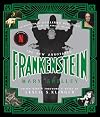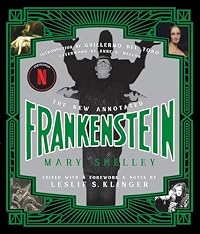
The New Annotated Frankenstein
by Mary Shelley, Leslie S. Klinger (Editor)
On This Page
Description
"'Remarkably, a nineteen-year-old, writing her first novel, penned a tale that combines tragedy, morality, social commentary, and a thoughtful examination of the very nature of knowledge,' writes ... author Leslie S. Klinger in his foreword to The New Annotated Frankenstein. Despite its undeniable status as one of the most influential works of fiction ever written, Mary Shelley's novel is often reductively dismissed as the wellspring for tacky monster films or as a cautionary tale about show more experimental science gone haywire. Now, two centuries after the first publication of Frankenstein, Klinger revives Shelley's gothic masterpiece by reproducing her original text with the most lavishly illustrated and comprehensively annotated edition to date. Featuring over 200 illustrations and nearly 1,000 annotations, this sumptuous volume recaptures Shelley's early nineteenth-century world with historical precision and imaginative breadth, tracing the social and political roots of the author's revolutionary brand of Romanticism. Braiding together decades of scholarship with his own keen insights, Klinger recounts Frankenstein's indelible contributions to the realms of science fiction, feminist theory, and modern intellectual history--not to mention film history and popular culture. The result of Klinger's exhaustive research is a multifaceted portrait of one of Western literature's most divinely gifted prodigies, a young novelist who defied her era's restrictions on female ambitions by independently supporting herself and her children as a writer and editor. Born in a world of men in the midst of a political and an emerging industrial revolution, Shelley crafted a horror story that, beyond its incisive commentary on her own milieu, is widely recognized as the first work of science fiction. The daughter of a pioneering feminist and an Enlightenment philosopher, Shelley lived and wrote at the center of British Romanticism, the 'exuberant, young movement' that rebelled against tradition and reason and 'with a rebellious scream gave birth to a world of gods and monsters' (Guillermo del Toro). Following his best-selling The New Annotated H. P. Lovecraft and The New Annotated Sherlock Holmes, Klinger not only considers Shelley's original 1818 text but, for the first time in any annotated volume, traces the effects of her significant revisions in the 1823 and 1831 editions. With an afterword by renowned literary scholar Anne K. Mellor, The New Annotated Frankenstein celebrates the prescient genius and undying legacy of the world's 'first truly modern myth.' "--Jacket. show lessTags
Recommendations






Member Recommendations

Member Reviews
For most of us, Frankenstein begins in 1931: the storm, the tower, Boris Karloff’s stitched face. Reading Mary Shelley’s actual novel feels like having the pop-culture scaffolding ripped away. There’s no “It’s alive!” moment of triumph—only a spiral of privilege, guilt, and self-delusion told entirely through other people’s retellings.
The Frankenstein family is a study in blindness. They’re rich, virtuous on paper, and utterly insulated from the consequences of their own choices. Victor grows up in that vacuum of accountability—pampered by a father too detached to guide him—and predictably becomes the kind of man who mistakes ambition for destiny. When he creates life, it’s less divine spark than spoiled show more experimentation. And when things fall apart, he spends the rest of the book performing misery instead of fixing anything.
Shelley gives us no stable truth. Everything we know is filtered through Victor’s confession and Walton’s transcription of it. It’s gossip elevated to theology, which makes the story feel eerily modern—an early case study in unreliable narration. Was there ever a Creature at all, or is it the guilt made flesh inside Victor’s sleepless mind? Shelley never says, and that’s what makes it brilliant.
The Creature himself starts out as a kind of Elizabeth—gentle, observant, yearning to be loved—but isolation erodes that goodness until he becomes Victor’s mirror: proud, wounded, obsessed with being seen. They destroy each other not because one is evil and one is pure, but because they’re the same man in different skins.
The real shock of Frankenstein isn’t horror—it’s recognition. Behind every lightning bolt and graveyard myth is a story about privilege unchecked, empathy withheld, and the way power can narrate its own sins as tragedy. It’s messier, sadder, and far more human than the movie ever let on. show less
The Frankenstein family is a study in blindness. They’re rich, virtuous on paper, and utterly insulated from the consequences of their own choices. Victor grows up in that vacuum of accountability—pampered by a father too detached to guide him—and predictably becomes the kind of man who mistakes ambition for destiny. When he creates life, it’s less divine spark than spoiled show more experimentation. And when things fall apart, he spends the rest of the book performing misery instead of fixing anything.
Shelley gives us no stable truth. Everything we know is filtered through Victor’s confession and Walton’s transcription of it. It’s gossip elevated to theology, which makes the story feel eerily modern—an early case study in unreliable narration. Was there ever a Creature at all, or is it the guilt made flesh inside Victor’s sleepless mind? Shelley never says, and that’s what makes it brilliant.
The Creature himself starts out as a kind of Elizabeth—gentle, observant, yearning to be loved—but isolation erodes that goodness until he becomes Victor’s mirror: proud, wounded, obsessed with being seen. They destroy each other not because one is evil and one is pure, but because they’re the same man in different skins.
The real shock of Frankenstein isn’t horror—it’s recognition. Behind every lightning bolt and graveyard myth is a story about privilege unchecked, empathy withheld, and the way power can narrate its own sins as tragedy. It’s messier, sadder, and far more human than the movie ever let on. show less
It is astounding that Mary Shelley wrote this novel at the age of nineteen and that she created a story with themes that still resonate two hundred years later. Lesley Klinger does a terrific job annotating the work. He covers everything from the author's life to natural history, the French Revolution and polar exploration. He provides the original 1818 published text and those sections of the 1831 text that Shelley revised from the original. Reading this book was like taking an intensive seminar on the novel. Through the annotations you come to understand that the novel is far more than a horror story, although it is that too.
REVIEWED: The New Annotated Frankenstein
WRITTEN BY: Leslie S. Klinger
PUBLISHED: August, 2017
This book is massive. And it’s gorgeous. And it’s well written, intriguing, insightful. This is the original text of the book from the 1831 edition along with Leslie Klinger’s copious notes and over 200 illustrations. A must-have for fans of Frankenstein, or anyone looking for additional insight into this classic.
Five out of Five stars
WRITTEN BY: Leslie S. Klinger
PUBLISHED: August, 2017
This book is massive. And it’s gorgeous. And it’s well written, intriguing, insightful. This is the original text of the book from the 1831 edition along with Leslie Klinger’s copious notes and over 200 illustrations. A must-have for fans of Frankenstein, or anyone looking for additional insight into this classic.
Five out of Five stars
The New Annotated Frankenstein reprints both Mary Shelley’s complete novel as well as an introduction from filmmaker Guillermo del Toro that examines his personal impression of the text and other Gothic/romantic authors, a foreword from the editor, Leslie S. Klinger (an expert on Frankenstein, Dracula, and Sherlock Holmes), that studies Shelley’s biography in her historical context alongside the novel’s legacy, as well as appendices from UCLA Distinguished Professor of English Literature Anne K. Mellor examining Frankenstein in light of modern trends of genetic engineering, a chronology of the novel’s events, Percy Blysshe Shelley’s review of the novel from 1817, and further examinations of the work on stage, screen, academia, show more and general popular culture. Throughout are illustrations of cultural references, geographic locations, historical figures, and more along with annotations that discuss revisions to the text over time or explain references that modern audiences are unlikely to understand. For those who have read Frankenstein before, this offers insights that will deepen their understanding of the work. For newcomers, this will help answer any questions they have as they read and give them a crash course in the book’s significance. A must-add to any fantasy, horror, or 19th-century literature lover’s bookshelf! show less
Ratings
Members
- Recently Added By
Author Information

437+ Works 73,217 Members
Mary Wollstonecraft Shelley was born in England on August 30, 1797. Her parents were two celebrated liberal thinkers, William Godwin, a social philosopher, and Mary Wollstonecraft, a women's rights advocate. Eleven days after Mary's birth, her mother died of puerperal fever. Four motherless years later, Godwin married Mary Jane Clairmont, bringing show more her and her two children into the same household with Mary and her half-sister, Fanny. Mary's idolization of her father, his detached and rational treatment of their bond, and her step-mother's preference for her own children created a tense and awkward home. Mary's education and free-thinking were encouraged, so it should not surprise us today that at the age of sixteen she ran off with the brilliant, nineteen-year old and unhappily married Percy Bysshe Shelley. Shelley became her ideal, but their life together was a difficult one. Traumas plagued them: Shelley's wife and Mary's half-sister both committed suicide; Mary and Shelley wed shortly after he was widowed but social disapproval forced them from England; three of their children died in infancy or childhood; and while Shelley was an aristocrat and a genius, he was also moody and had little money. Mary conceived of her magnum opus, Frankenstein, or the Modern Prometheus, when she was only nineteen when Lord Byron suggested they tell ghost stories at a house party. The resulting book took over two years to write and can be seen as the brilliant creation of a powerful but tormented mind. The story of Frankenstein has endured nearly two centuries and countless variations because of its timeless exploration of the tension between our quest for knowledge and our thirst for good. Shelley drowned when Mary was only 24, leaving her with an infant and debts. She died from a brain tumor on February 1, 1851 at the age of 54. (Bowker Author Biography) show less

Series
Belongs to Publisher Series
Common Knowledge
- People/Characters
- Victor Frankenstein; Mary Wollstonecraft Shelley
- Epigraph
- Behold: I live and will continue to live...
-MARY SHELLEY, Valperga
Classifications
Statistics
- Members
- 257
- Popularity
- 125,654
- Reviews
- 4
- Rating
- (4.46)
- Languages
- English, Spanish
- Media
- Paper, Ebook
- ISBNs
- 3
- ASINs
- 1