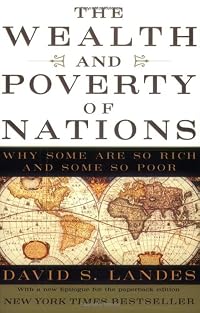
The Wealth and Poverty of Nations: Why Some are So Rich and Some So Poor
by David S. Landes
On This Page
Description
The Wealth and Poverty of Nations is David S. Landes's acclaimed, bestselling exploration of one of the most contentious and hotly debated questions of our time: Why do some nations achieve economic success while others remain mired in poverty? The answer, as Landes definitively illustrates, is a complex interplay of cultural mores and historical circumstance. Rich with anecdotal evidence, piercing analysis, and a truly astonishing range of erudition, The Wealth and Poverty of Nations is a show more "picture of enormous sweep and brilliant insight" (Kenneth Arrow) as well as one of the most audaciously ambitious works of history in decades. show lessTags
Recommendations




















Member Recommendations
The Mystery of Capital: Why Capitalism Triumphs in the West and Fails Everywhere Else by Hernando de Soto
br77rino De Soto does a wonderful job of making plain the problems of Third World capitalism, i.e., a lack of formal, standardized, and publicly-available property deeds. Every country that has successful capitalism also has the answer to the question: Who owns what?
30

Oct326 La tesi centrale del saggio di Diamond è che la causa dominante dei disuguali gradi di sviluppo tra popolazioni umane sia data dalle condizioni ambientali più o meno favorevoli. Il saggio di Landes ha un argomento un po' differente, e cioè il disuguale grado di sviluppo economico e di ricchezza tra popolazioni. Ma sulle cause di queste differenze è più articolato, e mette in rilievo l'importanza dei fattori culturali. È un punto di vista piuttosto diverso, e questo rende interessante il confronto tra le due opere.
20
Member Reviews
This marvelous book weaves an informative narrative on the history of nations and how they achieved their current(1998) status in the world at large. Thus we hear a lot about the dominance of Japan with their Gemba Kaizen and just-in-time production methods. It also explores a great number of other countries and why they didn't lead the way, so to speak.
For instance, take China. China invented and developed so many things back in the olden days, but never made real use of them. So they developed paper and block printing, but where was the literacy back in 1100 AD or so? So they managed to find the uses of Gunpowder, but they didn't find a more efficient formula for cannons and guns. This was all explained by the government and how it show more stifled creativity and drive for anything. The emperor decided what was good and bad, and a number of toadies decided who got to see the emperor. Even back in the time of Europe's rise to dominance, they did nothing but languish in the past. The thing that broke this was clocks and watches. Everything else was considered foreign trash or old news.
Thus Europe led the way with improved ship building techniques and navigation and such. When they went places they desired knowledge and trade. They wanted dominance too, of course. This was fueled in many ways by how they did things in the mother country. Take Spain for another example. They founded the "New World" and conquered the greatest nations in the Americas. The Aztecs and the Incas had much in terms of gold and silver, but this was a huge detriment to Spain. Since they received all of that specie, they went and bankrupted themselves; several times. This might seem counter-intuitive, but it doesn't actually improve the state of the nation all that much. They rested on their laurels and didn't develop new ways of farming and manufacture. Thus, by the 1600s they were already woefully behind.
Anyway, this book was really good, but somewhat out of date. Still, since it discusses the history of economics, it can be learned from. show less
For instance, take China. China invented and developed so many things back in the olden days, but never made real use of them. So they developed paper and block printing, but where was the literacy back in 1100 AD or so? So they managed to find the uses of Gunpowder, but they didn't find a more efficient formula for cannons and guns. This was all explained by the government and how it show more stifled creativity and drive for anything. The emperor decided what was good and bad, and a number of toadies decided who got to see the emperor. Even back in the time of Europe's rise to dominance, they did nothing but languish in the past. The thing that broke this was clocks and watches. Everything else was considered foreign trash or old news.
Thus Europe led the way with improved ship building techniques and navigation and such. When they went places they desired knowledge and trade. They wanted dominance too, of course. This was fueled in many ways by how they did things in the mother country. Take Spain for another example. They founded the "New World" and conquered the greatest nations in the Americas. The Aztecs and the Incas had much in terms of gold and silver, but this was a huge detriment to Spain. Since they received all of that specie, they went and bankrupted themselves; several times. This might seem counter-intuitive, but it doesn't actually improve the state of the nation all that much. They rested on their laurels and didn't develop new ways of farming and manufacture. Thus, by the 1600s they were already woefully behind.
Anyway, this book was really good, but somewhat out of date. Still, since it discusses the history of economics, it can be learned from. show less
Despite the title, this isn't a book about why, say Botswana is doing so much better than Zimbabwe these days due to such and such a policy or Germany versus Greece or practical advice on how the poor countries can turn things around and the rich countries help them. It's more descriptive than prescriptive. Rather it's a world economic history that deals with forces centuries, even millennium old. I appreciated that Landes wasn't afraid to be controversial; he takes dead aim at all forms of political correctness, multiculturalist cant, and such theories as those found in Said's Orientalism. Looking at other reviews, some complain Landes is too Eurocentric. Given the theme of the book, the wealth and poverty of nations, I can't blame him show more much. It's like that old joke about robbing banks--you go where the money is. Mind you, he seems to me to be not just Eurocentric but Anglocentric--although again, it does tie into his theory given Britain was arguably ground zero for the Industrial Revolution. And that is definitely at the center of his answer to the question posed in his subtitle concerning nations: why some are so rich and some so poor.
The book did leave me with questions. Landes begins with an analysis of geography. On the North/South axis, Landes believes the difference between tropical and temperate regions are crucial. But if that's so, why didn't North America develop a technologically sophisticated culture before contact with the West? Why then would the most impressive indigenous civilizations in the Americas rise out of jungles, such as the Mayans and the Incas? It's not a question asked in the book, which doesn't deal with the Americas until the era of exploration and colonization. Though to give Landes his due, Eurocentric doesn't mean triumphalist or apologist. If for whatever reason, you're ignorant of the atrocities committed by Europeans in the Americas or of the savagery of the Atlantic Slave Trade, Landes will certainly provide an education. (Especially when it comes to the Spanish Conquistadors. Landes is not kind to Catholicism or Islam, which he sees as stultifying upholders of dogma.) When Landes comes to examine the East/West axis, he sees as crucial the differences in property rights and development of markets. I'd be the last person to dismiss such factors out of hand, yet Landes' thesis as to the definitive factor that gave rise to the differences did raise both eyebrows:
Europe's great good fortune lay in the fall of Rome and the weakness and division that ensued. (So much for the lamentations of generations of classicists and Latin teachers.) The Roman dream of unity, authority, and order (the pax Romana) remained, indeed has persisted to the present.... [yet] fragmentation was the strongest brake on wilful, oppressive behavior. Political rivalry and the right of exit made all the difference.
Really? Because I do find it hard to believe the fall of Rome wasn't a tragedy for the West. Ancient Rome at its height is estimated to have had a population of one million. After its fall, no city, in Europe at least, would hit that threshold until London in 1811. Trade, literacy, urbanization all collapsed in the former Western Empire and arguably wouldn't fully recover for nearly a millennium. I do get Landes' point that authoritarian empires could do much to cripple technological and economic progress, but that still seemed a rather breathtaking claim. It is key to his theory however. Because if for Landes the key to the wealth of nations is the Industrial Revolution, the key to the Industrial Revolution is a culture of scientific inquiry and invention spurred on by a rivalry between nations, allowed room to breathe by a fragmented authority and fostered by a strong work ethic. (He sees this fragmented authority and work ethic as crucial in the rise of an industrial Japan as well.) In the end, geography isn't destiny, for according to Landes it's "not resources" that made the difference between nations but what "lay inside--culture, values, initiative." (And a constant related thread--the importance to growth and development of the "status and role of women" and the rights of minorities--Jews in history often being the canary in the coal mine.)
This work is erudite, entertaining, thought-provoking and written with style. (The kind of book that stretches vocabularies so have a dictionary handy.) The author is apparently an American, but he has a dry, at times acid, often deadpan humor I associate with the British. It's also hard not to respect a book that garners praise, as seen in the blurbs, from such celebrated yet ideologically diverse economists as John Kenneth Galbraith and Robert Solow. Landes himself, for all that he stresses the importance of property rights, is far from free market--he made frequent stabs, if not arguments, at free traders. I saw one reviewer that claimed this book was taught as an example of flawed historiography. Maybe so, but it's not evident to me. I appreciated that Landes often related the various controversies in the field, and there are extensive notes and bibliography. It seemed sound and told a great story. So many of the connections Landes made are fascinating; the breath of the technological and social details he presented and global scope he took in was impressive. It's a book well worth reading and thinking about. show less
The book did leave me with questions. Landes begins with an analysis of geography. On the North/South axis, Landes believes the difference between tropical and temperate regions are crucial. But if that's so, why didn't North America develop a technologically sophisticated culture before contact with the West? Why then would the most impressive indigenous civilizations in the Americas rise out of jungles, such as the Mayans and the Incas? It's not a question asked in the book, which doesn't deal with the Americas until the era of exploration and colonization. Though to give Landes his due, Eurocentric doesn't mean triumphalist or apologist. If for whatever reason, you're ignorant of the atrocities committed by Europeans in the Americas or of the savagery of the Atlantic Slave Trade, Landes will certainly provide an education. (Especially when it comes to the Spanish Conquistadors. Landes is not kind to Catholicism or Islam, which he sees as stultifying upholders of dogma.) When Landes comes to examine the East/West axis, he sees as crucial the differences in property rights and development of markets. I'd be the last person to dismiss such factors out of hand, yet Landes' thesis as to the definitive factor that gave rise to the differences did raise both eyebrows:
Europe's great good fortune lay in the fall of Rome and the weakness and division that ensued. (So much for the lamentations of generations of classicists and Latin teachers.) The Roman dream of unity, authority, and order (the pax Romana) remained, indeed has persisted to the present.... [yet] fragmentation was the strongest brake on wilful, oppressive behavior. Political rivalry and the right of exit made all the difference.
Really? Because I do find it hard to believe the fall of Rome wasn't a tragedy for the West. Ancient Rome at its height is estimated to have had a population of one million. After its fall, no city, in Europe at least, would hit that threshold until London in 1811. Trade, literacy, urbanization all collapsed in the former Western Empire and arguably wouldn't fully recover for nearly a millennium. I do get Landes' point that authoritarian empires could do much to cripple technological and economic progress, but that still seemed a rather breathtaking claim. It is key to his theory however. Because if for Landes the key to the wealth of nations is the Industrial Revolution, the key to the Industrial Revolution is a culture of scientific inquiry and invention spurred on by a rivalry between nations, allowed room to breathe by a fragmented authority and fostered by a strong work ethic. (He sees this fragmented authority and work ethic as crucial in the rise of an industrial Japan as well.) In the end, geography isn't destiny, for according to Landes it's "not resources" that made the difference between nations but what "lay inside--culture, values, initiative." (And a constant related thread--the importance to growth and development of the "status and role of women" and the rights of minorities--Jews in history often being the canary in the coal mine.)
This work is erudite, entertaining, thought-provoking and written with style. (The kind of book that stretches vocabularies so have a dictionary handy.) The author is apparently an American, but he has a dry, at times acid, often deadpan humor I associate with the British. It's also hard not to respect a book that garners praise, as seen in the blurbs, from such celebrated yet ideologically diverse economists as John Kenneth Galbraith and Robert Solow. Landes himself, for all that he stresses the importance of property rights, is far from free market--he made frequent stabs, if not arguments, at free traders. I saw one reviewer that claimed this book was taught as an example of flawed historiography. Maybe so, but it's not evident to me. I appreciated that Landes often related the various controversies in the field, and there are extensive notes and bibliography. It seemed sound and told a great story. So many of the connections Landes made are fascinating; the breath of the technological and social details he presented and global scope he took in was impressive. It's a book well worth reading and thinking about. show less
A massive account of world political and economic history, from the title setting out to explain why some countries (mainly the West) became wealthy, while most of the tropical "third world" remained poor. The trouble with such attempts is that they often descend to post-facto rationalizing. Almost any factor can be seized to "explain" the differences, and counter-examples can be found for any single cause-and-effect hypothesis. So the book amounts to not much more than a chronicle of historical events, with some speculations on the role of religion, on national character, climate and natural resources, and so on. It is difficult even to account for differences between parts of the West: why did the "industrial revolution" develop most show more robustly in Britain, for example? The author, refreshingly, tend to eschew "political correctness", and calls out deficiencies in the ruling mores and values in society, and challenges attempts to always blame some other entity or force; the positive message being, presumably, that it will be possible for any country or region to pull itself up economically, if policy is oriented to long-term improvement rather than to immediate indulgence in conspicuous consumption. show less
Difficult read, and much longer than it needed to be to get to the point. Refreshingly non-politically correct, contains many useful arguments against wimpy post-modern academic theories. P.466 makes some interesting parallels between fascism & socialism.
I read Landes and Diamond in tandem: why are different societies so different. They should be read in tandem. Diamond offers biological and geographical reasons for the differences in civilizations and their rate of "evolution." Landes notes societal and cultural differences for the differences in civilizations and their rate of "evolution." Both are correct and both are wrong in certain areas.
Reread for class.
Author's main thesis is that cultural values play an important role in whether or not a nation succeeds or fails. Some areas of his thesis are easy to ridicule, but there is a lot of meat behind the old recitations of Asians and math.
Impressive and very-well reasoned overview of historical forces (and a damning criticism of colonialism and totalitarianism), but the main omission is what to do in the near future about all this. Still a good book.
Author's main thesis is that cultural values play an important role in whether or not a nation succeeds or fails. Some areas of his thesis are easy to ridicule, but there is a lot of meat behind the old recitations of Asians and math.
Impressive and very-well reasoned overview of historical forces (and a damning criticism of colonialism and totalitarianism), but the main omission is what to do in the near future about all this. Still a good book.
This is an anecdotal account of how some nations are much wealthier than others. Culture counts. European culture is better at producing wealth than African, Middle Eastern, or South American.
Landes says that some forms of state intervention (much as mercantilism) might work better at times than free trade. He has no theory to determine when those times occur.
He avers that bad government (e.g., all of Africa), is always bad for the overall economy.
A thought-provoking work.
(JAB)
Landes says that some forms of state intervention (much as mercantilism) might work better at times than free trade. He has no theory to determine when those times occur.
He avers that bad government (e.g., all of Africa), is always bad for the overall economy.
A thought-provoking work.
(JAB)
Members
- Recently Added By
Published Reviews
In dit boek vergelijkt de auteur de economische ontwikkelingen in de werelddelen, zich afvragend waarom historisch gezien in Europa meer welvaart aanwezig is dan elders. Het antwoord ligt volgens hem eerder in een verschil van houding tegenover vernieuwingen dan in beschikbaarheid van natuurlijke voordelen of van technologische mogelijkheden. Het notenapparaat bevindt zich achter in het boek, show more onderscheiden naar de 29 hoofdstukken; er is een omvangrijke bibliografie en een gecombineerd register van personen, plaatsen, zaken en begrippen. De zeer verzorgde uitgave bevat enkele kaarten en cijfertabellen; andere illustraties ontbreken. Het werk zal voor wie van de grote lijnen in de economische geschiedenis houdt, aantrekkelijk zijn maar ook de in details geïnteresseerde lezer kan er veel van zijn gading in aantreffen. Toptien-boek (abonnement 1 en 2).
(Biblion recensie, Drs. J.C.M. van Stratum.) show less
(Biblion recensie, Drs. J.C.M. van Stratum.) show less
added by karnoefel
Lists

Economics
60 works; 5 members

Miracle of Europe
8 works; 1 member

Ten books that most shaped your view of history
91 works; 12 members

r/History Recommended Reading List
603 works; 12 members

My List
302 works; 1 member

Hakim's Marxist Book List
46 works; 3 members

Economics for the layperson
33 works; 9 members
Author Information

15+ Works 3,130 Members
David S. Landes was born in Brooklyn, New York on April 29, 1924. He graduated from the City College of New York in 1942. He received a master's degree in history in 1943 and a Ph.D. in history in 1953 from Harvard University. During World War II, he was drafted into the Army and was assigned to the Signal Corps because he had been taking show more mail-order courses in cryptanalysis. He worked on deciphering Japanese messages about the atomic bombs dropped on Japan. He later worked on a history of German preparations for the invasion of Normandy. His dissertation, Bankers and Pashas: International Finance and Economic Imperialism in Egypt, became his first book. His other works included Revolution in Time: Clocks and the Making of the Modern World, The Wealth and Poverty of Nations: Why Some Are So Rich and Some So Poor, and Dynasties: Fortunes and Misfortunes of the World's Great Family Businesses. He taught at numerous universities during his lifetime including Columbia University, the University of California at Berkeley, and Harvard University, where he retired in 1996. He died on August 17, 2013 at the age of 89. (Bowker Author Biography) show less
Awards and Honors
Distinctions
Series
Belongs to Publisher Series
Common Knowledge
- Canonical title
- The Wealth and Poverty of Nations: Why Some are So Rich and Some So Poor
- Original title
- The Wealth and Poverty of Nations
- Alternate titles
- Ο πλούτος και η φτώχεια των εθνών: Γιατί μερικά έθνη είναι τόσο πλούσια και μερικά τόσο φτωχά
- Original publication date
- 1998
- Epigraph
- ...the causes of the wealth and povery of nations - the grand object of all enquiries in Political Economy. -- Malthus to Ricardo, letter of 26 January 1817
- Dedication
- For my children and grandchildren, with love.
- First words
- Geography has fallen on hard times.
- Last words
- (Click to show. Warning: May contain spoilers.)We must cultivate a skeptical faith, avoid dogma, listen and watch well, try to clarify and define ends, the better to choose means.
- Publisher's editor
- Edwin Barber
- Blurbers
- Galbraith, John Kenneth; Solow, Robert; Arrow, Kenneth
- Original language
- English
Classifications
Statistics
- Members
- 1,888
- Popularity
- 11,416
- Reviews
- 20
- Rating
- (3.78)
- Languages
- 13 — Chinese, Czech, Dutch, English, French, German, Greek, Italian, Polish, Portuguese, Romanian, Spanish, Swedish
- Media
- Paper, Audiobook, Ebook
- ISBNs
- 40
- ASINs
- 12