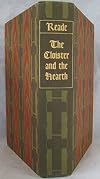
The Cloister and the Hearth
by Charles Reade
On This Page
Description
Cloister and the Hearth, Volume IV"The Cloister and the Hearth" is Charles Reade's greatest work--and, I believe, the greatest historical novel in the language. . . . "One can only say that this great writer--there is no greater praise--paints women as they are, men as they are, things as they are. What we call genius is first the power of seeing men, women, and things as they are--most of us, being without genius, are purblind--and then the power of showing them by means of "invention"--by show more the grafting of "invention" upon fact. No man has shown greater power of grasping fact and of weaving invention upon it than Charles Reade." -- from Walter Besant's introduction show lessTags
Recommendations



















Member Reviews
This remarkable novel shares the fate of many a former 'bestseller': its readership plummeted after its hour of fame passed, and has not been renewed. I came to The Cloister and the Hearth expecting Sir Walter Scott, but got a gripping and occasionally harrowing mixture of Les Misérables, Game of Thrones and Cadfael. The book has a highly unusual premise: to tell the story of the parents of Erasmus of Rotterdam. Given that Erasmus himself is not a major character in the book, this might sound like a post facto justification for a simple historical novel, but the events of the book do actually mirror Erasmus's own slightly romantic account of his heritage. Where Reade excels is in drawing character, making his large cast live and show more breathe; we rejoice at their triumphs and are dismayed by their many setbacks. His feeling for the period is similarly developed; the events of history unfold but are not made to dominate the story. Sadly, the novel is not without its flaws; first among these is Reade's unfortunate style for presenting dialogue. In order to represent the everyday Dutch of the fifteenth century, he employs mock-Elizabethan English that mars the book's conversation to the point of ridicule ('Zounds, stop that bellyache blether,' quoth he, 'that will ne'er wile a stiver out o' peasants' purses'). Despite this, and the expected slew of coincidences, The Cloister and the Hearth is a well-crafted story with strong characters that justifies its 800 or so pages. show less
This remarkable novel shares the fate of many a former 'bestseller': its readership plummeted after its hour of fame passed, and has not been renewed. I came to The Cloister and the Hearth expecting Sir Walter Scott, but got a gripping and occasionally harrowing mixture of Les Misérables, Game of Thrones and Cadfael. The book has a highly unusual premise: to tell the story of the parents of Erasmus of Rotterdam. Given that Erasmus himself is not a major character in the book, this might sound like a post facto justification for a simple historical novel, but the events of the book do actually mirror Erasmus's own slightly romantic account of his heritage. Where Reade excels is in drawing character, making his large cast live and show more breathe; we rejoice at their triumphs and are dismayed by their many setbacks. His feeling for the period is similarly developed; the events of history unfold but are not made to dominate the story. Sadly, the novel is not without its flaws; first among these is Reade's unfortunate style for presenting dialogue. In order to represent the everyday Dutch of the fifteenth century, he employs mock-Elizabethan English that mars the book's conversation to the point of ridicule ('Zounds, stop that bellyache blether,' quoth he, 'that will ne'er wile a stiver out o' peasants' purses'). Despite this, and the expected slew of coincidences, The Cloister and the Hearth is a well-crafted story with strong characters that justifies its 800 or so pages. show less
I have just re-read this after many years. It is a bit of an oddity: the story of the rather hopeless love affair of the parents of Erasmus the famous 16thC humanist scholar. But this is really just an excuse for Reade to rollick through medieval Europe, encountering rogues, cutpurses, beggars, hermits, saucy chambermaids, villainous landlords, mercenaries, lords, ladies and peasants. He based all this on contemporary accounts, which gives realism and colour to the story.
Rather like that other Victorian historical novel, "Lorna Doone", the story is vivid and compellingly told, and well worth reading even today.
Courage, mon ami, le diable est mort!
Rather like that other Victorian historical novel, "Lorna Doone", the story is vivid and compellingly told, and well worth reading even today.
Courage, mon ami, le diable est mort!
What a wonderful novel; my thanks to the person who turned me onto it. I won't belabor a plot summary, just know that it's a Victorian novel (written in 1861) that takes place during the late Middle Ages, and therefore contains the requisite "thee"s and "thou"s and even a few "forsooth"s, so if that doesn't sound like your cup of tea, you know who you are. But beyond that, what it is is a great historical romance filled with believable characters, medieval flavor, comedy, tragedy, and high adventure. The following is an incomplete list of words that I looked up during my reading of The Cloister and the show more Hearth:theodolitedithyrambpermanganatejalousieotiosepismireexequiesburthenminaretultramontaneexegesisdiademcatechumenskickshawkirtlefarthingalehircinekinearbalestrieranimalculaquadrivialganymedeorisonpsalteriespipkinaubergediapasonleveretpettifoggingdictcapiaswanionpizzlemijaureeminauderiesgrimacierepetroneldudgeoncurtal axchoughcordwainergroateftsoonspursuivantmanteletmangonelsbarbicanmachicolatefascinedevoirmalisonroof-treeviragolemantabormicklecleptycleptfebrifugalwhitemailcaitiffwhidscozeningtatterdemalioncul de boisqueanlapwingvopperrotbossglaivewindlassculverinmarchpanecanzonetorielcavilMyrmidonseptemviousseneschalmare's nestAspersoriumperadventureciliceThat's actually not a complaint; what I'm saying is that the book kept me on my toes, and that I learned a lot. show less
I haven't read this book for many years, but at one point was obsessed with it and went around antiquarian and secondhand bookstores buying up every copy I could find. Some volumes have the most amazing illustrations and if you're into collecting books these are worth tracking down.
The story is not only bitter-sweet but also a fantastic 15th Century romp with our hero, Gerard, getting into all kinds of scrapes, some of which are fraught with danger while others are absolutely hilarious.
The story is not only bitter-sweet but also a fantastic 15th Century romp with our hero, Gerard, getting into all kinds of scrapes, some of which are fraught with danger while others are absolutely hilarious.
What a wonderful novel; my thanks to the person who turned me onto it. I won't belabor a plot summary, just know that it's a Victorian novel (written in 1861) that takes place during the late Middle Ages, and therefore contains the requisite "thee"s and "thou"s and even a few "forsooth"s, so if that doesn't sound like your cup of tea, you know who you are. But beyond that, what it is is a great historical romance filled with believable characters, medieval flavor, comedy, tragedy, and high adventure. The following is an incomplete list of words that I looked up during my reading of The Cloister and the show more Hearth:theodolitedithyrambpermanganatejalousieotiosepismireexequiesburthenminaretultramontaneexegesisdiademcatechumenskickshawkirtlefarthingalehircinekinearbalestrieranimalculaquadrivialganymedeorisonpsalteriespipkinaubergediapasonleveretpettifoggingdictcapiaswanionpizzlemijaureeminauderiesgrimacierepetroneldudgeoncurtal axchoughcordwainergroateftsoonspursuivantmanteletmangonelsbarbicanmachicolatefascinedevoirmalisonroof-treeviragolemantabormicklecleptycleptfebrifugalwhitemailcaitiffwhidscozeningtatterdemalioncul de boisqueanlapwingvopperrotbossglaivewindlassculverinmarchpanecanzonetorielcavilMyrmidonseptemviousseneschalmare's nestAspersoriumperadventureciliceThat's actually not a complaint; what I'm saying is that the book kept me on my toes, and that I learned a lot. show less
One of my favorite historical novels, set in Europe during the 1500's. Reade goes into minute details of life in Europe during this period, and his characters are fleshed out with amazing depth and clarity. The first time I read this, I couldn't put it down.
Members
- Recently Added By
Lists

1898 C.K. Shorter List of Best 100 Novels
100 works; 34 members

Fifty Representative Historical Novels
50 works; 2 members

CCE 1000 Good Books List
1,033 works; 12 members
Trinity College Booklist (1951): Class Ten, English Literature
358 works; 5 members

To Read
37 works; 1 member
Author Information

92+ Works 1,329 Members
Charles Reade, 1814 - 1884 Charles Reade was born at Ipsden, Oxfordshire, on June 8, 1814. He entered Magdalen College, at Oxford, earning his B.A. in 1835, and became a fellow of the college. He was subsequently dean of arts, and vice-president of Magdalen College, earning his degree of D.C.L. in 1847. His name was entered at Lincoln's Inn in show more 1836; he was elected Vinerian Fellow in 1842, and was called to the bar in 1843. He kept his fellowship at Magdalen all his life, but after earning his degree, he spent the greater part of his time in London. His first comedy, The Ladies' Battle, appeared at the Olympic Theatre in May 1851. It was followed by Angela (1851), A Village Tale (1852), The Lost Husband (1852), and Gold (1853). But Reade's reputation was made by the two-act comedy, Masks and Faces, in which he collaborated with Tom Taylor. It was produced in November 1852. He made his name as a novelist in 1856, when he produced It's Never Too Late to Mend, a novel written with the purpose of reforming abuses in prison discipline and the treatment of criminals. Five minor novels followed in quick succession, The Course of True Love never did run Smooth in 1857, Jack of all Trades in 1858, The Autobiography of a Thief in 1858, Love Me Little, Love Me Long in 1859, and White Lies in1860, dramatized as The Double Marriage. In 1861, his masterpiece, The Cloister and the Hearth, was published, relating the adventures of the father of Erasmus. At intervals throughout his literary career he sought to gratify his dramatic ambition, hiring a theatre and engaging a company for the representation of his own plays. His greatest success as a dramatist was his last attempt, Drink, an adaptation of Zola's L'Assommoir, produced in 1879. Reade's health began to fail not long after, and he died in April of 1884, leaving behind him a completed novel, A Perilous Secret. (Bowker Author Biography) show less
Some Editions
Awards and Honors
Series
Belongs to Publisher Series
Work Relationships
Is contained in
Contains
Is abridged in
Common Knowledge
- Canonical title
- The Cloister and the Hearth
- Original publication date
- 1861
- People/Characters
- Gerard Eliassoen; Margaret Brandt
- Important places
- Rome, Italy
- First words
- Not a day passes orver the earth, but men and women of no note do great deeds, speak great words, and suffer noble sorrows. Of these obscure heroes, philosophers, and martyrs, the greater part will never be known till that h... (show all)our, when many that are great shall be small, and the small great; but of others the world's knowledge may be said to sleep: their lives and characters lie hidden from nations in the annals that record them.
- Last words
- (Click to show. Warning: May contain spoilers.)Some of the best scenes in this book are from his medieval pen, and illuminate the pages where they come; for the words of a genius so high as his are not born to die: their immediate work upon mankind fulfilled, they may seem to lie torpid; but, at each fresh shower of intelligence Time pours upon their students, they prove their immortal race: they revive, they spring from the dust of great libraries; they bud, they flower, they fruit, they seed, from generation to generation, and from age to age.
- Original language
- English
- Disambiguation notice
- The Classic Illustrated (comic book) version of The CLoister and the Hearth should not be combined with the actual full-text novel of the same name.
Classifications
Statistics
- Members
- 779
- Popularity
- 35,672
- Reviews
- 11
- Rating
- (3.69)
- Languages
- 5 — English, Finnish, French, German, Polish
- Media
- Paper, Audiobook, Ebook
- ISBNs
- 57
- ASINs
- 95