On This Page
Description
In DAY OF THE MINOTAUR, modern readers at last have an opportunity to rediscover the imaginative genius of Thomas Burnett Swann, a writer whose works have been compared with the marvel-packed sagas of J.R.R. Tolkien, the sweeping adventure-tales of Mary Renault, and the sheer story-telling magic of Jack Vance and Edgar Rice Burroughs. This is the novel of Eunostos, the last of an ancient and powerful race of bull-men; of the Achaean conqueror Ajax; and of the beautiful Thea, known as the show more Beast Princess. You will not soon forget these characters, nor the unusual Bears of Artemis, the treacherous, bee-like creatures called Thriae, and the rest of the humans and non-humans who come to the final battle in the thunderous War of the Beasts. A world of wonder and excitement that will grip your imagination from the first page to the last! show lessTags
Recommendations
















Member Reviews
Day of the Minotaur was Thomas Burnett Swann's first published novel, later classed as the third of a trilogy as he wrote his way backwards through its two prequels The Forest of Forever and Cry Silver Bells. I have read them in narrative sequence, so this book completes the series for me. The archaeological documentary conceit that Swann imposes in his preface by "T.I. Montasque, Ph.D., Sc.D., L.L.D., Florida Midland University" is a clumsy fit for the narrative voice of the Minotaur Eunostos, and he abandoned it in the further volumes.
The fantasy antiquity of this book closely matches the one in the contemporaneous Swann novella "The Murex" (republished in The Dolphin and the Deep), with bee-like Thriae rather than the Myrmidon ant show more people of the novella. Both involve feral girls as the "Bears of Artemis." But of course Day of the Minotaur foregrounds the Minotaur with his friends the Centaurs, the Dryads, the Panisci, and the industrious arthropod Telchines. As is the case in many of Swann's stories, this one recounts a twilight of the prehuman peoples.While its climax is a victory for the Cretan Beasts over invading Achaeans, its conclusion is the victors' emigration to the makarōn nēsoi, or the Isles of the Blessed. Erotic motivations--often cross-species--are conspicuous, although there is not really any sexually explicit narrative. The style is limpid and and heartfelt, often swelling with wholesome sentiment.
I'm getting to the point where I have nearly read up all of the Swann I have on hand. Green Phoenix is still waiting for me, along with at least ten books I haven't managed to collect. But I've built a lot of affection for his work, and I won't rule out re-readings in the future. show less
The fantasy antiquity of this book closely matches the one in the contemporaneous Swann novella "The Murex" (republished in The Dolphin and the Deep), with bee-like Thriae rather than the Myrmidon ant show more people of the novella. Both involve feral girls as the "Bears of Artemis." But of course Day of the Minotaur foregrounds the Minotaur with his friends the Centaurs, the Dryads, the Panisci, and the industrious arthropod Telchines. As is the case in many of Swann's stories, this one recounts a twilight of the prehuman peoples.
I'm getting to the point where I have nearly read up all of the Swann I have on hand. Green Phoenix is still waiting for me, along with at least ten books I haven't managed to collect. But I've built a lot of affection for his work, and I won't rule out re-readings in the future. show less
I vaguely remember reading this book when I was young. It had infiltrated my dad’s stash of 1970s sci-fi in the attic, sitting ill-at-ease beside Asimov, Arthur C. Clarke, Frank Herbert and Robert Silverberg. When I stumbled over a copy some twenty years later in Hay-on-Wye, I decided to read it again. And was it worth it? Hmm. It was written in 1966 and hasn’t dated well, in ways that would have gone over my head as a young teen. More on that in a moment. The story itself means well, though. Stuffed full of Greek mythology, it seems to have been written under the influence of Mary Renault. It’s the tale of Thea and Icarus, two half-Cretan children who escape the destruction of the city of Knossos – in a glider, naturally. They show more hope to reach the Country of the Beasts, the region into which Greece’s mythological creatures have withdrawn to escape the advance of men. But their headlong flight leads instead to further danger, leaving them stranded in the cave of the Minotaur himself...
For the full review, please see my blog:
https://theidlewoman.net/2020/02/06/day-of-the-minotaur-thomas-burnett-swann/ show less
For the full review, please see my blog:
https://theidlewoman.net/2020/02/06/day-of-the-minotaur-thomas-burnett-swann/ show less
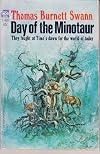
The cover illustration and blurb are deeply misleading. The minotaur who gapes so garishly on the front, lurking horribly with matted red hair through a dripping cave, turns out to be scarcely more fierce than Mr Tumnus the faun in C.S. Lewis's "The Lion, The Witch, and the Wardrobe". The frail and beautiful heroine - half-forest-dweller ("beast"), half Mycenaean princess -abandoned with her kid brother in the minotaur's lair, proceeds to ... tidy his den and make him a nice tunic! In tone the book is just a little more sexually charged than Narnia, as the gentle beast-folk (centaurs, dryads, and the like) fight a rearguard action against the ravaging Achaean Greeks, who are displacing the presumably more beast-friendly Mycenaeans. The show more story purports to be the memoir of the minotaur, who calls his tale "The Passing of the Beasts"; it might have been a better title for the book.
MB 28-ix-2010 show less
MB 28-ix-2010 show less
review of
Thomas Burnett Swann's Day of the Minotaur
by tENTATIVELY, a cONVENIENCE - October 23-26, 2021
As a young'un, a wee lad, I probably started reading fantasy at the same time or slightly before science fiction, when I was around 9 & I read The Hobbit. It didn't take long before I felt like I'd outgrown fantasy & I moved on to a wide variety of other literatures, taking awhile to eventually return to SF but not really to return to fantasy except on rare occasions. It wd've been while I was browsing my former favorite used bkstore (somewhat ruined for me by the hypochondria of its manager) that I noticed bks by this author, someone I wasn't previously familiar w/. Always looking for new authors to read works by it seemed about show more time to reinvestigate fantasy.. although "fantasy" might not really be the best label for this, rewritten myth might be a better term. According to the bk's author bio:
"THOMAS BURNETT SWANN was born in Florida in 1928 and served in the U.S. Navy during the Korean War."
Right off the bat I was in left field: I expected the author to be roughly of the generation of William Morris or William Hope Hodgson, not a solidly middle-of-the-20th-century guy. At least he cd've chosen the name "William", right?!
In fact, in my review of William Hope Hodgson's The House on the Borderland from a distant past of 4 yrs ago before most people turned into sheeple before my very eyes & lost the ability to say anything that wasn't prefabricated for them by their masters, I called attn to:
"The protagonists find a manuscript at a ruin & decide to read it. Hence we enter the fantastic part of The House on the Borderland. As a literary device, the found text is about as bad as 'it-was-all-a-dream'." - https://www.goodreads.com/review/show/2127802453
This literary device, the found-ms-that's-supposed-to-get-the-reader-to-imagine-that-this-is-a-true-story device really doesn't bother me as much as I imply above. &, yes, it's used in the "PREFACE" here:
"In 1952, when the young cryptographer, Michael Ventris, announced his partial decipherment of the clay tablets found in the ruins of Knossos, archeologists, linguists, and laymen greeted his announcement with enthusiasm and expectation. Since the excavations of Sir Arthur Evans at the turn of the century, the island of the fabulous Sea Kings had piqued the imagination with its snake-goddesses and bull games, labyrinths and man-killing Minotaurs. But instead of a Cretan Iliad, the tablets revealed a commonplace inventory of palace furniture and foodstuffs, with occasional names of a town, a god, or a goddess. In a word, they confirmed the already accepted facts that the ancient Cretans had lived comfortably, worshipped conscientiously, and kept elaborate records. Those who had hoped for an epic, a tragedy, or a history—in short, for a work of literature to rival the Cretan achievments in architecture and fresco painting—were severely disappointed.
"In 1960, however, an American expedition from Florida Midland University excavated a cave on the southern coast of Crete near the ancient town of Phaestus and discovered a long scroll of papyrus, sealed in a copper chest from the depredations of thieves and the weather. I myself commanded that expedition and wrote the article which announced our find to the public. At the time of my article, we had barely begun to decipher the scroll, which I prematurely announced to be the world's earliest novel, the fanciful story of a war between men and monsters. But as we progressed with our decipherment, we marveled at the accurate historical framework, the detailed descriptions of flora and fauna, the painstaking fidelity to fact in costume and custom. We began to ask ourselves: Were we dealing, after all, with a novel, a fabrication, a fantasy?" - pp 5-6
This is 'signed' on p 7 w/:
"T.J. Montasque, Ph. D., Sc.D., L.L.D.
Florida Midland University"
Cd Swann possibly be slyly complimenting himself w/ "we marveled at the accurate historical framework, the detailed descriptions of flora and fauna, the painstaking fidelity to fact in costume and custom"? Well, let's test this claim.
"My history belongs to the princes Thea, niece of the great king Minos, and to her brother Icarus, named for the ill-fated son of Daedalus who drowned in the sea when his glider lost its wings. I, the author, amd a poet and craftsman and not a historian, but at least I have studied the histories of Egypt and I will try to imitate their terse, objective style. You must forgive me, however, if now and then I digress and lose myself in the glittering adjectives which come so readily to my race. We have always been rustic poets, and I, the last of the line, retain an ear for the well-turned phrase, the elegant (yes, even the flowery) epithet." - p 9
"In Greek mythology, Minos (/ˈmaɪnɒs, -nəs/; Greek: Μίνως, Ancient: [mǐːnɔːs] Modern: [ˈminos]) was a King of Crete, son of Zeus and Europa."
[..]
""Minos" is often interpreted as the Cretan word for "king", or, by a euhemerist interpretation, the name of a particular king that was subsequently used as a title."
[..]
"Minos appears in Greek literature as the king of Knossos as early as Homer's Iliad and Odyssey." - https://en.wikipedia.org/wiki/Minos
"The Iliad (/ˈɪliəd/; Ancient Greek: Ἰλιάς, romanized: Iliás, Attic Greek: [iː.li.ás]; sometimes referred to as the Song of Ilion or Song of Ilium) is an ancient Greek epic poem in dactylic hexameter, traditionally attributed to Homer. Usually considered to have been written down circa the 8th century BC, the Iliad is among the oldest extant works of Western literature" - https://en.wikipedia.org/wiki/Iliad
SO, it seems that the author isn't really trying to convince the reader that this is 'fact' b/c he's placing the narrative in myth. What about his use of the word "glider" to describe Icarus's wings?
"Glider is the agent noun form of the verb to glide. It derives from Middle English gliden, which in turn derived from Old English glīdan. The oldest meaning of glide may have denoted a precipitous running or jumping, as opposed to a smooth motion. Scholars are uncertain as to its original derivation, with possible connections to "slide", and "light" having been advanced." - https://en.wikipedia.org/wiki/Glider_(aircraft)#Etymology
Given that Old English is the English from, at the earliest, the mid-5th century AD, that puts Swann's use of the word (albeit 'in translation') a minimum of 1,300 yrs later than the reputed time of this story. Of course, Swann is trying to redefine Icarus's flight away from mythology.
"The first heavier-than-air (i.e. non-balloon) man-carrying aircraft that were based on published scientific principles were Sir George Cayley's series of gliders which achieved brief wing-borne hops from around 1849." - https://en.wikipedia.org/wiki/Glider_(aircraft)#19th_century
However, let's not be too hasty. As I wrote in my review of Howard V. Hendrix's Lightpaths:
""Eilmer of Malmesbury was the country’s first aviator c1005AD.
"William of Malmesbury wrote about 100 years after the event in his epic ‘Deeds of the English Kings’:
"‘He was a man of good learning for those times; of mature age and in his early youth had hazarded an attempt of singular temerity: he had by some contrivance fastened to his hands and feet in order that he might fly as Daedalus, and collecting the air, on the summit of a tower, had flown for a distance of a furlong (200m); but agitated by the violence of the wind and a current of air, as well as the consciousness of his rash attempt, he fell and broke both his legs, and was lame ever after. He used to relate as the cause of the failure that he had forgotten to provide himself with a tail.’
"The date of the flight can be judged fairly accurately as it is recorded that Eilmer saw Halley’s comet in 989 and again in 1066. Assuming he had to be at least six to remember the comet, to make the flight in early youth suggests a date between 995 and 1010. Celebration of the millennium of the flight was held in Malmesbury in July 2010." - https://www.athelstanmuseum.org.uk/malmesbury-history/people/eilmer-the-flying-m..." - https://www.goodreads.com/story/show/1318307-howard-v-hendrix
So, who knows, right?
Okay, OK, I'm just having fun nit-picking. Obviously, the author is using the mythology as a springboard for his flights of fancy. I enjoyed it. The 2 main human protagonists of the bk used a glider to escape an invasion of up-to-no-good ruffians.
"To the west lay the hills, terraced with olive trees and vineyards, which climbed gradually into the Range of Ida and the Country of the Beasts, the forests which no one mentioned without a shudder, much less entered; the haunt, it was said by the cook, the gatekeeper, and the gardener, of the Minotaur, the Bull That Walks Like a Man. "Try not to land in the Country of the Beasts." She would not forget her father's warning.
"Myrrha, the handmaiden, exploded into the garden. At the same instant, Thea heard sounds beyond the walls. Marching feet, the clank of armor, the voices of men who march with such confidence that they want the whole countryside to hear their coming." - p 14
My method writing reviews generally involves my putting pencil markings indicating select parts of the bk while I'm reading it w/ notes at the beginning of the bk indicating the significance of the chosen section. When I'm 1st reading a bk, & haven't gotten much of a feel for it yet, I sometimes select a passage that seems like an odd choice to me when I've finished reading the bk & it's time to write the review. Now is such a time. While the above passage is fine, why didn't I pick a section where they're flying on the glider?! Instead, we next meet our heroes after they've crashed & been captured by the invaders. One of them has his eye on Thea as a juicy prize.
"Leaving Icarus to admire the fresco of dolphins, she climbed in the tub and turned a frog-shaped spigot to immerse her body with hot, steaming water. In the larger mansions, rain was trapped on the roof, heated by a brazier, and carried to the bathrooms through pipes of terracotta. Cretan plumbing was admired even in Egypt." - p 26
& to think that the word "Cretan" has turned into a slur meaning "idiot". Harumph. As Mike Heron sd: "Smiling Men with Bad Reputations".
"When I entered the cave, I was hungry as a bull. Once a week the farmers outside the forest bring me a skinned animal. Bellowing lustily to justify my reputation, I fetch the meat and take it home with me to cook in the garden. They call me the Minotaur, the Bull That Walks Like a Man. In spite of my seven feet, however, I am not a freak, but the last of an old and illustrious tribe who settled the island before the Cretans arrived from the East. Except for my pointed ears (which are common to all of the Beasts), my horns (which are short and almost hidden by my hair), and my unobtrusive tail, I am far more human than bovine, though my generous red hair, which has never submitted to the civilizing teeth of a comb, is sometimes mistaken for a mane." - p 35
Thea & Icarus escape to the Cave of the Minotaur, not wishing to be Beast-food, but also not wishing to be slaves to their captors. Hence, I & M 1st meet w/ I prepared to defend his life from the notorious appetite.
""Come down from there," I cried. "What do you think you are, a blue monkey? I won't hurt you."
""Oh," he said, surprised. You can talk, and in Cretan too."
""What did you expect me to do, moo or speak Hittite? As a matter of fact, your people learned their language from my people several hundred years ago."
""'Till now I have only heard you bellow." He was already climbing down from his ledge." - p 36
Our pal, the Minotaur, has giant ants working for him.
"It was, of course, her first meeting with a Telchin, a three-foot ant with almost human intelligence and with six skillful legs which make him the best lapidary in the world; he can carve and set gems more delicately than the surest human craftsman. But Thea saw only the great bulbous head, the many-facted eyes, the black, armored skin.
""It crawled down the ladder," she said in a whisper. "Then it came at me, waving its feelers."
""He didn't come at you, he came looking for me," I snapped emphasizing the he, for I saw that her scornful it had hurt his feelings." - p 46
I don't recall ever hearing tell of "Telchins" so I just had to look the word up online. No sense in taking it for granted that I can look it up any old time what w/ the New Normal threatening just about everything I hold sacred.
"This family of strange names belongs evidently to the Indo-European language, and
designated a class of demons of gigantic or dwarfish size, which were believed to possess great skill in all manner of arts and crafts. They were especially famous as blacksmiths. In antiquity several mythical works were ascribed to the Greek Telchins, such as the scythe of Cronos and the trident of Poseidon. They were mischievous, spiteful genii who from time immemorial became somewhat confused with the Cyclops. The Telchins were called children of the sea and were found only in a small number." - https://archive.org/stream/themythologyofal07alexuoft/themythologyofal07alexuoft...
Perhaps their being giant ants is Swan's touch. Another of Swan's touches is to have Thea, the more-or-less human, start to order the Minotaur's world.
"In the glow of a freshly lit lamp, three dove-shaped vases nested among the roots and bristled with poppies out of my garden. The sad little heads of my flowers stared reproachfully from every corner of the room, five heads to a dove.
""You've killed them." I cried. "You've cut their throats."
""Housed, not killed. In the garden, nobody noticed them."
""I did. Every day. Here it's like putting them in jail."
""I shall try to be a kind jailer," she smiled, straightening a flower." - p 54
I'm solidly on the Minotaur's side on this one. Uprooting the plants obviously dramatically shortens their life & detaches them from a root network. & for what? Some stupid aesthetic reason. Pshaw!
The Minotaur has a party & Thea continues to try to 'civilize' him.
""My turn," I called.
"Restraining fingers caught at my belt. "Mine," said Thea.
""I'll step on your toes," I protested, edging toward Zoe.
""Not in my dance." Her fingers were irresistable. "We call if the Walk of the Cranes." We linked hands and she led me through stately, meandering steps like those of the young virgins when they dance beside the River Kairatos, though the music seemed more appropriate to the opium-drugged priestesses of the Great Mother, when they yield themselves to ecstasy, writhe on the ground, and tear the bark from a tree with their savage teeth." - p 60
Thea & Icarus didn't remember their mother. She had been w/ the 'beasts', their father had been 'human' & had taken them back to 'civilization'. The Minotaur tells them their history.
"A mile from the Field of Stones, in a small clearing green with moss and fern, I showed them a fire-blackened stump which had once been a royal oak. Through the gutted walls, you could see the ruined beginnings of a staircase, spiraling around the tree and ending abruptly in air.
""Your mother's tree," I said. And I told them about Aeacus, their father. . . ." - p 70
The Queen of the Thriae is treacherous & lures Icarus into her lair w/ seductiveness.
"There were wicker chairs suspended from the ceiling on tenuous chains of grass. There were hangings of spider-spun silk through which the walls revealed their ribs of reed. Most of all, it was a room of flowers, which glowed in mounds like the heaped treasures spilled in Egyptian tombs when thieves are caught at their theft. One of the walls was coated with polished wax which mirrored the room like a misty garden and Amber's face as the queenliest of the blossoms. Surely, thought Icarus, no evil can touch me akong so many flowers—there are even bees at work collecting nectar." - p 88
The Thriae sold out to human invaders but the Minotaur & his friends outwitted them.
"The Thriae could not account for the strange sleep of their hosts. Intoxicated? Drugged? Exhausted by the rigors of conquest? They fluttered above the prostrated bodies, their dulcet tones growing shrill; they shouted, prodded with jeweled fingers, clamored—the queens for attention, the drones for caresses. Quietly the three Dryads congregated around Thea and began to help her collect the Achaen daggers.
"Amber, kneeling to prod a recumbent body, lifted her head to confront an armed and determined Thea, who seized the gauzy membrane of her wing and delivered a slap which spun her head as if it had been struck by the boom of a sail." - p 144
The Minotaur, being the author of this history, reveals his expectations that the future will not be kind to his fellow beings.
""Beast" will become synonymous with "animal," and "bestial" will be an epithet applied to savages and murderers." - p 157
Isn't it odd how people who're brutal are often sd to be "animals"?! I generally find humans to be far more destructive than any animal ever is. It's rare for there to even be animals that hunt in packs & when they do it's just in search of food & no more. Humans commit genocide on a regular basis for things far abstracted from food & territory - often out of sheer malice. Calling a human an "animal" as an insult implying brutality is an insult to animals.
When I was a kid, I had a bk on Greek Mythology. It was one of my favorite bks. I grew out of it as I started to think that Ancient Greek culture had too much influence on the present. Still, I obviously retain some of my childhood affection b/c I enjoyed this & I have many more Swan bks apparently of a similar ilk that I plan to read. show less
Thomas Burnett Swann's Day of the Minotaur
by tENTATIVELY, a cONVENIENCE - October 23-26, 2021
As a young'un, a wee lad, I probably started reading fantasy at the same time or slightly before science fiction, when I was around 9 & I read The Hobbit. It didn't take long before I felt like I'd outgrown fantasy & I moved on to a wide variety of other literatures, taking awhile to eventually return to SF but not really to return to fantasy except on rare occasions. It wd've been while I was browsing my former favorite used bkstore (somewhat ruined for me by the hypochondria of its manager) that I noticed bks by this author, someone I wasn't previously familiar w/. Always looking for new authors to read works by it seemed about show more time to reinvestigate fantasy.. although "fantasy" might not really be the best label for this, rewritten myth might be a better term. According to the bk's author bio:
"THOMAS BURNETT SWANN was born in Florida in 1928 and served in the U.S. Navy during the Korean War."
Right off the bat I was in left field: I expected the author to be roughly of the generation of William Morris or William Hope Hodgson, not a solidly middle-of-the-20th-century guy. At least he cd've chosen the name "William", right?!
In fact, in my review of William Hope Hodgson's The House on the Borderland from a distant past of 4 yrs ago before most people turned into sheeple before my very eyes & lost the ability to say anything that wasn't prefabricated for them by their masters, I called attn to:
"The protagonists find a manuscript at a ruin & decide to read it. Hence we enter the fantastic part of The House on the Borderland. As a literary device, the found text is about as bad as 'it-was-all-a-dream'." - https://www.goodreads.com/review/show/2127802453
This literary device, the found-ms-that's-supposed-to-get-the-reader-to-imagine-that-this-is-a-true-story device really doesn't bother me as much as I imply above. &, yes, it's used in the "PREFACE" here:
"In 1952, when the young cryptographer, Michael Ventris, announced his partial decipherment of the clay tablets found in the ruins of Knossos, archeologists, linguists, and laymen greeted his announcement with enthusiasm and expectation. Since the excavations of Sir Arthur Evans at the turn of the century, the island of the fabulous Sea Kings had piqued the imagination with its snake-goddesses and bull games, labyrinths and man-killing Minotaurs. But instead of a Cretan Iliad, the tablets revealed a commonplace inventory of palace furniture and foodstuffs, with occasional names of a town, a god, or a goddess. In a word, they confirmed the already accepted facts that the ancient Cretans had lived comfortably, worshipped conscientiously, and kept elaborate records. Those who had hoped for an epic, a tragedy, or a history—in short, for a work of literature to rival the Cretan achievments in architecture and fresco painting—were severely disappointed.
"In 1960, however, an American expedition from Florida Midland University excavated a cave on the southern coast of Crete near the ancient town of Phaestus and discovered a long scroll of papyrus, sealed in a copper chest from the depredations of thieves and the weather. I myself commanded that expedition and wrote the article which announced our find to the public. At the time of my article, we had barely begun to decipher the scroll, which I prematurely announced to be the world's earliest novel, the fanciful story of a war between men and monsters. But as we progressed with our decipherment, we marveled at the accurate historical framework, the detailed descriptions of flora and fauna, the painstaking fidelity to fact in costume and custom. We began to ask ourselves: Were we dealing, after all, with a novel, a fabrication, a fantasy?" - pp 5-6
This is 'signed' on p 7 w/:
"T.J. Montasque, Ph. D., Sc.D., L.L.D.
Florida Midland University"
Cd Swann possibly be slyly complimenting himself w/ "we marveled at the accurate historical framework, the detailed descriptions of flora and fauna, the painstaking fidelity to fact in costume and custom"? Well, let's test this claim.
"My history belongs to the princes Thea, niece of the great king Minos, and to her brother Icarus, named for the ill-fated son of Daedalus who drowned in the sea when his glider lost its wings. I, the author, amd a poet and craftsman and not a historian, but at least I have studied the histories of Egypt and I will try to imitate their terse, objective style. You must forgive me, however, if now and then I digress and lose myself in the glittering adjectives which come so readily to my race. We have always been rustic poets, and I, the last of the line, retain an ear for the well-turned phrase, the elegant (yes, even the flowery) epithet." - p 9
"In Greek mythology, Minos (/ˈmaɪnɒs, -nəs/; Greek: Μίνως, Ancient: [mǐːnɔːs] Modern: [ˈminos]) was a King of Crete, son of Zeus and Europa."
[..]
""Minos" is often interpreted as the Cretan word for "king", or, by a euhemerist interpretation, the name of a particular king that was subsequently used as a title."
[..]
"Minos appears in Greek literature as the king of Knossos as early as Homer's Iliad and Odyssey." - https://en.wikipedia.org/wiki/Minos
"The Iliad (/ˈɪliəd/; Ancient Greek: Ἰλιάς, romanized: Iliás, Attic Greek: [iː.li.ás]; sometimes referred to as the Song of Ilion or Song of Ilium) is an ancient Greek epic poem in dactylic hexameter, traditionally attributed to Homer. Usually considered to have been written down circa the 8th century BC, the Iliad is among the oldest extant works of Western literature" - https://en.wikipedia.org/wiki/Iliad
SO, it seems that the author isn't really trying to convince the reader that this is 'fact' b/c he's placing the narrative in myth. What about his use of the word "glider" to describe Icarus's wings?
"Glider is the agent noun form of the verb to glide. It derives from Middle English gliden, which in turn derived from Old English glīdan. The oldest meaning of glide may have denoted a precipitous running or jumping, as opposed to a smooth motion. Scholars are uncertain as to its original derivation, with possible connections to "slide", and "light" having been advanced." - https://en.wikipedia.org/wiki/Glider_(aircraft)#Etymology
Given that Old English is the English from, at the earliest, the mid-5th century AD, that puts Swann's use of the word (albeit 'in translation') a minimum of 1,300 yrs later than the reputed time of this story. Of course, Swann is trying to redefine Icarus's flight away from mythology.
"The first heavier-than-air (i.e. non-balloon) man-carrying aircraft that were based on published scientific principles were Sir George Cayley's series of gliders which achieved brief wing-borne hops from around 1849." - https://en.wikipedia.org/wiki/Glider_(aircraft)#19th_century
However, let's not be too hasty. As I wrote in my review of Howard V. Hendrix's Lightpaths:
""Eilmer of Malmesbury was the country’s first aviator c1005AD.
"William of Malmesbury wrote about 100 years after the event in his epic ‘Deeds of the English Kings’:
"‘He was a man of good learning for those times; of mature age and in his early youth had hazarded an attempt of singular temerity: he had by some contrivance fastened to his hands and feet in order that he might fly as Daedalus, and collecting the air, on the summit of a tower, had flown for a distance of a furlong (200m); but agitated by the violence of the wind and a current of air, as well as the consciousness of his rash attempt, he fell and broke both his legs, and was lame ever after. He used to relate as the cause of the failure that he had forgotten to provide himself with a tail.’
"The date of the flight can be judged fairly accurately as it is recorded that Eilmer saw Halley’s comet in 989 and again in 1066. Assuming he had to be at least six to remember the comet, to make the flight in early youth suggests a date between 995 and 1010. Celebration of the millennium of the flight was held in Malmesbury in July 2010." - https://www.athelstanmuseum.org.uk/malmesbury-history/people/eilmer-the-flying-m..." - https://www.goodreads.com/story/show/1318307-howard-v-hendrix
So, who knows, right?
Okay, OK, I'm just having fun nit-picking. Obviously, the author is using the mythology as a springboard for his flights of fancy. I enjoyed it. The 2 main human protagonists of the bk used a glider to escape an invasion of up-to-no-good ruffians.
"To the west lay the hills, terraced with olive trees and vineyards, which climbed gradually into the Range of Ida and the Country of the Beasts, the forests which no one mentioned without a shudder, much less entered; the haunt, it was said by the cook, the gatekeeper, and the gardener, of the Minotaur, the Bull That Walks Like a Man. "Try not to land in the Country of the Beasts." She would not forget her father's warning.
"Myrrha, the handmaiden, exploded into the garden. At the same instant, Thea heard sounds beyond the walls. Marching feet, the clank of armor, the voices of men who march with such confidence that they want the whole countryside to hear their coming." - p 14
My method writing reviews generally involves my putting pencil markings indicating select parts of the bk while I'm reading it w/ notes at the beginning of the bk indicating the significance of the chosen section. When I'm 1st reading a bk, & haven't gotten much of a feel for it yet, I sometimes select a passage that seems like an odd choice to me when I've finished reading the bk & it's time to write the review. Now is such a time. While the above passage is fine, why didn't I pick a section where they're flying on the glider?! Instead, we next meet our heroes after they've crashed & been captured by the invaders. One of them has his eye on Thea as a juicy prize.
"Leaving Icarus to admire the fresco of dolphins, she climbed in the tub and turned a frog-shaped spigot to immerse her body with hot, steaming water. In the larger mansions, rain was trapped on the roof, heated by a brazier, and carried to the bathrooms through pipes of terracotta. Cretan plumbing was admired even in Egypt." - p 26
& to think that the word "Cretan" has turned into a slur meaning "idiot". Harumph. As Mike Heron sd: "Smiling Men with Bad Reputations".
"When I entered the cave, I was hungry as a bull. Once a week the farmers outside the forest bring me a skinned animal. Bellowing lustily to justify my reputation, I fetch the meat and take it home with me to cook in the garden. They call me the Minotaur, the Bull That Walks Like a Man. In spite of my seven feet, however, I am not a freak, but the last of an old and illustrious tribe who settled the island before the Cretans arrived from the East. Except for my pointed ears (which are common to all of the Beasts), my horns (which are short and almost hidden by my hair), and my unobtrusive tail, I am far more human than bovine, though my generous red hair, which has never submitted to the civilizing teeth of a comb, is sometimes mistaken for a mane." - p 35
Thea & Icarus escape to the Cave of the Minotaur, not wishing to be Beast-food, but also not wishing to be slaves to their captors. Hence, I & M 1st meet w/ I prepared to defend his life from the notorious appetite.
""Come down from there," I cried. "What do you think you are, a blue monkey? I won't hurt you."
""Oh," he said, surprised. You can talk, and in Cretan too."
""What did you expect me to do, moo or speak Hittite? As a matter of fact, your people learned their language from my people several hundred years ago."
""'Till now I have only heard you bellow." He was already climbing down from his ledge." - p 36
Our pal, the Minotaur, has giant ants working for him.
"It was, of course, her first meeting with a Telchin, a three-foot ant with almost human intelligence and with six skillful legs which make him the best lapidary in the world; he can carve and set gems more delicately than the surest human craftsman. But Thea saw only the great bulbous head, the many-facted eyes, the black, armored skin.
""It crawled down the ladder," she said in a whisper. "Then it came at me, waving its feelers."
""He didn't come at you, he came looking for me," I snapped emphasizing the he, for I saw that her scornful it had hurt his feelings." - p 46
I don't recall ever hearing tell of "Telchins" so I just had to look the word up online. No sense in taking it for granted that I can look it up any old time what w/ the New Normal threatening just about everything I hold sacred.
"This family of strange names belongs evidently to the Indo-European language, and
designated a class of demons of gigantic or dwarfish size, which were believed to possess great skill in all manner of arts and crafts. They were especially famous as blacksmiths. In antiquity several mythical works were ascribed to the Greek Telchins, such as the scythe of Cronos and the trident of Poseidon. They were mischievous, spiteful genii who from time immemorial became somewhat confused with the Cyclops. The Telchins were called children of the sea and were found only in a small number." - https://archive.org/stream/themythologyofal07alexuoft/themythologyofal07alexuoft...
Perhaps their being giant ants is Swan's touch. Another of Swan's touches is to have Thea, the more-or-less human, start to order the Minotaur's world.
"In the glow of a freshly lit lamp, three dove-shaped vases nested among the roots and bristled with poppies out of my garden. The sad little heads of my flowers stared reproachfully from every corner of the room, five heads to a dove.
""You've killed them." I cried. "You've cut their throats."
""Housed, not killed. In the garden, nobody noticed them."
""I did. Every day. Here it's like putting them in jail."
""I shall try to be a kind jailer," she smiled, straightening a flower." - p 54
I'm solidly on the Minotaur's side on this one. Uprooting the plants obviously dramatically shortens their life & detaches them from a root network. & for what? Some stupid aesthetic reason. Pshaw!
The Minotaur has a party & Thea continues to try to 'civilize' him.
""My turn," I called.
"Restraining fingers caught at my belt. "Mine," said Thea.
""I'll step on your toes," I protested, edging toward Zoe.
""Not in my dance." Her fingers were irresistable. "We call if the Walk of the Cranes." We linked hands and she led me through stately, meandering steps like those of the young virgins when they dance beside the River Kairatos, though the music seemed more appropriate to the opium-drugged priestesses of the Great Mother, when they yield themselves to ecstasy, writhe on the ground, and tear the bark from a tree with their savage teeth." - p 60
Thea & Icarus didn't remember their mother. She had been w/ the 'beasts', their father had been 'human' & had taken them back to 'civilization'. The Minotaur tells them their history.
"A mile from the Field of Stones, in a small clearing green with moss and fern, I showed them a fire-blackened stump which had once been a royal oak. Through the gutted walls, you could see the ruined beginnings of a staircase, spiraling around the tree and ending abruptly in air.
""Your mother's tree," I said. And I told them about Aeacus, their father. . . ." - p 70
The Queen of the Thriae is treacherous & lures Icarus into her lair w/ seductiveness.
"There were wicker chairs suspended from the ceiling on tenuous chains of grass. There were hangings of spider-spun silk through which the walls revealed their ribs of reed. Most of all, it was a room of flowers, which glowed in mounds like the heaped treasures spilled in Egyptian tombs when thieves are caught at their theft. One of the walls was coated with polished wax which mirrored the room like a misty garden and Amber's face as the queenliest of the blossoms. Surely, thought Icarus, no evil can touch me akong so many flowers—there are even bees at work collecting nectar." - p 88
The Thriae sold out to human invaders but the Minotaur & his friends outwitted them.
"The Thriae could not account for the strange sleep of their hosts. Intoxicated? Drugged? Exhausted by the rigors of conquest? They fluttered above the prostrated bodies, their dulcet tones growing shrill; they shouted, prodded with jeweled fingers, clamored—the queens for attention, the drones for caresses. Quietly the three Dryads congregated around Thea and began to help her collect the Achaen daggers.
"Amber, kneeling to prod a recumbent body, lifted her head to confront an armed and determined Thea, who seized the gauzy membrane of her wing and delivered a slap which spun her head as if it had been struck by the boom of a sail." - p 144
The Minotaur, being the author of this history, reveals his expectations that the future will not be kind to his fellow beings.
""Beast" will become synonymous with "animal," and "bestial" will be an epithet applied to savages and murderers." - p 157
Isn't it odd how people who're brutal are often sd to be "animals"?! I generally find humans to be far more destructive than any animal ever is. It's rare for there to even be animals that hunt in packs & when they do it's just in search of food & no more. Humans commit genocide on a regular basis for things far abstracted from food & territory - often out of sheer malice. Calling a human an "animal" as an insult implying brutality is an insult to animals.
When I was a kid, I had a bk on Greek Mythology. It was one of my favorite bks. I grew out of it as I started to think that Ancient Greek culture had too much influence on the present. Still, I obviously retain some of my childhood affection b/c I enjoyed this & I have many more Swan bks apparently of a similar ilk that I plan to read. show less
Halfway between C.S. Lewis and the more imaginative world of J.R.R. Tolkien, we get this good entertainment about how the Mythic creatures lived with men, until the balance was upset by Dadelus, and Theseus...Good fun....
Read a few of Swann's many years ago and loved them, but found the characters in this too twee.
Couldn't work out whether it was aimed at kids or adults - an uneasy mix of child-like woodland fantasy and adult sexuality.
Members
- Recently Added By
Lists

David Pringle's Modern Fantasy: The 100 Best Novels
100 works; 5 members

Books Read in 2022
5,164 works; 113 members

Best Neglected Fantasy Books 1900-1955
30 works; 6 members
Author Information

45+ Works 2,112 Members
Some Editions
Awards and Honors
Awards
Notable Lists
Series

Belongs to Publisher Series
Terra Fantasy (44)
Work Relationships
Common Knowledge
- Canonical title*
- Die Stunde des Minotauren
- Original title
- Day of the Minotaur
- Original publication date
- 1966-10
- Dedication
- To Aunt Littlely, beloved.
- First words
- My history belongs to the princess Thea, niece of the great king Minos, and to her brother Icarus, named for the ill-fated son of Daedalus who drowned in the sea when his glider lost its wings.
- Last words
- (Click to show. Warning: May contain spoilers.)And of course he had, with Perdix.
- Original language
- English
- Canonical LCC
- 813.08766
*Some information comes from Common Knowledge in other languages. Click "Edit" for more information.
Classifications
Statistics
- Members
- 254
- Popularity
- 127,137
- Reviews
- 7
- Rating
- (3.50)
- Languages
- English, German, Spanish
- Media
- Paper, Ebook
- ISBNs
- 6
- ASINs
- 10